At the stake

Mindful of how badly most of us stake plants, I have been looking at alternative strategies.
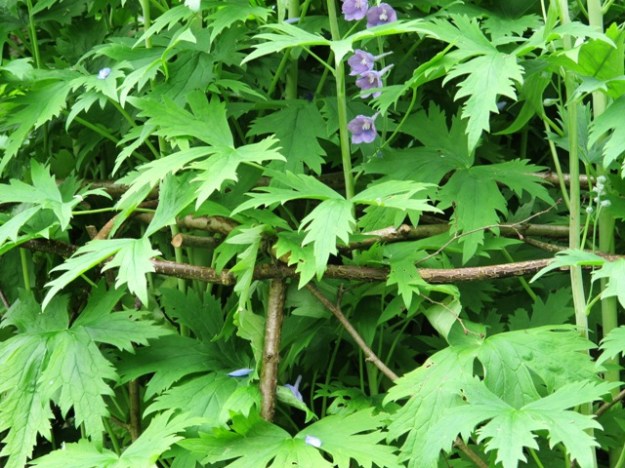
DelphiniumsDelphiniums are usually problematic. Rather than staking each flower spike individually, having a clump of them enables them to be retained invisibly. If natural fibre string is used for any ties required, the entire structure is fully biodegradable. This type of support is probably the most time consuming to construct. Whether it takes longer than to stake each flower stem individually, tying it with synthetic stretch tie to a plastic cane is debatable however.
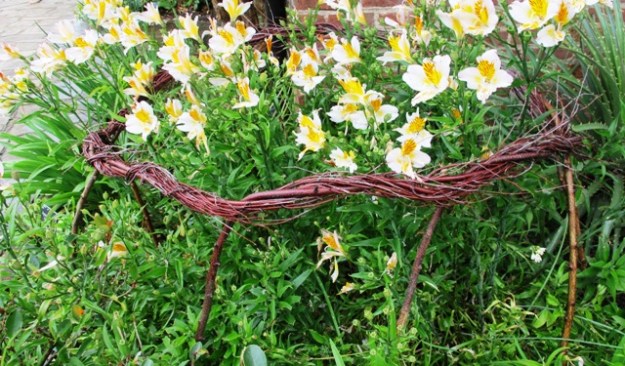
the weaving approachAlstromerias are inclined to fall apart in our climate with rapid growth rates and often torrential downpours. Here the weaving approach has been used, adapted from its traditional use in rural fences and hedges. Stems of willow have been pushed into the ground at regular intervals and then bent and woven, side growths and all, at the desired height. If you are using a material like willow which can root easily, you need to either treat the ends (boiling water should do it if you are shunning herbicides) or keep an eye out for the support starting to grow.
natural alternative, tying bamboo lengthsIn this case, wire mesh has been laid at about 30cm above the ground to support the plant, a tall thalictrum, as it grows. While neither invisible nor attractive, the plant growth will fill out and hide it as the season progresses. If you want to try a natural alternative, tying bamboo lengths together in a grid will work. We have used a vertical bamboo grid to give an unobtrusive frame for a seasonal climbing plant – Tropaeoleum tricolorum.
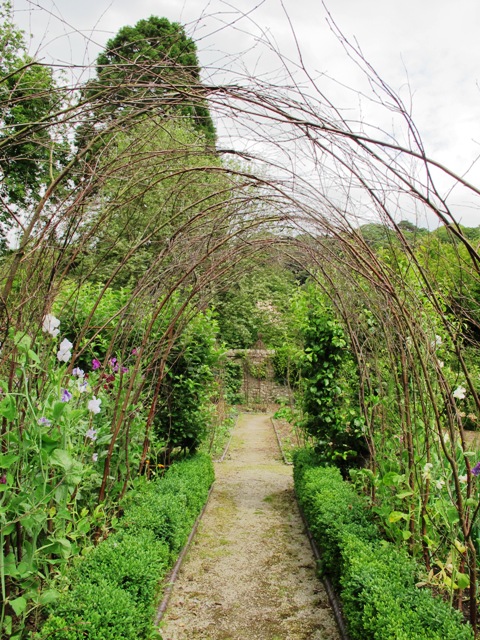
environmentally friendlyIt depends on what visual effect you want in your garden, but the use of natural materials to create a seasonal growing frame is as efficient while more environmentally friendly than tanalised timber, plastic or metal. It is just not as permanent but this may not be a requirement for some gardeners, certainly when it comes to annual crops such as sweet peas. The natural alternative will usually age more gracefully.
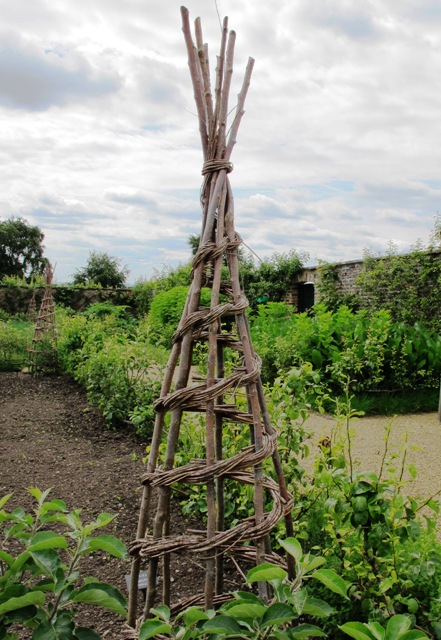
005 - CopyWe make bamboo teepees here, but any longer stretch of branch can be used and there is charm in the irregularity of using natural materials. Solid branches will last longer than bamboo, maybe longer than cheap metal ones you may purchase. Depending on what you are trying to grow, it may not be necessary to weave the horizontal supports. A top tie may suffice. In most situations it will be necessary to push the long supports into the ground to prevent the structure being blown over.
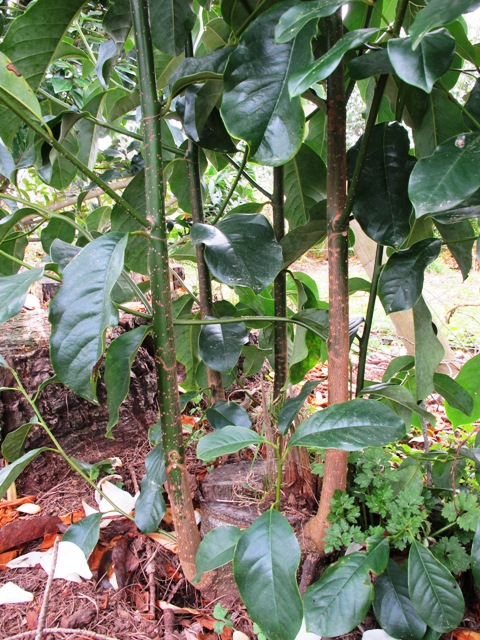
hazel is the traditional English materialIf you have the space, coppicing plants is the traditional means of ensuring an ongoing supply of fresh, green wood. We are very impressed at the coppicing potential of michelias here. Others coppice cornus already and hazel is the traditional English material. However, most gardens will have some suitable material available for gathering – grapevine, bamboo, willow, phebalium, wisteria canes – the choices are many. The growth needs to be flexible for weaving, more rigid if it is to be pushed into the ground, twiggy if it is to form a natural support for bushy plants – one material will not fit all situations.

First published in the Waikato Times and reprinted here with their permission.
Garden Lore

“Interest in flower arranging has increased in spite of the war. This may be explained by the fact that woman, with her love of beauty, turns to creating it as a way of escape from the cruel knowledge that, every day, beauty is being destroyed.”

The New Zealand Gardener, Vol 1, Issue 1, September 1944.

???????????????????????????????

The New Zealand Gardener then and now

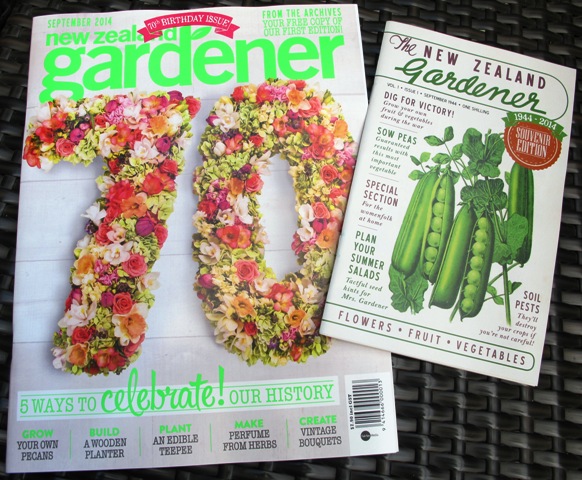
If you are not a regular reader of the New Zealand Gardener magazine, you may want to treat yourself to this month’s issue for nostalgia as much as the current content. It is the seventieth year of publication and to mark the occasion, the very first issue has been reprinted. Okay there is a bit of colour in it though I imagine the original was all black and white but it is both quaint and reassuring at the same time. The old fashioned courtesy and frugality is a reminder of times past. Honorifics are standard practice, with initials instead of christian names. Goodness, letters to the editor are to be paid at a rate of 5/-. By way of comparison, the purchase price of the magazine was only one shilling. That would make a modern letter worth $39.50, had the publisher continued with this largesse. A woman’s place is beyond doubt. It was of course during World War 2 that publication started in 1944 and that is a theme.

I used the word reassuring because quite a bit of the advice is still relevant today. Growing turnips, cape gooseberries or indeed delphiniums is not so very different now. If you are interested in the breakdown, there are seven pages on growing food crops and eight on “Science for the Gardener” (pests, disease, soil management and the like). The ornamental garden has nine pages and I particularly appreciated the column by ‘Silver Birch’ on the joys of importing rare bulbs. Not any longer with our border controls. Then “The Gardener’s Home” has eleven pages of recipes, advice and floral art. That section is by ‘Golden Willow’. Do we think she was married to ‘Silver Birch’?

The original issue comes as a free inclusion with the current September issue.

First published in the Waikato Times and reprinted here with their permission.
The Cottage Garden

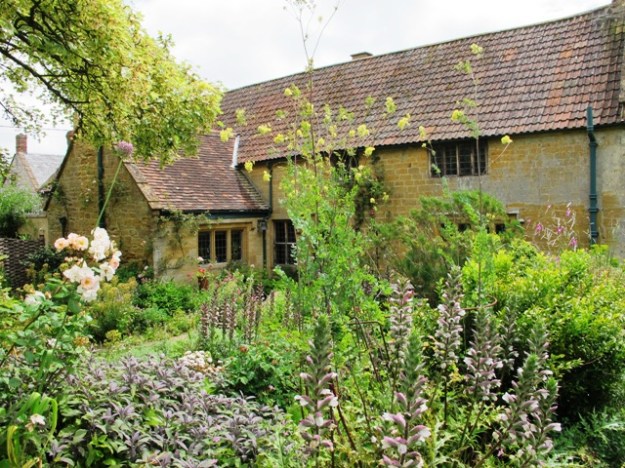
East Lambrook Manor House has sections dating back 600 years and a garden dating back to the late 1930s

East Lambrook Manor House has sections dating back 600 years and a garden dating back to the late 1930s

“We Made a Garden”, Margery Fish entitled her first gardening book in 1956. Her husband had died nine years previously which is perhaps why she was able to document the battles they had over their garden at East Lambrook Manor in Somerset. Margery won – not only in longevity but in the garden style that has earned her a place in history.

Cottage gardening. In this country there is a distinct shortage of cute cottages to act as the centrepiece but many people do not let that get in the way of attempting this style of informal gardening, founded on principles of mingling plants and allowing them to seed down. It is not as easy as it looks.

Cottage gardening is about combinations both deliberate and by chance – in this case a vetch and a broom.

Cottage gardening is about combinations both deliberate and by chance – in this case a vetch and a broom.

I was raised in a series of cottage gardens. It is what my mother did and that is not surprising, given that she started gardening in post WW2 Britain. It is a genre anchored in that time. WW1 saw a dramatic change from wealthy estates employing legions of gardening staff – they all disappeared off to fight and most either failed to return or did not return to the servitude of the estate system. But it was the second world war that saw the evolution of the DIY garden in a process of democratisation. Gardening was no longer the preserve of the landed gentry, nor confined to war time food production. The domestic garden came of age.

A yellow thistle relative – likely one of the centaurea family.

A yellow thistle relative – likely one of the centaurea family.

Margery Fish wanted an informal garden full of flowers all year round that she could maintain herself. She favoured simpler flowers which have a closer allegiance to wildflowers than to the Victorian vulgarity of bedding plants. To this day, her garden remains full of flowery froth and dominated by pastel colours. It has remained in private hands, with several different owners but these days it also has both staff (though few in number, I understand) and volunteers (greater numerically) to keep it as an historic garden open to the public.

The current owner likes yellow convertibles. This is a Morgan, though apparently reproduction.

The current owner likes yellow convertibles. This is a Morgan, though apparently reproduction.

Unexpectedly, the current owner was kind enough to give us a tour of the house, parts of which date back to the 14th century. The oppressive weight of responsibility that goes with owning an historic building weighed me down but it was certainly fascinating. And it was this house, seen as mellow and unpretentious, that motivated the style of garden Margery Fish pioneered in the surrounding two acres.

Convolvulus to the left, periwinkle to the right, plump marshmallow dog in the middle.

Convolvulus to the left, periwinkle to the right, plump marshmallow dog in the middle.

Looking at this and other examples, we discussed the fact that wildflowers and seeding down means something different overseas where plants are often native. Too many become invasive weeds here.

It is not too difficult to create a lovely cottage garden that looks great for three weeks of the year. I have done it, as will have many readers. It is how you keep it equally good for the other 49 weeks that is difficult. A good cottage garden does not have bare patches. It treads a fine line between free form and relaxed maintenance while not permitting weeds to spiral out of control. Plant thugs are restrained or removed before they become a major problem and choke out the more modest growing companions.

Santolinas are a cottage garden standard. There is one selected by Margery Fish named ‘Lambrook Silver’, though whether this is it, I do not know.

Santolinas are a cottage garden standard. There is one selected by Margery Fish named ‘Lambrook Silver’, though whether this is it, I do not know.

It is never all self-seeded – that is meadow style. In a good cottage garden, considerable thought and effort will go into managing plant combinations, creating contrast and harmony with foliage, not just flowers. Even knowing what to weed out and when to trim takes experience. There is usually some underpinning structure to give form – whether in modest hard landscaping or permanent shrubs. The clipped “pudding trees” (just Chamaecyparis lawsoniana) and a bit of hedging are used at Lambrook for this purpose.

The mistake is to tackle this type of gardening under the illusion that it is low maintenance and it does not require much skill, let alone plant knowledge. It is only a year that separates a pretty cottage garden from an out of control weedy wilderness in our climate.

First published in the Waikato Times and reprinted here with their permission.

Plant Collector: Romneya coulteri

Romneya coulteri - the Californian tree poppy

Romneya coulteri – the Californian tree poppy

I wish I could tell you I photographed this splendid Californian poppy in our garden here. We tried, we tried hard to get it established here but failed. That is because it grows in Californian desert and coastal conditions and we can not emulate those in lush dairy farm country. It is the dry open situation that is most important, summer heat less so. Good drainage and light soils are key. Readers in coastal areas might find it viable but be warned that it needs space. It is a giant poppy and the plant will reach around that 2m mark in height and a good 1.5m in width. It grows from seed but the plant develops rhizomes and will be perennial in the right conditions, spreading ever wider.

Look at that flower. It is just a typical poppy with six petals and golden stamens, but looking like tissue paper or crinkle fabric, each flower about 10cm across. It is the sort of plant that will stop you in your tracks. You will sometimes find it offered for sale in this country but probably only from specialist nurseries.

The coulteri in the name is a tribute to an Irishman, not a Californian celebrity. Thomas Coulter was a botanist and explorer who served as a physician to the armed forces around the Californian and Mexican area in the early 1800s. Apparently he botanised in his time off which seems a constructive activity.

First published in the Waikato Times and reprinted here with their permission.

The 1-Minute Gardener by Fabian Capomolla and Mat Pember

9781743517000I am totes the wrong demographic for this book. Believe me. It is zip zap instant gratification for the iPhone generation where everything has to be easy-as and fun fun fun. I am sure Mat and Fab have their loyal following in Melbourne although I think that hailing them as “Australia’s No 1 gardening authors” might be a little over-hyped by the publishers. However there is a contagious delight in their exuberance, even when you are not their target audience and that is not to be derided.

The book is a collection of 70 step-by-step photo sequences showing assorted, and often somewhat random, gardening skills. You too can “pimp your soil” with a one minute tutorial, just as you can learn how to manufacture a stink bomb (an old sock filled with blood and bone) to deter possums from coming on your property. The technical information is patchy, as is the photography. The enthusiasm is relentless.

This is urban food gardening for hipsters. I have heard it described as “the $70 lettuce approach to gardening”. At the end of it, you will get a nice lettuce (definitely not an uncool Iceberg variety) which you can pick leaf by leaf, but it will have cost you $70 to grow it. Need some compost? Cut open a 25 litre bag and tip it on. Need to top-up a no-dig garden? Layer on a variety of materials you have purchased at the store – pre cut mulch, pelletised fertiliser, mushroom compost, all purpose compost, potting mix AND worm castings. Your vegetables can hardly fail to grow in that environment. Just add water. By the way, a little metal letterbox makes a perfect small-space shed for your garden tools.

There is no concern about sustainability. Shipping sugar cane mulch from Queensland to Victoria is not an issue. This is about the urban good life. If it gets people gardening, that is good. With experience, they will learn what works and maybe consider the environment.

Maybe, just maybe, with experience they will also discover that one of the joys of gardening is that it can take time to get good results. By very definition, it is not an activity that gives instant gratification. If it takes the help of Fab and Mat to reach that stage of awareness, then all is not in vain.

The 1-Minute Gardener by Fabian Capomolla and Mat Pember. (Pan Macmillan Australia; SBN: 978 1 74351 700 0).

First published in the Waikato Times and reprinted here with their permission.