And the third and final part:  Gaudi and Casa Batlló

The adjoining buildings to Casa Batlló are attractive in their own right but somewhat eclipsed by Gaudi froufrou.

Casa Batlló was a private residence in the heart of Barcelona and the owners at the turn of last century were clearly not faint-hearted because they commissioned Antoni Gaudi to do a full makeover on their residence. Six stories of Gaudi creativity and flamboyance executed on an existing city terrace house in the early 1900s.  It is spectacular, in a domestic residential sort of way.
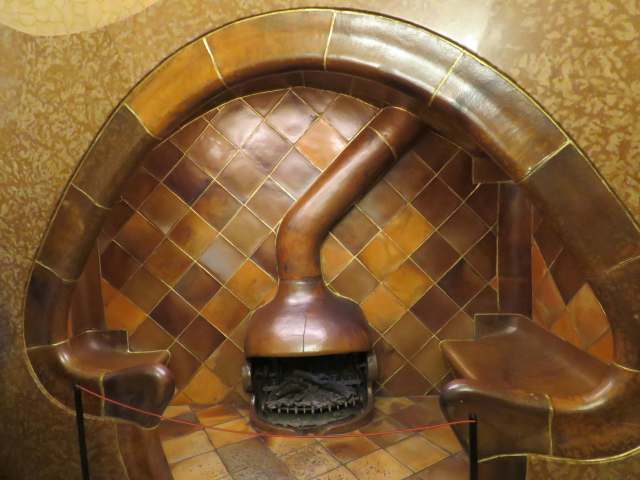
A fireplace that was presumably fully functioning in its day

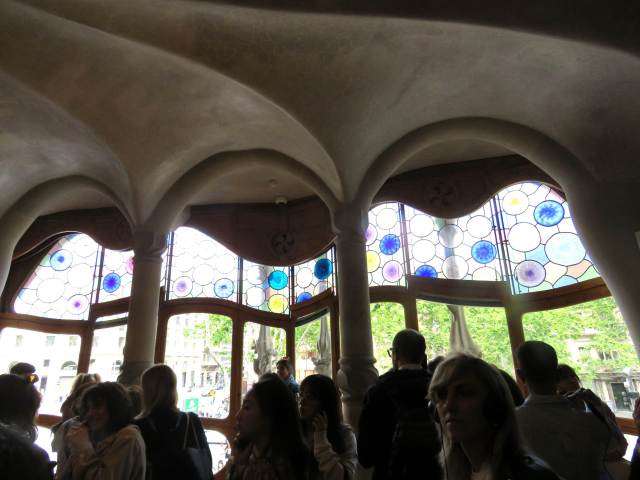
Again, the joy for me was in the light. I have always thought it would be really interesting to have a house with irregular windows breaking free from the square, the rectangle or the circular. Gaudi certainly managed it and the windows even opened. They are nothing short of sensational and, to my mind, the best feature of this extraordinary residence.
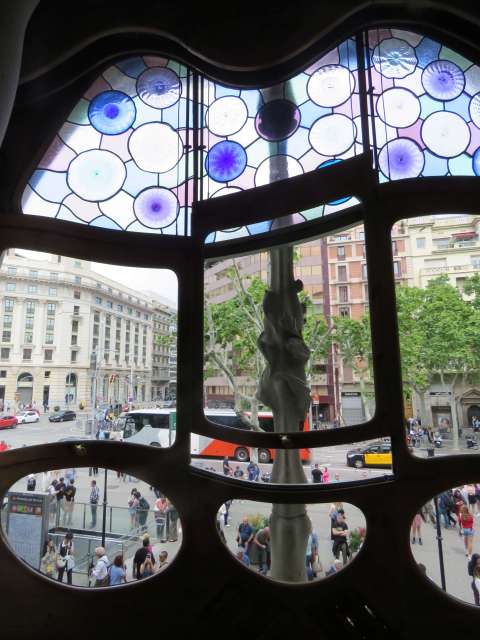
In the world of windows, these are simply sensational

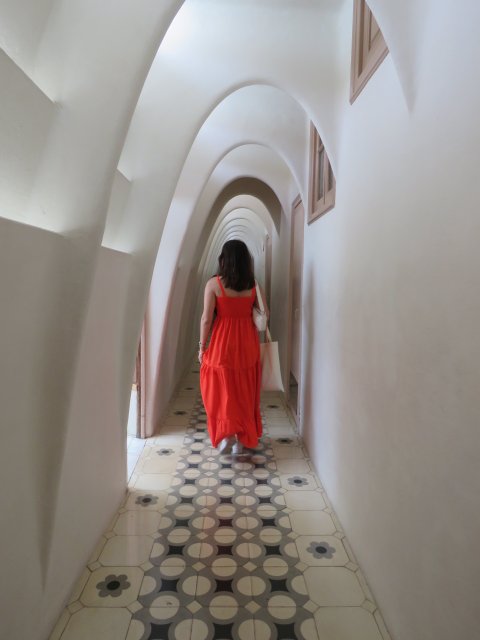
Gaudi really didn’t like straight lines and flat surfaces. The ceilings and walls often deviated from the norm and this is very much part of his signature style.

But let us head out onto the roof terrace, along with the other sightseeing hordes. The Spanish do a good line in roof terraces but only Gaudi added the mosaic froufrou that defines this one. Looking down gave me vertigo but I can see how one could sit up there and feel on top of the world, were it private again.
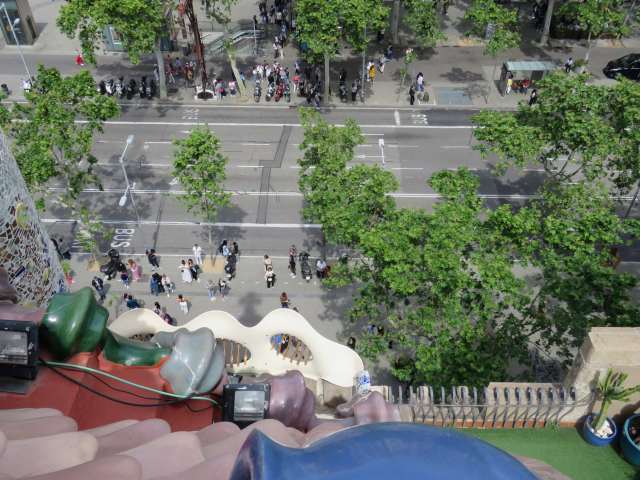
The street view, looking down from the terrace
Promises were made…

In its current state, the terrace is housing a café, festooned with lights and wiring and… wait for it… the Sky Garden. We were gold ticket holders so we alone were permitted to ‘Discover a new perspective of the rooftop’. This has absolutely nothing to do with Gaudi that I could discern but there was a thrill of anticipation as we showed our gold ticket entry and donned the mandatory white hard hats before climbing about three steps onto some scaffolded construction.

I think it is fair to describe the sky garden as over-hyped and under-delivered

A FAKE FLOWER ARBOUR – no, I am not joking. That is synthetic grass, too. It was so bad it was actually funny. What you see in the photos is it but looking better in a photo than in reality. You step up to enter one side, walk through and step down at the other end, handing back your monogrammed hard hat. What were they thinking when this project was conceived?
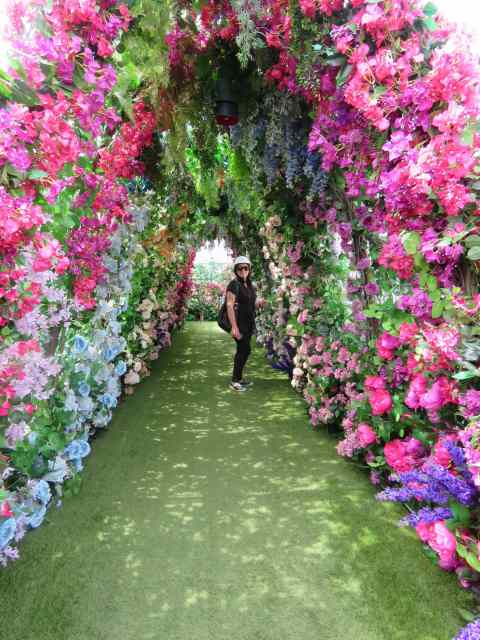
Why the requirement for a hard hat?

There are unexpected modern introductions to the world of entertainment at Casa Batlló and I guess this is the reality of keeping a modern tourist operation viable. The house is still in private ownership but with the Bernat family these days, not the Batllós. They carried out major restoration and set the place up to cope with one million visitors a year. For me, the restoration of the house alone was fascinating and a complete experience in its own right. It seems that is no longer enough for many others who expect more whistles and bells because the novel and unexpected whimsy of Gaudi is not sufficient.

The sound and light experience at the point just before exit was unexpected and pretty intense. It is billed as ‘The first real 360º experience in the world. The new media artist Refik Anadol presents his pioneering work “In the Mind of Gaudí”.’ We are talking about suddenly being enclosed in a room without warning and immersed in a  three minute surround sound and flashing light experience that was akin to a drug-induced trip. Personally, I doubt that Gaudi lived his life in the permanent state of hyped-up hallucination but there we are. It was at least beautifully put together and executed, unlike the modest rooftop flower garden of fake flowers.

The actual Gaudi was a complete experience in itself for me.

I see one aspect of the modern Batlló experience entirely bypassed me and that is the capacity to illuminate the front façade at night in ever-changing colours and effects. I like a good lighting display but I rather feel that one might want black-out curtains were one a resident in the many neighbouring apartments.  I am sure it was much quieter when the original family were still in residence.

Next week – back to gardening and gardens of the French Riviera.

The light, the light.

Part 2: Gaudi and the Parc Güell

More about the structure and the hard landscaping than about plant interest

Parc Güell was part of an ambitious suite of work Catalan architect, Antoni Gaudi carried out for entrepreneur, Count Eusebi Güell in the early 1900s. It was originally planned to be a luxury housing development so clearly that is not a modern concept but the housing did not progress and, over time, the park became a green oasis that opened to the public.

Clearly Gaudi enjoyed it because he bought one of the only two houses on the site (not his own work) and made it his home for the last 20 years of his life.

A Barcelona streetscape

Barcelona is a hot, dry city with a  population of over 1.6 million. It is also a city full of trees, particularly plane trees, and streetscapes that prioritise people over motor vehicles. But streetscapes remain that – streets with paved surfaces and spaces shared for many purposes.

Every good park has toilets but, alas, too many of them have insufficient numbers of women’s toilets and the queue for the loos is a common sight.
Another for my *bougainvilleas around the world* photo folder

Parks are more like breathing spaces, though nowadays it seems that Parc Güell is a space where one will always be sharing the breath of many other people. Regulations allow the admission of 1400 visitors per hour (pre-purchase of tickets is almost always required and days and times can sell out well in advance). While the area landscaped by Gaudi is 12 hectares, there are not a huge number of paths so you would need to get access to the further woodlands to get the feeling of being alone in nature.

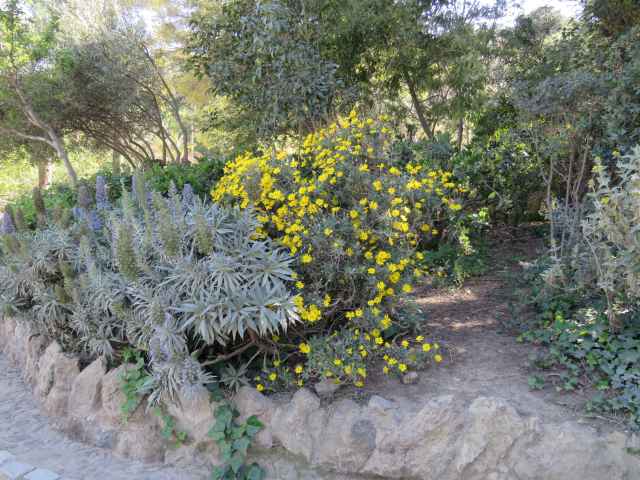
I don’t have high expectations of horticultural depth in public parks located in hot, dry countries with challenging growing conditions.

It is a park, a UNESCO world heritage site and a major tourist attraction – not a botanic garden. This means that the plantings play something of a second fiddle to the structure Gaudi created and the experience of the visit.

The structures Gaudi created In Parc  Güell are described as coming from his *naturalistic* phase, different to his creation of the Sagrada Familia. Personally, I would describe it as a blend of naturalism with Arts and Crafts and a fair lacing of Rococo but others may disagree.

There are a lot of colonnades in Parc Güell and I assume that as well as being an architect and a wildly eccentric creative, Antoni Gaudi was also a very good engineer. Some of the colonnades are supporting considerable weight.

The centrepiece terrace is a major construction

The somewhat over the top, naturalistic looking colonnades designed to have a rough hewn appearance give the broader structure to the park. The focal point of the huge terrace is also supported on a sea of columns but classical in style. From above, it just looks like a piece of land that has been levelled out, unless you look at the side.

Beneath the terrace
The light on the mother-of-pearl mosaic was another catch-my-breath moment of magic

From below, you can see the structure and, in true Gaudi style, he has altered the roof of the colonnaded structure below to change the flat form. As a general rule, I am not a great fan of mosaics but the light catching the mother-of-pearl effect was another experience when the beauty of light caught within the structure was simply amazing. Just beautiful.

If you zoom in on the photo, you will see a whole lot more mosaic work.

It is a narrow line between whimsy and kitsch. Gaudi certainly delighted in whimsy and it was one of his defining hallmarks. Are the porter’s lodge buildings in Parc Güell whimsical? Yes, they are but in my opinion they lean towards the cutsie-pie end of the spectrum that is weighted to kitsch.

Gaudi’s giant mosaic lizard
The green lizard I photographed in Urenui. Is Gaudi’s one art and this one kitsch? Or are they of comparable aesthetic value?

It was the giant lizard that made me think ‘oh dear’. As I have said, I am not a great fan of mosaic work in many contexts and for me, this crossed a line. It reminded me of this giant green lizard I photographed some years ago in a seaside village just north of here. And when I got to see the gifte shoppe at Casa Batlló the next day, there was an entire table of small models of this giant lizard, amongst a whole lot of other novelty souvenirs that had well and truly immortalised the gifted artist and architect in the most astonishingly naff memorabilia. Not that Gaudi is in any way responsible for tacky memorabilia that is being sold 98 years after his death, but it did show me what a narrow line he was treading with his wit and whimsy, how easily it can tip over to kitsch.

The Gaudi souvenirs were of no aesthetic value whatsoever.
The musicians playing around the park were a delight
I liked how the jet vapour trails felt part of Gaudi’s whimisical roof structure.
I kept photographing towers. Gaudi was a devout Roman Catholic and often used religious iconography. All mosaic again.

Let there be light

Part 1: Gaudi and the Sagrada Familia

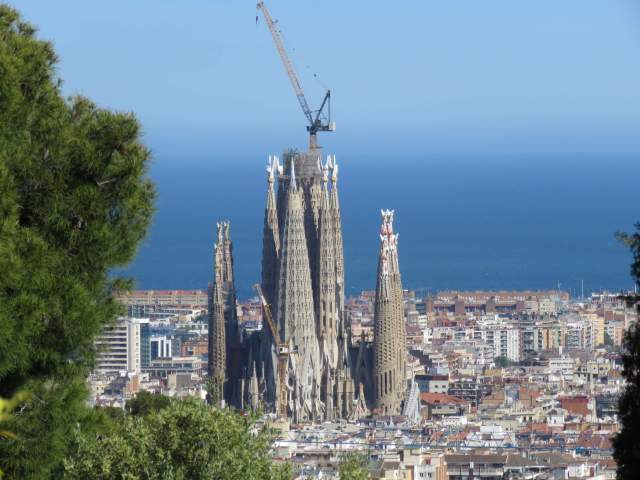
It is hard to grasp the scale of the Sagrada Familia when beside or inside it. Here it is as seen in the distance from Park Güell

I had never been to Barcelona before landing there on my May trip. My few days in Barcelona turned in to a crash course on Gaudi and I loved every minute of it. I wanted to see the Sagrada Familia, having heard so many others speak of it. To that, my daughter added Park Güell and Casa Batlló and I knew absolutely nothing at all about them before I visited. Clearly I did not do a lot of research in advance and this may not be a bad thing because it meant I had no expectations at all. And verily, I was amazed.

I knew the Sagrada Familia had been under construction for quite some time but I thought I had read that it had finally been completed. It hasn’t been completed yet and that shouldn’t surprise us. Many of the major churches and cathedrals from times past took a century or more to build and even then had more additions in subsequent centuries. The Sagrada Familia is technically designated a basilica by papal decree, not a cathedral, and construction has been ongoing since it was started in 1882.

Even the ceilings are remarkable with their detail
and the cloisters

I checked and it seems that it is scheduled for completion in 2026 but I think that might just be the towers and, with six still to go, I wouldn’t bank on that date. The planned main entrance and additional decoration and sculptures will see work continuing well into the 2030s. The scaffolding, cranes and protective shields will likely remain in place for a while longer yet.

No matter. What has been completed is astounding and takes quite a bit to visually absorb. The sheer scale is impressive as is the detail and complexity. I am sure that any readers who have seen it will agree that it is quite simply an extraordinary building.

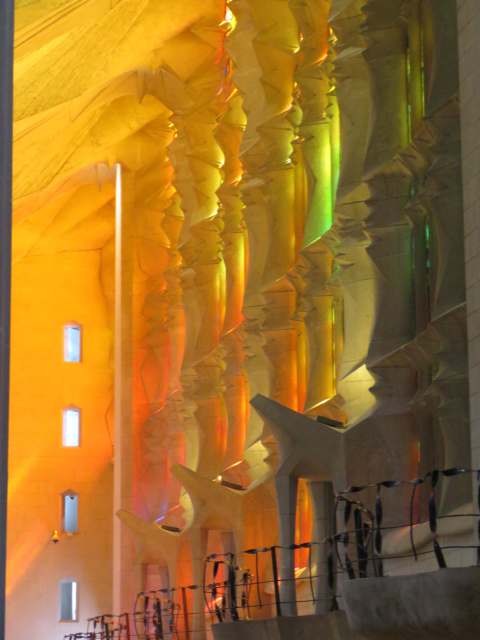
Flooded with late afternoon light

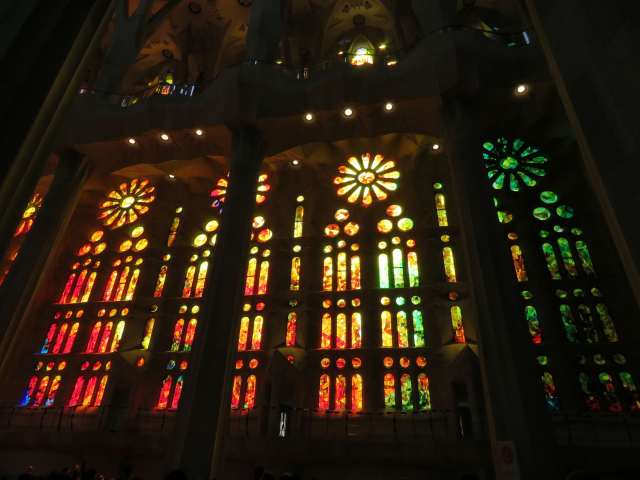
The stained glass is certainly impressive and varies from traditional to contemporary and the colour palette changes for different walls.  But it was the interplay of architecture and afternoon light that simply took my breath away. Much of the Sagrada is impressive, interesting, curious, even odd at times but the light – the light was an emotional experience for me.

Antoni Gaudi was an architect but his skills and creativity went well beyond the designing of buildings. While hailed as the leading practitioner of the style now termed ‘Catalan Modernism’, I think his work is so individual, varied and unique that it probably warrants its own category as simply ‘Gaudi’. The Sagrada is described as a meeting between gothic style and Art Nouveau. I would add Arts and Crafts into the mix, too.

Above the entry on the first side of the basilica to be completed
And the more recent entry completed on the opposite side

I found the contrast in styles between the entrance that was completed first in a more traditional style and the cubist approach to the more recent entrance on the other side very odd. From what I read on line, considerable effort is being made to keep to Gaudi’s vision so he must have left some records to hint at the blocky, Cubist style of ornamentation and religious imagery.

And then there is the very odd whimsy of the coloured fruit on top of the gables.

To be honest, I am just not sure what was in the architect’s mind just here

The Sagrada Familia remains the magnus opus of Gaudi but was by no means his only work. More on the grandeur, the detail, the mastery of light, the whimsy and, dare I say it, the occasional descent into kitsch in the next part on  Park Güell.

Grave matters

I am back again. Not quite firing on all cylinders yet but getting there. Back again from where, you may or may not wonder – Barcelona and the south of France. Alas, in Nice Covid finally tracked me down after I had managed to avoid it for a full four years. Fortunately, it has been a fairly mild case for which I give credit to my many vaccinations and boosters but I do not recommend flying long haul when still in recovery. It did rather set me back.

Fortunately, the unwanted Covid experience was towards the end of my trip so I managed to pack in plenty before being forced into isolation. I need to gather my thoughts on the larger topics but thought I would start with a minor diversion into graveyards. I have never taken a great deal of interest in graveyards generally, although I have written often enough about the pretty flower combinations in Te Henui Cemetery in New Plymouth.Te Henui has set a high standard for graveyards in general.

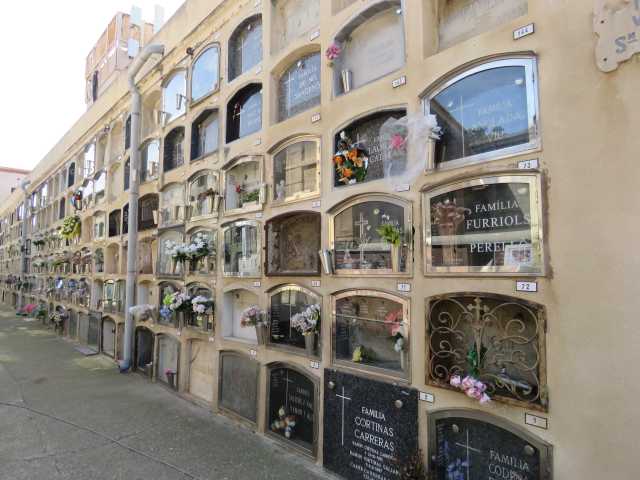
Space saving in Barcelona

It was entirely by accident that daughter and I stumbled upon the space-saver approach of a cemetery in Barcelona. I don’t know how the logistics work of fitting several members and generations of the same family into one of these coffin-sized stacked compartments. Some of the stacks were seven stories high which must give some challenges when it comes to opening the entrance to add another deceased. Are they maybe just adding ashes in urns?

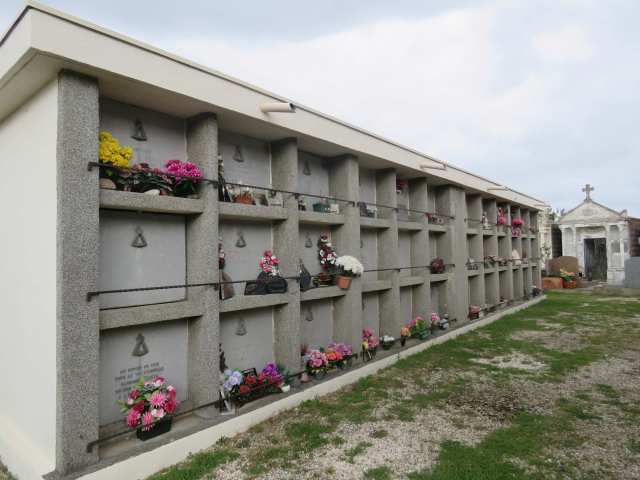
A modern approach to space saving across the border in the south of France

I found the modern version of the grave condominium in a small French graveyard in Montesquieu-des-Albères, the village closest to where my daughter is living for this year. These were three high, two deep and fully coffin-sized but clearly modern so not yet accommodating generations of the same family.

This burial technique may be utilitarian and lacking aesthetics but I can certainly see the practicality of it in terms of saving space while still enabling some sense of a permanent memorial. I had never really thought about the nature of graveyards before – that a one-off payment can secure a single plot that then becomes a permanent – sacred, even – installation where any maintenance becomes the responsibility of some other body to care for and respect the deceased down the decades and centuries. It is a curious concept, when you think about it. Over time, graveyards can take up a lot of space if they are predominantly one individual per plot.

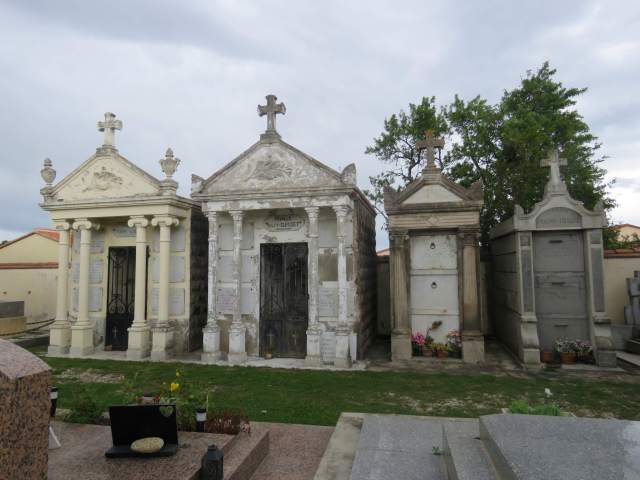
Family tombs in Montesquieu-des-Albères

In death as in life, graveyard real estate can make differing social and economic status crystal clear. We have not generally gone for the family tombs in Aotearoa New Zealand. The French seem to be quite big on tombs and they do make a statement on the standing of la famille.

These graves, memorials and tombs in Montesquieu surround a church whose oldest parts date back to (wait for it) 1123.

I photographed the only pretty part of this cemetery. Overall, it could not hold a candle to our Te Henui one for plantings and beautification. Death can be a very austere experience.

When it comes to tombs and memorials, this one to the Hanbury Family in La Mortola, a botanical garden just across the Italian border from Nice, set a high standard for aesthetics and grace. I felt we might have sold Mark’s parents short. Both were cremated, in accordance with their wishes, and we brought their ashes back to the garden here that they created. It seemed entirely appropriate at the time. It is only when I saw this Hanbury memorial – which, if my memory serves me right, may house some of the family ashes – that gave me pause to ponder whether we should have done more. But I think it would have looked somewhat ostentatious and out of place in our garden.

Not the Chagall grave in the cemetery of St Paul de Vence but a good example of the preference for fake flowers and fake plants

I walked to the village cemetery at the end of the hilltop village of St Paul de Vence, drawn to see the grave of Marc Chagall who spent some time living there at the end of his life.

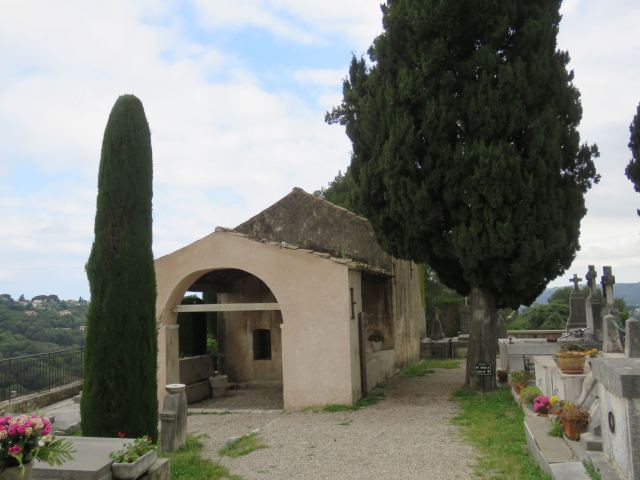
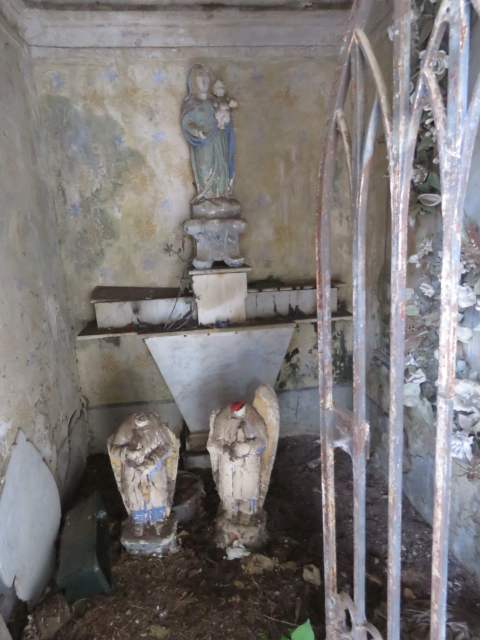
The graveyard chapel recorded that it was first mentioned back in 1356 so probably not quite as old as the church in Montesquieu.

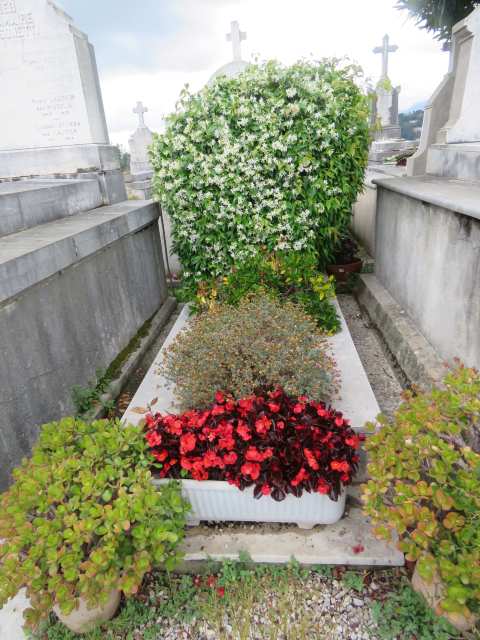
I did find one grave that was adorned with living, flowering plants but it was unusual. The families of St Paul de Vence favour the longevity of fake blooms.

Back on tombs, I am not sure that there is much that is bleaker than a long disused family tomb. The Famille Lambert and Famille Flour appeared to have fallen into oblivion which was somewhat poignant to see.

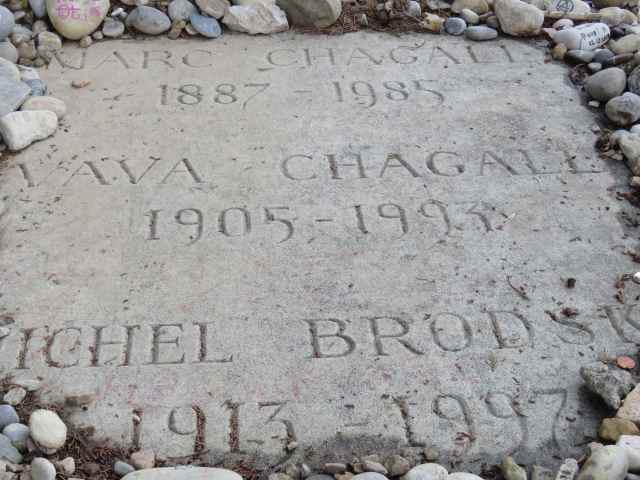
The grave of Marc Chagall and family

The grave of Marc Chagall, however, has a casual but vibrant energy to it that belies his death in 1985. It also accommodates his second wife, Vava Chagall and a third person clearly attached to Vava because he bears her maiden name. If you look at Chagall’s lifetime of work, the grave seems all the more appropriate. It is clear that it is tended regularly to this day but I am not sure about the fake pink rose.

Autumn delight

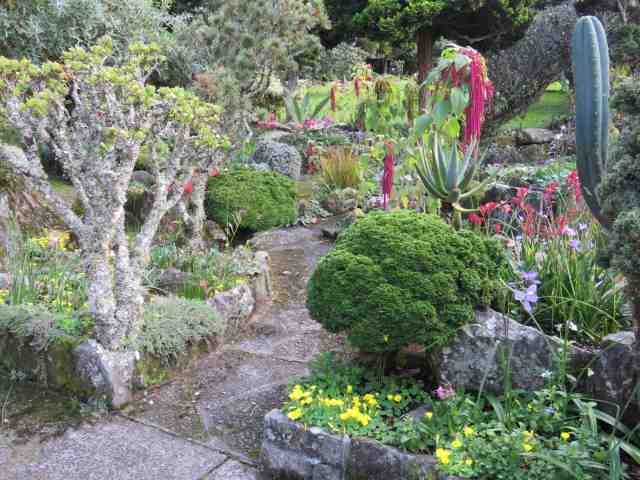
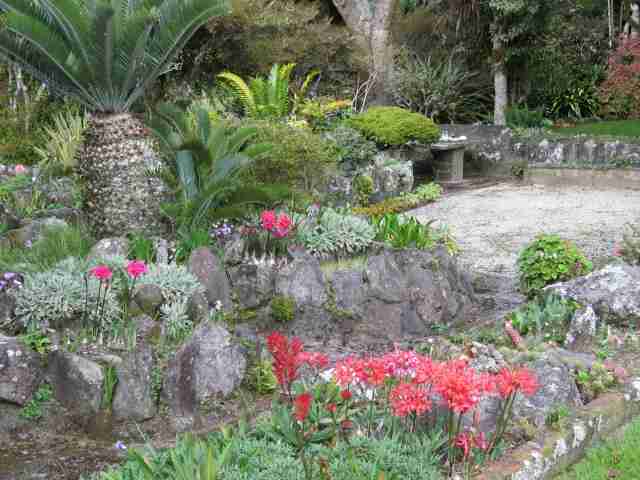
The rockery plantings are complex and varied but that is what makes it all the more interesting to us

I am not quite gone yet; on Wednesday I start the long haul over to Barcelona and then the south of France.  In the meantime, the rockery has been bringing me much pleasure. If I ever have to downsize both house and garden, I might be tempted to turn any new, smaller garden into rockery.  Rockeries lend themselves to highly detailed, high-interest level gardening and I can see I could be quite happy pottering in a rockery – as indeed was Mark’s dad, Felix, in his later years. It is a particularly absorbing area to garden, even if there are times I regard it as the gardening equivalent of micro-surgery.

There was quite a bit of excavation and construction that went into our rockery, especially given it was a blank canvas and largely flat to start with.

Ours is a raised rockery with different levels so it has detail in its design, not just in its plantings. Mark’s mother always used the plural ‘we’ when she talked about building the rockery, but we think it more likely that she designed it and then supervised Felix in its construction, which included some excavation to achieve different levels. Every original garden structure here was done by hand or, on occasion maybe, using horse power. Felix did not have a tractor or access to any of the machinery we can call on these days.

As our rockery measures some 20 metres by 10 metres, it is not small and it is certainly not low maintenance. Because it is largely raised beds and pockets of soil for separate plantings, it dries out and heats up in summer. Our frequent heavy rains drain quickly but that also leaches a lot of the nutrients out of the soil in the process. Bulbs generally need excellent drainage and many thrive in poor soil so they are quite happy in this environment. We try to get around with a thin layer of compost every spring and when I excavate a pocket to sort out its contents, I will add compost when I replant. But the soil overall is pretty impoverished and generally lifeless in the summer heat. There are almost no earthworms in summer but they seem to return as temperatures cool.

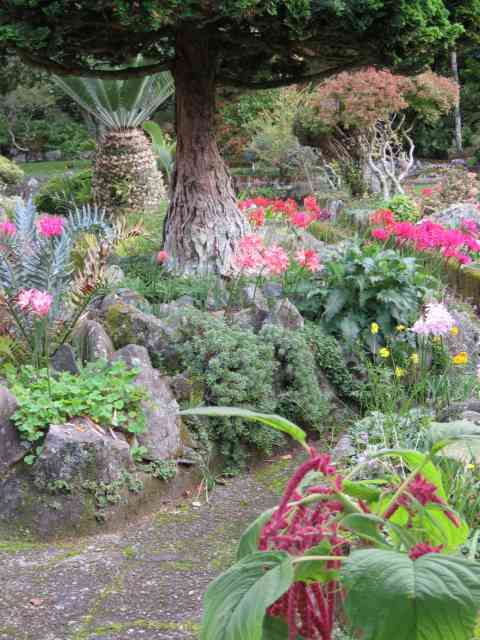
Rockeries are traditionally a re-creation of rocky mountain slopes to grow alpines. We can’t grow alpines here where our conditions and climate are anything but alpine. Our rockery basically consists of elderly dwarf conifers of considerable character and a few cycads giving all year round structure, offering some shadier areas beneath for bulbs of many descriptions. Smaller bulbs and many species rather than bigger hybrids which look out of scale, with one notable exception.

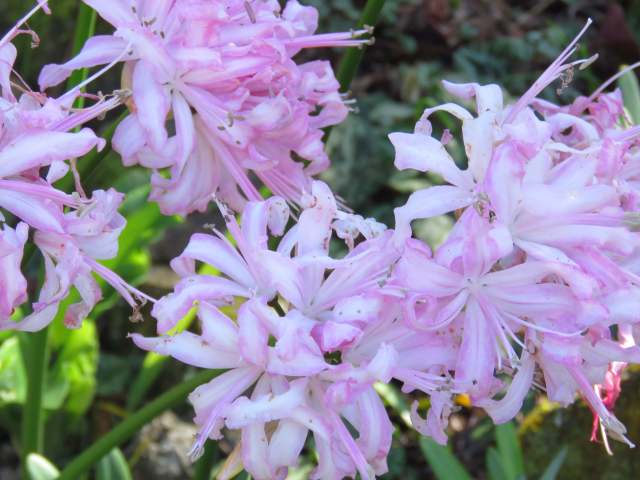
Nerine sarniensis hybrids

That exception is the Nerine sarniensis hybrids, most of which were bred and selected here although we have a few of the early Exbury ones and some of the species nerines. They are sensational at this time of the year. Along with Cyclamen hederafolium and the ornamental oxalis, they keep the autumn rockery full of blooms and colour.

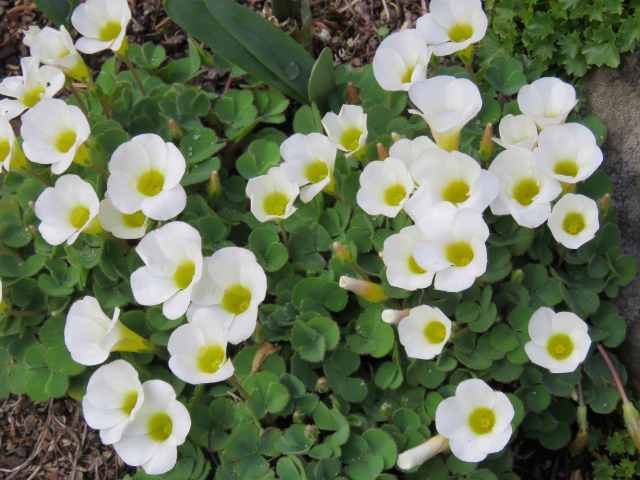
Not all oxalis are equal. Some are much more floriferous and better behaved than others. This is O, luteola and it makes an excellent garden plant,

Last year, Zach reassembled the oxalis collection. Years ago, I planted them all out because I didn’t want to be repotting them every year and he set about retrieving some of each. We had only lost one or two inbetween times and he now has over 30 varieties in pots – most from the garden and a few extras he has picked up from local markets.

It is hard to fault Oxalis purpurea alba with its long flowering season, mass blooming and non-invasive ways.

A much maligned genus, the oxalis shine at this time of the year. We are only a few months off the short snowdrop season and the start of the dwarf narcissi and lachenalias. There is always something of interest going on in the rockery and it is constantly changing as different bulbs and plants take their time to shine. Always, Mark and I remember Christopher Lloyd saying in conversation on a TV programme, “I think you will find high maintenance is a great deal more interesting.” We could not agree more.