
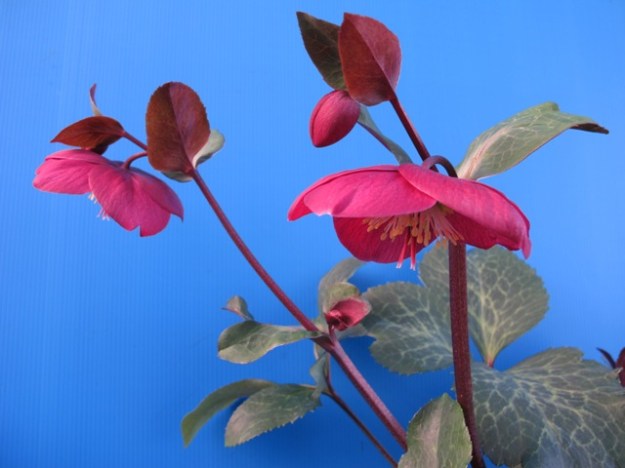
We are very impressed by Hellebore ‘Anna’s Red’
It takes a special plant in a garden centre to make us think immediately that we must have it there and then. This new hellebore is one.
There are three stand-out features. It holds its flowers well above the foliage and they are outward facing so displayed well. The foliage is beautifully marbled and interesting in itself. The flower colour is an attractive magenta-burgundy but without brown tones that often mute those colours.
I did a search to see if I could find the breeding but all the internet tells me is that it is one of the “Rodney Davey marbled group”, Davey being the breeder. Fair enough – it is the work of a dedicated hellebore specialist and if he does not wish to disclose the breeding, that is his right. Looking at it, our guess is that it probably has quite a bit of H. niger in it, in which case to get this strong colour into that species is a real triumph. It is the way the flower is displayed that makes us think of niger (some of you may grow “White Magic” with its upward-facing flowers). While there are similar burgundy colours in the H. orientalis group, none of them display their flowers as well and we have yet to see these combined with such attractive, marbled foliage.
The breeder lives in the south of England and the plant was named for prominent garden writer, Anna Pavord. Fortunately, due to the wonders of micropagation (tissue culture), the plant has been multiplied hugely and is available everywhere that I can see, in both this country and overseas. It is worth having and no, I was not given a plant to review. We truly did spot it in a garden centre and buy it.
First published in the Waikato Times and reprinted here with their permission.
 1) Confining planting to geometric blocks (Mondrian-style perhaps, for students of art), has been evident in show gardens in recent years but has now become mainstream. This is a new planting on Hampstead Heath, done by the public authorities. The sharp lines will blur over time. It is a shame about the buxus blight that is already evident. A different clipped shrub may have been a better choice.
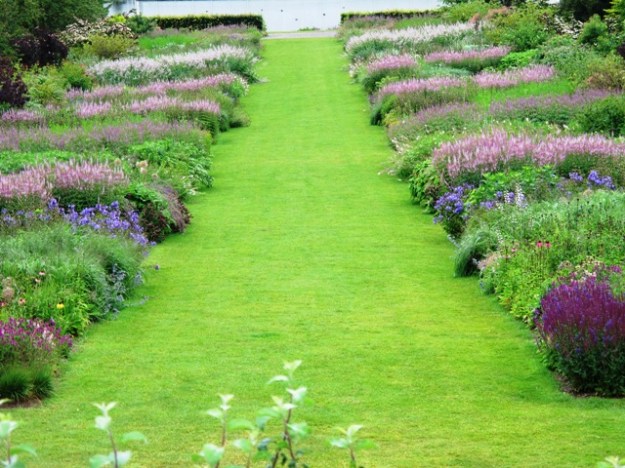 2) Piet Oudolf’s rivers of colour in the modern borders at Wisley have been controversial since they were planted in 2000, but we think they are glorious. They also take much less labour to maintain than the traditional twin herbaceous borders. Each ribbon of colour has about four different plants in it and the colours will change through the season. You need to be able to look up or look down on this type of planting (or both). Viewed on the flat, you would not see the diagonal effect.
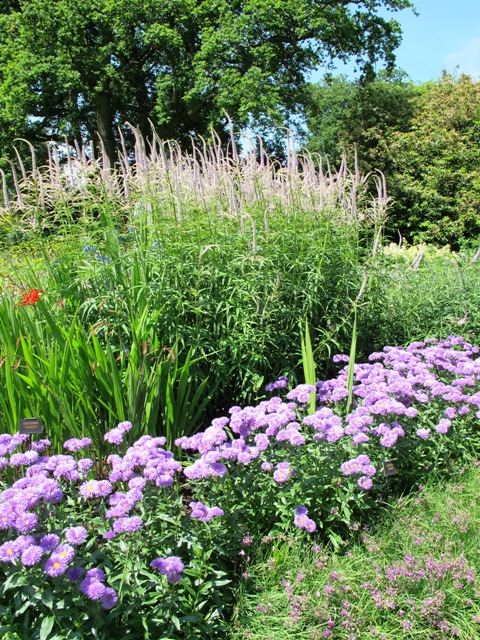 3) Less ambitious may be to snake a river of one perennial through clumping plantings. In this case it is an erigeron daisy but I have already done it in my own garden with irises (the blue sibirican ones and also Higo iris). A river effect alters the dynamic of big, round clumps of plants or can give some visual unity to an otherwise disorganised planting.
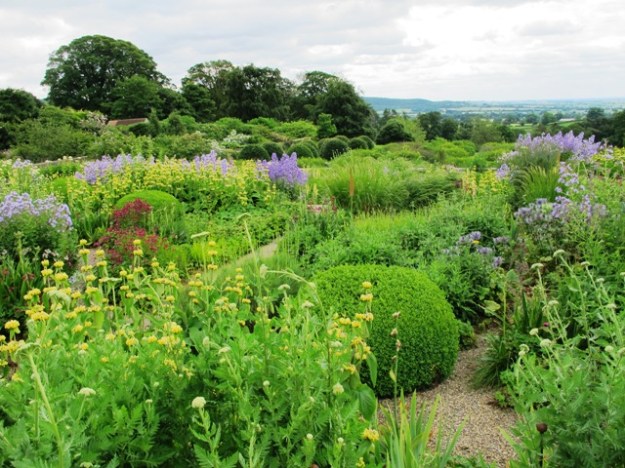 4) Big generous clumps of perennial plants, each standing in its own space, are one of the hallmarks of the New Perennials Style that has been widely adopted in modern UK and northern European gardens. This is a private garden, the work of British designer, Tom Stuart Smith. It takes a big area to carry out well. Each plant is occupying an area at least a metre across, sometimes more. Clipped shrubs act as punctuation points.
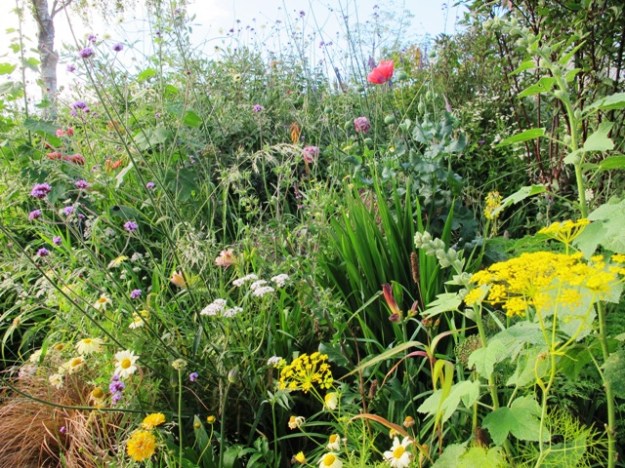 5) The classic cottage garden mix and match style is harder to manage than it looks if you are determined to keep both a succession of flowers and good coverage – to avoid bare patches – throughout the warmer months. This is in a Dorset garden owned by a good gardener. In lesser hands, it can become a hodge podge with bare bits and small plants of potted colour added in an effort to fill in the gaps.
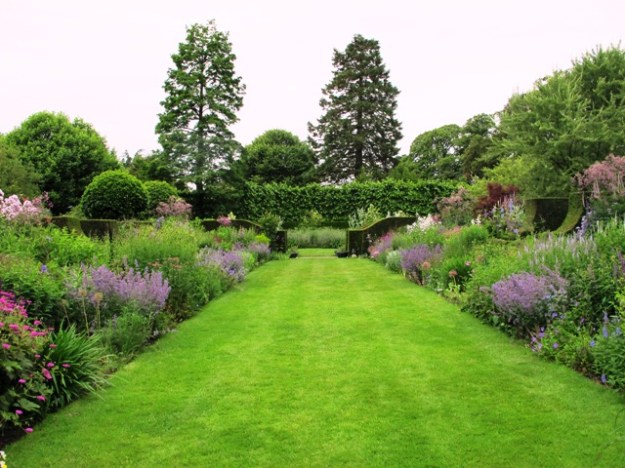 6) The classic twin herbaceous borders adapted to a more personalised, private garden (in this case Gresgarth, near Lancaster) by breaking up the expanse into shorter sections using clipped hedging in battlement style and strategic topiary. In line with modern expectations, planting is now deliberately colour-toned and separate sections allow the colour palettes to be kept apart. The effect is deliberately refined.
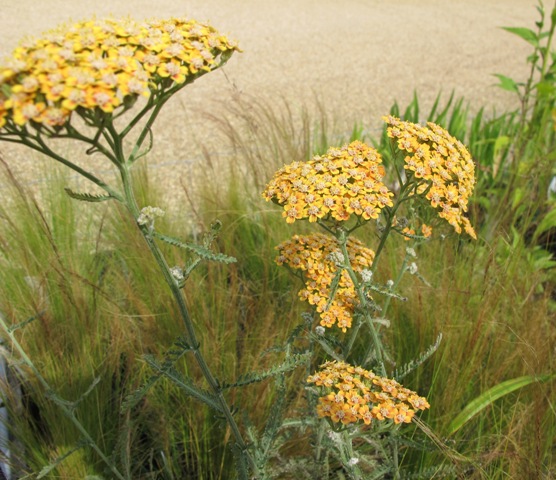 7) Grasses! Grasses! More grasses! And many meadows, let alone prairie plantings. No discussion about modern perennials is complete with referencing these major trends. These deserve attention in greater detail and are part of a bigger picture of focussing on more environmentally friendly approaches to gardening.

 Tikorangi The Jury Garden