
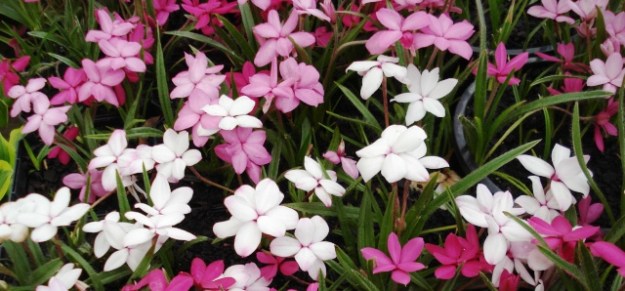
Rhodohypoxis are to be in drifts, not clumps, thank you.
I commented to a photographer once about the immaculate interiors featured in glossy magazines and how our home could never look like that. She laughed and said she once went back to get some extra photos for a feature and the place did not look the same at all. Oh, so this is how they usually live, she thought.
It is an illusion made possible by the fact that photographs capture a single moment in time and it applies equally to gardens as to house interiors. I do it when I take photos. I look at the first image and then I will rearrange or remove something to get a clearer, more pleasing shot. The folly is when we think we can achieve and maintain that in real life. It is a trap to which many of us fall victim.
This train of thought came about recently as I spent a day redoing a garden bed. In my mind, I know exactly what I want and yet again, I am on a quest to make it happen. In this case, it is a bed with five clipped and shaped small camellias in it, backed by a clipped hedge. How much can you do with about 12 square metres of garden? A lot, it turns out.
This bed, in full sun, started as a cottage garden themed on red and yellow, full of roses, perennials and annuals. It looked lovely for 3 weeks of the year and messy for the remaining 49 weeks. It then went formal(ish) and I wrestled with finding the perfect ground cover. Rubus pentalobus (‘the orangeberry plant’) was too invasive. Violets were too vigorous. Cyclamen hederafolium were lovely for about 8 months of the year but were dying off during our peak visitor season. We changed the hedge last year from clipped buxus to clipped Camellia transnokoensis (tiny white flowers and small leaves). I reduced the number topiaried camellias which give the structure. I started inter-planting the cyclamen with rhodohypoxis for spring colour and a little ground hugging perennial called scutellaria with white flowers for summer cover.

How ironic that I still went searching for a photograph to show the garden bed looking good – but had to settle for Spike the dog creating a dust bath in the reworked ground covers. This is a long way from the mental image I have of what it is to look like.
My most recent effort was because the rhodohypoxis were looking too clumpy and I wanted them drifty, not clumpy so I spread them out, while trying to make sure that the cyclamen were sufficient in number to make an uninterrupted winter carpet. It is still looking dry and dusty at the moment but will it work?
Yes and no. It will, I hope, closely match my mental image at some points in the next year or two – but it won’t stay that way. Gardens have plants and plants are not static. The mistake is thinking that we can create constant pictures in our gardens and that when it most closely matches the mental image we have, that we can then keep it that way.
It is possible to achieve something nearing perfection in a garden. For a couple of weeks. For 52 weeks? Without an army of able staff and a stand out area of replacement plants “out the back” somewhere, I doubt it. None of us own Versailles where, reportedly, the entire colour scheme of the extensive parterre gardens could be changed overnight. Even Sissinghurst today has a large nursery out of sight, full of plants to bring in as required to spruce up the displays in the garden.
Does the answer lie in a very formal garden? Not unless you are going to use artificial plants. I have seen formal gardens where the hedges and shapes have lost their sharp edge because the wretched plants will insist on putting out fresh growth. When you lose the sharp edges in a formal garden, there’s not much of interest left.
It would be much better, surely, to rid ourselves of this idea that we can achieve photographic perfection in real life gardens. But that is easier said than done, as evidenced by my repeated efforts in the garden border mentioned above. When all is said and done, I am still worried about the scutellaria which may be better in partial shade than full sun.

Cyclamen hederfolium give pretty flowers from summer through autumn and carpet of attractive foliage until mid spring
First published in the Waikato Times and reprinted here with their permission.
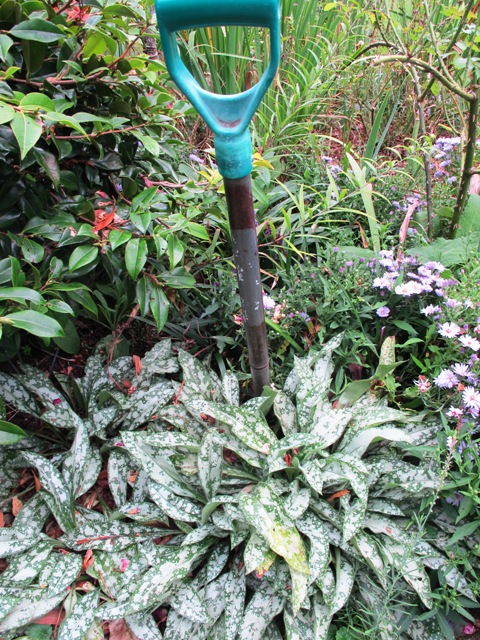 1) Clumping perennials can get overcrowded and start to deteriorate over time. Some will stop holding their flowers up well, some can die out from the middle while others just look tired and messy. Some need digging and dividing relatively frequently to stay looking their best. This clump of pulmonaria (unromantically known as lungwort) probably started as a single crown two years ago but grows rapidly.
 2) Dig out the clump, shaking off the soil. If you are not sure what you are doing, hosing off the dirt can make it easier to see the structure of the root system which varies between different plants.
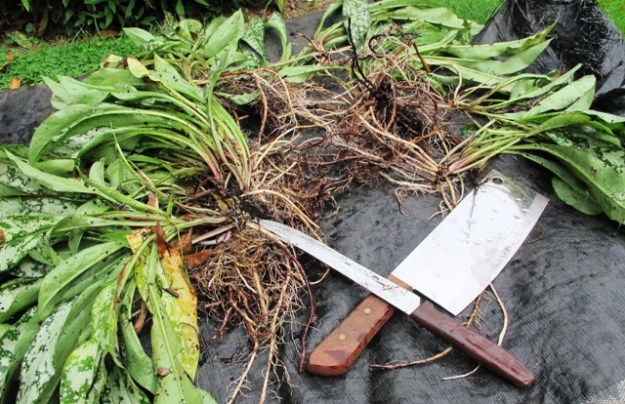 3) Part the leaves to find the separate sections growing from the centre or crown of the plant. Some plants just pull apart. An old carving knife is helpful and a meat cleaver is good for larger clumps with tough crowns. You can use a spade but it is hard to get accurate cuts. The pulmonaria yielded at least 15 divisions, all of which would grow as separate plants if I wanted that many.
 4) Replant the strongest divisions into soil which is well dug and friable. If you are only lifting and dividing every 10 years or longer, this can be a major task as soils compact over time. If you are doing it more often, it is easy as the soil stays looser. Spread the roots evenly and cover to the same level it was earlier. We like to add compost mulch and then water thoroughly but gently. Removing some leaves reduces the stress on the plant.
 5) These three perennials also benefit from lifting and dividing every few years. From left to right: an aster which just pulls apart into separate sections, mondo grass (ophiopogon) which also pulls apart but sometimes needs the runners snipped, and polyanthus which usually needs to be cut through the crown to ensure that each piece has roots attached.
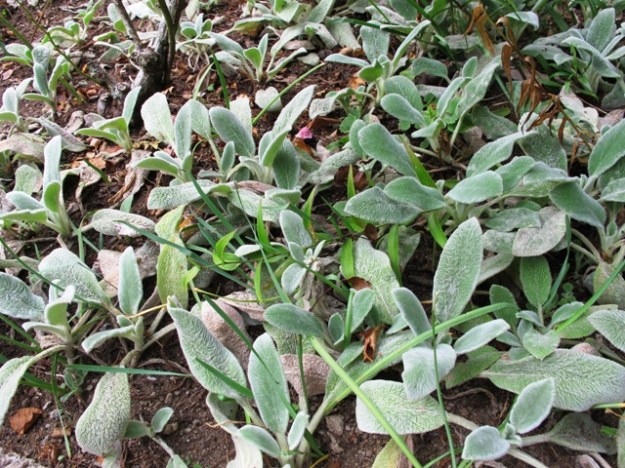 6) This patch of stachys (lambs’ ears) was dug and divided three weeks ago and has already recovered well because it is in full growth. Timing is not critical in our mild climate but done in midsummer, care needs to be taken to avoid the roots drying out and plants will need thorough watering for the first week.



 Tikorangi The Jury Garden