Plant Collector: Tigridia pavonia

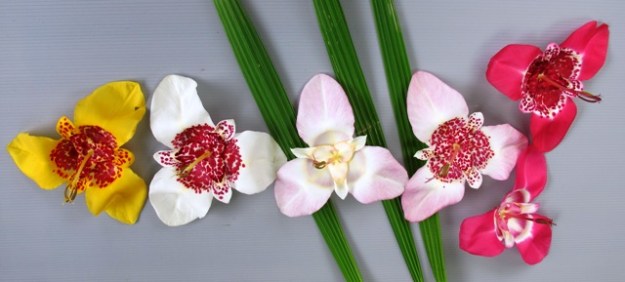
Tigridia pavonia - missing the scarlet red one we have which had no flowers open on the day

Tigridia pavonia – missing the scarlet red one we have which had no flowers open on the day

There is nothing rare, choice or difficult about these bulbs which can border on garden weeds, they are so easy. But in the right situation, they are a delight in the summer melee. Tigridias are from southern Mexico but probably on the road to naturalising anywhere hospitable. They set prodigious amounts of seed and can reach flowering size from seed in two years. Their common name is jockey caps and they belong to Iridaceae (iris) family. The flowers are relatively large – up to 15cm across – with 3 large outer petals and 3 inner small ones, but short-lived. Each bloom only lasts one day, opening in the morning and wilting away to oblivion by evening. However, each stem produces multiple blooms in succession. The pleated leaves are attractive in themselves and both flower and foliage sit around 60cm high. In case you are worried about weed potential, be reassured that they are easy to pull out if they pop up in the wrong place and you can control them by removing seed pods.

Tigridias want full sun and good drainage but also some summer rain when in growth. We find they combine well with larger growing summer plants like dahlias and lychnis in less formal areas of the garden.

Mark’s very late Uncle Les (he who bred such camellia classics as Jury’s Yellow, Anticipation and Debbie) spent some time trying to breed the freckles out of tigridias which always seemed a rather odd track to take, though the freckle-less blooms perhaps have a finer charm of some sort.

First published in the Waikato Times and reprinted here with their permission.

Garden Lore

“It is a greater act of faith to plant a bulb than to plant a tree.”

Clare Leighton, Four Hedges (1935)

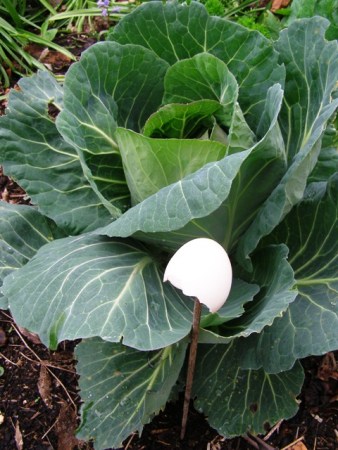
Do we really believe that cabbage whites have large enough brains to be duped?

Do we really believe that cabbage whites have large enough brains to be duped?

Garden Lore: Cabbage whites and brassicas
Brassicas are like ambrosia to the cabbage white butterfly. Or maybe heroin. For this reason, we prefer not to grow brassicas during the summer months when the cabbage whites are at their most active. I am a reluctant consumer of cabbage, broccoli and cauliflower at the best of times. The latter two are passable in a winter soup flavoured with cheese (blue cheese is the classic, but any cheese helps). However, many of the increasingly popular Chinese greens also belong to the brassica family, and these are acceptable to me at any time of the year.

You can net the vegetables, but the netting needs to be raised clear so that the winged parent cannot land and lay eggs through the netting. If you want to spray, talk to your local garden centre about BT (which is a bacterial based treatment) or pyrethrum-based options. Pyrethrum is the active ingredient in flyspray and was originally extracted from a daisy. These days it is more likely to be synthetic but it remains a pretty safe control. Vigilant digital control (squashing with the fingers on a daily basis) can work in the early stages. We think it is a myth that egg shells on sticks will confuse the butterfly and they will fly away. White butterflies show no territorial instincts at all, that we have ever seen.

If you don’t like added protein to your cooked vegetables (while Mark does not mind the odd cooked caterpillar, most people find them very offputting), you can sprinkle lots of salt over the florets or leaves as you prepare them, then cover them with cold water for a few minutes while the caterpillars die. Rinse them thoroughly, inspect closely and cook with no added salt.

First published in the Waikato Times and reprinted here with their permission.

Climbing and clambering clematis

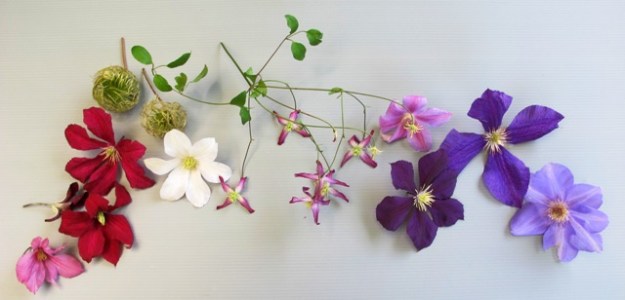
A selection of clematis which are still flowering in the garden, including two of the decorative seed heads

A selection of clematis which are still flowering in the garden, including two of the decorative seed heads

Clematis. I have not written about clematis before. This is in part that there is clematis specialist living around the corner from us and my technical knowledge on the genus is so sparse that I am worried about betraying my ignorance. I am terrified he will come and set me right. But they are such a lovely addition to the summer garden.

When I looked up clematis, I didn’t feel quite so bad about my botanical ignorance. It is a huge family with hundreds of different species (somewhere between two and three hundred or even more). Add to that the thousands of different hybrids that have been named. While ignorance may not be bliss, it is at least understandable in the face of such complexity. At least I found out that they are buttercup relatives – members of the Ranunculaceae family.

There are clematis and there are clematis. Some are altogether too vigorous. Who can forget “old man’s beard must go” on the telly? Clematis vitalba is such a strong grower that it threatens our native forest and can kill established trees. It is one garden escape that cost this country dearly. C. vitalba is not alone in its strangling and invasive personal habits but one hopes that somebody will have made those decisions long before you look at a pretty plant in the garden centre.

Clematis are equally notorious for karking it when planted out. That magnificent specimen in a pot with a frame covered in flowers can disappear before your very eyes when transferred to the garden. The problem is usually “clematis wilt”, reportedly a fungal affliction. If you spot it, cut back to healthy leaves, or even to the base of the plant if the whole thing is affected. Remove the diseased sections, cross your fingers and wait. Often, the plant will shoot again but it can take a while and the clematis roots can survive a year or longer without shoots above ground.

These are the only plants I know where the advice is to plant deeper in the ground than in the pot – around 8cm deeper is good. This is largely protection against the dreaded wilt, as far as I can see, so follow the advice. Like most climbers, they prefer their roots in cool, humus rich soil with adequate moisture levels but their heads in the sun. This is not always that easy to find, especially as you have to combine it with something for them to climb up. Once away, they can get purchase and twine onto surfaces that are not smooth – their instinct is to reach for the sun so most will climb if possible.
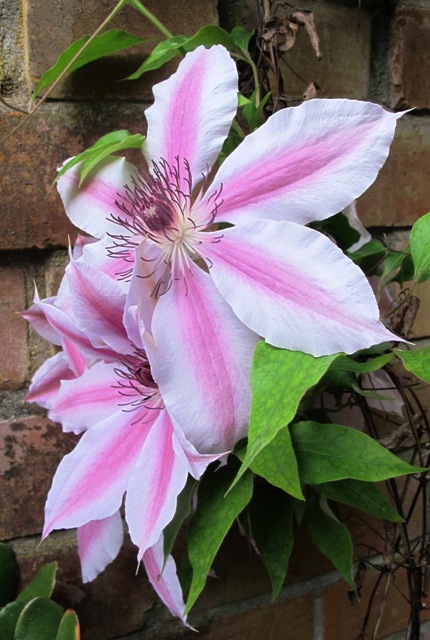
What we have as the tried and true "Nellie Moser" although it may be a seedling rather than the real thing

What we have as the tried and true “Nellie Moser” although it may be a seedling rather than the real thing

As garden plants, I favour the hybrids and the viticella types. We have a fair number twining their way through shrubs in mixed borders and they never fail to delight when they flower. You need to make sure that you don’t have overly rampant varieties when they are expected to co-exist with other plants. I took out what I think were texensis types – given to me as ground cover but distinctly shy on flowering, bell-shaped which I was not so keen on, and given to choking habits. I did not think they justified their position but there may be better texensis varieties available.

We have several growing under cover. Everybody admires “Niobe” in bloom. She has large flowers in deep burgundy but she proved damn difficult in the garden and it has taken several attempts over a fair number of years before we had a plant performing well, scrambling through evergreen azaleas. Planted in the ground but under cover with just some rain run-off to keep the roots moist, she has been much more reliable.

At the opposite end of the scale, the lovely, late-flowering yellow C. tangutica threatened a takeover bid in the garden but when relocated to a trellis under cover, behaved perfectly in comparative isolation.
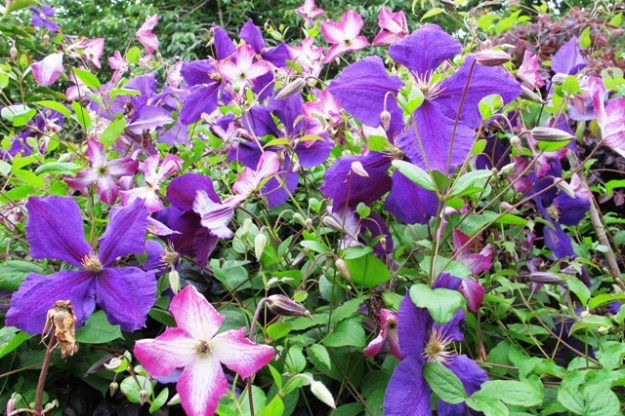
Two named varieties. I just don't have the names any more.

Two named varieties. I just don’t have the names any more.

Often they can be combined with other climbers to extend flowering interest. We have clematis planted successfully with wisteria, Trachelospermum jasminoides and schizophragma. The latter two plants, for those who struggle with plant names, are a garden-friendly jasmine-type plant and a variation on the climbing hydrangea.

If you cut back most of the hybrids to just above ground level after flowering, feed and water them, you can encourage a second coming about six weeks later. Now is the right time to try this if you have some that have, as we say, ‘passed over’. However, it won’t work with the early spring flowering Clematis montanas. We don’t have C. montana any longer (it is a bit rampant for the garden, being better at covering old water tanks or sheds. It is once flowering only and needs different pruning treatment, if any. Most of the others I cut back to maybe 30cm above ground in winter and they are fine. Once established, they are easy and reliable and bring delight in spring and summer.

We have some lovely native clematis in this country but they are a story in their own right for another time.
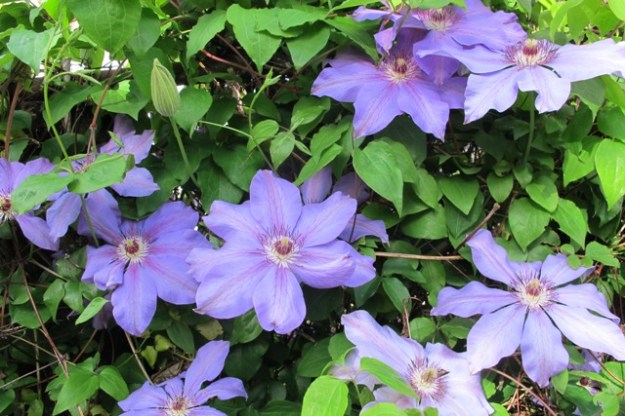
An unnamed blue seedling that has settled down happily in a mixed border

An unnamed blue seedling that has settled down happily in a mixed border

If you want to know more about different types of clematis or maybe even buy mail order, my neighbour is http://www.mrclematis.co.nz/ (email: yaku@xtra.co.nz). He produces a phenomenal range and has a passion and knowledge for the genus way beyond mine.

First published in the Waikato Times and reprinted here with their permission.

Plant Collector: Crocosmia “Lucifer”

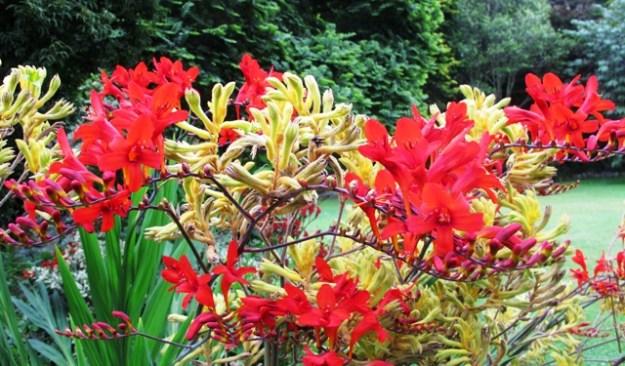
Red Crocosmia 'Lucifer' with yellow anigozanthus

Red Crocosmia ‘Lucifer’ with yellow anigozanthus

When they are roadside weeds, these bulbs are often referred to as montbretia. Treading on thin ice, I admit that we have orange-red ones growing amongst agapanthus on our roadside. At least it is better than the dreaded bristle grass that is the scourge in our area. “Lucifer” is a superior form, a hybrid with bigger flowers and stronger colour, making it popular as a garden plant. It is strong growing and both the pleated leaves and the flower spikes can get above waist height and it is almost indestructible. I like to keep it confined but it makes an attractive display beneath the apple trees and also alongside an equally strong growing yellow anigozanthus (kangaroo paw) which we have at the front of the rockery.

The bulbs are not unlike gladiolus corms and form chains below ground. It is the ability to grow when the chains are separated that makes these both easy and verging on weedy in some situations. We have a much larger flowered golden orange form which may be “Star of the East”. I say we have it, but we are waiting to see if indeed it is still here because it has been nowhere near as vigorous as “Lucifer” and each year we worry we have lost it.

Crocosmias are a small group of South African bulbs belonging to the iridaceae family. They are winter dormant, but their one drawback as a garden plant is that it takes a long time for the foliage to die down and they can be unattractive in autumn. That said, they are such toughies that I often trim the foliage off early to tidy them up.

First published in the Waikato Times and reprinted here with their permission.

Garden Lore

“Once it has a toehold, incongruity has a way of advancing systematically through the garden like quackgrass.”

Des Kennedy, Crazy About Gardening (1994)

A wonderful blue but don't trust this commelina in NZ

A wonderful blue but don’t trust this commelina in NZ

Garden Lore – weed plants

We bought a packet of seed of this pretty Commelina coelstris ‘Sleeping Beauty’ a few years ago and we have been working on eradicating it ever since. Mark decided it was dangerous as soon as he saw the seed set, even before we found that if you fail to remove all the tuberous roots, it can stage a comeback. It has such a pretty blue flower and we are fans of blue. Mind you, it is not as if it flowers in abundance like the common lobelias that seed down here and do no harm at all. I checked an American website and opinion was divided on the invasiveness of this plant but its ability to grow across a huge range of climatic zones, in every soil possible and in both sun and shade is a good indicator of weed potential in the hospitable conditions we have in this country. Pretty wildflowers in harsher climates can be an environmental curse here.

We haven’t complained to the seed company selling the commelina. Last time we mentioned to them about the weediness of a line they were selling (it was so-called strawberry spinach), the response we got was a dismissive: “Nobody else has had a problem with it”. The sub text to this might be: ‘we have no intention of stopping selling this plant and clearly you have no idea what you are talking about’. Since then, we have noticed others complaining about strawberry spinach. It took us years to eradicate it. It wasn’t even particularly appetising. Buy this, or the commelina at your peril. Campanulas are a better option for easy-care blue flowers.

First published in the Waikato Times and reprinted here with their permission.