Garden Lore

“Now that all the other many-hued flowers have scattered without a trace, the dead white head of the miscanthus remains alone in the fields until the end of winter. As it stands there so gracefully, not realising that it has entered its dotage, and bending its head as if in memory of past glories, it looks exactly like a very old person, and one cannot help feeling sorry for it.”

Sei Shonagon The Pillow Book of Sei Shonagaon (tenth century, translated by Ivan Morris 1967)

023Garden Lore: Mulching with lawn clippings

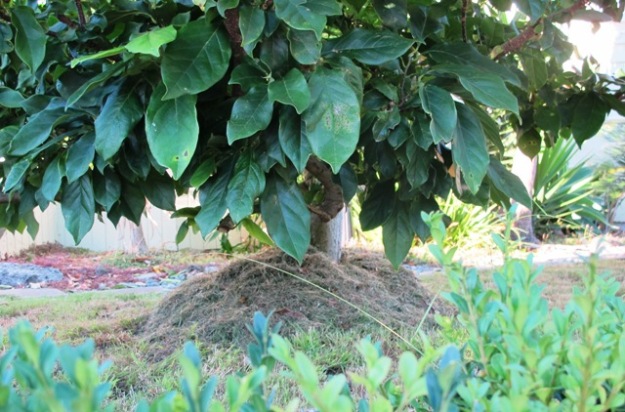
Naturally I stopped to look at this magnolia tree in a garden in Auckland. I was trying to work out if it was our Magnolia Black Tulip, bred here by my Mark. I think it was but I was so disturbed by the grass clippings beneath that I wanted to knock on their door and proffer advice. There is nothing wrong with using grass clippings as a mulch but with two provisos.

Most importantly, keep the clippings clear of the trunk of the tree. The main risk is opening up the tree to collar rot by encasing the trunk in warm, moist material. This enables fungal disease to get in, damaging the outer tissue of the stem or trunk. This can be fatal over time and the tree is likely to show damage by dying from the top down.

Keep the clippings to a relatively shallow depth, maybe 10cm. Grass can generate quite a bit of heat as it starts to compost and few plants appreciate their roots and trunks or stems being heated. In this case, I think they have the grass clippings piled on much too deeply and they are probably adding to them regularly. At the very least, clearing a breathing space of a few centimetres around the trunk would be good practice to avoid potential problems. Prevention is always better than scrambling to find a cure when one suddenly realises the tree is looking sick.

First published in the Waikato Times and reprinted here with their permission.

Plant Collector: Streptocarpus

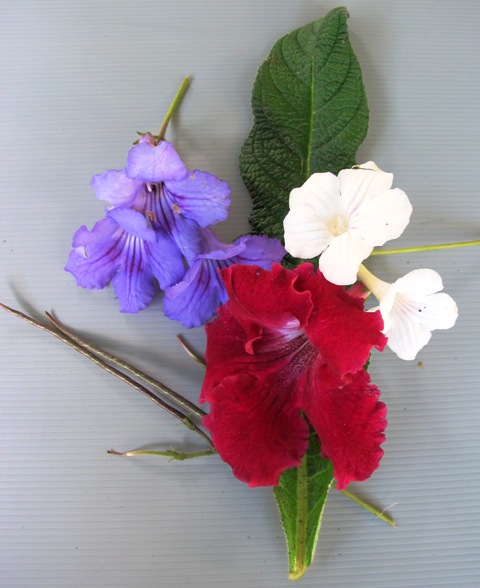
Streptocarpus hybrids - woodland bedding for mild climates

Streptocarpus hybrids – woodland bedding for mild climates

Not much shouts “mild climate” louder than using streptocarpus as bedding plants in shaded areas of the garden. That is because they are seen as conservatory plants in the temperate gardening world and few think to use them outdoors. They won’t take frost or very damp conditions, but they can withstand cooler temperatures.

The flowers are what is described as salver-shaped and sit above the foliage, usually in clusters. These will be hybrids, not the original species which grow in shady spots throughout quite large parts of Africa. A distinctive characteristic is the thin, spiral seed heads. Brittle leaves can get damaged easily, as well as snapping off but they also root easily from leaf cuttings so try replanting entire broken leaves. The root system is small and shallow, which means that it is not difficult to lift and divide established plants.

In a garden situation, we don’t get the quality blooms that are possible under cover but we do get months of flowering. If you don’t have a frost free, shaded garden position, these are still worthwhile plants to try indoors but keep them out of full sun.

Streptocarpus belong to the Gesneriaceae family. The best known members of this family are probably the touchy but very pretty African violets which are widely sold as house plants in this country. You may also recognise a similarity to what we often refer to as gloxinias – though it appears that the common gloxinias are not. Not gloxinias, I mean. They are more likely Sinningia speciosum, which I am unlikely to remember.
061
First published in the Waikato Times and reprinted here with their permission.

Garden style

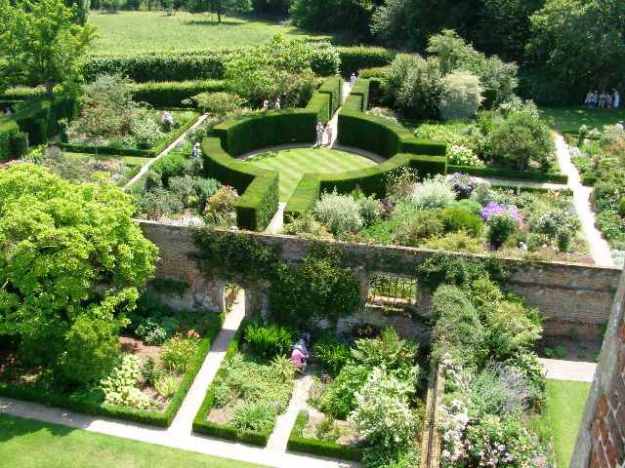
Sissinghurst of course - the inspiration for many, many gardens in NZ. Too many.

Sissinghurst of course – the inspiration for many, many gardens in NZ. Too many.

Truly, it is difficult to be original in the garden. Oh, there can be the odd touch of whimsy or indication of flair but generally it has all been done before. Somewhere. The skills lie in how you put the ideas together and manage it all. It is a bit optimistic, grandiose even, to consider that you can come up with some brilliant concept that nobody has thought of before. But that is all right. We are all in the same boat.

We had a small British gardening tour through last week. Not all garden tours are equal by any means and we particularly enjoyed this one. They were both knowledgeable and enthusiastic, giving us as much stimulation as we hope we gave to them. We have a huge debt to British gardening traditions in this country.

I have looked at Italian gardens but they are more about design, space and hard landscaping (and wealth) than gardening as we know it here. The plant interest is minimal. But should an Italian stonemason want to enter your life, do not turn him away. There is a history of magnificent stonework in that culture.

More about wealth, power and lifestyle than plants - the Alhambra in Spain

More about wealth, power and lifestyle than plants – the Alhambra in Spain

Southern Europe has a pretty difficult climate. If it is not hot and dry then it is cold and dry. So the historic gardens of Spain and Portugal that I have seen were also about wealth and power. Their hallmark is magnificent hard landscaping and good design but they too, are light on plants.

Japanese gardening is one that exists in something akin to a bubble all of its own. It is deeply steeped in symbolism, tradition and contemplation. I admit I have not been to Japan so I don’t know much about the modern gardening trends, but from afar it appears that the old traditions remain dominant. They seem to be relatively immune to the eclectic cobbling together of ideas from around the world that most of us do.

We have drawn upon Asia for the tropical gardens, so fashionable at the moment. I wrote about the hotel-style gardening in the middle of last year.

I understand our preoccupation with lawns and the high value placed on the dreaded “kerb appeal”, in real estate speak, have a debt to USA but those are questionable contributions to our gardening heritage here.

In fact, large parts of the world do not garden at a domestic level as we do. In some cases it is lack of physical space – or any outdoor, private space at all in heavily populated areas. In other cases, the conditions are just too hard. If your ground is set like concrete and it is alternately too hot and then too cold to be outside, the motivation must flag.

If you look at Britain, you can see a gardening ethos that is very close to our own. It is probably no accident that while their conditions are nowhere near as easy as ours, nevertheless it is a relatively mild climate. Being islands, the sea has a tempering effect and they lack the extremes of temperature and near absence of rain that many other countries experience. Many of the great and intrepid plant hunters originated from Britain and they have always put a high priority on plants – new plants, varied plants, plant combinations, entire collections of a single plant genus. Gardens are expected to have a high level of plant interest, not just grand design. Even what we would regard as the great gardens of last century (the likes of Great Dixter, Sissinghurst and Hidcote) are still essentially domestic gardens in their origin. These are less a statement of power and wealth and more an example of gardening obsession.

Meadow gardening and a return to a more natural style is evident in UK gardens, less so here.

Meadow gardening and a return to a more natural style is evident in UK gardens, less so here.

So it is curious that we have only adopted a few key garden styles from that country – notably cottage gardening, mixed borders and the Sissinghurst garden rooms’ genre. We have been very slow on the uptake when it comes to what is now called the New Perennials Movement and just as slow on the dialogue they have been having in recent years about a return to a more naturalistic style of gardening. When I say slow on the uptake, I mean I have not seen anything at all in our gardening media and few of the colleagues I have talked to even know what these mean.

Yet I have heard it described by UK garden expert Carol Klein, as “the most influential garden movement in Britain in the last 15 years”. Mind you, the term New Perennials Movement, appears to be of recent usage only and it brings together the apparently disparate threads of naturalistic, meadow, grasses and prairie gardening that we noticed on our last visit there in 2009. Much of it was still seen as pretty avant garde then. Maybe it has bedded in better now.
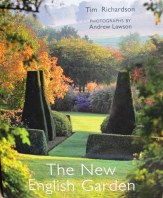
069 (2)In the meantime, “The New English Garden” by Tim Richardson, published by Frances Lincoln, is more than a coffee table book. The sumptuous photographs and presentation are complemented by an intelligent and discerning text. Perhaps the problem is that we New Zealanders are still visiting only the most famous gardens and the existence of a whole new style has so far bypassed us. We are heading back this June to have a closer look.

First published in the Waikato Times and reprinted here with their permission.

Garden Lore Friday Jan 31 ,2013

“By the time you have grown two thousand species you could believe that you had exhausted Nature’s imaginative variability; by the time you have grown five thousand you realise you never will.”
Geoffrey Charlesworth, The Opinionated Gardener (1988)
OLYMPUS DIGITAL CAMERA
Garden Lore: wheelbarrows
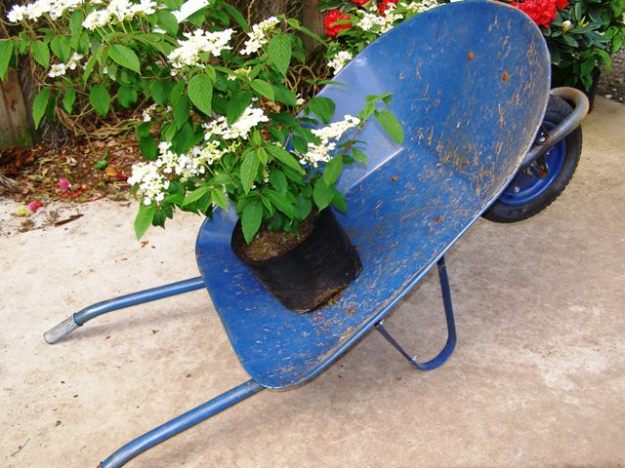
Quite possibly, you may not have pondered the origins of the wheelbarrow but when you think about it, it is a design of some genius – a single wheeled cart with great manoeuvrability which enables the pusher to move pretty heavy loads and to tip them out easily. Its origins go back in the mists of time. Chinese history often attributes its invention to Chuko Liang around AD 200, when records show it being used to transport military equipment and supplies. There is some evidence that it dates back even earlier and there is a school of thought that it may even go back as far as Ancient Greece around BC 400. It did not come into wide use in Europe until the Middle Ages but when it did, it must have made life a lot easier.

The position of the wheel varied from the middle to the front throughout history but has now settled on the latter. The whole principle of the single wheeled barrow is the even distribution of weight. After 2000 years, you would think we could get this right every time but that is far from true. There are too many barrows – particularly at the cheaper end of the market – which will tip over easily unless you load them perfectly, starting from their centre point of balance. If you are buying a new barrow, try placing something a little weighty right at the back and then at the side. A well designed barrow won’t tip.

First published in the Waikato Times and reprinted here with their permission.

January bulbs for mid summer

Regular readers will know that we are very keen on bulbs here. As I surveyed the January ones, I figured that most bulbs are stars on their day. I guess because they are both seasonal and transient, they have to wow in their short time in the spotlight. A bulb in bloom can make you look in admiration, despite even the most unattractive location. We would not be without them.

The prized worsleya

The prized worsleya

Indubitably, the star this week is the unusual Empress of Brazil (Worsleya procera syn. rayneri) which does indeed hail from Brazil. It is an exotic showstopper. But the reason it is hardly ever seen is because it is rare in cultivation and requires a patient gardener. This particular specimen took 13 years from planting to bloom. There aren’t many gardeners willing to wait over a decade for a flower.

Scadoxus multiflorus ssp katherinae

Scadoxus multiflorus ssp katherinae

The Scadoxus multiflorus ssp katherinae are also big and showy but much easier to source, being very popular with Auckland landscapers. We have reached the point where they seed down and are naturalising themselves beneath trees where they have become a real feature in the summer shade garden. Some of those blooms are getting close to the size of human heads. We have South Africa and Zimbabwe to thank for these beauties.

Auratum lilies

Auratum lilies

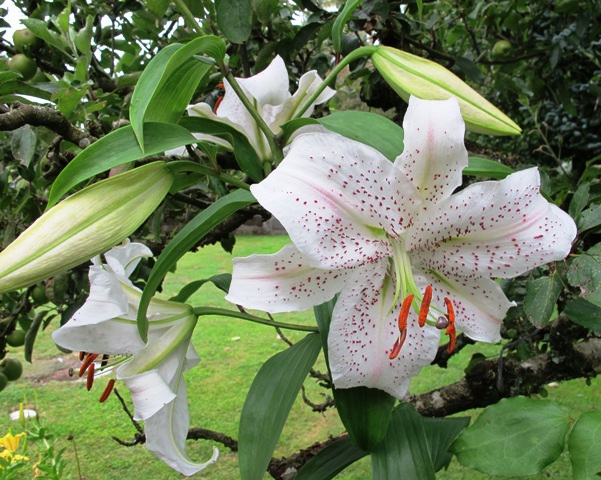
In sunnier spots and on the margins, it is the lilies that astound. I wrote about the aurelians two weeks ago but it is now the time for the auratums (sometimes known as the golden-rayed lily of Japan). These can be sourced from garden centres in winter. Just make sure you never let the bulbs dry out, even when they appear dormant. If you give them lots of TLC for the first few years, you can increase numbers from the small offshoots as well as raising seed.

Gloriosa superba

Gloriosa superba

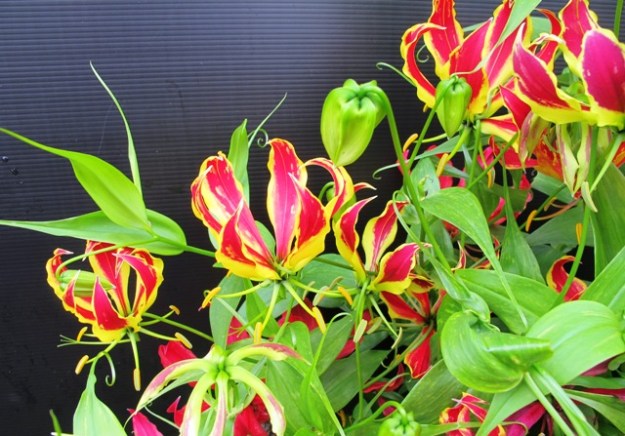
Gloriosa superba are often called climbing lilies, though they are only distant relatives at best. These are great plants for hot, dry conditions – the sort of spot many of us have under house eaves facing north. They flower for a long time in high summer and require absolutely no care at all beyond giving them something to cling to so they can climb rather than tumble.

Gladiolus

Gladiolus

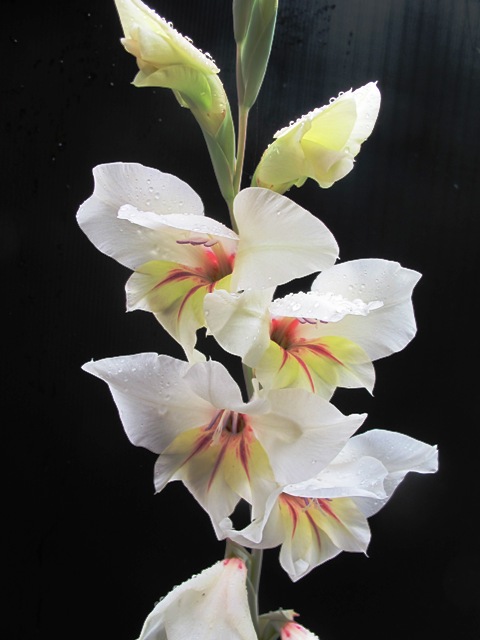
Gladioli! Dahlias! We often take both families for granted but summer gardens would be poorer for their absence. We don’t have many of the Dame Edna hybrid gladdies. While there is a certain charm in their exuberant vulgarity, we are less enamoured of the rust that afflicts the foliage, making them unattractive plants. This white gladiolus is not a species, as far as we know, but it is somewhat further back up the breeding chain from the modern hybrids. Dahlias I tend to lump in with perennials though technically they are tubers, so within the bulb group.

Crinum moorei

Crinum moorei

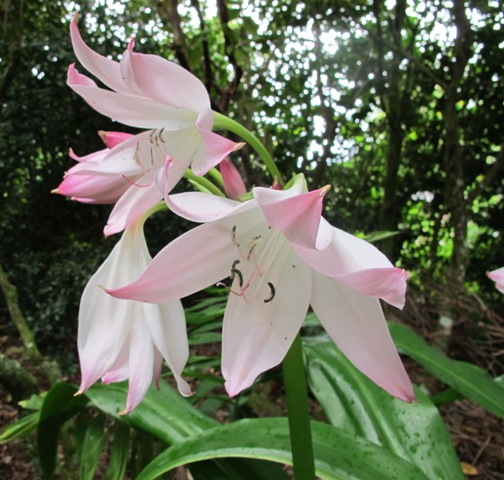
The crinums are coming into flower and C. moorei is another shade garden option though it needs to be in a position where its rather large foliage can be ignored during the times when it is scruffy. These plants stand chest height, the fragrant flowers close to nose level so there is nothing small and dainty about them.

Add in the crocosmia featured last week, the tigridias in Plant Collector today, summer flowering ornithogalum, the yellow zephyranthes (‘rain lilies’), even the early Cyclamen hederafolium coming into flower. While January is not in any way peak bulb season, those in bloom add a great deal to the summer garden.

First published in the Waikato Times and reprinted here with their permission.