Plant collector: Aurelian lilies

The lovely Aurelian lily hybrids

The lovely Aurelian lily hybrids

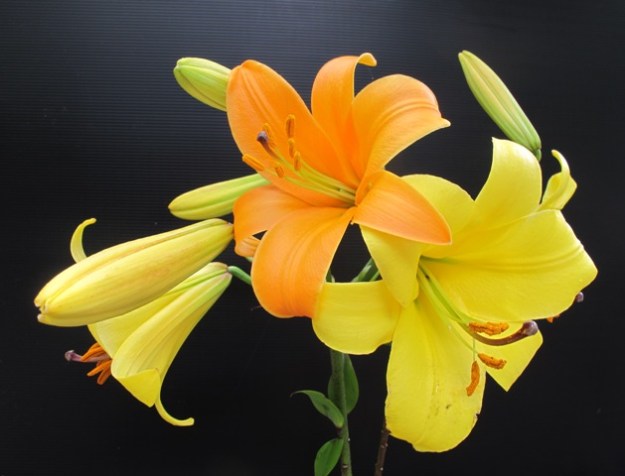
‘Tis the season of the Aurelian lilies. These are hybrids (so crosses of different species) and fall within the trumpet lily group. Their blooms are indeed shaped like trumpets which face outwards, often dropping a little with their weight. And sweetly scented, though not with the heady intensity of the auratum lilies which are just starting to open.

Aurelians are all hybrids of Lilium henryii. It is orange with reflexed petals (so they curve backwards) and no scent but it is a tough survivor. The original crosses were with Lilium sargentiae from China which is a trumpet species so brought in the flower form along with the fragrance. Now the Aurelians are pretty mixed in terms of breeding but typically flower in shades of yellow and apricot orange. Most will set seed so if you can’t find them to buy, you can at least raise seed if you know of somebody with them. These are seedlings Mark raised to build up numbers for the garden. It can take from 3 to 5 years for seed to reach flowering size.

Like most lilies, these bulbs like humus rich conditions and plenty of sun and moisture. They are quite tall – up to 180cm – so grow them amongst plants that you can prop the lily stems up against or they will need individual staking. Despite very sturdy stems, the weight of the flower heads pulls them over. The number of flowers per stem can vary from one (often an indication of weaker bulbs) up to full heads. The most I have counted is 18.

Aurelian was a Roman emperor and, of course, aureum means golden in Latin.

First published in the Waikato Times and reprinted here with their permission.

Garden Lore

“I always think of my sins when I weed. They grow apace in the same way and are harder still to get rid of.”

Helena Rutherford ElyA Woman’s Hardy Garden” (1903)

Sago!

Sago!

Garden Lore: Friday 10 January, 2014

Most of us above a certain age grew up with milk puddings. Semolina, sago and tapioca were the most common thickening agents. Until recently, I had vaguely assumed that they basically derived from the same source of starch and the difference was in the grade of grain. Not at all. Semolina is usually durum wheat-based. After the outside husks and wheat germ have been removed, what remains is the inner part, or middlings. This is what gets ground into flour but before that stage, basically it is semolina. It can also be obtained from rice and maize crops – the latter becomes the dish known in USA as “grits”. Modern times have seen old fashioned semolina give way to the trendier North African couscous, which is essentially very similar in makeup but sold as a quick-cooking product having been steamed and then dehydrated. Israeli couscous (which resembles tapioca or frogs’ eyes) is simply further processed to this larger form.

Sago, on the other hand, is a starch that comes from the pith in the trunks of various palms but particularly Metroxylon sagu and is largely a product from New Guinea and South East Asia. Tapioca has an entirely different origin, being from cassava (Manihot esculenta) which grows as a tuberous root and is a tropical plant which originated in South America but is now a staple food in the Pacific and Asia as well.

These days, I only have sago in the kitchen cupboard. That is because I sometimes use a recipe idea which is vintage Alison Holst. When stewing rhubarb, add sago with the diced fruit (1/4 cup to 4 cups of fruit). It takes a little longer to cook, but the result is somewhat jellied and the acidity of the rhubarb has gone. It is very palatable, even for non-rhubarb fans.

First published in the Waikato Times and reprinted here with their permission.

The answer truly lies in the soil

005 (2)Who has never complained about the absence of flavour in supermarket tomatoes, particularly when out of season? Almost without exception we laud the merits of homegrown produce as being much more flavourful, even more so if crops have been grown from heritage varieties. Very hipster these days. Many people believe that the flavour has been sacrificed in commercial crops in the quest for high production.

Things are never that black and white. For some years, we have been pondering the triggers for flavour. I cite my experience with tomatoes in Southern Italy. A taste treat beyond compare, so full of flavour were they. But it was only the first week of June so it wasn’t a hot, dry summer that determined the quality of the taste. Nor, indeed, was it the variety. In recent years there has been an explosion of heirloom or heritage seed varieties becoming available in this country. We have tried growing a fair number of different ones and, to be ruthlessly honest, while better than the wishy washy supermarket ones, they all fall well short of those I ate in Italy. That leaves the soil as the key variable.

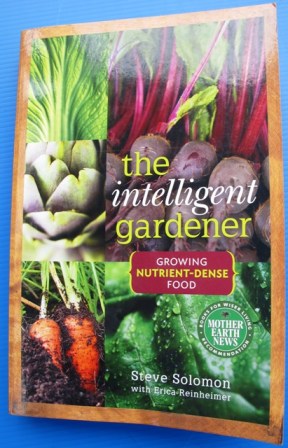
The answer may indeed lie in the soil. Unfortunately the solution is not as simple as scattering fertiliser with added trace elements, which is the usual recommended treatment. We have taken good care of our soils here and believed that we made good, balanced compost to nourish them. I use the past tense – believed. Summer reading here is “The Intelligent Gardener” by Steve Soloman. That is to say, Mark is reading it and sharing the highlights as he goes. While some of the book drives him nuts, the underlying premises make a lot of sense. Our soils are almost certainly nowhere near as good as we thought.
008
The subtitle of the book is “Growing Nutrient-Dense Food”. Nutrient density has been hovering on the periphery of our lives ever since Kay Baxter started writing about it. It is the principle that you can have two apparently similar crops but one has a much higher nutritional value than the other. Kay Baxter is the leading light of the Koanga Institute and a true pioneer of organics and the preservation of heirloom and heritage varieties in this country. She advocates the use of Brix measures to determine nutrient density. Brix are commonly used in the wine industry to measure sugar content.

It may be something of a leap to link flavour to nutrient density, but it seems logical that there may well be such a link and certainly both go back to the nature of the soil.

As a country, New Zealand has some widely recognised soil deficiencies. Insufficient naturally-occurring iodine is why we have iodised salt in this country. Prior to that, goitre was very common in humans and indeed in animals. “Bush sickness” is a widely recognised problem attributable to cobalt deficiencies on pumice soils. Selenium is deficient. At the risk of treading on sensitive ground in the Waikato, I understand that the trace element fluorine is deficient in NZ which is a major contributor to why New Zealanders have long been renowned for poor teeth. According to my father, who was a medico in the British army in WW2, they could pick the NZ soldiers at time of autopsy because most had false teeth. Correspondingly, pre-dental bleaching, all those beaming white toothy smiles of many Americans were apparently attributable to higher levels of naturally occurring fluorine.

If you are really keen on running a closed system of food production with no external inputs, it matters a great deal that you understand the exact composition of your soils in considerable detail. Even then, it is not as simple as topping up a certain element because there are reactions and inhibitors which can affect the ability of soils to incorporate additions. But most of us get our food from a variety of sources, which means deficiencies don’t usually have dire effects on human health because there is a degree of balancing out which occurs.

Mark is planning to delve further into the exact compositions of our soils. We are interested to see whether better balanced soils will give us better flavoured food. We will be watching to see if the link between flavour and nutrient density is proven. Certainly, it is disconcerting to have our existing notions about the quality of our soil and compost turned upside down. But this is not a once over lightly project which will appeal to all gardeners.

If you want to know more, the Koanga website is: http://koanga.org.nz/ The book referred to is “The Intelligent Gardener” by Steve Soloman. (New Society Publishers; ISBN:978 0 86571 718 3). Elder daughter purchased it for her father from the bookshop of Canberra Botanic Gardens. In this country, you may need to order it, in which case the ISBN number is important.

First published in the Waikato Times and reprinted here with their permission.

Plant Collector: Justicia carnea alba

The white candles of Justicia carnea alba

The white candles of Justicia carnea alba

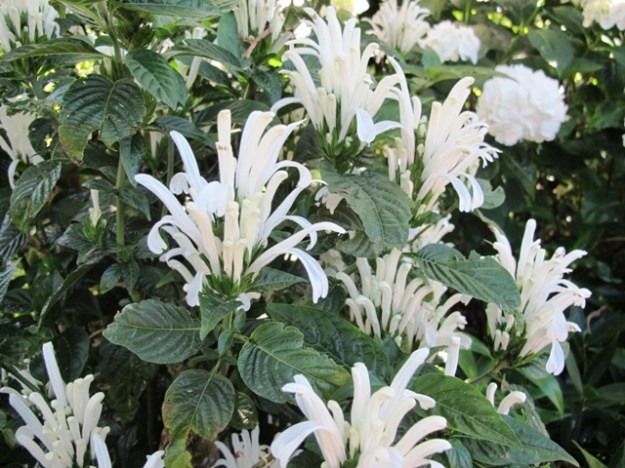
Christmas candles? Reminiscent of the tufting of old fashioned candlewick bedspread? It has also the unromantic name overseas of shrimp plant, a reference to the shape of the flowers. The white justicia has been bringing me a great deal of pleasure in recent weeks. We have always had the pink and yellow forms but I thought we had lost the white until I found it looking a little ragged and squashed by surrounding plants. I moved it and it hasn’t looked back. It can be a bit of a straggler so I constructed a discreet little bamboo frame to hold the plant together.

There are over 400 different justicia species, mostly from tropical to warm temperate Central and South America (think Brazil, amongst others) but J. carnea appears to be one of the showiest and is the most common in cultivation in this country. It has a very long flowering season across the summer months. This plant is only a metre tall at this stage but left to its own devices, I expect over time it will reach the 2.5 metres of the pink and yellow ones we have.

There aren’t many plants which will flower profusely in heavy shade. Most plants need sun to bloom. So it makes an ideal larger woodland plant with one proviso. The information online says it will not take below 7 °C. I don’t think it is that sensitive. We can get colder than that here and it has never shown damage but clearly it is quite cold sensitive and is regarded as a glasshouse plant in many areas of the world.

Justicias belong to the acanthaceae family.

First published in the Waikato Times and reprinted here with their permission.

Garden Lore

“It takes a while to grasp that not all failures are self-imposed, the result of ignorance, carelessness or inexperience. It takes a while to grasp that a garden isn’t a testing ground for character and to stop asking, what did I do wrong? Maybe nothing.”

Eleanor Perenyi, Green Thoughts (1981).

Japanese black trifele tomatoes

Japanese black trifele tomatoes

Heirloom and heritage seed varieties

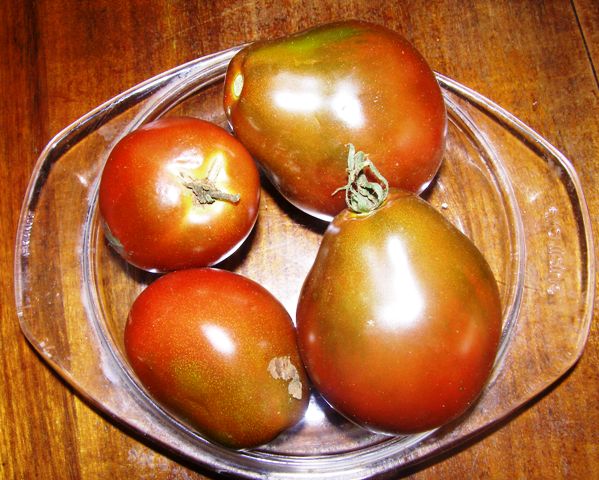
I see Kings Seeds define “heirloom” seed varieties as being selected strains dating back to pre-1960s. Anything grown from seed will be a selected cultivar from the original species over time and may be very different from wild forms. While, by definition, heirloom varieties are open pollinated (by insects or wind), so too is the vast majority of seed we grow. I tried to work out whether there is an agreed difference between “heirloom” and “heritage” but generally the terms seem to be used loosely and interchangeably.

A number of people and organisations have been working for years to preserve our heirloom varieties in this country but none more so than the Koanga Institute and Kay Baxter in particular. Why does it matter? It is really important to keep genetic diversity in a world where commercial production is driven by other imperatives – particularly high productivity. The kiwifruit industry is a clear example of the perils of depending on a single cultivar of yellow fruit. If disease (PSA, in that case) takes it out, the impact is devastating.

Heirloom is not a synonym for high health. Some will be, some won’t and some will not perform well outside their original area. While most of us like to think it is synonymous with better flavour, that is not always true, either. It has nothing to do with being organic although many organic gardeners will favour heirloom varieties. Essentially, all “heirloom seed” means is that a particular seed strain has shown sufficient merit in some area of performance for people to keep it going for over fifty years. And long may we continue to preserve these different strains of seed.

First published in the Waikato Times and reprinted here with their permission.