Garden Lore

“I have come to understand the unspeakable loveliness of a solitary spray of blossoms arranged as only a Japanese expert knows how to arrange it…and therefore I cannot think now of what we Occidentals call a “bouquet” as anything but a vulgar murdering of flowers, an outrage upon the colour-sense, a brutality, an abomination.”

Lafcardio Hearn, Glimpses of Unfamiliar Japan (1894).

008 (2) - Copy
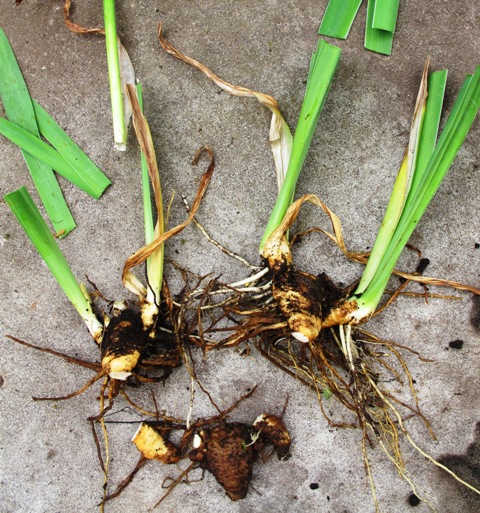
Dividing bearded irises
This will be the last call for irises on this page for a while, but if you have bearded irises, now is a good time to divide them. This should be done every few years to avoid clumps getting too congested, at which point they will stop flowering. Make sure you don’t damage the rhizomes as you dig them up. Wash them if need be to see what you are doing. Discard any mushy or damaged sections as well as the darker coloured older sections in the centre which have already done their dash. Fresh offsets (where leaves will now be growing) need to be about 8-10cm long before you cut them off so, if they are smaller, keep the parent rhizome with them. Cut the leaves back to about 15cm to reduce stress. Remove any spent flower spikes. Replant by spreading the roots but keeping the rhizome nestling just on top of the soil where it can bake in the sun.

Timing is not critical but done now, the iris has a chance to re-establish its roots and get a good footing before it has its winter rest. Bearded irises need full sun and excellent drainage to prosper.

First published in the Waikato Times and reprinted here with their permission.

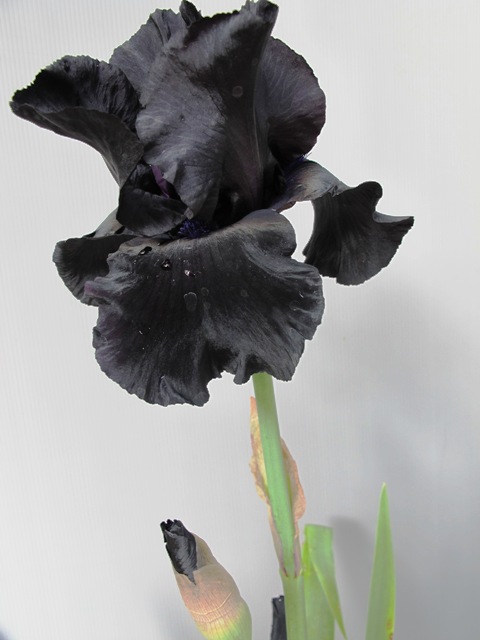
Plant Collector: Tall Bearded Iris “Black Suited”

Iris 'Black Suited'

Iris ‘Black Suited’

In last week’s column, I included a photo of the black iris called “Anvil of Darkness”. This week it is the turn of the larger “Black Suited” to bloom and for wow factor, it sure has what it takes as a specimen bloom. It opened pure black but both these dark, velvety irises take on very deep purple tints as they age. These are novelty blooms in that black flowers are rare in nature and Mark is a bit suspicious of how well they stand out in the garden. I had been wondering about combining it with some white Siberian irises I have which flower at more or less the same time but he felt that was too obvious and it would look better surrounded by soft pastel colours, probably perennials rather than more irises.

Both these black irises were the work of an American breeder, Sterling Innerst, who was actually a primary school teacher who liked to breed irises in his leisure. He named 213 different new hybrids before his death in 2010 and I guess we might be grateful that the handsome “Black Suited” was not in fact named “Erotic Touch” or “Grobswitched” as two others were. “Black Suited” was first released in 2000 and any debt to original species is a fair way back in the past. He was crossing hybrids so it is a cross of “Before the Storm” with “Black Tie Affair”. The flower spike stands about 50cm.

I wondered whether breeding black irises was a recognised breeding quest but I see that the iris equivalent of the blue rose is in fact a pure red. It has yet to be attained.

First published in the Waikato Times and reprinted here with their permission.

Stripes, splashes and edges – variegated plants

Yellow variegated conifers are redolent of the 1960s and 70s but we have retained those that add a statement to the garden landscape

Yellow variegated conifers are redolent of the 1960s and 70s but we have retained those that add a statement to the garden landscape

New Zealand gardeners are not, in the main, huge fans of variegated foliage. There are exceptions – hostas being one – but as a general rule, we tend to avoid bi-coloured variations. This often surprises overseas gardeners, particularly British ones who are far more enamoured of such things.

I am sure it is related to the differing quality of light in this country. New Zealand is remarkable for its clear, bright light. In recent times, that light has been even less filtered due to the hole in the ozone layer. Those prized white, cream, yellow or pale variegations burn badly in the sunlight. If the sun doesn’t get them, then the winds often do and burned brown edges take the charm away.

It is different in countries with softer, more diffused light. Often such conditions go with lower sunshine hours and in a climate which is generally greyer, yellow plants and variegations can add a bright touch in the garden and landscape which is valued.

Variegations are usually sports – mutations, genetic aberrations, if you like. Sometimes it is the result of a virus. Most plants grow with one solid colour on the foliage. All sorts of plants can throw up a branch or stem with a variegation but most of these will be unstable and revert back to the original single block colour. Where a variegation can be isolated and increased by propagation, the resulting plants often the lack the vigour of the original plant.

Hideous variegated plants I have seen include a nasty variegated oleander in Spain. The mottled and margined leaf added nothing to what is a lovely flowering street tree in the right climate, in my opinion at least. There was a ghastly variegated spirea (a yellow and green leaf with murky pink flower) that we saw being sold widely in the UK. In this country, the top selling rhododendron for a number of years in the 80s was a mutant named President Roosevelt. Some of you may still have it in your gardens so stop reading now if you are going to take offence. It was the first plant I cut out when we bought the property across the road from where we now live. I do not think the yellow mid-rib to the leaf added anything but when you add a red and white variegated flower to green and gold foliage, it was all too much for me. But distinctive, so it sold.

We have retained the odd variegated yellow conifer here but only because they are handsome, established trees which make a contribution to the landscape. I can’t think that we would choose to plant them from scratch.
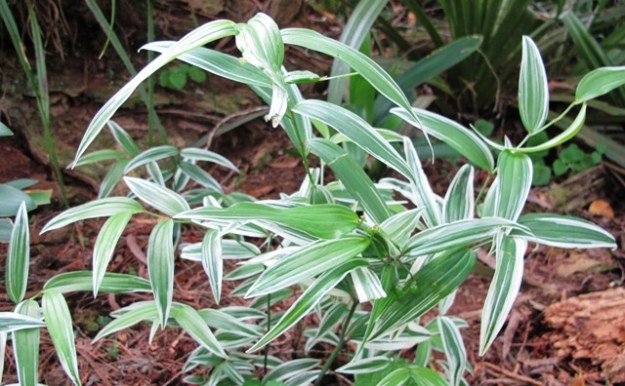
The variegated disporum lit up a dark area but proved altogether too invasive

The variegated disporum lit up a dark area but proved altogether too invasive

That said, in darker areas of the garden, the odd bit of variegated foliage can light up an area. It was for this reason that Mark planted the ground cover that I think is Disporum sessile variegatum. It’s pretty green and white foliage gave a lift in the shade. I have spent the better part of this week weeding it out because, unlike other disporums we grow (‘diaspora’, I keep calling them), this one was scarily invasive. It spread alarmingly, rampantly and through everything. We have retained only one small patch in a confined area. The rest is now in the compost heap. Plant this one at your peril. This variegated form is an exception to the rule in that, for us, it is much strong growing than the others we grow.

Farfugium tussilagineum argenteum looks good in shaded areas

Farfugium tussilagineum argenteum looks good in shaded areas

Other variegated shade plants we use – but in moderation – is a white edged form of Soloman Seal, a yellow striped renga renga lily (arthropodium), a handsome variegated crinum, farfugiums (which most readers will still know as ligularias) and, of course, hostas. But not all together. The secret to using plants with variegated foliage is to set them off with plenty of block-coloured foliage.
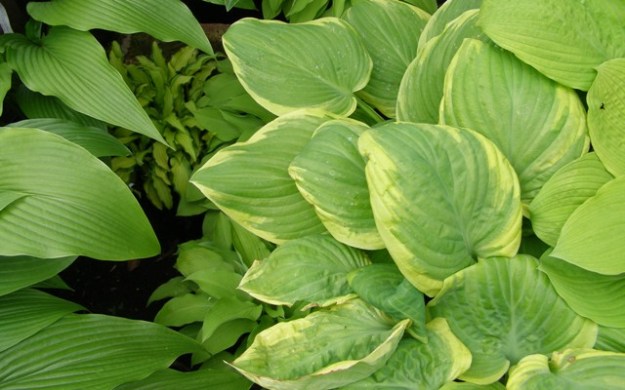
Offset variegated hostas with other plain coloured varieties for best effect

Offset variegated hostas with other plain coloured varieties for best effect

Nowhere is this more apparent than with hostas. Too often, people will only buy the fancy, variegated ones and I have never seen a good planting of a variegated hosta beside other variegated hostas, all different. But take the same hosta and put it beside some plain coloured foliages and it can add zing and star in its own right.

Most variegated plants lean to the “Look at me! Look at me!” sort of statement. If you are going to grow variegated plants, make sure that you use them so that they are the feature they want to be and don’t sit them alongside a medley of other plants also demanding to be the star. That becomes a jumble.

First published in the Waikato Times and reprinted here with their permission.

Garden Lore

“The moment trees are in bud and the soil is ready to be worked, I generally come down with a crippling muscular complaint as yet unclassified by science. Suffering untold agonies, I nonetheless have myself wheeled to the side line and coach a small, gnarled man of seventy in the preparation of the seed-bed. The division of labor works out perfectly; he spades, pulverizes and rakes the ground, while I call out encouragement and dock his pay whenever he straightens up to light his pipe. The relationship is an ideal one, and I know he will never leave me as long as the chain remains fastened to his leg.”

S. J. Perelman Acres and Pains (1951).

Following an association of ideas from Collector this week, if you want to camouflage something in your garden, colour it matt dark-charcoal or black. The eye passes over it without registering it because the colour recedes into the background. Too often, gardeners think that if you paint something green, it will meld but it is very easy to get the wrong shade. Blue greens tend to stand out in the garden (which is why glaucous or blue foliage is often prized), yellow greens can look a bit yuck and there are some ghastly synthetic-looking greens. I saw friends get it wrong with a green fence which really, they should have painted black. It stood out like a sore thumb when they wanted it to merge discreetly into the background.

The same goes for plant ties, permanent stakes, supports, ugly tanks or even trellis screening – anything that is necessary but you don’t want to notice. Just don’t go for a high gloss finish.

First published in the Waikato Times and reprinted here with their permission.

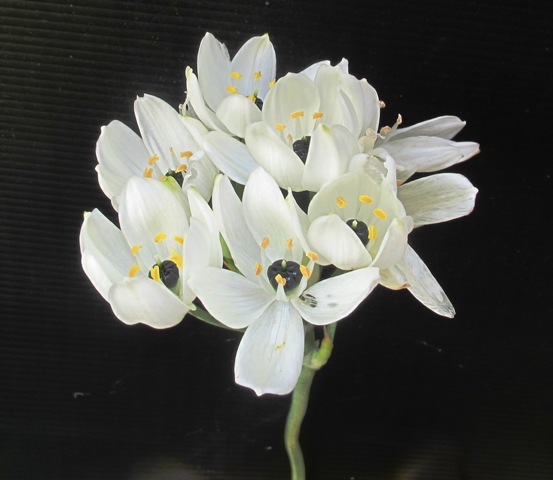
Plant Collector: Ornithogalum arabicum

The lovely Ornithogalum arabicum

The lovely Ornithogalum arabicum

I am so delighted to see several of these in bloom in the rockery this spring. I planted flowering sized bulbs a few years ago and they failed to reappear for probably the last two seasons. I assumed they did not like our conditions but apparently they will, upon occasion, bide their time.

Sometimes known as the Arabian star flower or the Star of Bethlehem flower (this may depend on whether one is Islamic or Jewish, maybe?), I have also seen O. arabicum referred to as a black-eyed Susan although that is more commonly ascribed to rudbeckias. Whichever, each lovely, creamy white flower looks as if it has a black bead in the centre, surrounded by soft yellow stamens. The foliage appears to die off as the flower comes and it sits at about 30cm high, without needing staking – just the right height to sniff the pleasant fragrance. It is reputed to be good for picking but I will need a whole lot more in the garden before I’m willing to cut them.

This particular ornithogalum comes from the Mediterranean area so is going to be happiest in full sun with well drained conditions. Other species come from Europe and South Africa and they all belong to the order of hyacinthaceae. Believe it or not, there is a Facebook page for O. arabicum which has some lovely photographs though only 73 “likes” as one says in Facebook parlance.

First published in the Waikato Times and reprinted here with their permission.