Why viburnums send a shiver down Mark’s spine

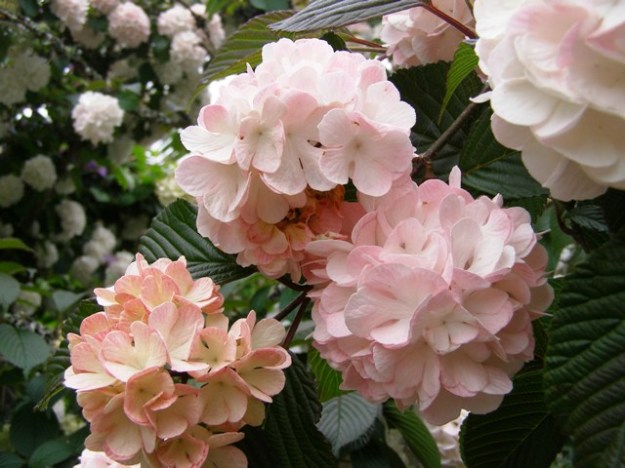
Viburnum plicatum 'Roseace' - pretty as a picture

Viburnum plicatum ‘Roseace’ – pretty as a picture

In times gone by, we used to retail plants from here seven days a week for much of the year. My Mark was a reluctant retailer at best, though his plant and gardening knowledge is immense and he was perfectly capable of giving good advice if he liked the visitor. Alas, too often he would comment wryly: “That was one who put the cuss into customer”. He certainly never subscribed to the view that the customer is always right.

The mere mention of viburnums sends a shudder down his spine, even after a fair few years. A couple came in asking for Viburnum plicatum ‘Mariesii’ which they had seen growing in a prestigious garden. Mark checked that they understood this was a white lacecap variety and they assured him they knew what it was. Turned out they had no idea at all. Some time later, when the plant came in to flower and was not the common white snowball bush, the husband dug it up from the garden, put it in a supermarket bag and brought it back wanting a refund. He’d probably only paid $15 for a big plant of it. It was of course correct to its descriptive label (we take pride in such matters) and a fine specimen but it just wasn’t what he thought it would be. It is a bit like opening a packet of lollies, tasting one and then expecting to return the open packet many weeks later because you didn’t like the flavour.

I felt sure ‘Mariesii’ should be in flower for me to photograph – it is a beautiful big white lacecap flower on a large shrub with fresh green, pleated foliage and it tends to grow in layers like a cake. Mark and I agreed we must have it planted somewhere. We just can’t quite remember where. That is the problem of a big garden lacking records. It will have to wait in anonymity until we stumble over it again.

What started me thinking about viburnums were two plants which are looking particularly striking this week – ‘Roseace’ and one with the difficult name of V. sargentii ‘Onondago’. It took me a while to commit the second name to memory.

‘Roseace’ (sometimes ‘Rosacea’) is the pink form of the classic pompom viburnum, which is usually the form known as V. plicatum ‘Sterile’, or the Japanese snowball. It is a sport which was sold widely two decades ago and it forms a large, deciduous shrub to over 2 metres tall with an abundance of pretty, peachy-pink snowball flowers. That is at its best. Being a sport, it can revert to the more dominant white. We found this to our cost when we propagated a fair number from our main plant and then had to wait until they all flowered because only some of them came pink. Mark went through the original plant and pruned out all the white sections a few years ago but I see it is rather patchy pink and white again, though nevertheless very pretty and showy.

V. sargentii 'Onandago'

V. sargentii ‘Onondago’

‘Onondago’ is different, being narrow and upright. Its fresh spring foliage comes out deep maroon and lacecap flowers (like flat hydrangea blooms) have the tiny fertile flowers in deep red in the centre, surrounded by a ring of larger white sterile flowers. It is a selection out of the US National Arboretum in Washington and, being a seedling not a sport, it is very stable.

Viburnums come from a large family with over 150 different species identified. Most are from the temperate areas of the northern hemisphere so are generally hardy and are of the shrub/large shrub/small tree type. There are evergreen, semi evergreen and fully deciduous species. I am pretty sure it was the evergreen V. tinus I saw grown quite widely throughout Hamilton making a small tree that flowers in spring.
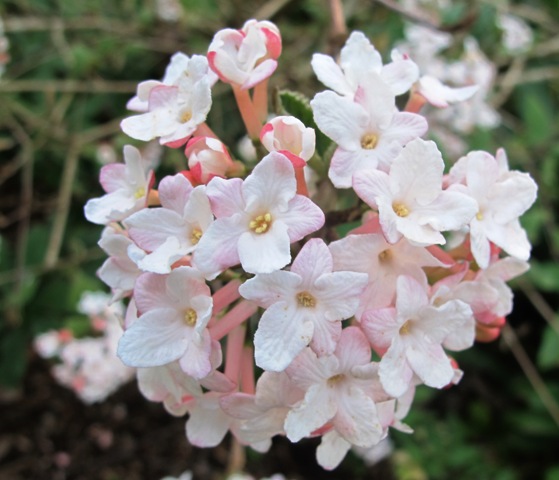
Balls of delicious fragrance from one of V. carlesii hybrids

Balls of delicious fragrance from one of V. carlesii hybrids

Earlier in the season, we had the somewhat short-lived delight of the waxy, fragrant balls of a couple of different ones. I am pretty sure they were ‘Anne Russell’ and x carlcephalum – both are hybrids from the Korean species of V. carlesii. We have them planted beside the driveway and the scent is easily as strong as a good daphne with more spectacular flowers, though their season is much shorter.

Most viburnums are very easy to grow, being not at all fussy about soils and conditions. They are a bit of an unsung hero, really, making good backbone plants which star when in flower and behave themselves for the rest of the year. Some of the deciduous varieties also give good autumn colour in inland or colder climates.

Just try and find out what you are buying before you plant it and don’t expect to dig it up and return it bare rooted because you made a mistake. Mark might have been more understanding over the ‘Mariesii’ had the customers been a little less know-it-all at the time of purchase. Instead he was intensely irritated, scarred now by the memory.

First published in the Waikato Times and reprinted here with their permission.
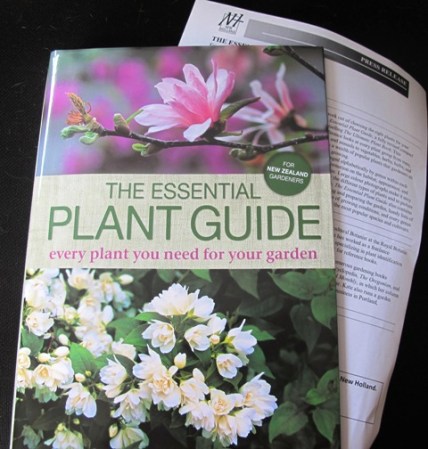
The Essential Plant Guide

???????????????????????????????The subtitle of this large book is “Every plant you need for your garden” and the cover, presumably generated specifically for the NZ market by the publisher and the NZ distributor, New Holland, boldly states “For New Zealand Gardeners”. It isn’t. The authors are Australian and American and the text has not been adapted for NZ conditions which are very different. Including plants like meconopsis (which will seed down and naturalise, don’t you know?) and trilliums as great garden plant options is problematic. There are reasons why you don’t see many crepe myrtles (lagerstroemia) growing in this country (they need hot, dry summers) and cornus are not great in the mild north and mid north. Arisaemas – we know quite a bit about arisaemas here. A. sikokianum is incredibly difficult to keep going as a garden plant but that is at least better than the recommendations for some which we think aren’t even in this country. Recommended camellia and rhododendron varieties are often (mostly?) ones more popular in the authors’ home countries and are not the NZ market choices. I would not be sure that they have all been imported to NZ, let alone in production.
It is a nice looking book which runs to over 800 pages. There is a double page spread on most genus, cheapened by the ubiquitous “Top Tips” which sometimes aren’t. The organisation into sections (trees, shrubs, fruit trees, cacti and succulents, orchids etc) makes it a little clumsy to use. Ferns are lumped with palms and cycads.

The bottom line is that a book for NZ conditions would take into account what performs here and what is available here. This is just a generic plant reference book with no specific application to gardening in this country.

The Essential Plant Guide by Tony Rodd and Kate Bryant (Global Book Publishing; ISBN: 978 1 74048 035 2).

First published in the Waikato Times and reprinted here with their permission.

“There is a dangerous doctrine – dangerous because it precludes endless gardening pleasures – that every plant in the garden should be disease-free, bug-free, hardy to cold, resistant to heat and drought, cheap to buy and available at any garden center.”

Henry Mitchell Henry Mitchell on Gardening (1998)

073
The gardening basket

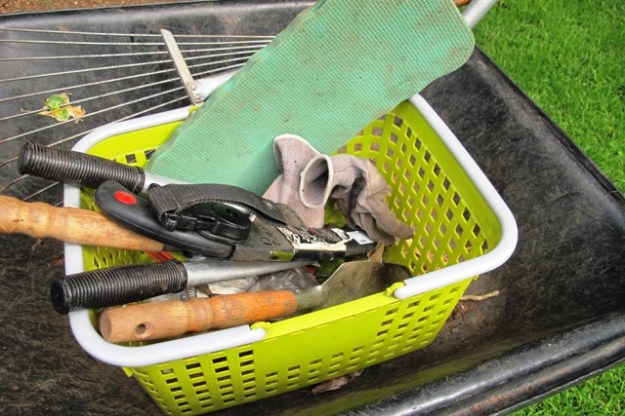
As we feel the intense pressure of getting our garden all groomed for the busiest 10 days of the garden visiting year here, I was thinking how very useful is my gardening basket. Not for me the style of a pretty willow or cane basket or the tradition of the wooden trug – the former is not going to like getting wet while the latter is heavier. I am afraid mine is utility Warehouse plastic, but invaluable nonetheless. I can almost always find my trowel, secateurs, pruning saw, Wonder Weeder, lawn weeder, kneeling pad, garden gloves and other accoutrements because I just toss them into the garden basket and cart it around with me. When I have finished for the day, I put the basket in the barrow and wheel it into the carport ready for the morrow. Being plastic means I can hose it out when it gets grungy. The only drawback is that this means the two men in my gardening life can also find my gardening tools any time they want to borrow something. One returns them, the other does not always return them to the same place.

A gardening basket may be a thoughful gift for children to give a gardening grandparent or mother.

First published in the Waikato Times and reprinted here with their permission.

Plant Collector: Ranunculus cortusifolius

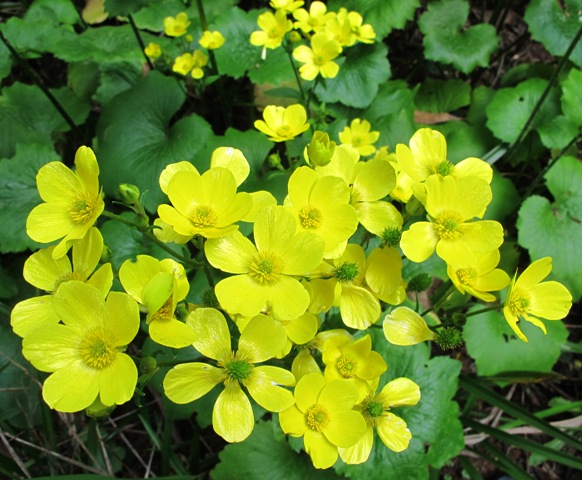
Not the ordinary field buttercup, Ranunculus cortusifolius

Not the ordinary field buttercup, Ranunculus cortusifolius

I am guessing that some readers may look at the photo and sniff about common old buttercups. Yes this is a buttercup, but not the nasty, weedy one even if the flowers may look similar. There are hundreds of different ranunculus (or should that be ranunculae?) and quite a few of those are what we call buttercups. This species is highly prized as a garden plant, as long as you aren’t offended by the extremely bright yellow flowers. It hails from the Azores and Canary Islands, sitting in the ocean between North Africa and Western Europe. The online references talk about it being perennial. We would describe it more as biennial, similar to a foxglove. It seeds down gently and in the second year it flowers. The plants are fully deciduous, going dormant and dying off in early summer and returning into growth by early winter. This is usually the pattern of plants triggered into growth by autumn rains.

The foliage is soft and not dissimilar to cineraria, though oft described as maple-like in shape. And yes, you can play the game from childhood of “do you like butter?”

First published in the Waikato Times and reprinted here with their permission.

About tanalised timber in the veg garden…

Our bean frame - it's hard to avoid tanalised pine in the veg garden

Our bean frame – it’s hard to avoid tanalised pine in the veg garden

Living rurally, the stream of free farming newspapers descending into our letterbox seems never ending. I cannot say we read them from cover to cover, but it is surprising how much interesting material is in these publications. It was ‘Straight Furrow’ that yielded this week’s most interesting article. It was about a project looking for hard wood alternatives to tanalised pine.

The timber production of this country, based as it is on Pinus radiata, derived from a forestry project started way back in the 1870s, trialling various options. Clearly the pine was the stand out performer and work has been ongoing on selecting the best characteristics for plants which are to be commercially cropped. Modern plantation pine is a somewhat different tree to the gnarly old pines sourced originally from Californian and then Australian seed sources. The use of pine as a building material is a boon for what little is left of our native forests, though we are guilty of plundering the hard woods of Asia instead – especially when it comes to outdoor furniture and more upmarket decking.

The pine we use is grown very quickly and is soft as a result. To get any durability outdoors, it is treated by tanalising it in a solution that contains chrome, copper and arsenic. There is now a quest to find quick growing hardwoods as an alternative and some of the eucalypts look extremely promising.

What does this have to do with gardening? The impetus for this research was, apparently, the discovery of arsenic in the Marlborough aquifer back in 2003. In this case, it was not a cause for panic. That arsenic was occurring naturally and not a danger to health. But, as an aside to that particular study, elevated arsenic levels were found in the soils. These were linked to the use of tanalised posts. When you think about it, we use gazillions of tanalised posts in this country, many of them treated to an advanced level so that they are durable in the ground. There is a scary thought.

It appears that those readers who ask whether it is safe to use tanalised timber in the vegetable garden are indeed asking a valid question. It is pretty difficult to avoid when you think about it. The planks many people use to avoid compacting soil when walking between rows are likely to tanalised. The waratahs often used to stake tomatoes, the poles to build the bean frame… but especially the sides of raised vegetable beds. Yes, apparently these do leach toxic chemicals into the surrounding soil. And plants are very good at absorbing heavy metals, especially leafy greens like vegetables.

It appears that some within the wine and kiwifruit industries are very keen on non-tanalised hardwoods as an alternative. Both these producers have extensive need for wooden growing frames. Organic farmers and growers are also anxious.

I have not read that it has been proven beyond any doubt that anyone has suffered from ill health or death as a result of secondary contamination from tanalised timber. It is your call entirely as to whether you consider it is a risk worth taking. It appears that different people respond differently to chemical poisoning. An anecdote about somebody who lived to a ripe old age despite an extremely careless attitude to sprays is not proof of safety because it may be that the next person suffering multiple allergies is a result of very little exposure.

Presumably the leaching of chemicals from tanalised timber slows down as it ages, so if you are using some near edible crops, look for the old stuffveg.

Heart macrocarpa is probably the most suitable alternative to tanalised pine at this stage, though it will rot eventually. The eucalypt alternatives being researched are offering maybe 25 years without being treated but the research project has a way to go yet.

For the record, the article referred to is in the October 15 issue of Straight Furrow, page 11, headed “Hardwood project promises billions”, written by Jon Morgan. The sad point of that story is that they just missed out on $3 million dollars of government funding because they were not able to guarantee that the project would earn $200 million dollars in exports by 2030. It is a fairly sad comment on the nature of government funding for research. It seems an exorbitantly high bar to set for a modest contribution, but the project is continuing. Imagine some of our pine plantations replaced with eucalypts. That would change the landscape.

First published in the Waikato Times and reprinted here with their permission.