Tulips, but not from Amsterdam

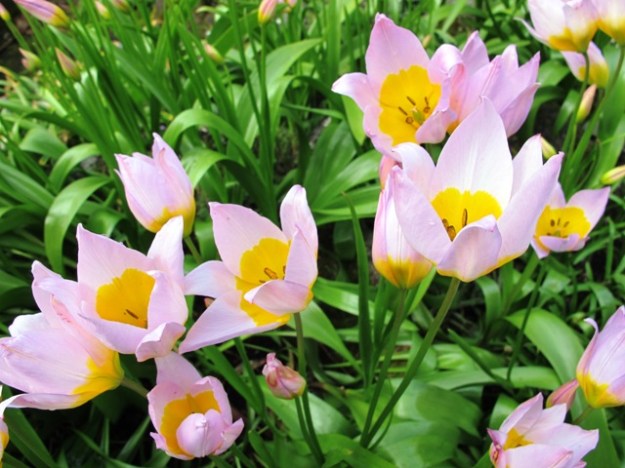
Tulips from Crete - T. saxatilis

Tulips from Crete – T. saxatilis

Tulips. They are Dutch in origin, aren’t they? Well no. The original tulips are no more Dutch than I am, but the modern hybrid tulips largely originate from the flat home of dairy, dykes, windmills and clogs. And in a love affair spanning 450 years, the Dutch have made this plant family their own.

We don’t grow many tulips in our own garden. The showiest by far is a tulip from Crete – T. saxatilis. Most people are surprised to find that there is a tulip from that Greek island because, after all, tulips come from Holland, do they not? In fact the species in the wild – and there appear to be somewhere between 70 and 100 different species recorded – do not originate from anywhere in Northern Europe. Instead, stretching from Southern Europe, through Northern Africa, the Middle East and spreading overland from Turkey to north western China, tulips have a wide territory. Many of them favour mountainous areas with hot, dry summers and cold winters and therein lies the hint to the problems people can have with getting the modern hybrids to flower past the first season in their garden. Most need a much greater winter chill than we can give them here.
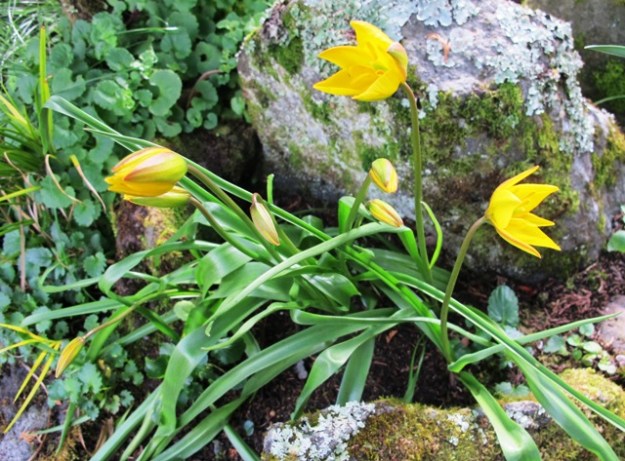
Some species - we just don't know which one

Some species – we just don’t know which one

We have three different tulips in the garden. The Cretan species is wonderfully easy-care and increases gently and reliably. I love the unlikely contrast between the lilac pink and bright gold. Then we have a pure yellow one which is inclined to nod its head. Mark thinks it may be a hybrid, not a species, though I am unsure of how he reached this conclusion. It never increases but it does at least return each year. And we have a small flowered, small growing species of unknown origin. Charmingly understated, might be the descriptor.
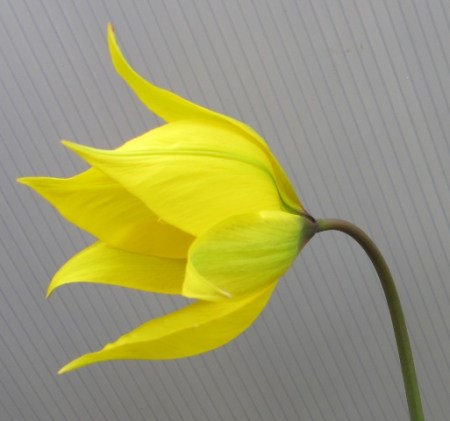
Indubitably tulip, but we have no name on it and it never increases.

Indubitably tulip, but we have no name on it and it never increases.

I am not the world’s greatest fan of modern tulip hybrids but concede I am in a minority. I have toyed with the idea of bulk buying bulbs of one or maybe two selected cultivars to drift through areas of the garden. A swathe of pure white tulips or maybe clusters of a deep wine colour might add to the early spring herbaceous plantings even though they may be a little clichéd. But I prefer to spend money on bulbs which have a life-span beyond just one season. I can’t bring myself to treat tulip bulbs as a disposable commodity. It seems a shocking waste of money, resources and effort.

I was a bit surprised to find that even in the UK, tulips are often treated as annuals because their repeat performance is patchy at best, despite the fact that their winters are much colder than ours. Tulip bulbs are much cheaper to buy there which may be a factor.

It is not that these hybrids all die after flowering for the one season. They just decline and flowering diminishes considerably in subsequent years unless you go to the trouble of lifting them, separating the offsets, chilling them and replanting in fresh ground. That is a lot of effort. Holland apparently produces fresh tulip bulbs by the billions each year, so I guess there is an insatiable demand from people who do keep replenishing supplies.

The early variegations and novelty breakthroughs were almost certainly caused by virus which, while giving variety, also weakens the plants over time. Nowadays, the variegations are the result of genetic breeding and selection, and considerable effort has been made to get rid of the debilitating viruses. Most of the modern hybrids descended originally from T. suaveolens, which we do not have in our garden here.
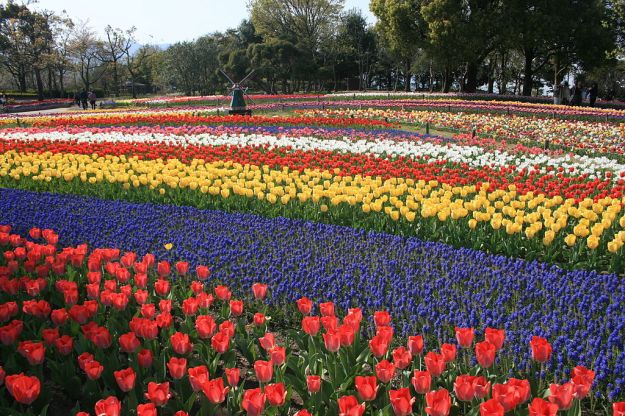
I went looking for a photo of tulip fields in Holland and found instead this one of tulip fields in Japan, pretending they are in Holland!

I went looking for a photo of tulip fields in Holland and found instead this one of tulip fields in Japan, pretending they are in Holland!

The history of tulips is fascinating but not without debate. The earliest cultivation of tulips was apparently recorded 1000 years ago in Persia. How and when they arrived in Northern Europe is disputed, but they appear to have been taken there in the mid 1500s. By 1637, what is now called “tulip mania” had hit Holland. Single bulbs could command fabulous prices – reportedly as high as 10 times the annual income of a skilled craftsman. But it was not just the wealthy plant collector who coveted these flowering plants. They had become an investment commodity, priced way beyond their actual value. This extraordinary situation has received a lot of attention because it was the first recorded instance of rampant, economic speculation on a product but there is ongoing debate about the extent and the detail. Economic data from 1637 is always going to be a little sparse and sometimes unreliable. Whatever, it makes a good story and “tulip mania” has entered the lexicon as a term for a freakish economic bubble, such as the sub-prime mortgage bubble in most recent times.

Going back to garden plants, in their simplest form tulips are generally cup-shaped and can face upwards or downwards. Essentially they all have strappy foliage and while it looks as if they have 6 petals, botanically they have 3 petals and 3 sepals. Ten times an average income seems an awful lot to pay for one of those.

First published in the Waikato Times and reprinted here with their permission.

Plant Collector: Daphne genkwa

Daphne genkwa - as lovely as a flowering shrub can be

Daphne genkwa – as lovely as a flowering shrub can be

We only grow a few types of daphne in gardens although there are many more known species. Most are grown for their fragrance, rather than any spectacular display. D. genkwa is different. Once established, it is as spectacular as any flowering shrub in the garden and in a most unusual hue of lilac blue. Because it is deciduous, all you see in late winter or early spring are arching branches smothered in the prettiest of displays. The individual flowers don’t even look like the usual daphnes, being larger, more delicate and of different form with a long corolla or tube.

What it lacks is a strong scent. In fact I didn’t realise it had any scent at all until I put my nose right amongst the flowers. This one is grown for its looks. Genkwa is renowned for being difficult to propagate so is not widely available. It is generally done from root cuttings. If you can find one, plant it somewhere with plenty of space to grow – maybe two metres all round to accommodate its arching growth. I killed an established specimen by trimming it after flowering one year so the replacement plants, bought at some expense, will be left entirely to their own destiny. It has fine, light foliage so when not in flower, is just an anonymous border shrub.

First published in the Waikato Times and reprinted here with their permission.
Garden lore

I never had any other desire so strong, and so like to covetousness, as that one which I have had always, that I might be master at last of a small house and a large Garden.

Abraham Cowley The Garden (1666)

“There is a psychological distinction between cutting back and pruning. Pruning is supposed to be for the welfare of the tree or shrub; cutting back is for the satisfaction of the cutter.”
Christopher Lloyd The Well-Tempered Garden (1973)
018 (3) Garden lore – spring pruning

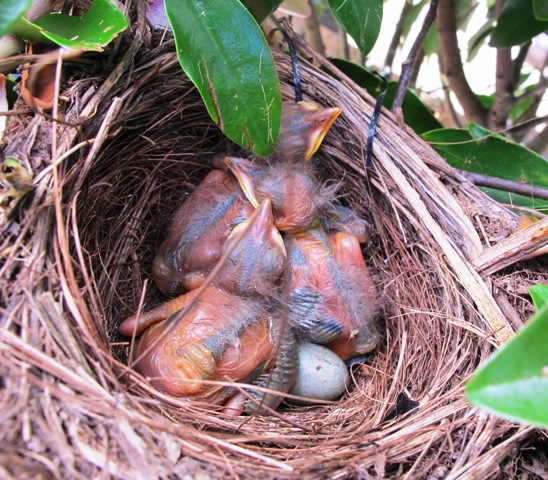
With spring now officially here – unofficially it arrived some weeks ago for many of us – it is the last call for hard pruning and clipping. The birds will be starting to nest and if you leave it any later, you will be carrying out the ornithological equivalent of mass infanticide. In addition to that, the sap will be starting to rise and it is generally better to prune when the plant is in a dormant or near dormant state. Grapevines in particular must be pruned right now. They weep for ages after pruning if you do it too late.

My definition of pruning and shaping is anything that requires a saw (be it a hand saw or chainsaw), loppers and secateurs. Hedge clippers, line trimmers and snips see you in the territory of clipping and shaping. If you are using a line trimmer on hedges or bushes in spring, do a check for nests first. Those mechanised tools are unforgiving and indiscriminate once they are going.

Raspberries and apples should also be pruned without delay.

First published in the Waikato Times and reprinted here with their permission.

Descending into farce: Tikorangi Newsletter no.4

Tikorangi-Butter-paperTikorangi Newsletter 4, Tuesday 10 September
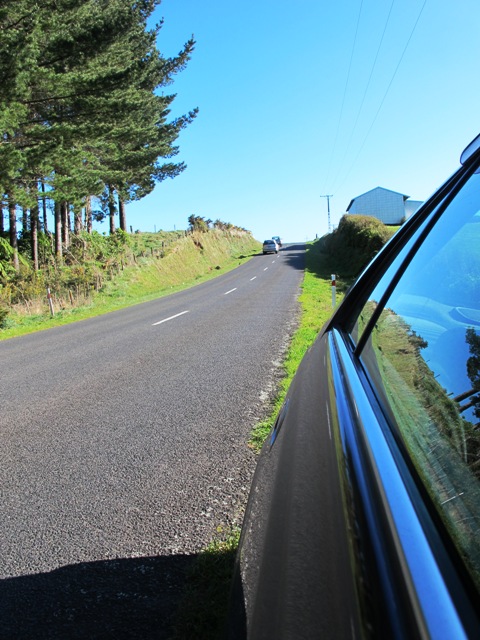

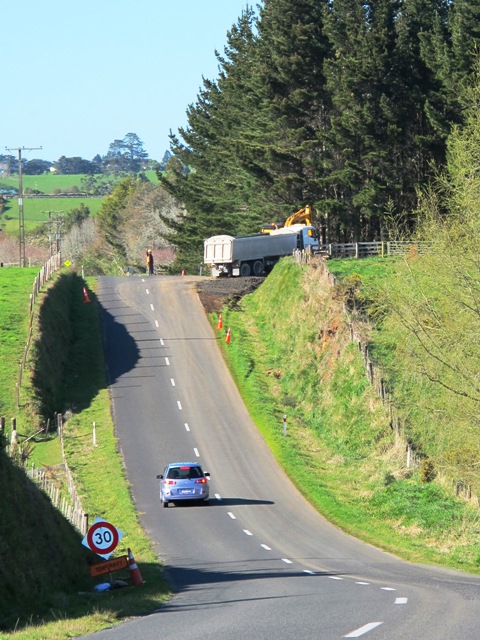
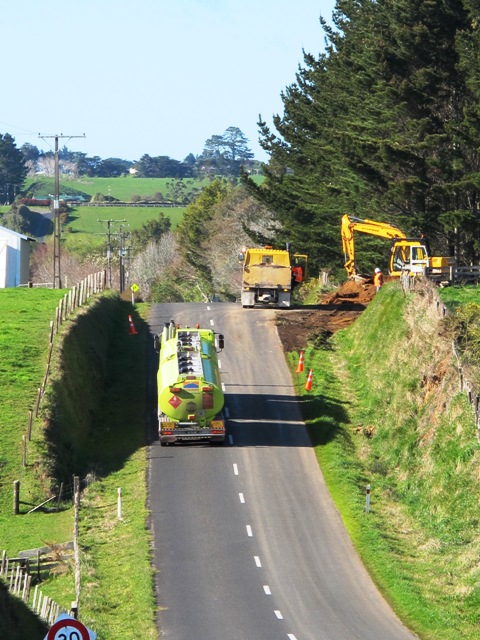
Plenty of road signage was in place at 10.31 on Friday 6 September when work had commenced

Plenty of road signage was in place at 10.31 on Friday 6 September when work had commenced

Music_quote_icon

“Ooh, I bet you’re wondering how I knew

About your plans t’ make Greymouth blue.

Well I heard it through the grapevine

How you remove their road signs

Oh, I heard it through the grapevine”

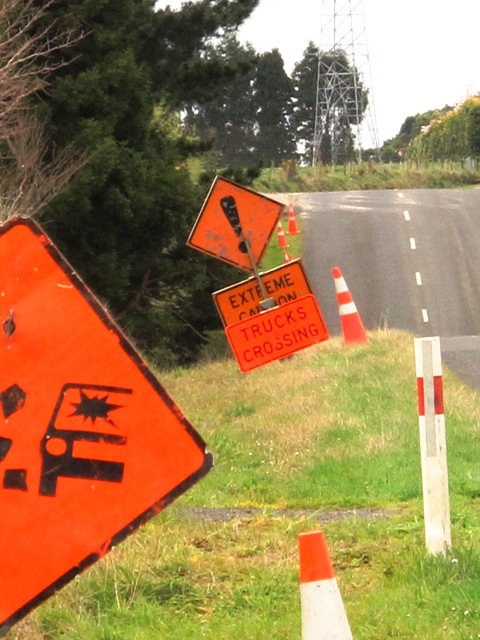
* Now Tikorangi residents, it is not the fault of Greymouth Petroleum or their contractor that people are “removing” the warning signs from the entry to their new Kowhai C well site. These photographs, taken after smoko on the very day they started work clearly show that there is a full complement of safety signage in place at that time. Since then, our roading man at Council has been told from a most reliable source, “on the grapevine” as he says, that safety signs are “being removed”. This is a matter of public safety and it may be that those alarmist residents who have been in contact with Council expressing concern at the safety of that entranceway have decided to make it even more dangerous by removing signs. Obviously. Seems logical to us here at NPDC. sad_smilesad_smile

Plenty of warning signage coming from the other side at 10.20am on Friday 6 Sept

Plenty of warning signage coming from the other side at 10.20am on Friday 6 Sept

* And the mayor is not pleased with some of you at Tikorangi. You may have heard him on the 10am news bulletin on National Radio today. My, but he made us proud here back in the office. You will be proud too, to hear that it is only a very few people in Tikorangi who are not thrilled with the new Kowhai C site. The vast majority are very supportive of your mayor, your council and Greymouth Petroleum. Very few indeed object and they are spoiling it for all those of you who think that site is perfectly placed. So to the 85 of you who turned up to the first meeting in the Tikorangi Hall on March 5 and bleated about your concerns, to those of you who turned up in our Council chambers to “support” your speakers on April 23 and again on June 11, to those fictional 80 people who signed the letter you gave us opposing that site (75 of you allegedly being residents or landowners around the immediate block of Kowhai C), to Otaraua Hapu and to those of you who have been hounding us with emails, phone calls and personal visits all year, we say “back off”. You are just a small minority so you don’t count. Your mayor has spoken. And by the by, he is hopping mad at the news (heard down the grapevine, too) that some of you are now referring to him as Rumpelstiltskin.sad_smilesad_smilesad_smile

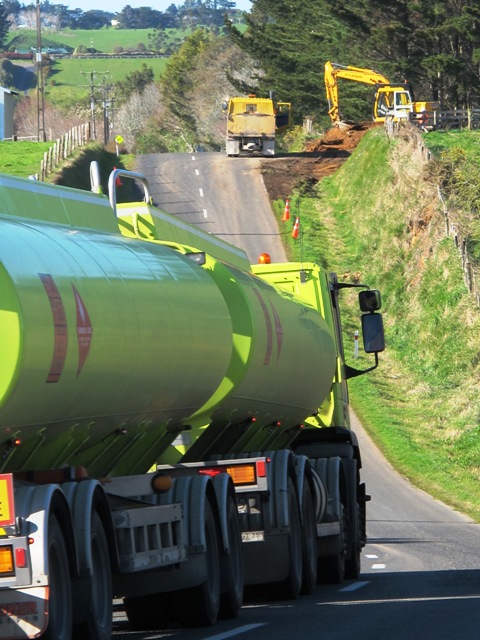
* Just to clarify the situation with regard to the well site entrance: what is happening now is “construction” and is therefore NOT a controlled activity. When all this frenzy of construction activity is pretty much over in a month or six weeks, only then will the company and Council start on widening the road and making the entranceway safer. Because that is how we operate here at NPDC.

* We are not going to say nga mihi to everybody in Tikorangi. We are not best pleased with you sad_smile and we are hoping for an improvement in behaviour shortly. Under the new legislation passed by central government, we have been able to pass on certain key names to the GCSB and we expect that they will shortly be conducting raids on certain Tikorangi terrorist cells in search of Greymouth contractor’s missing road signs.

* sad_smileDon’t make us sad, Tikorangi. We want smiley faces on our next newsletter.

Tikorangi-Butter-footer
13th September. My but what a difference a few days can make. Look at all the signage and road cones that have appeared. Were the “removed signs” returned?

And 3 days later: look!

And 3 days later: look!

  • Tikorangi Newsletter 3 (including my letter to NPDC).
  • Click here to read the second issue of your Tikorangi News.
  • Click here to read the first edition of your Tikorangi News.

The following letter is reproduced with the permission of the writer. Gavin Faull is managing director of Faull Farms Ltd – Trewithen Partnership with land adjacent to the Kowhai C well site. His email was sent to the mayor and councillors on Tuesday September 5.

Dear Harry,

Like (Otaraua Hapu), like my fellow Tikorangi residents, I too am shocked, disappointed, bewildered at the behaviour of council and the complete ignoring of the concerns of the Tikorangi residents.

I will not repeat all the issues that have been presented over the past months.

I am totally dismayed that

1. No consultation is required with the people of Tikorangi
2. There are no affected parties regarding Kowhai C
3. That we gamble with the future of our agricultural industry and our environment.

We have seen what happened to Fonterra’s reputation in China over a relatively minor “dirty pipe” episode

This was the third scare for Fonterra which represents 25% of the NZ economy.

The environmental risk is huge if there are not very, very strict controls in place, legislated and policed. There seems to be huge difficulty to even monitor traffic movement in Tikorangi – a relative simple process. How are we going to monitor and manage toxic waste?

You know that Fonterra is reviewing very carefully milk collection from land farms in Taranaki and has already advised that no new land farms can supply milk to Fonterra. This is clearly signalling concern by Fonterra.

What is my protection regarding possible toxic contamination with my dairy farm immediately adjacent to Kowhai C?? Am I not an affected party?? I can assure you that if this becomes an issue and Fonterra refuses my milk production then I will have a huge compensation claim from all parties – Greymouth; NPDC,TRC and all executives and members of management of all these companies and organisations who have been charged with the responsibility of professional management. The liability potential would be huge.

As you know I am all for progress. I have been involved in many business developments in Taranaki that have positively helped the economic growth of Taranaki.

I am not for stopping economic development.

I am just amazed at the total lack of management and the enforcing of responsible environmental controls.

Government is elected to represent the people and protect the people.

The concerns of the Tikorangi residents will not go away.

Regards
Gavin

Gavin M. Faull, JP
Managing Director

Tikorangi News 3: September 8, 2013

Tikorangi-Butter-paper

Hi de hi, campers!

Welcome to the third edition of Tikorangi News. Matters are unfolding so rapidly in Tikorangi that we at New Plymouth District Council understand that you need to be kept well informed. At Council we understand. We are very understanding. We understand that Tikorangi residents are disappointed that the Kowhai C site is going ahead. We do. We really, really understand.
010
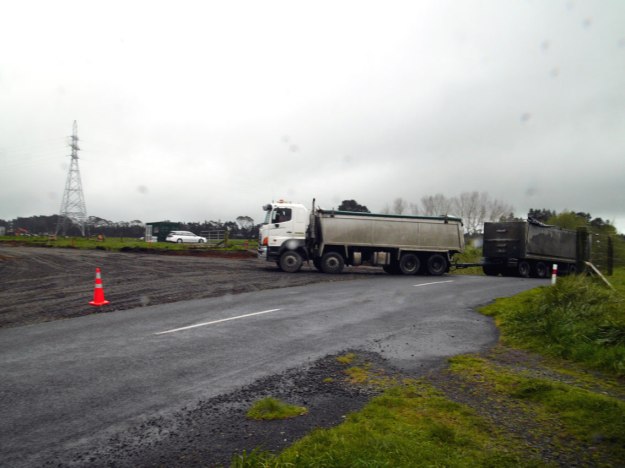
by-school-NgatiMrd-04-09-13 3.49 pm.* Tikorangi folk will be thrilled to see that, like Arnie, Greymouth Petroleum are back! They sure are back. Be reassured that we, here at Council, understand your concerns about safety issues at the entrance to their lovely new Kowhai C site but we are right across safety issues. All of us here at Council are well briefed on their Traffic Management Plan and there is no danger at all. It is perfectly safe.regular_smile
Ngatimaru-Rd-04-09-13--3.45
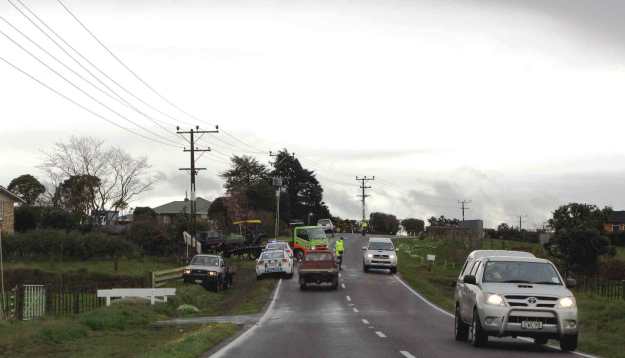
* It is idle speculation that a Greymouth vehicle may have been involved with this minor traffic incident on Ngatimaru Road at 3.45pm on September 4. We understand the lady in the ute who may have been rear-ended is absolutely fine although the ute may not make a full recovery.
011

* Isn’t it wonderful that Greymouth have distributed their newsletter to local residents? It is so packed with handy information and updates so everyone is now really well informed as to what is happening. You will have noted their comment that “We choose sites as far away as possible from residents.” It is not Greymouth’s fault that you Tikorangi folk have your houses too close together. We have reviewed the situations of the neighbours’ houses closest to both Kowhai B and C at 350 metres or less and have concluded, in the most understanding way, that effects will be less than minor and therefore perfectly acceptable. You can trust us to protect your interests. regular_smileregular_smile

* Since learning that they were to get the consent, Greymouth Petroleum’s field staff have been busy as little beavers in the last week visiting local residents. This is called retrospective consultation with the local community. If you haven’t seen your Greymouth rep yet, give them a call. Offering them home made cake and a cuppa is a good way of showing them country hospitality.

021 - Copy* The good folk at Venture Taranaki tell us they are well down the track of preparing their report on the economic benefits to Taranaki of flaring and night lighting sites. Local residents will be well aware that these activities have the positive benefit of lowering their household power bills. There are many other benefits and Venture Taranaki expect to be able to quantify the financial and employment benefits that accrue from the companies’ generosity with flaring and night lighting. Local residents may not realise that a side benefit of flaring is, reportedly, a reduction in flying insects and as a result the risk of a malaria or Ross River virus outbreak in Tikorangi has been greatly reduced.
024
* Some Tikorangi residents have called for a lowering of the speed limit through the area. We have taken this suggestion seriously and sought independent expert advice. Contrary to what local residents may think, the expert advice is very clear that we should be raising the speed limit to 120km/hr. This simple action will result in a considerable lowering of risk because the time taken for heavy vehicles carrying hazardous loads to pass your property will be greatly reduced. We will be gazetting the new speed limit shortly and new signage will be posted.

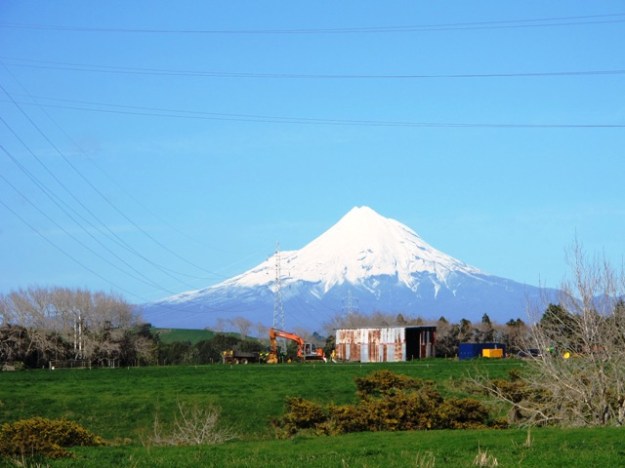
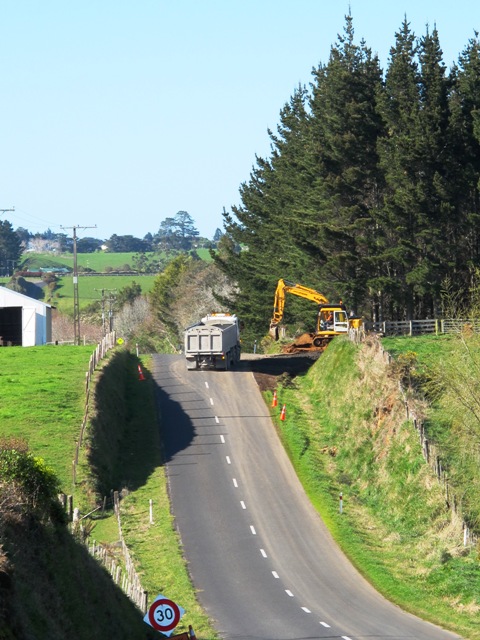
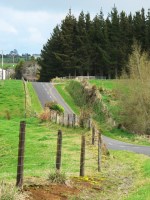
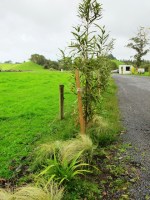
???????????????????????????????* Even we at NPDC have been astonished at just how quickly Greymouth Petroleum have been able to improve your local countryside. It took just one and a half days to change it from this boring and dull country road (shown to the left), into this lovely new scene shown below. You hardly know they are there, do you Tikorangi? This is the incredibly small environmental footprint they have.
Otar-Rd-12.11-pm-07-09-2013

Todd's plantings

Todd’s plantings

Greymouth's pittos

Greymouth’s pittos

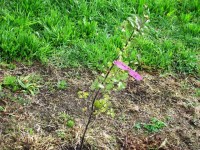
* In the spirit of friendly competition, it is clear that your two local petrochemical companies are actively working to make their sites more beautiful than their rival’s. Todd’s entranceway to their Mangahewa C site features rewarewas with herbaceous under plantings. Not to be outdone, Greymouth have spared no expense and gone for high quality pittosporums along the boundary of the Kowhai B site. That is just the ticket. The companies are going to make sure that Tikorangi is more beautiful than ever.

Mangahewa-C-quarters-march-* sad_smile We have heard a few mutterings that some residents may not be happy about the establishment of a semi-permanent single men’s camp with the access on little Stockman Road. My, oh my, what whingers some people are. Such camps are commonplace in the outbacks of Australia and Tikorangi is just as remote. There haven’t been any problems with the camp at Mangahewa C site and we see its relocation to Stockman Road could be a positive move for the community. And of course if somebody wanted to build a hotel on Stockman Road, we would approve it so a single men’s camp is not so different. What could go wrong?

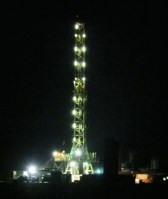
* Residents closest to Mangahewa C who are sad that the last well is to be drilled shortly will be so excited to hear that Todd Energy are planning to drill another four wells there in the near future. Such good news for all. Look upon this as a potential tourist attraction. In the meantime, lucky residents along Tikorangi Road will be pleased to hear that it is highly likely that Mangahewa E will be starting soon and you will get to enjoy the brand new, state of the art drilling rig painted in special colours.regular_smile
005
On that positive note, we conclude. Kia kaha Tikorangi! And if things get you down, raise a smile. At the office, we are running a sweepstake on how many more well sites can be fitted in Tikorangi. There will always be room for more.
Your very understanding team at NPDC.

On-top-of-hill-K-C-
Tikorangi-Butter-footer
Click here to read the second issue of your Tikorangi News.
Click here to read the first edition of your Tikorangi News.

My letter to NPDC councillors, emailed on September 2. It has elicited just two replies. A courteous acknowledgement from Cr Biesek and a classic case of passive-aggressive self justification from a councillor who had best remain unnamed at this stage.

Dear Councillors,

It is difficult to convey the sense of betrayal felt at the news that your Council officers are ready to sign off the Kowhai C site. It will not be going to a hearing. I am assuming there are no affected parties under their interpretation of the RMA. There has been no community consultation.

The Tikorangi community came to you in good faith. The letter signed by 80 adults, 75 of whom live in the immediate block around the Kowhai C site, represented a rare expression of unanimity in the district in opposing that site. But you shelved that letter. Greymouth Petroleum has not even bothered to acknowledge receipt of it.

In good faith, we have spent countless hours working to find paths through the development. After all, we were only opposing one site. We could work with the other 12 well sites (now numbering 95 or so potential gas wells consented or in the process of being consented in Tikorangi with a further possible 17 that I know of – there may be more). There was always the sticking point of Kowhai C but your staff assured us it was “on hold”. Your website still shows it as “paused”.

And all the while, as we sat around the table with your staff and put in a great deal of work behind the scenes, those very same staff were working with Greymouth to repeatedly massage their application for Kowhai C to the point where it is now ready to be signed off. But they didn’t tell us that. The first we knew about it was when work started on the site last Tuesday.

Reassurances that it is for 4 wells only and for 15 years ring hollow. Now that they are in, it is easy for things to change and for later applications to vary the consent, based on existing use. There is already precedent for this at Mangahewa C. Councillors change, staff change. You have opened the door to industrial development in the one block which this community opposed.

What is more, in an historic move, Otaraua Hapu stood in solidarity beside Tikorangi residents to oppose Kowhai C site and told you that this is their territory and they had not been consulted or given their consent. Otaraua tell me that the courts have now confirmed that it is indeed their rohe although Ngati Rahiri have challenged that ruling so it is still before the courts. What is important is that Otaraua Hapu has still not been consulted and council officers have not responded to repeated messages and emails on this matter. Yet you are signing off their territory for heavy industrial development. It appears that no lessons have been learned from history.

All but one of the councillors around your table listened courteously and, I thought, gave us a fair hearing even though some of you showed definite allegiances soon after.

But you did nothing. So Kowhai C is going ahead.

Shame on Council staff. The so-called Tikorangi Protocol was based on good faith and trust. I have neither left.

Yours sincerely,
Abbie