Garden lore

“In fine weather the old gentleman is almost constantly in the garden; and when it is too wet to into it, he will look out of the window at it by the hour together. He has always something to do there, and you will see him digging, and sweeping, and cutting, and planting, with manifest delight…; and in the evening when the sun has gone down, the perseverance with which he lugs a great watering-pot about is perfectly astonishing.”

Charles Dickens, Sketches by Boz

???????????????????????????????

Dealing with large container plants

Woody trees and shrubs cannot be left permanently in tubs and containers and expected to prosper. At some point they will start to go back badly because you have put them into an artificial, controlled environment. While you can extend by regular feeding, there comes a time when you have to repot, which is easier said than done with large plants and heavy pots. Get a large piece of plastic and gently tip the pot over on its side. You may need to support the plant to prevent damage. Then with an old carving knife, start excavating the old potting mix, rolling the pot as you go. This is not usually a three minute job.

Once you can get the plant right out of the pot, remove all the old potting mix that you can. I finish off by using the hose to wash out more. If it is going back into the same pot, you will probably have to trim the roots. Make sure you trim the top as well, to reduce stress on the poor plant. Repot using a good quality potting mix, making sure you get mix all through the plant as well as underneath and around it. Most mixes come with slow release fertiliser already added, in which case don’t add extra. Keep the final level about 2.5cm below the rim of the pot to make watering easier.

First published in the Waikato Times and reprinted here with their permission.

Garden lore

“(Gardening) is not graceful, and it makes one hot; but it is a blessed sort of work, and if Eve had had a spade in Paradise and had known what to do with it, we should not have had all that sad business of the apple.”

Elizabeth, Countess von Arnim, (1866-1941).

002 (2)

Autumn leaves
Most of us are probably at peak leaf fall at the moment. One more strong wind and they will all be on the ground where they will turn uniformly brown and sludgy. Do not think of fallen leaves as a bother but as a resource. Never tell me you burn your leaves.

That is just bad and wasteful. Leaf litter is not as nutritious and balanced as good compost but it has merit and should be regarded as an important part of the cycle of nature.

The simplest method is to use a leaf rake to scoop all the leaves back discreetly under the trees where they can gently break down to humus with the winter rains and microbial action. Come spring time, you can rake them back out to use as garden mulch if you wish.

Dried leaves can be put through a composting process where they count as adding carbon content.

In our vegetable garden, which has a couple of very large deciduous trees which drop a prodigious amount of autumn leaves, we use a simple circle of chicken netting tied together. All the leaves get piled into it and left to decompose. It stops the birds from making a mess of the piles.

It pays to clear fallen leaves out from fishponds. Rotting leaves will increase the nutrient levels, leading to later problems with algae growth and, in really bad cases, can kill the fish by reducing oxygen levels as they break down.

First published in the Waikato Times and reprinted here with their permission.

Stripes, hedges and gardening on the flat

Striped gardening a la Monet (photo: Michal Osmenda via Wiki Commons)

Striped gardening a la Monet (photo: Michal Osmenda via Wiki Commons)

There I was last week, railing against the fad for edging plants everywhere and referencing planting in stripes. We watched a programme which we had recorded on Monet’s famous garden at Giverny. There was his striking central allée and it was planted in long stripes! But beautiful, complex stripes created with painterly style and panache.

I have yet to visit Giverny and I may have trouble motivating Mark to accompany me. Being a New Zealander, he has an abhorrence of crowds and that particular garden is renowned for packing ‘em in. That said, good friends of ours went last year, not expecting to be overly impressed, but they were blown away by it so if we are in that part of the world (an hour or so north of Paris), we will probably go. And admire planting in stripes.

It is probably no surprise that a Frenchman would go with formalised planting. The genre of parterres (regimented planting of colour on formal terraces) is closely identified with the French nobility of old. It was primarily designed to be viewed from upper windows and is essentially using flowering plants as a tool to paint patterns in stylised form, such as we see on fabrics.

Monet used more of a mix and match of colours to get the beguiling complexity we associate with Impressionist art, but if you look at the composition around that central allée, it is still geometric.

The danger is that if you over simplify it, you are more likely to end up with bedding plants arrayed in the style of the old fashioned traffic island or floral clock.

Next up came a programme we had of BBC Gardener’s World where lead presenter, Monty Don, was walking down one of the paths in his garden and lo! There was another garden in distinctive stripes. It was all dead straight. Very tall hedges either side, a middle layer of matched small bushes planted in long stripes inside, edged by buxus with a narrow path between the matched borders. There is something engaging in the simplicity of such a scene, but it is still really like a house hallway outdoors – an access way which you want to lead to somewhere more open and spacious at either end.

David Hobb's garden in Canterbury

David Hobb’s garden in Canterbury

It started a conversation here about creating a garden on a dead flat site with no established trees or structure. That is apparently what Monty Don did and he went with masses of clipped hedges to give form. I saw the same strategy in large Christchurch gardens on the flat. These hedges gave both structure and protection from Canterbury’s winds which can howl across the plains.
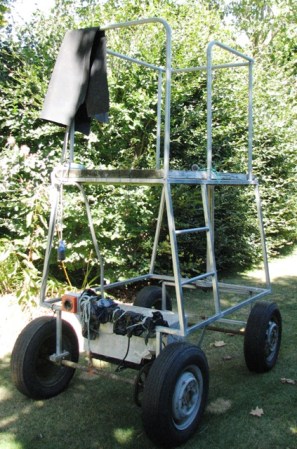
Mobile hedge-trimming platform from Trotts Garden in Canterbury

Mobile hedge-trimming platform from Trotts Garden in Canterbury

Ever practical gardeners, we could see difficulties in the longer term. In order to get good structure, you need to let the hedges grow tall – around the 4 metre mark in large spaces. Formal hedges need trimming at least once a year, more often if you want clean crisp lines. If you get the mechanical hedge trimming contractors in, you have to keep a vehicle path width down either side of the hedge. If you do it yourself, you need mobile scaffolding, a good eye and the determination to get it right. It is not a path we would choose to go down ourselves. There are more fun things to do in the garden than endless hedge trimming. These may not be gardens to grow old in, unless you can afford the labour to carry out the trimming.

The alternative in large flat gardens is to plant good long term trees with sufficient space to grow to reach their potential. They can give the structure and form in the long term and as long as you choose well, they are not going to need anywhere near the regular maintenance of the formal hedge.

Next, on the long, wet weekend, we reviewed yet another of the gardening programmes we had saved. This time it was the UK’s longstanding and vastly experienced garden presenter, Alan Titchmarsh (a refreshingly unpretentious Yorkshireman) with his Love Your Garden series. One episode showed a simply astounding, verdant, lush forest on a very traditional, flat, rear section.

If you have ever seen British suburbia, the British equivalent of our traditional quarter acre section is a narrow plot which is the width of the semi detached or terraced house (in other words, two rooms wide if you are lucky) with a small front area and a longer rear area. This was one of those. I think Alan Titchmarsh said it was 30 metres long but it can’t have been more than 8 metres wide, if that.

The gardening owner had taken this long, thin rectangle and entirely disguised it. The main device was a zigzag wall structure running diagonally across the yard which had then been planted heavily. The foliage hid the wall but that structure turned a blank, open canvas into a much more complex design with different conditions in which to grow plants. Against the odds, there were hidden areas to be discovered and the garden was not visible at any point in its entirety (except, presumably from an upstairs window).

You can take a dead flat, unprepossessing piece of ground and turn it into something surprising and deceptive if you have flair. But then you can take planting in stripes and turn it into something special as well, if you are another Claude Monet.

First published in the Waikato Times and reprinted here with their permission.

Plant Collector: Pyrostegia venusta

Pyrostegia venusta

Pyrostegia venusta

Like a bright beacon from the tropics on a bleak winter’s day, is this somewhat rampant climber with its common name of the flame vine. It is usually associated with Brazil, probably because that is where it was first collected for the west, but in fact occurs naturally throughout Argentina, Paraguay and Bolivia as well. Unfortunately, it is proving a bit weedy in some parts of the world because it can be invasive but there does not seem to be any record of problems in this country. It is frost tender.

It is a member of the Bignoniaceae family, for the botanically minded, and is evergreen. In the wild, it reportedly flowers in the cool, dry season and is pollinated by humming birds. I have long regretted the absence of exotic little humming birds in my life and the fact ours never sets seed may be due to the lack of a pollinator. Given its rampant growth, this is probably a good thing. Ours is growing outdoors against a warm wall and it is a bit of a miracle that it flowers at all, given that our cooler seasons are invariably wet. Photos on the internet suggest that it may be a great deal more floriferous in drier, warmer climates. It does, however, continually stage a takeover bid for the garage and we regularly hack it back. At this time of the year, its exotic flowers remind me of why it is still in the garden here.

First published in the Waikato Times and reprinted here with their permission.

Plant Collector: Monstera deliciosa

Monstera deliciosa - commonly known as the fruit salad plant

Monstera deliciosa – commonly known as the fruit salad plant

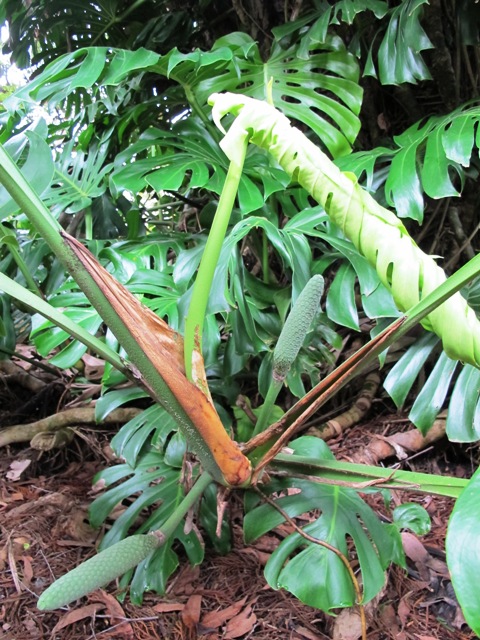
Most people know this as the fruit salad plant, widely grown as an indoor plant though more likely in commercial spaces because they grow quite large. However, it isn’t completely tender and can be grown outdoors as long as it is free of frost or snow. It puts out aerial roots and climbs without doing damage to the host tree. Some of ours are now maybe 10 metres up, giving a luxuriant, tropical effect. Each leaf is about 70cm across and lengthways.

If you look carefully, you can spot the fruit in the photo. There are two green phallic shapes, not to be confused with the unfurling leaf. The fruit is more a curiosity for us than anything else. It takes a year to ripen, at which point the green scales that form the outer casing start to split and peel off, revealing the creamy centre. It is variously described as tasting like a pineapple, jackfruit, mango or banana – in other words, exotic-ish. Because we lack the heat for proper ripening, the natural oxalic acids remain high so the fruit is more akin to eating tropical textured and flavoured fine shards of glass.

Hailing from tropical rain forests of northern South America (Colombia to Mexico), the monstera is a member of the arum family, which is very apparent when you see the hooded creamy flowers. You are most likely to find small monstera plants in the house plant section or if you know of someone with one, a length of stem with some aerial roots will grow away.

First published in the Waikato Times and reprinted here with their permission.