Shaping up michelias

Written for and first published in the Royal Horticultural Society yearbook of the Rhododendron, Camellia and Magnolia Group 2025.

Over our years of experience with the michelia group of the magnolia family – en masse, so to speak – we have learned that we can treat them as we treat camellias when it comes to clipping and pruning in our climate. I italicise those last words because I hesitate to advise gardeners in more extreme conditions.

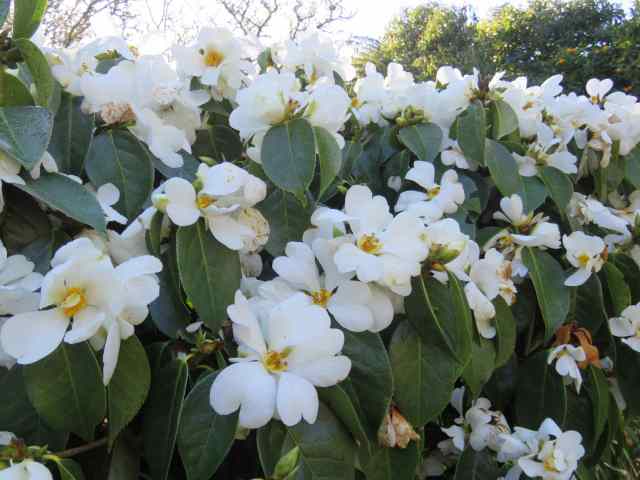
In a world where hardier michelia species are generally white or maybe cream, this is an example of Mark’s breeding programme getting more colour options into the future.

We have a very soft climate. We are never very hot and never very cold, regular rain falls all year round but our sunshine hours are high and we are on friable volcanic soils. If that sounds like gardening paradise, it probably is, as long as you can cope with the wind we get here on the west coast of the North Island of Aotearoa New Zealand.

We also have an abundance of michelias to work with, as a result of my husband, Mark Jury’s breeding programme with the genus down the past 30 years. We have never kept track of the numbers raised here but it will be in the thousands. From those, three have been released under the Fairy Magnolia™ branding; there are two more in the pipeline for release shortly and we are in the process of selecting maybe another three. That leaves many, many seedlings that have been rejected along the way, including entire crosses that he has decided are not worth pursuing. Most get cut out but some we have utilised as screen hedging and shelter belts. There is no shortage of raw material here.

I often claim that we don’t do a lot of heavy clipping and shaping; I have seen Italian gardens and compared to them we are minor players indeed. We do a lot of pruning because our garden is mature and is strong on trees and shrubs which take management down the decades. When it comes to detailed clipping and shaping, it is mostly on camellias and michelias.

Fairy Magnolia® ‘Blush’ soon after planting, circa 2005
And in 2012

We started with Fairy Magnolia® ‘Blush’, planted twenty years ago in front of our brick wall. These were original stock plants grown in large containers in the nursery so they went into the ground with big root systems. We gave them a season to get established and then started shaping to lollipops. They have grown a little larger over the years but not hugely so. Every spring, as flowering finishes, we clip them hard, removing somewhere between 30% and 50% of their foliage.

Pruning in 2013. We remove more these days to keep them to size.
More or less frozen in time by 2020. The untrimmed section on the plant in the foreground is to allow the blackbird babies in a nest time to fledge and fly. We try to avoid ornithological infanticide – a hazard of early spring pruning.
We clip for future blooms so we only clip once a year, as they finish flowering. By the end of summer, they can be a bit woolly in appearance but if we cut again then, we would be removing many of the flower buds. If you want a sharp form all year round, don’t start with plants you want to flower well, at least not michelias or camellias. We use secateurs to trim. Hedgeclippers may be faster but they cut all the external leaves, the edges of which then go an unsightly brown. There is only a day’s work in clipping this row and cleaning up.

We have two smaller umbrella shapes which will now be well over 20 years old. The variety is to be released internationally this year under the name of Fairy Magnolia® Petite Peach. The photo above shows how much growth we are removing each year to keep the plants to a set size.
Fairy Magnolia® ‘Petite Peach’

If you want to create standardised lollipops, be patient. Let the plants become well established and growing strongly before you start serious shaping. You need a strong central leader to hold up the weighty head. Too often, I have seen plants in garden centres that have been *trained* to standards with a spindly trunk and all side growths removed, so it is entirely dependent on the strong stake holding it upright. You will have a higher success rate if you start with a plant which has a central leader as well as multiple side growths which you can trim but not remove entirely until later. Reduce particularly strong branches which are competing with the central leader but those side growths give the plant more strength and vigour. The leader doesn’t have to be dead straight to start with. What looks like a kink in a stem that is one to two centimetres across will have disappeared by the time it is five to ten centimetres in diameter. Don’t stake unless you have to. Long term, you want the plant to stand straight on its own and plants that are staked from the start come to depend on the stake rather than developing their own strength in the roots and stem. Once the plant has reached the height you want, then you can start serious shaping and when the central leader is strong, you remove all side growths below the top knot.

The side-on view shows the width we are keeping these plants – Fairy Magnolia® ‘White’
They were somewhat large plants on our very small tractor when we moved them from the open ground in 2015

Our pleached rows of Fairy Magnolia® ‘White’ have taken patience. Pleaching is basically a hedge on stilts. These came in as large plants we dug out from the field where they were growing in 2015. They have looked good and flowered well in the intervening decade but it took until last spring’s pruning for me to look at them and sigh with satisfaction. At last we had that two dimensional plane sitting above the camellia hedge below that we had envisioned from the start.

We have two matched lengths either side of a central court garden, trimmed flat down the length

Again we trim hard once a year, as flowering finishes, using secateurs and loppers to remove probably 40% of the foliage to freeze them in size and to create the form we want. They are bigger plants and surrounded by gardens, so trimming them is more challenging and slower than the aforementioned lollipops. Good ladders help. We bought both an orchard ladder and a platform ladder and I see our gardener, Zach, has both of these out when it comes time to trim the pleached rows.

A tall hedge of michelia seedlings straight after trimming in October (above) and nine weeks later below, showing how quickly the new growth fills the gaps. The untrimmed tuft on top in the photo above is because of a bird’s nest. When we trim and prune in spring, we are mindful that it is nesting season and work around any we find.

We also use michelias as tall screening hedges kept to about three metres and these, too, get trimmed after flowering. They can look a little sparse when first done but it is only a matter of six weeks before the flush of new growth fills in the spaces.

The same hedge as planted in 2017 – seedlings cut hard back to allow them to grow afresh.

About once every five years, these plants need to be picked over more thoroughly, to take out dead wood in the middle where branches have not resprouted. It saves them from getting woody and ugly over the longer term.

Magnolia laevifolia ‘Velvet and Cream’ was cut back hard to bare wood in 2023 but was bushy and flowering again the next season.
I only include this photo because it still makes me laugh. We used to trim with hedge clippers. When I found these making a handy platform for a bird’s nest in the M. laevifolia. Mark’s comment was, “Oh. So that is where I lost them.” 

Well established plants that are growing strongly can be trimmed back to bare wood, as can camellias and rhododendrons. It is a last resort when a plant has got away on us but we have done it successfully, notably on M. laevifolia. The plants may take another year or two to flower again but they will reshoot from bare wood.

Michelias can be pollarded and respond by putting up straight shoots.

Unexpectedly, michelias also have potential as a coppiced crop, or what we refer to as a sustainable wood-lot, much as hazel is used in the UK. We found this out by chance when we were running low on winter feed for our very small number of beef cattle – more a group of cattle than a herd. Mark started trimming michelia branches as stock food (do NOT try this with rhododendrons which will kill animals) and they were perfectly happy eating the foliage. The plants which were cut to the ground, allowing us to use the trunks for firewood, responded by reshooting from the base with very straight stems.

Another of Mark’s oretty seedlings

In our climate, michelias can set prodigious amounts of seed. In fact, setting too much seed is one of our most common reasons for rejecting a cultivar as unsuitable for commercial release. They are not as prolific in harder climates but if you can find one that sets seed, raising the seed is not difficult and the results are reasonably quick, by woody  tree and shrub standards. You will get seedling variation; if you want a hedge of identical plants you need to buy or propagate by cutting or grafting to get them all the same. We like the seedling variation which makes for a more interesting, though less formal, flowering hedge. If you are using seed from the same source, the variations are more likely to be subtle, not radically different. It is likely that Magnolia laevifolia will be the most common seed setter in the UK and Europe. It clips well but can be slow to get established. If you can find a hybrid that sets seed, it generally brings a degree of hybrid vigour.

Fairy Magnolia® Cream is strongly scented

With most michelias, there is the added bonus of scent. In our humid climate, camellias are ravaged by camellia petal blight and we no longer get the mass displays on the reticulatas and japonicas. To some extent, the michelia group have filled the gap and they are rewardingly free of pests and diseases.

A note on nomenclature: Michelias have been reclassified as magnolias so all species are now listed as magnolia. The Jury hybrids are sold under the trademarked name of Fairy Magnolia®. For purposes of clarity, we continue to refer to them as michelias in common usage, to differentiate them from both deciduous magnolias and other species of evergreen magnolias, particularly M. grandiflora.

We have a matched pair of Fairy Magnolia® ‘Cream’ at our gateway which we prune to restrict each year. The photo below shows it growing as a roadside plant with no pruning. We can’t allow our gateway plants to get to that size in the space they are in so we are pruning to freeze them in size.

Bits and bobs – garden thoughts from November

It is an instant garden approach and sometimes that quick result approach is the very best way to reward effort and encourage further learning.
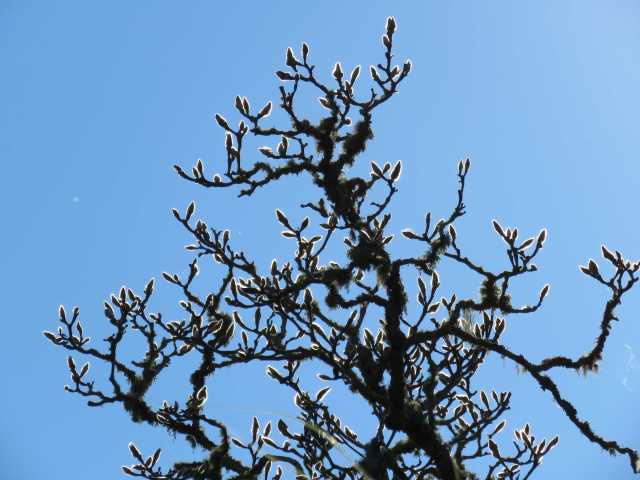
The magnolia in winter

I have various photos of the modest little Anglican Church of St John the Baptist in my local town of Waitara. Until now, all have involved either the splendid Magnolia campbellii which brings me great delight every winter or the golden delight of their Ginkgo biloba. But look! Now they are supporting a community garden and the Waitara Foodbank, Pataka Kai. For overseas readers, kai is the Māori word for food while pataka is a place of food storage or pantry.

The ginkgo in autumn

Just as with Pataka Kai’s free cooking classes, there is a strong element of learning and sharing in their community garden project. This is not just about crisis intervention for those who cannot afford food; it is equally about building community and sharing skills to equip people with confidence and knowledge, now and into the future.

I have no affiliation to any church but their act of making land available for a community garden is Christian outreach at the most local, grassroots level and that is to be lauded. The Magnolia campbellii remains untouched and is on the other side of the church. Where the garden is now, used to just be tidy, mown grass that contributed nothing obvious to the wellbeing of the congregation, the wider community or the environment.

The transient delight of a bed of poppies amongst the roses at Waiongana Gardens

The annual Taranaki garden festival is now well behind us but we did get out to a few gardens. The bed of self-sown pink poppies in Waiongana Gardens was a particular delight in its charming simplicity, even knowing that it will have been an ephemeral affair.

Waiongana’s distinctive log walls

Their log walls are pretty unique and likely to stay that way when you consider the logistics of creating them, needing the raw material, the equipment to cut the logs and then the machinery to move them into place. Who needs insect hotels when you can edge your large property with au naturelle log walls providing habitats and acting as an attractive boundary?

There is a whole lot more to Riverlea, but look at their outdoor seating

Riverlea is a stand-out garden for a number of aspects. I could highlight several but I would single out the placement of garden seating. Mark has always been adamant that gardens should, as he says, ‘make sense’. There needs to be an underpinning logic. He is not big on contrivances. So garden seating should be where you use it, not a single painted chair placed in the middle of a border as a dreaded focal point. Same with gazebos, summer houses – or *pavilions* as the aspirational call them these days. These should have a useful purpose and location, by very definition. Being an ornament or a statement of opulence is not enough, at least in our books. At Riverlea, every space to pause and sit a while, either alone or with friends, impressed with its placement and its welcoming feel. It makes a garden feel occupied, enjoyed and appreciated, personalised.

The devastation wrought by the storms at the beginning of November, particularly in Southland, brought up the thorny issue of trees and power lines. Again. The power was out in some areas for weeks and the photos of fallen trees showed some extreme scenes. We went through Cyclone Dovi a few years ago. That was bad enough but the Southland storms were way worse. Trees and power lines are not a good combination.

I have every sympathy with linesmen who go out in all sorts of extreme conditions to try and restore essential services. I can understand why the lines and power companies do not like trees and would like clearways around every power line.

If we must have clearways around power lines, all but the conifer would have to go from our little historic church in Tikorangi,
Draw back a little and that is the Tikorangi church on the left and the school on the right. Some of those trees at the school would have to be felled if every tree that could potentially fall on the power lines had to go.

But what would clearways look like? It is one thing to expect trees to be kept out of the lines so that wind won’t blow the branches around and cause damage and power outages. It is quite another if every tree that could potentially fall upon a line were it to be uprooted had to be removed or have the top taken out of it as a precaution.

Clearways for power lines would mean the removal of the Norfolk Island pines on the right in the near future.

Climate change is here. It seems that what it will look like in our country includes extreme storms with increasing frequency. Trees, especially very large, mature trees, are a critical part of attempting to counter climate change. It takes decades for trees to reach maturity. Historically, we have many power lines which were placed where it was most convenient or the cheapest option and now they are in the wrong places, really. I don’t know what the answer is. How do we balance the environmental benefits of large trees with the need to keep electricity supply?

Sometimes life can deliver unexpected delights and so it was with a delivery of a magnificent book sent to us by the UK-based botanical artist, Barbara Oozeerally. There are several pages of paintings of Jury magnolias in a large format book full of exquisite magnolia paintings. It is a book to be treasured. When I wrote to thank her, it transpired that she is a long-time subscriber to this site and her love for magnolias goes beyond painting them. She has a collection of nearly 50 different magnolias in her own garden. If you don’t have space for 50 magnolias in your garden, I can recommend her book to experience the genus vicariously, all year round.

Magnolia ‘Felix Jury’ , as painted by Barbara Oozeerally

The bulbs of November

Arguably, rhodohypoxis could be the provincial flower of Taranaki. Like clockwork, they bloom on cue for the garden festivals which take place here at the start of November and there wouldn’t be too many gardens that don’t have rhodohypoxis growing either in garden soil or, more commonly, in shallow pots. They may hail from southern Africa, but we have made them our own.

Rhodohypoxis baurii ‘Ruth’

For all our years opening the garden and when we had the nursery, we would pot up what seemed like an inordinately large number of these little rhizomes in shades of pink, white and deep carmine. I wondered if we would reach saturation point when every local gardener and any return gardeners from out of the region already had them, but we never did. It seems the market for these charmers – referred to as ‘roxypoxies’ by more than one customer – is endless in the month of November.

Orange tritonias

Also standing out are the orange tritonias. There is nothing subtle about these easy bulbs, also from South Africa. They need to be managed and used thoughtfully or they just look a bit… vulgar really. They pull their weight in vibrant meadows, set against deep blue flowers or in predominantly green situations.

I am pretty sure those are pastel tritonias at the front of the borders at Riverlea Garden

I am pretty sure the muted pink clumps repeated down the front of the borders at Riverlea Garden are also tritonias, or a close relative. They were very pretty and maybe easier to place in the garden than the orange.

White ixias in the front left. And of course those red and yellow alstromerias on the other side are also rated as bulbs. And I would assume that the Iris sibirica ‘Blue Moon’ can be included in the bulb fraternity with its underground rhizomes.

Also in the ‘easy’ bulbs class are ixias – African corn lilies. Not that all ixias are equal. I had a brief look at the ixia family and it seems there are somewhere around 100 different species and there seems to be quite a strong correlation between different colours and different species. Our form of Ixia viridiflora – the best known and unusual coloured one in strong blue-green – is a poor form. Despite my best efforts, it never flowers well and I have seen photos of way better performing selections. It is the pure white ixia that delights me this week, both in the Wild North meadow and in conjunction with the blue Iris sibirica in the borders. We also have ixias in various shades of pink from pastel to cyclamen pink, in lilac and in yellow.

Romulea rosea
Romulea candidissima

Romuleas can be a bit too enthusiastic on the reproduction stakes but both R. rosea (in brightest pink) and R. candidissima (in pure white) are earning their keep this week. Mark tells me that the best romulea is R. sabulosa but it is also the most difficult to grow and we lost it.

It has taken us a long time to get to the name of this – Herbertia lahue or prairie nymph

Crossing the ocean to the central and southern Americas, we get Herbertia lahue with the charming common name of Prairie Nymph. Neither Mark nor I have known what this was until now, although Mark gave his assessment that it ‘looks dangerous’. He is right that the visible evidence of seed development is scary, but in all the years we have had it, it has not become an invasive problem.

I have brodiaea firmly embedded in my brain so I may struggle if in fact it is now a tritelia

Then there are the multitudinous but welcome plants of Brodiaea laxa ‘Queen Fabiola’. Or is it definitively reclassified as a tritelia these days? This I do not know. It has built up most satisfyingly here without becoming a problem. In a climate where the giant blue alliums are not a starter for us – or indeed for many people in this land, given the whopping price per bulb let alone sparse availability – I see my brodiaeas as the poor man’s alternative to swathes of late spring blue. True, it falls over in the rain but it stands up again when the rains stop.

Flattened by the rain this week but what I think of it as the poor man (or woman)’s blue allium replacement
Albuca flaccida (not canadensis!)

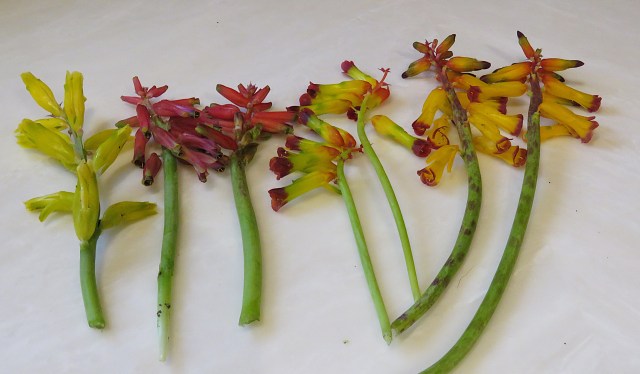
It has taken a few years (read: quite a few, possibly many years) to build up Albuca flaccida  (incorrectly named and sold in this country as A. canadensis, including by us) in sufficient numbers to put on a show but we are finally there. In the class of graceful, hooded, hanging bells in yellow with green stripes, this South African bulb is a winner and even more charming when in a clump of many. The bigger growing white and green albucas are only just opening and we will get to them next month.

I will struggle with remembering Sinningia instead of gesneria but the cardinalis remains the same

Sinningia cardinalis (alternatively known as Gesneria cardinalis) is one of our curiosities here, built up over decades to be standout clumps of foliage and flowers that attract attention. I am not aware that it has a common name but it belongs to the same family as African violets, streptocarpus and some gloxinias. You don’t see it around much because it doesn’t appear to reproduce easily from seed and its large tuber doesn’t set offshoots so propagating it requires a bit more skill than most bulbs.

Pretty sure it is one of the gladiolus species but we don’t know which one. These often seemed to be loosely grouped into G. carneus but that may not be right

Our interest in bulbs largely begins and ends with what we can grow as garden plants. We have enough garden without having to faff around with pots. Some bulbs are easier to manage in pots, particularly those that are being grown outside their climatic and geographic areas. It is easier to manage water and growing medium requirements in pots, as well as controlling temperature and day length. It is also easy to take your eye off pots and find the contents withered away to nothing in high summer, eaten out by hungry mice in winter, or sprouting with unwelcome seed from invasive neighbours. Ideally, potted bulbs should be replanted in fresh mix every year. We prefer to keep them to the garden once we have enough to plant out.

But wait there is more! I had forgotten entirely about the arisaemas, which is quite a big oversight on my part. This oddity is A, dahaiense.

‘No longer in the garden’

Shirley’s book cover

There is always an element of sadness when marking a death. But it seems that Shirley Greenhill’s time had come and she managed an appropriate ending – dying at home yesterday, mere days after she had her garden open for her final time in the annual Taranaki Garden Festival.

I bought the last copy of Shirley’s self-published book a few years ago, less because I wanted to read it than because I wanted a little bit of Shirley to live on in my bookcase. Not only was Shirley an excellent gardener for more decades than many of us would like to count, she was a marvellous woman – pragmatic, down to earth, warm, characterful and empathetic.

For many years, she and her good mate, Jill Kuriger would bowl into our nursery. Both were knowledgeable about plants, extremely capable gardeners, genuinely interested in what Mark and Felix were doing in the garden here, lighting up our day with their good humour and no-nonsense approach. Many people will remember both Shirley’s big garden in Fenton Street, Stratford and Jill’s country garden on the lower slopes of our maunga, Mount Taranaki, and then their smaller town gardens as they scaled back their gardening efforts in recognition of passing years – but they never scaled back as far as tiny retirement projects.

Shirley’s ‘retirement’ garden was largely flat but hardly small.

Stratford had a reputation for producing gardeners. I think Shirley might have been the last of her generation – Jill Kuriger, Russ and Biddy Barrett, Jim and Molly Hopkirk, Gwyn Masters, Erica Jago, Les Taylor and there may have been more.

Shirley, you gardened right up until you died and you made it to 90, creating beauty, bringing pleasure to countless garden visitors and delighting many of us with your warmth and practical humanity. RIP. You have earned a peaceful rest.

The bulbs of October

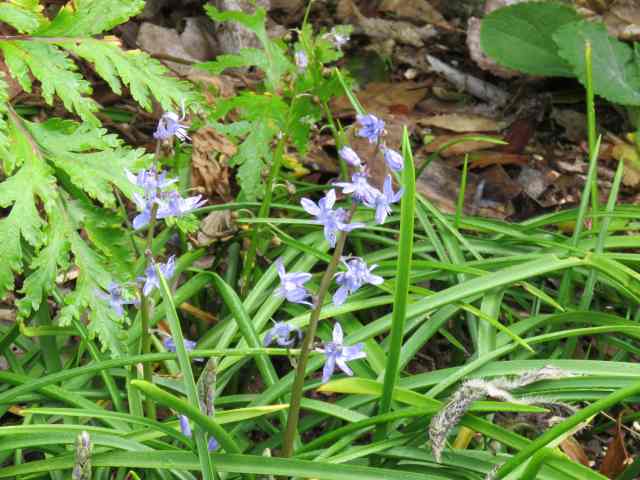
Bluebells in abundance but now all but passed over for another year

October opened with the bluebells, the pinkbells and the whitebells. I don’t want these in cultivated garden areas any longer but they are very pretty in wilder areas. In terms of a single colour sweep, blue is always best. White might as well be onion weed. Pink is a bit novelty-ish. When it comes to a colour mix, blue should still be in the highest proportion, as it is in the wild. At least that is the rule of Abbie if you are after a naturalistic, sweeping meadow effect.

This was as good as the Hippeastrum papilio got in the unusually prolonged spring rains
Looking happier in previous years – Hippeastrum papilio

Last month belonged to red Hippeastrum aulicum. This month opened with Hippeastrum papilio. It has taken a few years but we now have plenty of this bulb, able to be counted by the score rather than single figures. It is available for sale and it is expensive to start with – probably around $25 or $30 a bulb. But it is not difficult to grow and it multiplies at a reasonable rate if you quietly lift and divide it every year or two, replanting into well cultivated soil with some compost added. Its flowers are large and showy. Its season was somewhat shortened this year with The Rains. It feels as though it has rained most days this spring. The magnolias and michelias did not appreciate the very wet season and were particularly disappointing. H. papilio tried to bloom and did well enough for me to get this photo. Alas, when I looked a few days later, even with their heavy texture, the blooms had largely sogged out and given up.

The erythroniums in a previous year

The dogs tooth violets – Erythronium revolutum – are marginal with us at the best of times. Their very soft blooms can mush up in our spring rains so I had to reach into my file photos, given that there were a few brave blooms at best. The Fritillaria meleagris is equally marginal our climate and has also been and gone for the season. These are plants that are very charming but they will love your conditions more if you can give them more winter chill and less spring rain.

We have failed to get a species name for this striking, late-season lachenalia. Its pink, blue and pale colouring is almost luminous.

The lachenalias have proven more weather hardy for us. Now that the early ones have long gone, we are onto the late bloomers, particularly this rather striking pink and blue number and the white species L. contaminata.

Veltheimias – ‘Rosalba’ is prettier than the more common pink V. capensis

The veltheimias are another large bulb that has surprised us with its willingness to settle in and naturalise. It is a South African native, triggered into growth by autumn rainfall but otherwise happy in dry, conditions. We assumed it would want full sun but Mark’s efforts scattering seed through the woodland areas has seen it settle in without fuss and gently establish in shade as well as sun. Veltheimia capensis is the pink form and it is common enough and reasonably hardy; the prettier lemon and pink form is less common, probably less hardy and is Veltheimia capensis ‘Rosalba’.

Scadoxus puniceus

Our other stalwart this month and into early November is Scadoxus puniceus. Part of the family oft referred to as blood lilies, this species is not common. You will be lucky to find it offered for sale in New Zealand. The summer flowering Scadoxus katherinae (technically S. multiflorus ssp katherinae) is readily available, although certainly not cheap. We have both gently seeding down in woodland where they make big, bold statements with their presence. If you are a patient gardener, you can build these up from a single bulb, as we have. If your conditions are favourable, you may even get them to naturalise over time, as we have.

It may remain a spiloxene to us, although it seems it is now reclassified as a pauridia

I am not writing a comprehensive book so I am not doing a full listing of which bulbs flower this month. There are too many, from pretty Albuca canadensis through to Phaedranassa cinerea,  that sit on the choice, less common end of the bulb spectrum. There are families that we tend not to think of as ‘bulbs’ like alstromeria (we must have those blooming every month of the year) or the vast iris family. And there is that whole cluster of somewhat messy bulbs which often seem to overlap categories – babiana, sparaxis, ixia, vallota, tritelia, brodiaea, spiloxene syn  pauridia and more – many coming into flower now.  I say messy because a fair number of them come up with foliage that starts to die off as the flowers open. There are times I think greater separation between flowers opening and foliage browning off would be preferable.

Ornithogalum arabicum

I will mention Ornithogalum arabicum, sometimes referred to as black-eyed Susan but it shares that name with other plants too, which all goes to show that common names can be problematic. Arabian star flower or star of Bethlehem are perhaps preferable options. It is not that O. arabicum is particularly rare but it does exercise great mystique for me as a prime example of random reinforcement. Every few years it pops up flower spikes but it clearly does not wish to be taken for granted because it doesn’t do it every year. It makes it a fresh surprise and pleasure when it deigns to bloom.

Look at that set of bulb offshoots. Every one will grow, given half a chance.
Even more bulblets forming at the base of the flowers

Unfortunately, I am also dealing with An Incident – The Incursion of the Allium Bulbs. “Oh, that is the one Dad tried to get rid of,” Mark said as he passed. It is probably a species that was sold at some stage but, with over 1000 species of alliums now identified, I have no idea which it is. There are not too many of that thousand that I would accept these days, excepting onions and garlic, of course. Look at how many bulbs a single stem is creating. And not just at the base. If you look at the flowers, you can see a whole lot more babies forming at the base of each bloom. This is a scary rate of reproduction. I shall continue attempting to get rid of it here, even though total eradication does not seem possible. 

Do not be fooled by the pretty flower with the strong onion scent. Let this in at your peril and future generations of gardeners will rue your decision.