Of rhododendrons and the roof

Mark’s ‘Floral Sun’

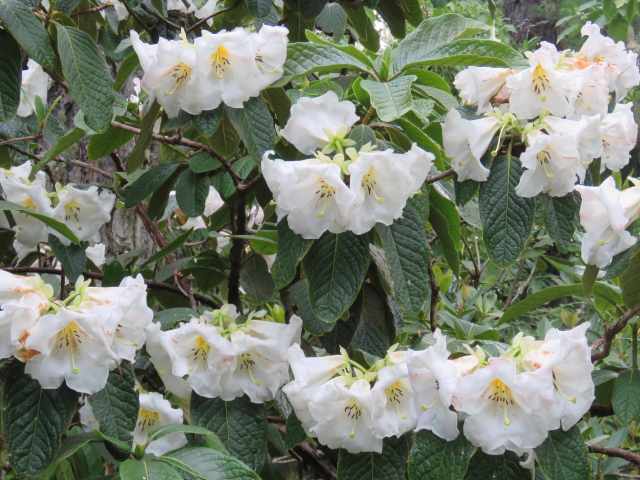
As the deciduous magnolia season draws to a close, it is time for the rhododendrons to star. And Mark’s rhododendron hybrids ‘Floral Sun’ and ‘Floral Gift’ have indeed been starring this week. Not only are they gorgeous, they are also scented, Gift even more so than Sun.

On Friday next week, we have the New Zealand Rhododendron Association conference attendees coming here. This was originally scheduled for 2021 but cancelled at the last minute as large parts of the country went into the second Covid lockdown. We agreed to them coming this year even though we no longer open the garden.

We are not the rhododendron garden we once were. They were a key plant when Felix and Mimosa started the garden here and Mark started the nursery on rhododendrons. We produced a huge range, including many of the showy American rhododendrons that were all the rage back then. Some readers will remember the days when everybody wanted ‘Lems Cameo’, ‘Lems Monarch’, ‘Puget Sound’ and the likes.

Mark’s ‘Floral Gift’ has been a bit of a sleeper star. We worried that it was a bit sparse on foliage at the start but it has gone from strength to strength as a garden plant. This plant was moved a few months ago from an area where it had become too shaded and it has not worried at all about that relocation.

In the time since, we have lost many plants which either faded away or up and died on us, as Mark describes it. This includes a lot of the species, the dwarf varieties which are largely bred from alpine species and the showy hybrids from places with colder climates. Rhododendrons are reasonably adaptable plants as long as they get a winter chill (which they don’t here), a situation which is not hot and dry in summer or too wet at any time. I console myself with the knowledge that the British Royal Horticultural Society’s flagship garden, Wisley, has recently felt the need to relocate a lot of their rhododendron collection to more northerly RHS gardens in order to save it. Wisley has a low rainfall and the combination of increasingly dry conditions combined with milder winters meant that many varieties were endangered.

Public gardens play a major role in preserving species and collections but that is not a responsibility we take on as a private garden. We just go with the flow and adapt. One of those adaptations has been to largely eliminate the use of sprays. Some of our rhododendrons required spraying every year to keep them healthy but there is nothing sustainable in that. So it comes down to accepting that we will lose ‘Rubicon’, ‘College Pink’, the Loderi hybrids and some others.

At least the nuttalliis still thrive here

What we do know is what will thrive and look good without spraying. We have always been fond of the maddenii group and particularly the nuttalliiis. None of them have the big, round, ball trusses commonly associated with rhododendrons but most are scented, keep good foliage, do not get infested with thrips (which is what gives white leaves and weakens the plant), suffer from leaf burn on the edges of the leaves and they are far happier in our mild conditions without a winter chill. I much prefer them to the classic ball trusses now but I spent countless hours trying to persuade customers and retailers of their merits when we were producing them commercially. Too many just wanted rhododendrons with big red trusses.

One of Mark’s unnamed hybrids. Please notice the foliage.

Mark set out to see if he could breed healthy plants with ball trusses and clean foliage in order to meet the market demand. But it takes a long time to breed and assess new woody plants (except for roses which have a super-quick turnaround) and, in the meantime, rhododendrons fell from favour for all the reasons mentioned above, meaning demand dropped away and we retired from the nursery and plant production. So even though some of them are pleasing, they just sit in a long row in a paddock and we look at them from time to time.

It is more about the foliage than the flowers on these unnamed seedlings. Of course they need to put up plenty of good blooms but plants that stay looking good and lush all year round with no spraying, feeding or mollycoddling was the important factor in breeding.

I may pick blooms of those that are looking good to show the conference attendees when they visit. It is not that the flowers are exciting breakthroughs; it is that they have good foliage and a healthy habit as well as mass flowering, even when grown in full sun without ever being fed or sprayed. That is an achievement. One day, rhododendrons may come back into fashion and there is a little resource sitting here for a future generation to capitalise on.

Besides preparing the garden for the conference and an overseas tour due soon after, our roof has been dominating our lives here for the past few weeks. Like other houses from the same era of the early 1950s, we have – or had – a concrete tile roof and those tiles are now so fragile that they break if you so much as look at them. We bit the bullet and decided we could no longer delay replacing the roof. It is not an easy roof and therefore eye-wateringly expensive. The lead scaffolder commented that it is one of the most difficult scaffolding jobs on a domestic house that he has done because of the different roof levels. So we are surrounded in scaffolding, piles of tiles, bricks, new roofing and a whole lot more. And a partially reroofed house with stop-gap weather proofing in a Taranaki spring is high stress. Yesterday’s rain had Mark and me crawling around in ceiling cavities patching remaining cracked tiles from inside and strategically placing buckets. I don’t often concede to age but I came to the conclusion that we really are getting too old to be crawling around in ceiling cavities. If it is fine tomorrow, we should see the main body of the roof finished with only ridge cappings, flashings, spouting and downpipes to go. I am looking forward to the day when we no longer have to worry about leaks and occasional internal floods (two so far this year).

A work in progress

The new roof is an anachronism in materials – long run roofing iron – but not in colour. The old tiles had weathered to grey-brown but we can see that they started off in a shade that was more orange than red and I can remember those startling orange tile roofs from my childhood. The new roof is dark brick-red-brown and that will be fine, probably an improvement on the earlier orange-red. I did not want a grey roof. There is enough greyness in the world without voluntarily adding more.

The chimney was a cause of nagging anxiety

Dropping the back chimney to below roof level was a major job that took three men with a jackhammer and a sledge hammer all day on Friday. We didn’t use that fireplace – we have three others – and we have long worried that the massive brick tower was an earthquake hazard that had the potential to demolish part of the house and take lives if it ever snapped off. We have to take earthquake risks seriously in our shakey, quakey isles. Architecturally, I am sad to see it gone but it will be a relief not to worry about earthquakes or leaks.

Going, going…
… gone.

Whether all this will be completed, cleared and the outside areas reinstated before the conference people arrive at the end of next week remains to be seen but they are coming to see the garden, not the house. At least we are not open for the garden festival because that would have been a problem.

Faffin’ around

This lemon cymbidium orchid has not flowered before that any of us can remember but it is a little charmer. The lilac is a Dendrobium Bardo Rose.

I am a faffer in the garden. At times it feels like an indulgent use of time but really, the greatest pleasure I find in the state commonly called ‘retirement’, is being time-rich. I have the time to faff and I derive a great deal of pleasure from paying attention to detail to get things right, in my eyes at least.

Our gardener, Zach, brought us two orchids he picked up at the local orchid show, knowing that we wanted to extend the cymbidiums beyond the ones Mark and our daughter gathered several decades ago. We wanted clean colours that could light up a space and provide contrast to the rather large number of brown cymbidiums we have. Brown was the fashion colour back when our young daughter became the recipient of generous gifts from enthusiasts wanting to encourage her.

Zach and I placed them where we thought they would work and he planted them in slightly raised mounds of coarse woodchip and bark that we gather on site. As soon as I looked, I knew they were wrong but I was a bit reluctant to say anything after he had gone to the trouble of planting them. Then Mark came in and started to say, “I was walking down the far end of the Avenue Garden when something startled me.” I have lived with him long enough to be able to finish his observation for him – “a lime green orchid?” “Yes,” he replied. “I didn’t realise when it was sitting on the bench that it was such a synthetic, fluorescent colour. Maybe it would fit in better in a more shaded area surrounded by green foliage.”

Better when placed more discreetly and not out on its own shouting ‘look at me! Look at me!’ The photograph has come out more gold and the earlier lime colour seems to be changing as the flower matures.
I think the white will bed in more harmoniously than where we had it
I originally placed it by this massive red-brown orchid but it was too stark a contrast and instead of adding a light touch, it simply looked out of place. This one may be brown but it has at least nine very long flower spikes laden with bloom.

Zach, bless him, is very obliging and willing to see the garden through our eyes. We found what we hope are final homes for the new orchids. The white one was also misplaced and looked far too starkly bridal amongst the browns but fits in more naturally in another place entirely. While we were about it, he moved one I thought was hideous – a caramel brown in tone with a startling red throat – to a less prominent position where it fits in with the colours of the clivias as opposed to being beside a pretty, pink cymbidium.

Not my favourite cymbidium

I am much happier with the result. Zach has been quietly dividing and relocating bits to extend the orchid display and feeding them with compost. The plants are responding most gratifyingly after decades of benign neglect. What the cymbidiums may lack in subtlety, they make up for with their exotic character and the many weeks they last in good bloom in the garden.

Pleione orchids flowering now

The pleiones are pretty rather than exotic and very much a seasonal delight. Their flowers are much more delicate and they have a short season. They also need more attention each year to keep them going. Without looking after them and replanting most years, we would lose them. We like them enough to be willing to fuss over them.

Dendrobiums in pink and white, backed by the primrose calanthe orchids that are passing over now

The Bardo-Rose dendrobiums are also dainty but not as pernickety as the pleiones. They too can survive on benign neglect with minimal attention.

We have brown brown, red brown, murky brown, caramel brown and golden brown. Six flower spikes so we can’t complain.

Faffing about pays dividends in my book. We garden on a pretty large scale for a domestic garden but it is the detail within that larger scale and landscape that keeps it interesting for us all year round.

In Monet’s garden – taking garden grooming to ridiculous lengths

Attention to detail is not to be confused with immaculate gardening. I have been in a fair number of immaculate  gardens in my time – not a leaf out of place, not even a blade of grass. Preternatural tidiness. It is much admired by some but really only achievable by extraordinarily precise, tidy people who have a small garden, because it needs attention every day. And maybe these immaculate gardeners only maintain this pristine perfection when their garden is open to the public. Even if we aspired to that level of garden grooming it is neither achievable nor sustainable across the 10 acres that we actively manage as garden. Fortunately, it is not one of our garden goals. I have never forgotten the sight of four young gardeners at Monet’s  garden in Giverny, picking over the pelargoniums. They were not dead-heading; they were literally dead-petalling – picking off the spent petals from each individual bloom. I was riveted by the sight but honestly, I couldn’t think that it was worth paying four sets of wages to pick off dead petals for the visiting hordes. That is much too much attention to detail.

The Yellow Magnolias

Magnolia ‘Honey Tulip’ with ‘Iolanthe’ behind

When the first yellow magnolia hybrids became available in New Zealand in the early to mid 1990s, they were a bit of a revelation. Most deciduous magnolias are from parts of central Asia and come in shades of pink, white, purple and hues through to red. Yellow seemed a significant addition and many people hadn’t realised that USA has its own deciduous magnolia and it flowers yellow. That is M. acuminata, sometimes referred to in its homelands as the cucumber tree.  

It takes time to see how a magnolia will perform in a different climate. We knew that M. acuminata was very cold hardy, could grow very large (think 30 metres) and had small flowers. When you are looking at small nursery plants sporting their first yellow flowers, they can look exciting – something very different and new, to us at least. Given time, the picture becomes clearer and I quote Wikipedia: “Unlike most magnolias, the flowers are not showy. They are typically small, yellow-green, and borne high in the tree…”.

Magnolia ‘Yellow Fever’ on one of our road boundaries. I have never understood why anyone would choose that name

I remember talking to an American enthusiast about magnolias and it was a revelation as to different perceptions of plant hardiness. When we talked about hardiness in magnolias in our temperate climate, we measured things like vulnerability of the open flowers to frost or late storms. The timing of flowering mattered most to us. To the Americans, it was a matter of whether the bark split when the ground and trees froze in winter. That is next-level plant hardiness and they need plants that flower later in the season. Their yellow magnolia species is hardy in their winter cold.

One of the early yellow hybrids – probably ‘Yellow Fever’ – in the magnolia dell at Pukekura Park
And a close-up to show the problem of smaller flowers getting engulfed by new foliage. Most of the first batch of yellow selections flower even later so the flowers get hidden more.

The problem with most of the yellow hybrids in our temperate conditions is that the flowers come out late, at the same time as the leaves, and get lost in the foliage. The trees also grow extremely quickly and become large. The early hybrids came from Brooklyn Botanic Gardens In New York. We started with ‘Elizabeth’ (flowered early enough to beat the foliage but cream, not yellow and small flowers), ‘Yellow Bird’ (best yellow but flowered with its foliage and the small flowers became lost to view), ‘Yellow Fever’ (paler yellow but its main flowering came before the new foliage swamped them from sight and it still puts on a good display, despite its small flowers) and ‘Sundance’ (just another small, pale yellow in a similar mould). To those we added ‘Koban Dori’ (reputedly like a dwarf M. acuminata but the bright yellow flowers disappear behind the lush new foliage), ‘Eva Maria’ (novelty flower in a mix of pink, yellow and green that looks striking viewed close up but simply murky as a landscape tree – the same can be said of ‘Woodsman’) and ‘Hot Flash’ (which we rate as one of the better options because it is a good strong colour and it largely flowers on bare wood for us).

Poor old ‘Hot Flash’ never even got out of the nursery. It has long since rooted through from its pot but at least we get to admire it in a prominent spot beside the driveway to the neighbours.

In the years since those early hybrids, there has been an explosion of new selections internationally. The size of blooms has increased a bit but most keep that upward pointed shape and, in our conditions, most flower with their new foliage . Many magnolia specialists agree that too many yellow hybrids have been named. We stopped collecting more because Mark started hybridising his own and none of the overseas hybrids seemed to shout out to us as ‘must-haves’.

‘Honey Tulip’ on the left, ‘Hot Flash’ on the right
and ‘Honey Tulip’ on the left with ‘Sundance’ on the right

Mark’s ‘Honey Tulip’ is the only yellow he has named and he selected it for its cup shape – rounded petals, different to the more pointed shapes of other yellow hybrids – its reasonable flower size by yellow standards, smaller growth habit than the originating species and the fact that it flowers in abundance before the leaves appear. We have not regretted selecting it as it continues to go from strength to strength as the tree matures.

The original plant of ‘Honey Tulip’

But ‘Honey Tulip’ was a step on the way. Mark would have preferred a clearer yellow and his quest has always been to see if he could reach a big flower – something the size of an ‘Iolanthe’ bloom – in clear yellow with the cup and saucer form. As we edge past the peak blooming season for the Asiatic magnolias in red, white and pink, his yellow seedlings are all starting to bloom. The dream of a big, proper yellow ‘Iolanthe’ type bloom will likely take another generation or two of plant breeding and, sadly, he may be running out of time. But there is enough amongst the seedlings to see that it is possible. He has reached the size, the colour and the flower form – just not all on the same plant yet!

We are flowering a lot of next generation ‘Honey Tulip’ controlled crosses and most are ending up looking very like their dominant parent. Good colour but not good enough to name.
And again – a good plant but not good enough to name when we already have one
‘Big Flop’, as Mark calls this one. Getting there on size and overall flower form but the upper petals flop and it is not a good enough colour
Good flower size and form but not there yet on colour – more cream than yellow
Good colour but not flower form
Getting closer but Mark hates the notched petals…
Good colour and flower size but the tree is growing way too large to even consider

Breeding magnolias is a numbers game, Mark will tell you. Amongst the several score of yellow seedlings, there are two that excite us. Neither are big yellow ‘Iolanthes’ but there is enough that is special about them to make us pick them as worth tracking for potential selection. I don’t share photos of ones that we think may be special, sorry. You only get to see them when we rule them out or when they are actually ready for release. In a world already overcrowded with yellow magnolia selections, we need to be very confident before we add one or two more.

Magnolia time

Blue skies and space to let magnolias grow to their potential certainly helps the display

We are currently at peak magnolia and this year has been a relief. Flowering in the past two years has been – dare I say it – pretty damn disappointing. Very wet springs saw blooms weather-mark badly, infected by some form of blight, and turn to droopy brown slush. They were not inspiring at all and I was beginning to wonder if one effect of climate change might be to take out the impressive splendour of our flagship plant family. This year they are magnificent after a bit of a stuttering start. Mind you, we have been blessed with perfect conditions – clear, calm and dry with only the occasional storm or downpour.

June 13, which is very early for us. The display this year never actually improved on this although more snow fell.

The season started unusually early. The first flowers on M. campbellii var campbellii opened at the end of May before the leaves had even fallen and winter was upon us. Every year I like to get out and photograph our tree against the maunga, Mount Taranaki, and the first photo of that was on July 6, before the mountain even had its full cover of snow. Similarly, ‘Vulcan’, ‘Burgundy Star’ and M. campbellii var mollicomata ‘Lanarth’ all opened their first blooms in early June and early July which is mid-winter here. Interestingly, that early start proved to be a false start on all four of them. They never really recovered from it to give us their usual mass display of splendour. Some are limping on, still with flowers, but the overall display from them has not had the usual breathtaking oomph. There are always some disappointments and this is the first year I can remember when those varieties have been rather ho-hum. We are concluding that an early start can in fact be a problem more than a promise.

Magnolia ‘Felix Jury’ on the left with white ‘Manchu Fan’
Magnolia ‘Felix Jury’.

The main flowering on  the rest has more than made up for the disappointing. Day after day of blue skies have delivered us perfect blooms with none of the previous problems of blight turning petals to mush. We know it is a good season because Felix’s Magnolia ‘Atlas’ is looking splendid. When we first released it, Mark described it as being like a giant pink cabbage and one of the largest magnolia flowers in the world at the time. It is the only one of ours that seems to perform better overseas than here. Year after year, I have struggled to get good photos of unblemished blooms because it does not like our spring storms but this year, this year it is perfect.

Magnolia ‘Atlas’
Magnolia nitida, for those of you who like to see something different

We have many magnolias. I have no idea how many. We also have space so we can allow trees to grow to the size they wish. Some of our magnolias are species and some are named cultivars from other breeders but the vast majority of our plants are seedlings from the breeding programme and there are literally hundreds of those. While we have only ever named twelve Jury magnolias (eight from Felix, four from Mark and another four of Mark’s are in the pipeline for release), they are the pick from several thousand seedlings. The majority end up getting chainsawed out as being of insufficient merit to retain but some are very good. They don’t meet our stringent criteria for releasing a new plant but they are good enough to keep across the property.

Just an unnamed seedling but looking very pretty this week

Finally, I saw a death notice recently for writer, gardener and magnolia lover, the inimitable Biddy Barrett. We have always referred to this pretty pink seedling as ‘Biddy’s Pink’ as she was adamant it should be selected for release. Mark didn’t agree so it remains a one-off plant but R.I.P Biddy. Your pink lives on.

Biddy’s Pink – a reference name only. This one has never been named and released.
Biddy’s Pink – pinker than Iolanthe but otherwise very similar
Mark’s Magnolia ‘Honey Tulip’
Felix’s ‘Milky Way’
And a purple seedling to cover the current range of colours in deciduous magnolias

Orchids a-plenty

It is magnolia season and I have been photographing magnolias to share on a Facebook page I belong to, mostly populated with Northern Europeans which is how I learned yesterday morning that Mark’s Magnolia ‘Honey Tulip’ is performing well and bringing delight to a magnolia enthusiast in Ukraine. That seemed a little poignant. But this lovely yellow orchid has been sitting in my photo files waiting for its week to star so it is the turn of orchids to feature in this busy spring season.

I can’t recall seeing this yellow one flower before. Our garden apprentice, Zach, is a keen orchid man and I asked him if he had moved it to its current location, fed it or done anything to encourage it to burst into bloom and he thought not. It may be that after Cyclone Dovi, we have more light in this area and that spurred it on. It is lovely.

Brown shades are not my favourite but it earns its keep every year

Cymbidiums have long been imbued with an aura of luxury because of their role in floristry but have, perhaps, been somewhat overlooked as garden plants in areas where they can be grown. The flowers last for many weeks in excellent condition and then die off fairly gracefully. Of all the orchids we grow, they have the longest season in bloom and are very showy, even if they lack the more delicate charm or curiosity of many other members of the same family. And they are easy-care. We have had most of ours for decades and the only attention they ever had was to stake flower spikes when necessary. They are getting a bit more love from Zach who is dividing larger clumps to spread around and giving them a bit of compost from time to time but they still rate as low maintenance plants.

This one is growing in the fork of a tree and gets completely ignored until it comes into flower each year

Our style is to work them into woodland plantings in conditions of high shade and go for the natural look. I have seen them used in mass plantings and I am guessing that is an expensive option because it involves buying mature plants with spikes forming from a commercial grower. The problem with sourcing plants from a commercial grower is that their main market is floristry and the flowers can look a bit over the top in a garden – a bit too large. That is fine if it is the look you are after but it is not our preferred look.

This one is small, dainty even for a cymbidium. Bigger is not always better.
For context, it is in the bottom right of the photo, in Zach’s most recent orchid and fern construction to add some height in a formerly dull end-point of a border

We are not experts in orchids. Aficionados – and the incredibly complex family of orchids attracts its own devotees who often develop an extraordinary in-depth knowledge of different orchid species and groups – tend to be collectors who lavish a great deal of time and love to growing their orchids in pots, often under cover. But they aren’t often gardeners. Our interest in orchids is pretty much focused on what we can grow in the garden here. Over time, that has come down to a limited range as we have learned what will thrive and lost what does not.

Calanthes

Cymbidiums are the current stars, along with calanthes. We only have four different calanthes and I am sad I lost the pretty lilac one but we have A Lot of those four different ones, particularly the pale yellow one which I am told is Calanthe ‘Higo’ (C. sieboldii x C. aristulifera). As Zach and I stood admiring them, he commented that they look way better in the large drifts we have, that a single plant in a pot is not particularly remarkable. What a difference 50 years of allowing them to multiply in the garden can make. The calanthes last for several weeks in flower and having different ones means we will have them flowering from now through until the start of November.

Pleiones

Pleiones are another ground orchid. They are just starting to put up flower spikes so I had to find a photo from previous years. They are much more delicate in texture, their season is pretty short and they need more care and management to keep them thriving because their bulbs sit half in and half out of the soil and die off after flowering. But they are one of the prettiest orchids and worth the effort. Ours are all in white and shades of lilac and purple. There are lovely yellow ones and we built them up into the hundreds but they did not last in the garden. The yellow ones need more of a winter chill than they get here. We will give plants some care but not the level of mollycoddling required to lift them each season and reproduce the chill factor by refrigerating them and then planting them out again.

Dainty Bardo-Rose dendrobiums which we have in shades of pink, lilac, lemon and white

Dendrobiums can be fantastic garden plants and the Bardo-Rose hybrids are just opening their first flowers. They are another easy-care woodland option but much daintier and more refined than the cymbidiums. Later in  spring, will see the Satyrium corrifolium which is happy in the rockery and demands only admiration and no care, followed by the Dactylorhiza (maybe maculata) which is slowly and quietly in retreat – which is probably a reflection of our warmer winters in recent times.

I have just discovered that we have around 120 native orchids, almost all of which are so modest (read: tiny and often green or greenish flowers) that they might be described as visually insignificant. At least one of the native earina species appears naturally over trees all through the garden but only orchid devotees will find it thrilling to see. I went to photograph one but it is not in flower yet so must close with more cymbidiums.