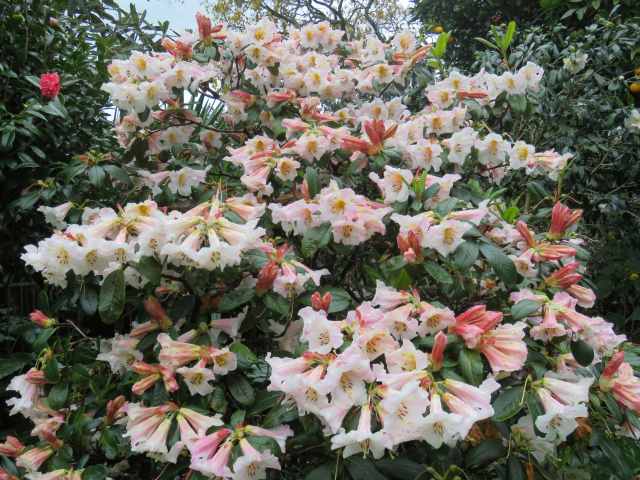
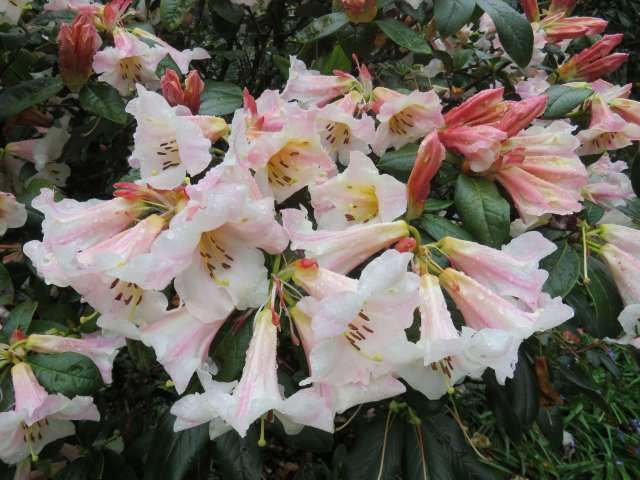
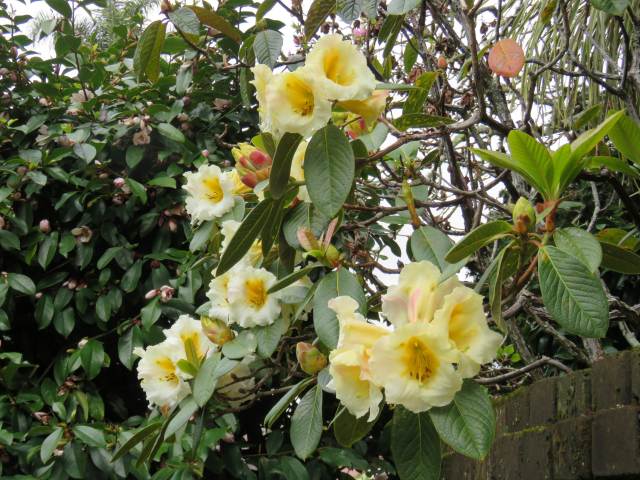
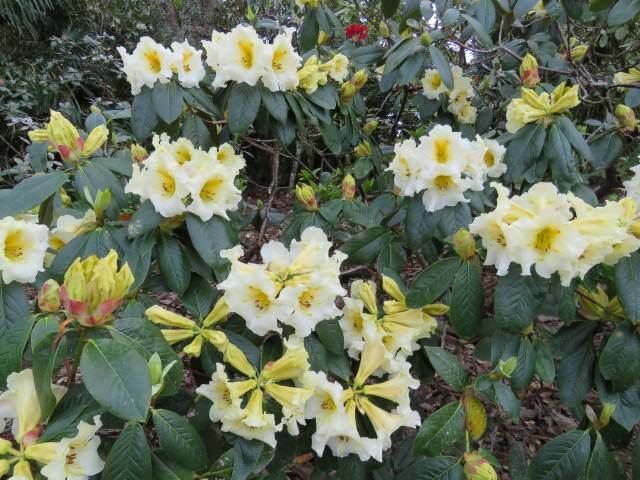
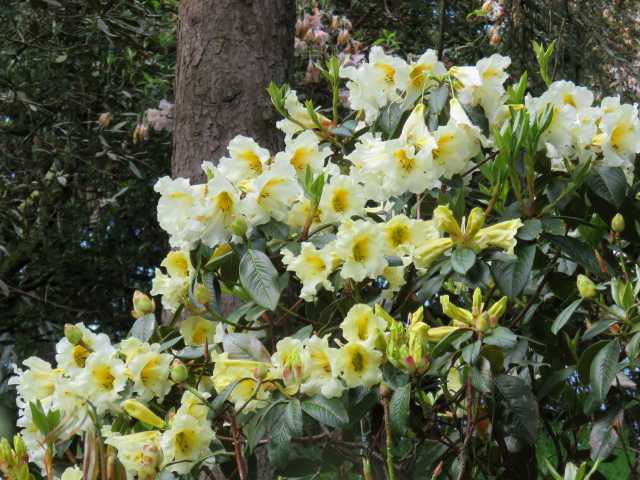
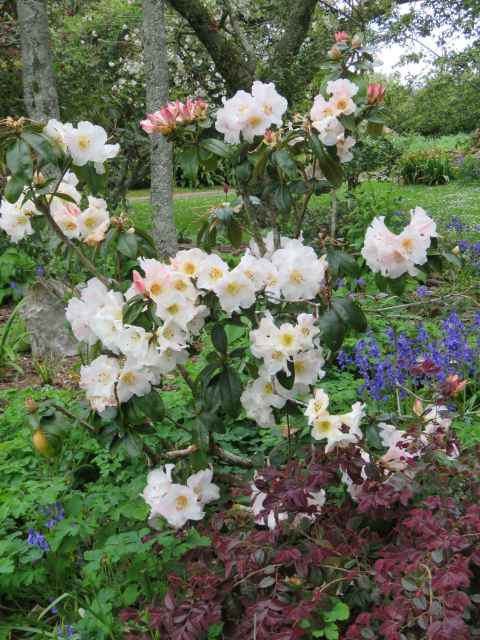
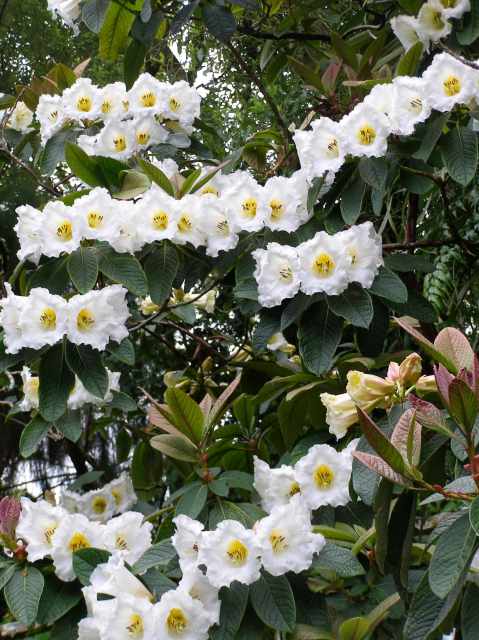
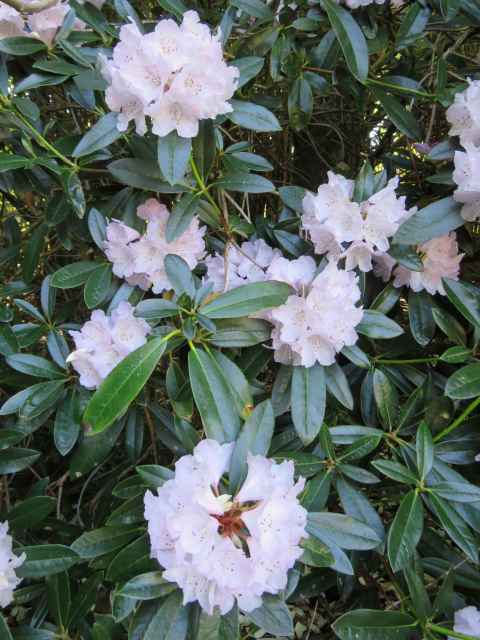
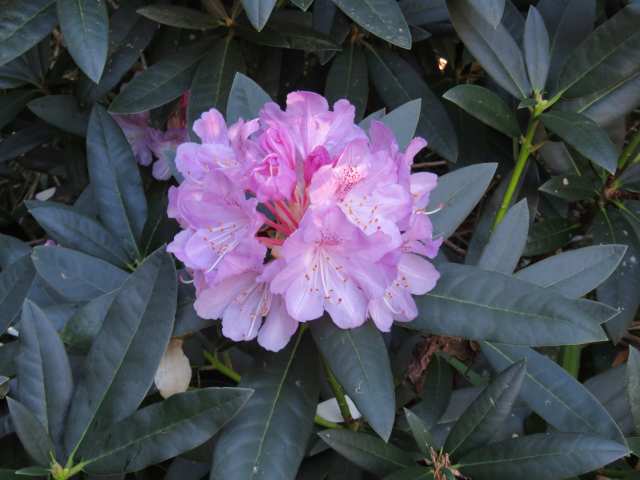
This particular rhododendron is looking splendid in the Avenue Garden and scenting the air around it. It has no name. It is one of Mark’s unnamed seedlings from the breeding programme. His comment was that it looks terrific in bloom and pretty anonymous for the rest of the year. To be fair, that could be said of the majority of rhododendron shrubs.
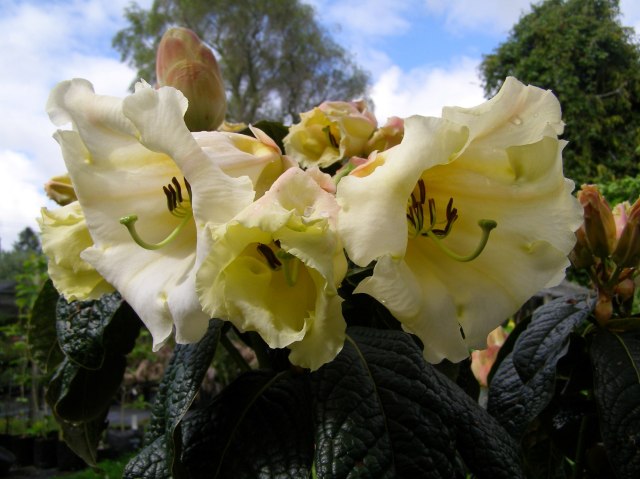
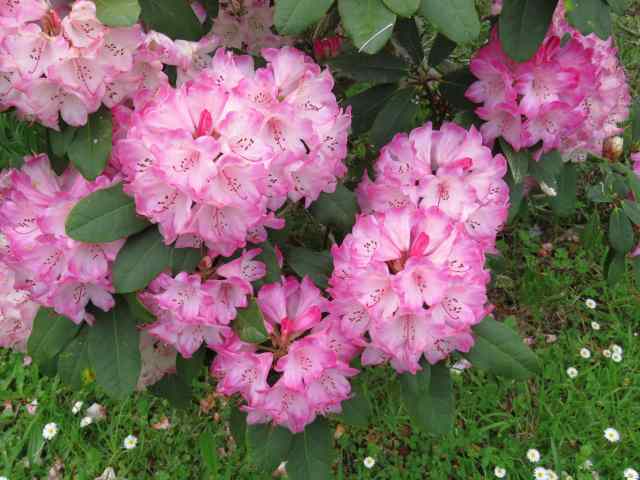
‘Floral Sun’. An additional reason for its selection was its compact, bushy growth.
Years ago, Mark crossed Rhododendron ‘R. W Rye’ with R. sino nuttallii. From the resulting seedlings, he chose ‘Floral Sun’ to release commercially. Those who know how understated and reserved my Mark is, will understand why I have never forgotten him looking at plant of ‘Floral Sun’ in our garden and sighing with satisfaction, saying: “If I never breed anything as beautiful as that, I will still die happy.” He doesn’t remember saying that now.
I think this one is a sister seedling of the original cross, not the back cross to its mother. It has the inclination to leggy growth sometimes seen in R. sino nuttallii.
A controlled breeding programme means one usually ends up with a row of sister seedlings and it then becomes a case of assessing whether any are worth selecting for further trialling and commercial release. Mark’s practice was always to select only the best one of a cross to name, to plant the runners-up in the garden and cut out the rest. We have a lot of runners-up or also-rans in our garden.
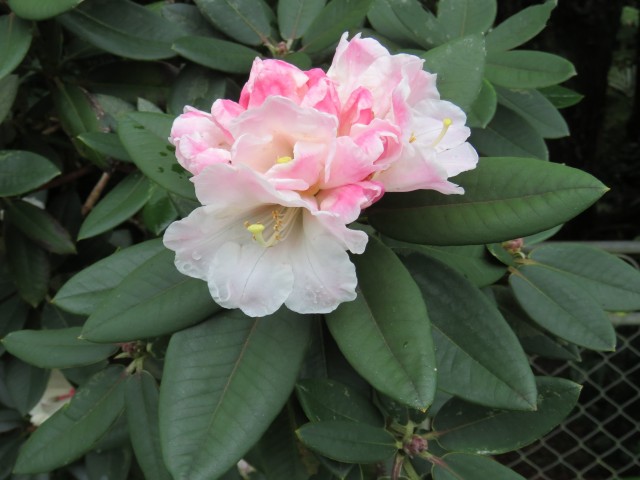
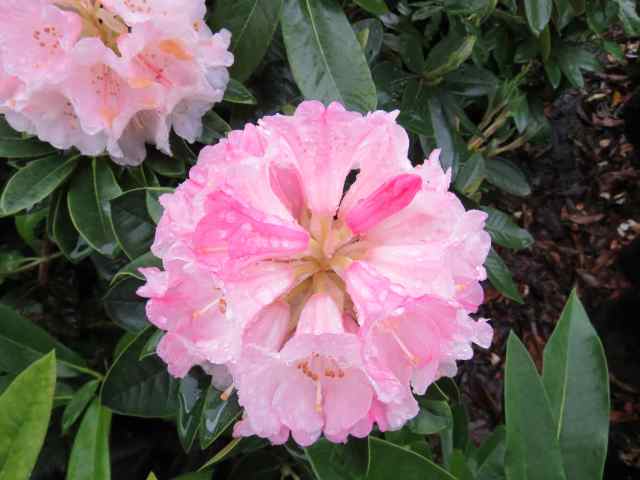
The only one of a run of seedlings that came out a different colour
Curiously, from that cross, every single one flowered yellow except this pink and cream confection in Avenue Garden.
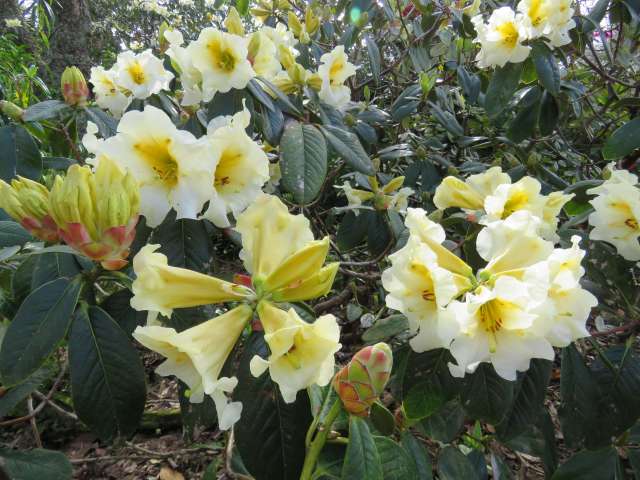
I had to eat my words. When he told me he was doing this particular cross, I quipped that he would probably end up with a whole lot of small flowered white rhododendrons with no scent. But no, he ended up with a whole lot of scented, soft yellow sino-nuttallii types, most with heavily textured foliage.
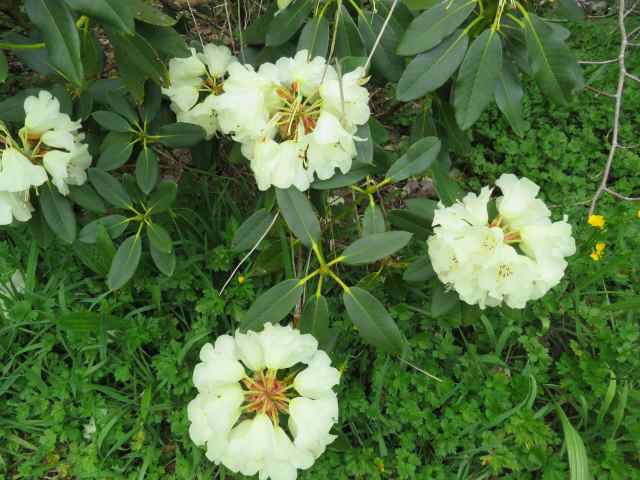
A back cross of ‘Floral Sun’ to its parent, R. sino nuttallii.
He tried back crossing ‘Floral Sun’ onto R. sino nuttallii again and we have a few of the progeny of that cross planted out. None were ever named or selected because pretty flowers are not enough to warrant selection. The growth habit is equally important and he wasn’t happy enough with any to go further.
I can’t find a photograph on line that is free for me to use of Rhododendron R. W. Rye but it is a smaller flowered hybrid which is a strong yellow. The ever-handy internet did at least tell me who it was named for. Mr Rye was the head gardener at Castle Kennedy Gardens, near Stranraer on the east coast of Scotland. The only reason why I remember Stranraer is because it is where the ferry from Belfast used to land. Back around 1992, I spent a deeply stressful week in Northern Island as part of an international group being hosted by the British Foreign Office at a time of considerable tension during The Troubles, as that period of time was euphemistically labelled. As Stranraer hove into sight, I breathed out and relaxed for the first time all week.
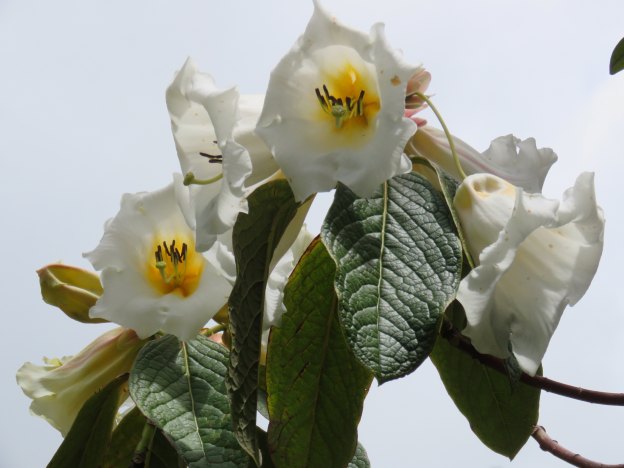
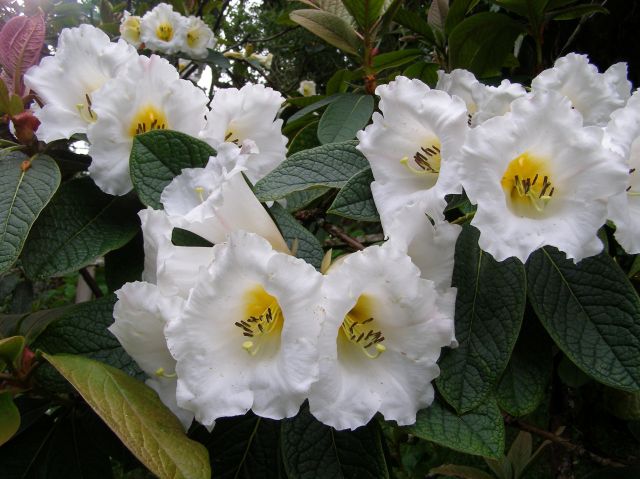
The scented glory of R. sino nuttallii
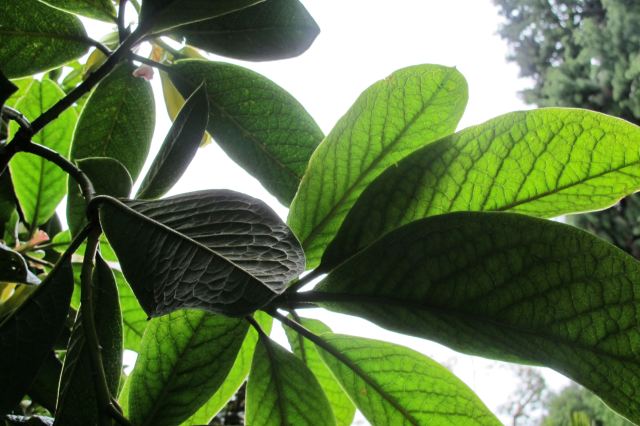
Even the foliage on R. sino nuttallii is handsome
Rhododendron sino nuttallii photographs feature strongly in my photo files. It is my absolute favourite rhododendron and we grow many of it, as well as nuttallii hybrids. It is naturally white with spectacular trumpets although we also have a white flushed pink form. I can see why Mark wondered if he could extend the colour range of the species.
As the magnolia season wanes, the rhododendron season is starting to hit its stride. Nothing marks the passage of time more than the garden.
As the deciduous magnolia season draws to a close, it is time for the rhododendrons to star. And Mark’s rhododendron hybrids ‘Floral Sun’ and ‘Floral Gift’ have indeed been starring this week. Not only are they gorgeous, they are also scented, Gift even more so than Sun.
On Friday next week, we have the New Zealand Rhododendron Association conference attendees coming here. This was originally scheduled for 2021 but cancelled at the last minute as large parts of the country went into the second Covid lockdown. We agreed to them coming this year even though we no longer open the garden.
We are not the rhododendron garden we once were. They were a key plant when Felix and Mimosa started the garden here and Mark started the nursery on rhododendrons. We produced a huge range, including many of the showy American rhododendrons that were all the rage back then. Some readers will remember the days when everybody wanted ‘Lems Cameo’, ‘Lems Monarch’, ‘Puget Sound’ and the likes.
Mark’s ‘Floral Gift’ has been a bit of a sleeper star. We worried that it was a bit sparse on foliage at the start but it has gone from strength to strength as a garden plant. This plant was moved a few months ago from an area where it had become too shaded and it has not worried at all about that relocation.
In the time since, we have lost many plants which either faded away or up and died on us, as Mark describes it. This includes a lot of the species, the dwarf varieties which are largely bred from alpine species and the showy hybrids from places with colder climates. Rhododendrons are reasonably adaptable plants as long as they get a winter chill (which they don’t here), a situation which is not hot and dry in summer or too wet at any time. I console myself with the knowledge that the British Royal Horticultural Society’s flagship garden, Wisley, has recently felt the need to relocate a lot of their rhododendron collection to more northerly RHS gardens in order to save it. Wisley has a low rainfall and the combination of increasingly dry conditions combined with milder winters meant that many varieties were endangered.
Public gardens play a major role in preserving species and collections but that is not a responsibility we take on as a private garden. We just go with the flow and adapt. One of those adaptations has been to largely eliminate the use of sprays. Some of our rhododendrons required spraying every year to keep them healthy but there is nothing sustainable in that. So it comes down to accepting that we will lose ‘Rubicon’, ‘College Pink’, the Loderi hybrids and some others.
At least the nuttalliis still thrive here
What we do know is what will thrive and look good without spraying. We have always been fond of the maddenii group and particularly the nuttalliiis. None of them have the big, round, ball trusses commonly associated with rhododendrons but most are scented, keep good foliage, do not get infested with thrips (which is what gives white leaves and weakens the plant), suffer from leaf burn on the edges of the leaves and they are far happier in our mild conditions without a winter chill. I much prefer them to the classic ball trusses now but I spent countless hours trying to persuade customers and retailers of their merits when we were producing them commercially. Too many just wanted rhododendrons with big red trusses.
One of Mark’s unnamed hybrids. Please notice the foliage.
Mark set out to see if he could breed healthy plants with ball trusses and clean foliage in order to meet the market demand. But it takes a long time to breed and assess new woody plants (except for roses which have a super-quick turnaround) and, in the meantime, rhododendrons fell from favour for all the reasons mentioned above, meaning demand dropped away and we retired from the nursery and plant production. So even though some of them are pleasing, they just sit in a long row in a paddock and we look at them from time to time.
It is more about the foliage than the flowers on these unnamed seedlings. Of course they need to put up plenty of good blooms but plants that stay looking good and lush all year round with no spraying, feeding or mollycoddling was the important factor in breeding.
I may pick blooms of those that are looking good to show the conference attendees when they visit. It is not that the flowers are exciting breakthroughs; it is that they have good foliage and a healthy habit as well as mass flowering, even when grown in full sun without ever being fed or sprayed. That is an achievement. One day, rhododendrons may come back into fashion and there is a little resource sitting here for a future generation to capitalise on.
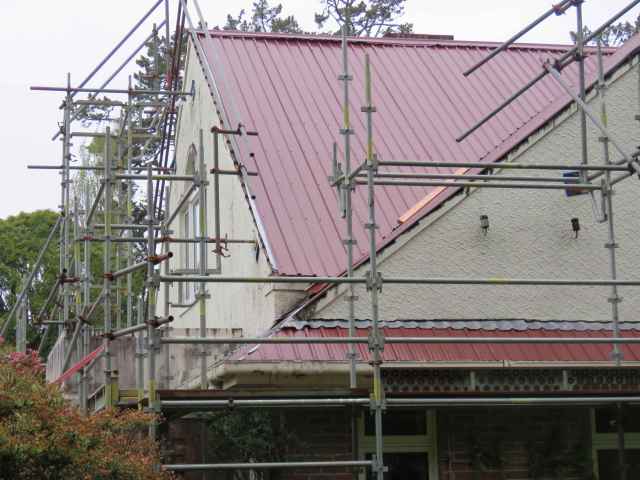
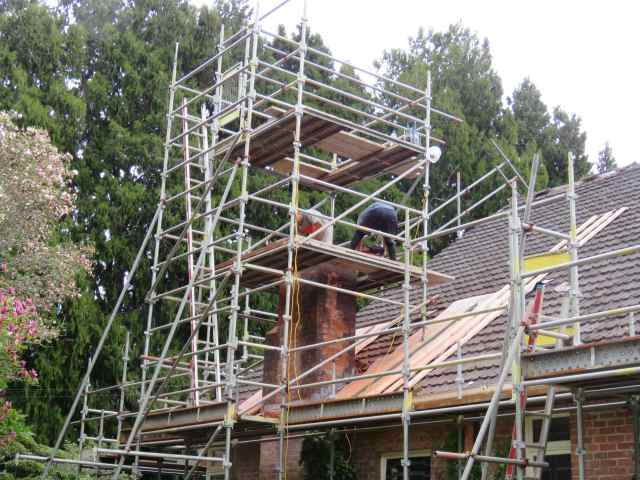
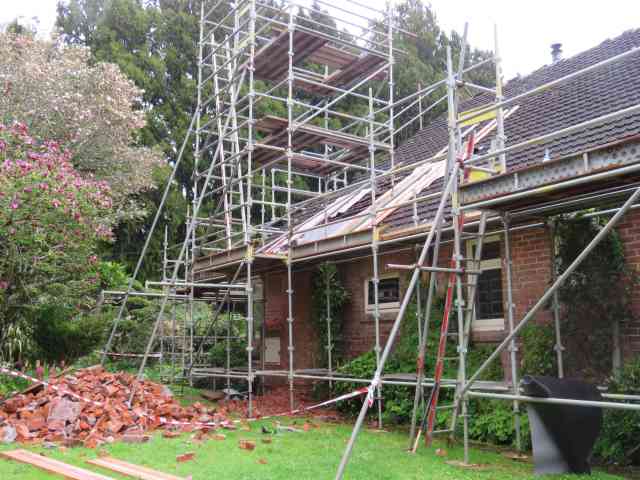
Besides preparing the garden for the conference and an overseas tour due soon after, our roof has been dominating our lives here for the past few weeks. Like other houses from the same era of the early 1950s, we have – or had – a concrete tile roof and those tiles are now so fragile that they break if you so much as look at them. We bit the bullet and decided we could no longer delay replacing the roof. It is not an easy roof and therefore eye-wateringly expensive. The lead scaffolder commented that it is one of the most difficult scaffolding jobs on a domestic house that he has done because of the different roof levels. So we are surrounded in scaffolding, piles of tiles, bricks, new roofing and a whole lot more. And a partially reroofed house with stop-gap weather proofing in a Taranaki spring is high stress. Yesterday’s rain had Mark and me crawling around in ceiling cavities patching remaining cracked tiles from inside and strategically placing buckets. I don’t often concede to age but I came to the conclusion that we really are getting too old to be crawling around in ceiling cavities. If it is fine tomorrow, we should see the main body of the roof finished with only ridge cappings, flashings, spouting and downpipes to go. I am looking forward to the day when we no longer have to worry about leaks and occasional internal floods (two so far this year).
A work in progress
The new roof is an anachronism in materials – long run roofing iron – but not in colour. The old tiles had weathered to grey-brown but we can see that they started off in a shade that was more orange than red and I can remember those startling orange tile roofs from my childhood. The new roof is dark brick-red-brown and that will be fine, probably an improvement on the earlier orange-red. I did not want a grey roof. There is enough greyness in the world without voluntarily adding more.
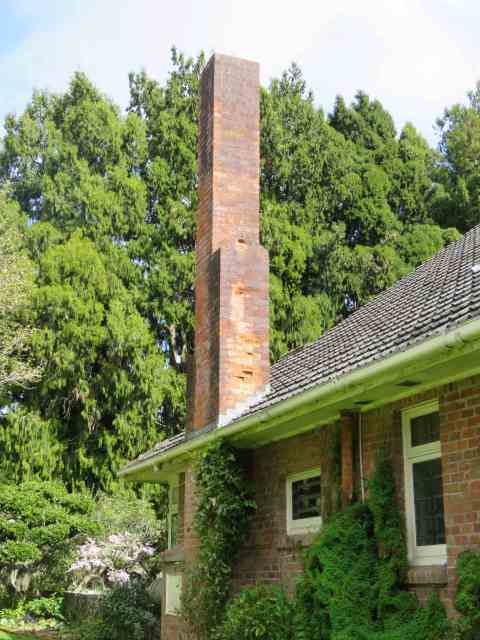
The chimney was a cause of nagging anxiety
Dropping the back chimney to below roof level was a major job that took three men with a jackhammer and a sledge hammer all day on Friday. We didn’t use that fireplace – we have three others – and we have long worried that the massive brick tower was an earthquake hazard that had the potential to demolish part of the house and take lives if it ever snapped off. We have to take earthquake risks seriously in our shakey, quakey isles. Architecturally, I am sad to see it gone but it will be a relief not to worry about earthquakes or leaks.
Going, going…
… gone.
Whether all this will be completed, cleared and the outside areas reinstated before the conference people arrive at the end of next week remains to be seen but they are coming to see the garden, not the house. At least we are not open for the garden festival because that would have been a problem.