First published in the spring journal of the American Magnolia Society, Issue 93.
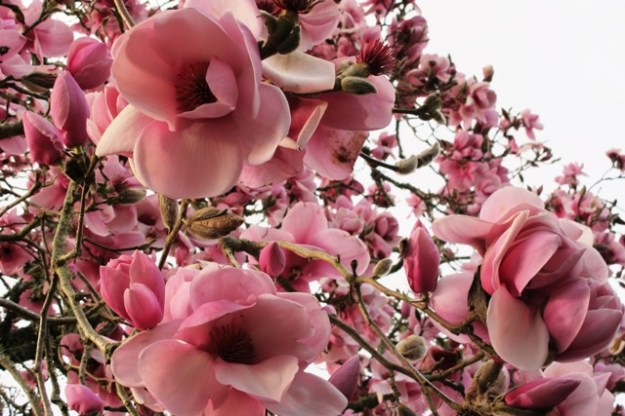
Magnolia ‘Iolanthe’ is one of our star performers here and has achieved considerable stature after 50 years. It has necessitated relocating the vegetable garden
The Jury magnolia reputation has been built on a small number of named varieties. Felix Jury only ever named eight of his own breeding – Magnolias ‘Apollo’, Athene’, Atlas’, ‘Iolanthe’, Lotus’, Milky Way’, ‘Serene’ and Vulcan™ . We don’t include the variety M. ‘Mark Jury’ in that list because it arrived here as a seedling of Lanarth purchased from Hilliers and all Felix did was to grow it and, in due course, name it. There is no record of how many seedlings he raised. Mark’s comment is that it wasn’t a huge number and he guesses somewhere between 50 and 100 in total. Mark curbed his father’s suggestion of naming a few more because they were too close to ones already selected, although we have a few fine sister seedlings from those breeding lines in the garden here.
In his turn, Mark has raised many more controlled crosses. He has never kept track of the number, but a rough guess brings him around the 1000 total of deciduous magnolias grown to flowering size so far. Of those he has named a grand total of four. He is discerning. All were chosen because they represented a breakthrough in some aspect: an ability to produce flowers on young plants, not grow so rapidly as to indicate that they will become forest giants, propagate relatively easily and flower reliably every year while setting buds down the stems to prolong the season.
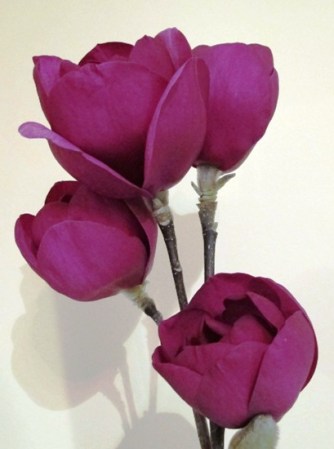
Black Tulip – good form, solid, dark colour and heavy petals
Magnolia Black Tulip® was selected because it sets flowers freely on young plants and achieves a depth of solid dark color with heavy textured petals in an attractive goblet form which holds its shape. M. ‘Burgundy Star’ offered a totally different habit of growth, strongly fastigiate, and the large star-shaped blooms over a prolonged period are a purer red at their best.Being three parts M. liliiflora ‘Nigra’, he hoped it would also prove hardier and maybe hold its color in colder climates. Felix® is our personal favorite so far. It is big, up to 30cm (12 in) across. It is very showy. With us, it can appear a rich red, but even when the color gets bleached out in colder climates, it retains a good depth of deep rosy pink. It was everything that Felix Jury himself was trying to breed – a big, rich-colored M. ‘Iolanthe’ – and he lived long enough to see it bloom. This is a cultivar that we think is just going to get more spectacular with age and size.

Magnolia Honey Tulip™ is a soft golden version of M. Black Tulip® scheduled for release in 2013. The rounded flower form and heavy textured petals appear to be an advance in the yellow magnolias. (photo by Sally Tagg)
This year will see the first release of Mark’s newest cultivar called Honey Tulip™. It is a golden honey version of Black Tulip® and represents a breakthrough in flower form and petal substance in the yellows. It retains its color through the flowering season where the comparators (Magnolias ‘Yellow Fever’, Sundance’ and ‘Hot Flash’) all become increasingly pale. Magnolia Honey Tulip™ is a soft golden version of M. Black Tulip® scheduled for release in 2013. The rounded flower form and heavy textured petals appear to be an advance in the yellow magnolias.
For our climate, it is particularly significant that it flowers on bare wood, whereas most of the yellow hybrids flower at the same time as they come into leaf. It is also less vigorous, which is to its credit, given that the yellows tend to compete with timber trees here in their rate of growth.
What takes time to sort out is how well these magnolias will perform overseas in different climates. M. Vulcan™ has been patchy at best internationally and washes out to a muddy purple in cold climates. M. ‘Iolanthe’, too, has not matched up in many overseas locations. Yet, here in New Zealand it is a flagship magnolia. The original plant is now somewhere over 50 years old and planted in the most prominent spot in our garden. Year in and year out it takes our breath away with its sheer magnificence. There is a lot of trial and error involved in how these plants perform overseas and we have been particularly delighted to see that M. Felix® seems to be measuring up across a range of climates.
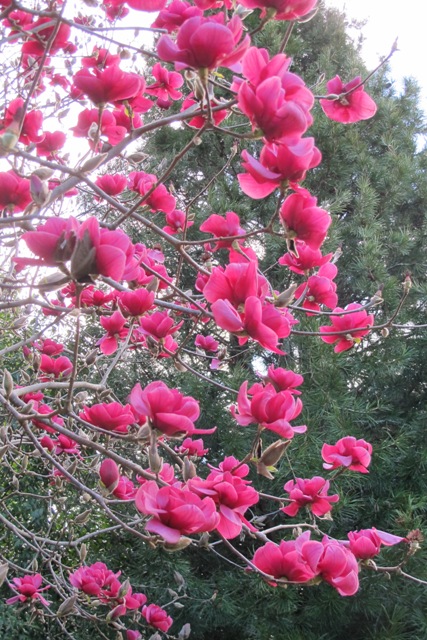
Felix®, bred by Mark, fulfilled the magnolia breeding ambitions of his father, Felix Jury. It is heartening to hear reports of how well it is performing internationally.
Mark continues with breeding deciduous magnolias. The quest here is for a yellow M. ‘Iolanthe’ (in other words, a very large cup-and-saucer bloom in yellow). He is after pure reds which lose the magenta hue common to the first generations of new hybrids and he is getting very close to it. There is certainly room for an improved M. Vulcan™ which would bloom with better color in other climates and fade out with more grace as its flowering season draws to a close. There is a way to go yet in a pure purple.
The process here is to grow seed to a large enough size for planting out, which usually takes about 18 months. They are then planted wherever there is space. Our shelter belts (windbreaks) are rows of trial plants, including magnolias. Some are in groves, some edging a stand of native forest, some lining our road verges and he has now resorted to rows in the open ground. From time to time, Mark heads out with the chainsaw. If the seedlings haven’t flowered by five years old, they get the chop. If it becomes clear that a cross is of no particular merit, the batch will be felled. If one is looking very promising, others will be cleared to give it space. Over time, the first groves have been thinned down from about 120 to the best 20, which will remain in situ. Because, of course, if you are only naming about four out of a thousand, there are a rather large number of also-rans which are too good to cut out, but not good enough or sufficiently different
in the eyes of the breeder to release.
The Michelias
Venturing into the michelia branch of the magnolia family has been much more recent. The first crosses only go back about 17 years, but the turnaround is much faster so the total number raised is already larger than the deciduous magnolias. One has been widely released and is on the market as Fairy Magnolia® Blush. The next two are scheduled to be released this year – Fairy Magnolia® White and Fairy Magnolia® Cream.
The decision to brand these with the trademarked name of Fairy Magnolia® was made by our agent, Anthony Tesslaar Plants. With the reclassification by taxonomists of Michelias to Magnolias, it seems important to highlight the difference between these and the larger, evergreen grandiflora types.
Michelias flower in two to three years from seed so it is possible to use them for further hybridising and to see directions quickly. However, there is an additional hurdle. Deciduous magnolias are usually budded and it is only the occasional one which falls at the propagation hurdle. Michelias are much more of a mass market proposition and have to propagate easily from cutting and in tissue culture. We have a far higher fall-out rate when it comes to trialing for ease of propagation. We were disappointed when a green-yellow full sister to Fairy Magnolia® Blush, which had very distinctive large green buds encased in brown velvet, fell at the last hurdle. It’s a good plant. It just doesn’t propagate reliably. With hindsight, it is a little sparse in foliage, too, so maybe it is to the good that it didn’t make it to international release.
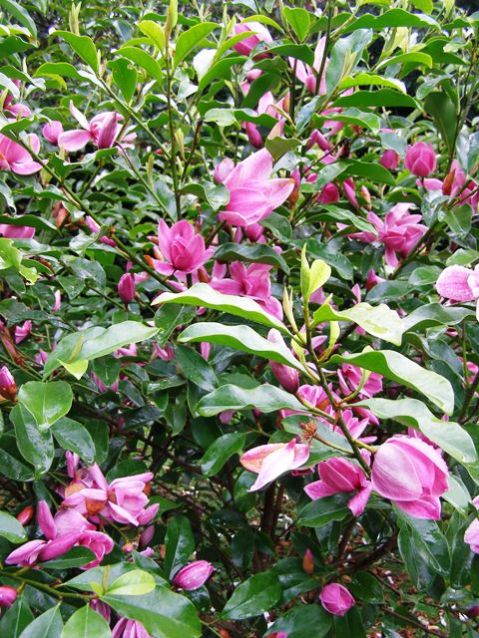
While Mark is getting some interesting colors in the michelia hybrids, none has yet passed the propagation trials.
Similarly, the colored varieties appear to be problematic when it comes to propagation. The breeding program has yielded some good pure yellows which are easily on a par, color-wise, with the yellow deciduous magnolias. None so far have propagated reliably. Even more disappointing have been the purples. Hopes are raised when a plentiful number of flower buds open to good-sized, distinctive purple flowers, but none of these seedlings has so far passed the propagation test with high enough percentages. If they are reluctant to strike from cutting, it appears that they are equally problematic in micropropagation.
Fragrance has been another issue. Even when using two strongly fragrant parents, a large proportion of the offspring are bereft of any scent at all. We have many visually splendid plants, some representing real breakthroughs in form or flower, but doubt the willingness of the buying public to embrace a michelia with no scent. Mark has been backcrossing some of these to scented species to see if he can get the fragrance back.
Others are rejected because they are too fertile, setting far too much seed, which will lead to a scraggly plant over time, and a scraggly plant with weed potential in some conditions. Some crosses have simply been too vigorous in growth to contemplate them as garden plants of merit no matter how lovely the blooms.
New Zealand’s borders are now well and truly closed to any imports of new species of any genera so Mark has not had access to recent introductions. In fact, he is working on a limited range – mostly M. doltsopa, M. figo, M. laevifolia and M. maudiae. M. alba and M. champaca have proven to be blind alleys so far and the obscure and as yet unidentified wild-collected michelia species brought back from Vietnam by the late Os Blumhardt has little merit or breeding potential. Mark observes that he has not seen other new species that he covets or that he thinks will add much of significance to the hybrids, so the closed borders have not been the problem that he initially feared. He has ruled out using allied plants such as Mangletias because they lack the floriferous characteristic that is a bottom line for any hybrid. By this stage he is down to about the sixth generation of crosses and back crosses using the sought-after characteristics of favored species and hybrids, so the genetic makeup of individual hybrids has become increasingly complex.
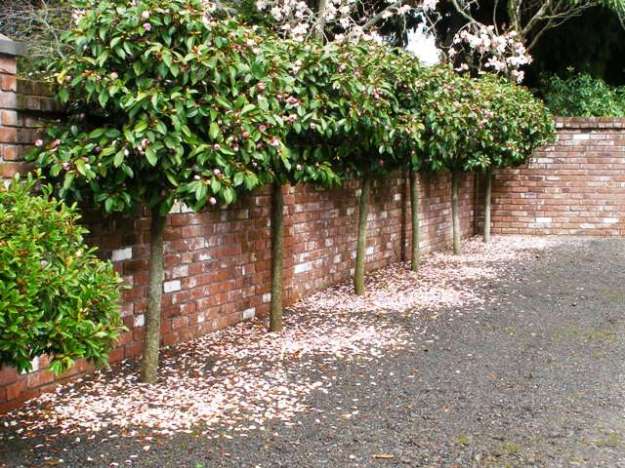
Fairy Magnolia® Blush clips very successfully. These plants are kept to this size with trimming in late spring and a light follow-up in late summer.
Fairy Magnolia® Blush brought consistent pink coloring into the range along with bushy growth and floriferous characteristics over a long season. The natural bushiness and the ability to take hard trimming are both important characteristics. The early M. doltsopa x foggii crosses from Os Blumhardt (particularly ‘Mixed Up Miss’ and ‘Bubbles’) make splendid juvenile nursery plants, but as they mature, they become leggy and open and most people would not look twice at them. We have had many seedlings the same and discard any which make only tip growths. Blush has a light and pleasant scent and, despite having doltsopa and figo in its parentage, it has proven much hardier in the US than we dared to hope and appears to be coping as low as zone 6 with winter protection and comfortably dealing with zone 7b conditions through the years of pre-release trials in the USA. It is hard to breed the perfect plant – the foliage can be a little more olive green than we would like and it would be good to get a larger, pinker bloom, but it is maturing well here.
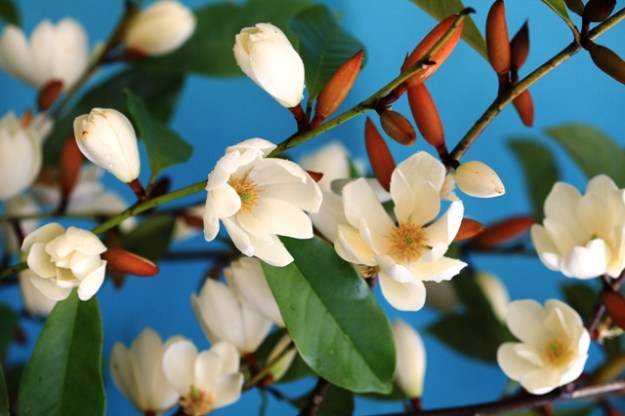
Fairy Magnolia® Cream has very fragrant, large cream flowers over a long season and will be released internationally in 2013. (photo by Sally Tagg)
Fairy Magnolia® Cream, to be released this year, is similar to Blush in breeding and performance, but with desirable brighter green foliage and a very strong fragrance. Its peak flowering season extends into months and the blooms are a little larger than Blush, measuring at least 10cm across. Fairy Magnolia® White is from a different breeding strain. It has been selected from a very consistent run of seedlings which we have long referred to as the Snow Flurry series. It is one of the earlier flowering michelias, opening in winter, and with a higher proportion of M. doltsopa it is not likely to be as hardy in cold climates as Blush and, we hope, Cream. Where climate and space allow, we think it should prove to be a big improvement on existing doltsopa types. It has smaller leaves and wonderful
velvet brown buds opening to the purest of white starry flowers with excellent fragrance. It is much bushier in habit and has never shown the tendency to defoliate after flowering which can be problematic with some doltsopa types (and indeed with many M. laevifolias here). While it forms a plant of some stature (maybe 5m x by 4m, or 16 ft x 13 ft, if not trimmed), it is not going to become a giant like the M. doltsopa, which now takes up a greater area than an urban house plot in our park.
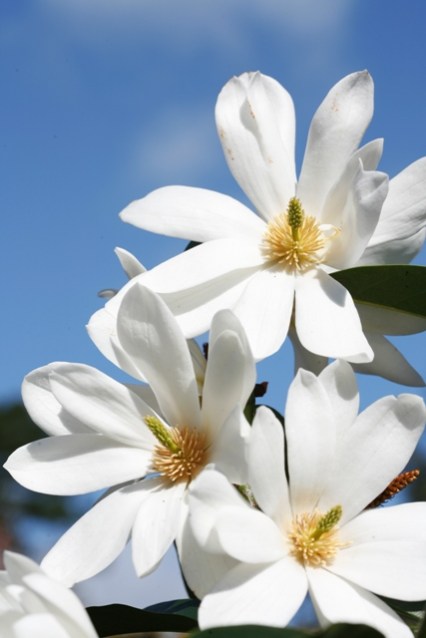
Fairy Magnolia® White is from a different breeding line and we see it as a garden friendly M. doltopa type with very beautiful, perfumed flowers. (photo by Sally Tagg
In recent years, we have wound up the wholesale and retail nursery here in order to concentrate on the garden and plant breeding. At the rate he is going, Mark may eventually end up naming and releasing a few more cultivars than his father, but the selections will have been made from trials involving a much greater number of cultivars.

Magnolia Burgundy Star – as yet unproven overseas but we are hopeful it may prove hardy and keep good flower colour
-39.042098
174.300314