
Bragging rights on the home grown pineapple
“But where are the hollyhocks? I can’t find any hollyhocks,” the garden visitor said last weekend. I can honestly say that that is a first here. Nobody has ever commented on the absence of hollyhocks before. But it is true. We have none. I haven’t tried growing hollyhocks since the children were young and school gardens were still a part of the gardening calendar. The problem with hollyhocks is that they are very prone to rust in our climate which spoils the look.
There are, of course, many other plants we don’t grow. I can’t think that we have any petunias and gerberas are notable for their absence. Sweet peas we lack. Ditto tuberous begonias and we are distinctly light on fuchsias. Some plants we do not grow because we don’t like them, others because they don’t like us. Some are not worth the effort and presumably at least some are because we have never even thought of growing them.
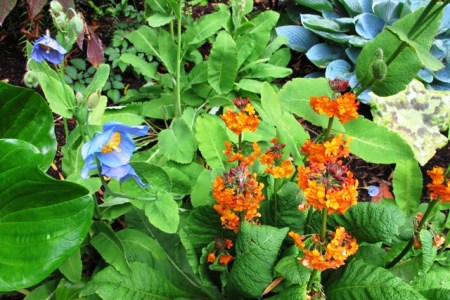
The cold border in the park with meconopsis and Inshriach primulas
The challenge for many a keen gardener is to grow plants which are either very difficult or are well out of their natural zone. We certainly identify with this group. It is enormously satisfying to grow something which is not known in your local area. To this end, we are always trying to stretch the climatic boundaries and we do have options in a big garden. Mark put his cold border onto a south facing slope where temperatures are noticeably cooler and he has managed to get some of the plants which want a colder winter settled in. The blue poppies (meconopsis) from the Himalayas, less common but colourful Inshriach primulas from Scotland, the Chatham Island forget-me-nots and the deep coloured burgundy hellebores are all much happier in cooler conditions.
On the ridge above, the Marlborough rock daisy (Pachystegia insignis) and trickier forms of astelias perch in exposed conditions compensating for our high humidity and mild temperatures. A different north facing slope gives us hotter conditions for the aloes and yucca plants that will rot out elsewhere.
Some highly desirable plants defeat us entirely. We’d certainly grow herbaceous paeonies if we could but they want low humidity, hot, dry summers and dry, cold winters to do well. There is no way we can simulate those conditions. Having had a Dunedin childhood, I loved the Bleeding Heart plant (now named Lamprocapnos spectabilis but formerly and widely known as Dicentra spectabilis). I bought several over a few years to try in different parts of the garden but they never returned for a second season. There was a little lesson there for me – just because garden centres sell a lovely looking plant in full flower does not mean that it is suitable for the local area. Oftimes they are shipped in from places where they do grow well. That is a lesson many others have learned, I am sure.
Where we draw the line is when it comes to having to spray in order to grow plants out of their normal climatic zone. We are not prepared to festoon sensitive plants in frost cloth either but that is because we can’t be bothered and we don’t want that ghostly presence of draped shapes in the garden. Chemical intervention is a step too far altogether.
I have never gotten over my shock when a very experienced gardener told me she kept her alpines alive in our conditions by drenching them in fungicide once a week. I can no longer look at her alpine area as an example of good gardening. Fungicides are not that good for the environment and in my opinion, good practice dictates they should only be used when absolutely necessary and not as a routine application. So no hollyhocks here – we are not going to spray to keep them healthy and we don’t want diseased plants sitting around festering.
If you are not a gardener who relishes the challenge of pushing climatic boundaries, then keeping to plants which are happy in your conditions is going to make life a whole lot easier. This does tend to mean you can’t have a sub tropical garden in Hamilton because winters get cold and frosty. Second daughter attended Waikato University a decade ago and she commented on the gardens she walked past which had clearly been “landscaped” in summer on a tropical theme. Come winter, the plants were blackened, looking very sad and often dead. If you are a novice gardener, take up walking. You can see much more on foot than you will ever see from a car window and noting what is growing well and is being repeated in gardens around your area is a good guide. It may also be an indication of what plants are available for sale.
For those of us who like a challenge, there is nothing quite like the bragging rights that come with… a pineapple! Yes, this was grown and harvested from our very own pineapple patch set against a warm brick wall. Not as sweet as a Dole one but not exactly a run of the mill crop for our area.
First published in the Waikato Times and reprinted here with their permission.

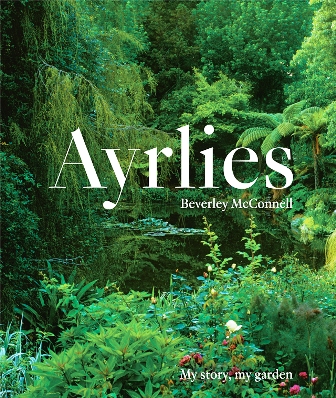 The subtitle of this book is “My story, my garden” and that pretty much captures the flavour. These are Bev McConnell’s memoirs and as both the author and her garden reach maturity, the timing seems entirely appropriate. Her garden, Ayrlies, is located at Whitford, south east of Auckland and over the past 40 years, both the garden and the gardener have earned a leading position. This is a book about a garden, not a gardening book as such. The author writes about her own experiences and while there is wisdom and advice contained in the text, it is not a manual or a reference book.
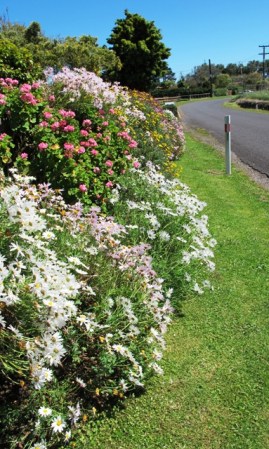 I smile each time I pass a property down our road. The frontage is a froth of flowers for much of the year. There is nothing choice. Most of them are common enough daisy bushes and pelargoniums which balloon out onto the road verge. It is just a delightful picture for the passing motorist – it being in a position where there is no foot traffic. What makes it a little bit special, to my mind, is that the sole reason for this planting is to bring pleasure to passersby. From my vantage point on the road verge, it looks as if the property owner would not really see this particular planting from their house windows or indeed from inside their garden. That shows a generous gardening spirit, in my opinion.
 Tikorangi The Jury Garden