Plant Collector: Rhodohypoxis

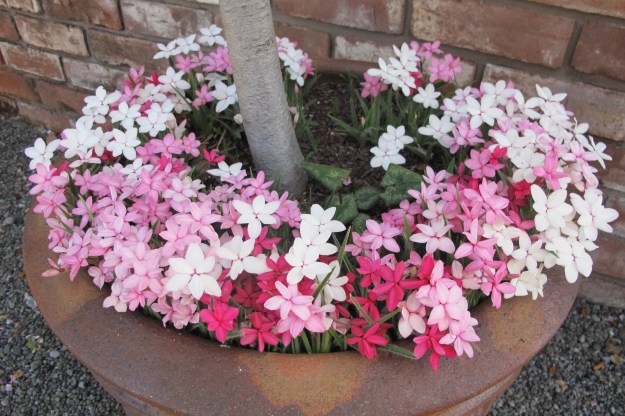
Pretty little rhodohypoxis - Ruth (white), Susan (pink), Albrighton (dark)

Pretty little rhodohypoxis – Ruth (white), Susan (pink), Albrighton (dark)

As the peak time for spring bulbs passes over, the South African rhodohypoxis come into their own. These are cracker little plants, forming a colourful carpet in well drained, sunny conditions. They are also great in wide, shallow bowls or underplanting shrubs in containers, as illustrated. Their fresh growth is triggered by autumn rains and they have a long flowering season from mid spring into early summer, as long as they don’t dry out. The foliage is short and grassy and hangs around unobtrusively until autumn when the plant goes dormant for a brief time.

There are a mass of different named rhodohypoxis, though most are just selections of R. baurii. Essentially they come in sugar pink, deep pink to red, white, bicoloured variations and occasional double forms. They are really easy to grow and multiply up most satisfyingly, with one proviso. The rhizomes are tiny and dark brown – sometimes not unlike the clawed ranunculus and other times just small, brown lumps. This means they are alarming anonymous when dormant and I am sure that is when most people forget where they are and either flay them round when weeding or plant something on top of them. If in doubt, plant them in a pot and sink the whole pot in the garden while you build up numbers.

With a rhodohypoxis expert staying here this week, we had a discussion on whether these bulbs are technically tubers, corms or rhizomes. The internet uses all terms interchangeably. The decision came down fair and square on rhizome status.

First published in the Waikato Times and reprinted here with their permission.

Garden lore

It surprised him to discover that gardening, for all its air of prelapsarian serenity, is furiously competitive, frequently indulged in by the envious, the deceitful, the quietly criminal.

The Pedant in the Kitchen by Julian Barnes (2003).

Onehunga weed or prickle weed in the lawn.

Onehunga Weed

Onehunga Weed

The greatest curse of the lawn is the prickly Onehunga weed. If you know you had it last year – prickles in the feet- now is the time to act. It will take several years to eradicate entirely, but it will get worse if you leave it. You want to break the cycle and stop it from setting seed in early summer. These weeds are annuals – usually they germinate in autumn, romp away in spring (right now, in fact), flower, set seed and prickles and die as lawns dry out over summer. If you only have a little, hand weed it. There are specific sprays developed for Onehunga weed (ask at your local garden centre). We prefer to let the grass grow considerably longer than usual and then follow up in two to three weeks time by cutting it very short – scalping it in fact. The growth stretches the Onehunga weed up and it does not survive being cut very short. Timing is of the essence – if you leave it too late, the prickles and seeds will be developing. Onehunga weed does best in poor conditions. It is not so good at competing in a lush, healthy lawn.

Outdoor Classroom – pruning wisteria


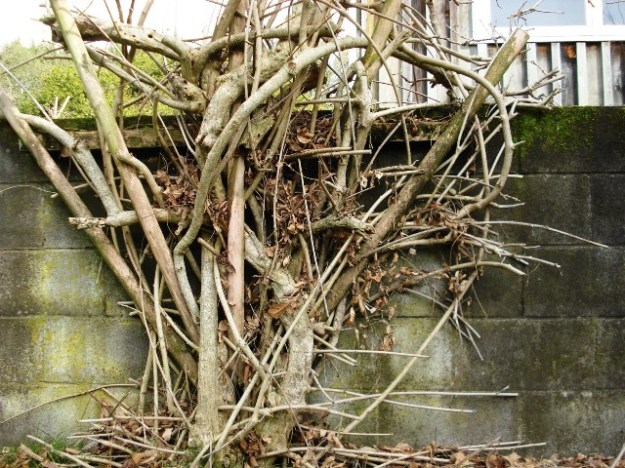
Wisterias are vigorous vines which lose all their leaves in winter. You can not plant them and leave them. If you are not going to prune them at least once a year, you may be wiser to take out the whole plant. After several years of less than thorough pruning, this particular plant had multiple runners which had escaped and run along both the base and the top of the block wall for at least fifteen metres. Planted against a house they will split the spouting if left unchecked.


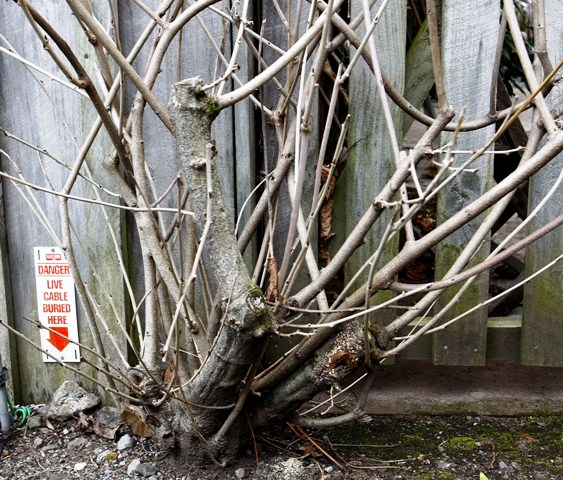
Wisterias flower on old growth so you can’t cut them off at the base and get flowers this season. Look at the plant and decide the shape you want. Check the old stems for borer and rot. Wisterias are vulnerable to the borer larvae. Cut out any bad damage. Choose which stems and canes you wish to keep. You probably don’t need to keep them all.

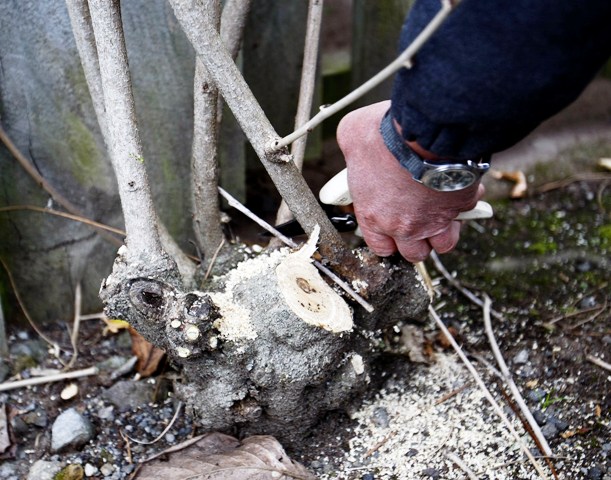
Take out all thin or surplus canes and growths, starting from the base of the plant. Some wisterias are grafted. If you can see where the graft is, you must cut off any growths below that because they will be from the vigorous root stock which will be a stronger grower. This is a cutting grown plant so it does not apply. Don’t put all your trust in one trunk only. It always pays to train a replacement alongside it. The older and more gnarled the trunk, the more chance of borer and rot taking hold.

???????????????????????????????
Further up the plant, decide your central framework (the shape, or skeleton of the plant) and shorten all minor growths to two to four spurs (leaf buds). This is the same principle to pruning an apple tree. You can use the prunings to weave supports for other plants in the garden because they are flexible and they won’t take root easily.


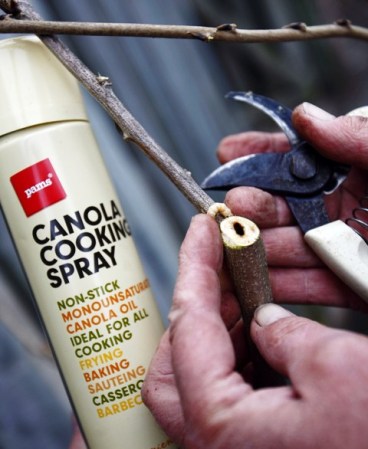
Look for tell tale borer holes in remaining stems and treat these. Spraying kitchen oil or fly spray down the hole can work.

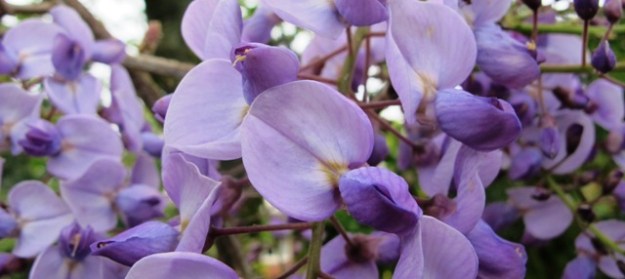
There are two main groups of wisterias, the Chinese ones (“sinensis” which just means from China) and the Japanese ones (floribunda). The Chinese ones usually have finer leaves and they flower on bare wood before the spring foliage appears. Japanese ones tend to have longer flower racemes to compensate for the fact they flower with their new growth. As a relatively random piece of information, the Chinese ones twine anti clockwise whereas the Japanese ones twine clockwise.

The high cost of “regional gardens”

The Taranaki Regional Council’s summary of their annual report arrived as an inclusion in our free community newspaper. “Duty of Leadership”, it heads itself with a wonderful air of importance. The section that interested us was the one on the regional gardens which had around $2,100,000 spent on them in the last financial year.

Just to clarify, the regional gardens do not include the likes of Pukekura Park and King Edward Park which remain with District Councils. The regional gardens are a different kettle of fish entirely to the highly valued urban spaces that city parks and gardens provide. They are comprised of Tupare and Hollards (both former private gardens of a similar size and age to our own garden) and Pukeiti (formerly a private trust garden).

When Regional Council took over these gardens, in their wisdom they decided to give free entry. Except nothing is free. It just means the entry charges have been replaced by ratepayer funding despite the fact that many of the bona fide garden visitors are tourists. So ratepayers are paying for the free entry of people from beyond the region.

The same report this week claims close to 20,000 visitors to Pukeiti last year. We wonder how entries are counted for all the gardens, given that people just walk in. Without electronic counters, there is no way of knowing how many people actually visit and I can’t say I have noticed electronic counters on Tupare’s entrances. As far as we know, Council are claiming combined visitor numbers in the vicinity of 50,000 people. That sounds great – until you divide the $2mill and find it is costing ratepayers around $40 per head for every person that sets foot in those gardens.

We question how many of those 50,000 claimed attendances are actually to see the gardens. A fair proportion are there simply because the gardens are being used as a ratepayer subsidised venue. People who go to Farmers Markets, Fun Runs (there’s an oxymoron for you), an Antiques Fair and weddings are NOT garden visitors. The gardens are merely an incidental backdrop.

Our educated guess is that the number of bona fide garden visitors who go specifically to look at lovely gardens would be less than half that figure. There just aren’t that many garden visitors around. So even if they attract 25 000 genuine garden visitors, that ratepayer subsidy leaps to $80 for every man, woman and child who sets foot in the gate.

The decision to waive all entry fees and place the full costs of these gardens on the ratepayer is one which immediately put Regional Council in direct competition with the private sector. I am still stunned at the naivety of one councillor who said to me recently, “Have you had no positive spin-off?” Well no, because Council set the value of a garden visit at a big fat zero. We see garden tours come in to the province whose itineraries include all or most of the free Council gardens and one or two small town gardens. The much vaunted cruise ship last summer is only one case in point. Of course tour participants pay an all-inclusive price so any extra profit from concentrating on the free gardens goes straight into the pockets of the tour operators.

I quote an email received by friends with a large private garden: “We plan to bring a group down to New Plymouth for 4days early Nov.& have had your gardens recommended to visit. Even though we have brought other groups to New Plymouth we have not come out to Oakura. We are looking at coming to your place either the 5th or 6th Nov. depending on the weather. Are your gardens open all year?, & is it a free council one?

In fact Council have made it much harder for the private gardens which suddenly look very expensive at a $10 per adult gate charge. But to say so publicly (as I am here), is to open oneself to accusations of self interest and sour grapes. Of course we are more interested in our own garden. What couldn’t we do with half a million dollars of public money a year? In fact the annual garden festival (the Powerco Taranaki Garden Spectacular) is the event that makes opening a private garden viable here, not the provision of very expensive regional gardens with free entry.

The Taranaki Regional Gardens have a whiff of empire building about them. Add in the rugby stadium in New Plymouth, as the Taranaki Regional Council has, and the empire expands. Bring on local body reform.

Today’s column is but the latest in a series over recent years. Earlier columns on this topic include:
1) Taranaki Regional Gardens Part 1 – first published late 2004
2) Taranaki Regional Gardens Part 2 – first published, apparently January 2005. A satirical take on the situation.
3) And Taranaki Regional Gardens Part 3 – which tells about the treatment of an unsolicited submission. When in doubt, levy accusations of self interest. This may explain why we no longer bother trying to follow the “official” channels (read: hoops to jump through) set up by Council.
4) A tale of Pukeiti Rhododendron Trust and ratepayer funding Published March 2010.
5) A letter from a ratepayer My satirical letter to the chair of the Taranaki Regional Council from July, 2010. (He never replied, of course.)

Plant Collector: Satyrium corrifolium

Satyrium corrifolium

Satyrium corrifolium

The complex orchid family has a large number of different satyrium species and most of them, including S. corrifolium, are native to southern Africa. These are terrestrial orchids which means they grow in the ground and these ones are tubers. Corrifolium is fully deciduous and come mid spring, delights us with its vertical accents of orange and yellow bicoloured flowers in the rockery. The references tell me that they get to well over a metre high but ours are all around the 60cm mark. At a metre high, we would have to stake them with our winds in this country. The leaves are fleshy and few in number, forming a rosette at the base. The biggest problem is that they come into growth in winter and are a bit frost tender so would need protection in inland areas.

This is another plant probably best sourced through local orchid societies. Once you have one, with care you can increase it from the tubers but you will probably have more success doing this in a pot than in the ground. Keep the pot on the dry side when the plant is dormant so the tubers don’t rot. In a garden situation, plants need good drainage and will grow in both full sun and semi shade.

Note: We don’t have S. corrifolium available for sale but we do have plenty of Satyrium odorum with its green flower spike and scent reminiscent of lemon cloves. It is just coming in to flower now.

First published in the Waikato Times and reprinted here with their permission.