Outdoor Classroom – pruning wisteria


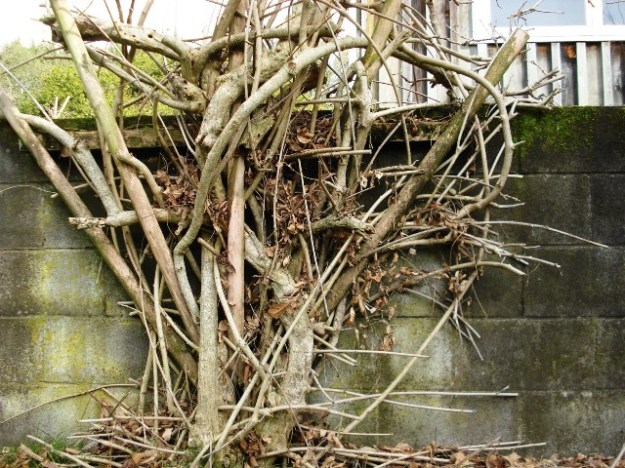
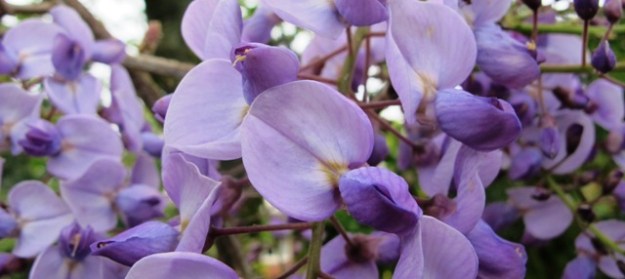
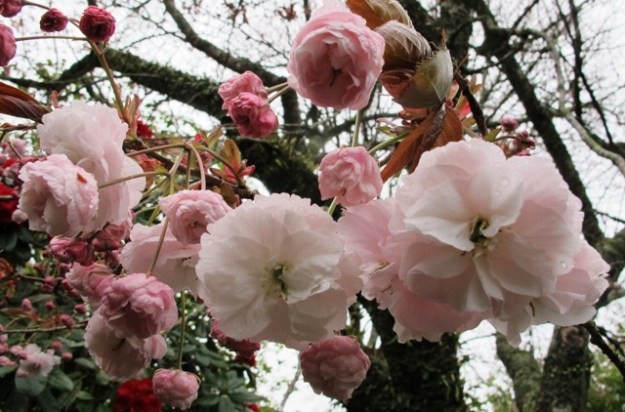
Wisterias are vigorous vines which lose all their leaves in winter. You can not plant them and leave them. If you are not going to prune them at least once a year, you may be wiser to take out the whole plant. After several years of less than thorough pruning, this particular plant had multiple runners which had escaped and run along both the base and the top of the block wall for at least fifteen metres. Planted against a house they will split the spouting if left unchecked.


Wisterias flower on old growth so you can’t cut them off at the base and get flowers this season. Look at the plant and decide the shape you want. Check the old stems for borer and rot. Wisterias are vulnerable to the borer larvae. Cut out any bad damage. Choose which stems and canes you wish to keep. You probably don’t need to keep them all.

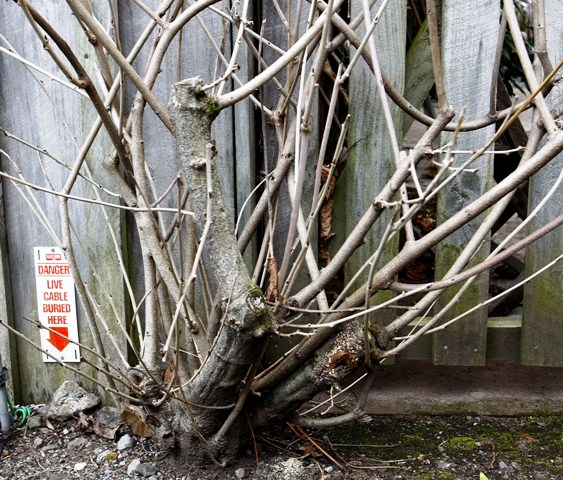
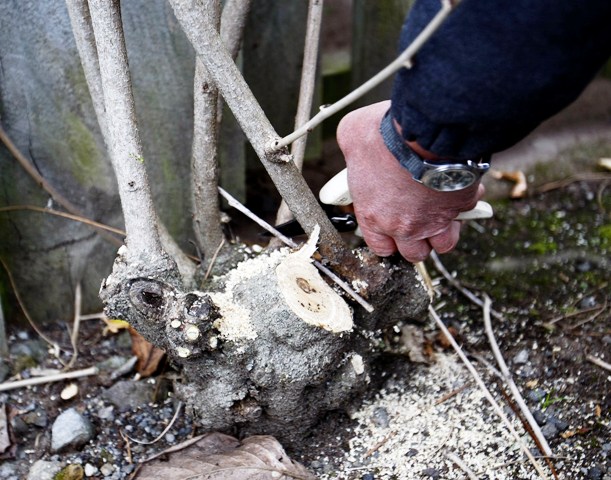
Take out all thin or surplus canes and growths, starting from the base of the plant. Some wisterias are grafted. If you can see where the graft is, you must cut off any growths below that because they will be from the vigorous root stock which will be a stronger grower. This is a cutting grown plant so it does not apply. Don’t put all your trust in one trunk only. It always pays to train a replacement alongside it. The older and more gnarled the trunk, the more chance of borer and rot taking hold.

???????????????????????????????
Further up the plant, decide your central framework (the shape, or skeleton of the plant) and shorten all minor growths to two to four spurs (leaf buds). This is the same principle to pruning an apple tree. You can use the prunings to weave supports for other plants in the garden because they are flexible and they won’t take root easily.


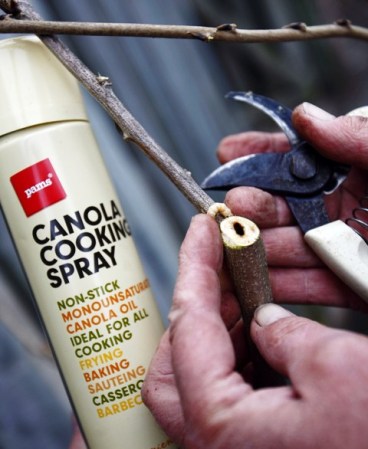
Look for tell tale borer holes in remaining stems and treat these. Spraying kitchen oil or fly spray down the hole can work.

There are two main groups of wisterias, the Chinese ones (“sinensis” which just means from China) and the Japanese ones (floribunda). The Chinese ones usually have finer leaves and they flower on bare wood before the spring foliage appears. Japanese ones tend to have longer flower racemes to compensate for the fact they flower with their new growth. As a relatively random piece of information, the Chinese ones twine anti clockwise whereas the Japanese ones twine clockwise.

The high cost of “regional gardens”

The Taranaki Regional Council’s summary of their annual report arrived as an inclusion in our free community newspaper. “Duty of Leadership”, it heads itself with a wonderful air of importance. The section that interested us was the one on the regional gardens which had around $2,100,000 spent on them in the last financial year.

Just to clarify, the regional gardens do not include the likes of Pukekura Park and King Edward Park which remain with District Councils. The regional gardens are a different kettle of fish entirely to the highly valued urban spaces that city parks and gardens provide. They are comprised of Tupare and Hollards (both former private gardens of a similar size and age to our own garden) and Pukeiti (formerly a private trust garden).

When Regional Council took over these gardens, in their wisdom they decided to give free entry. Except nothing is free. It just means the entry charges have been replaced by ratepayer funding despite the fact that many of the bona fide garden visitors are tourists. So ratepayers are paying for the free entry of people from beyond the region.

The same report this week claims close to 20,000 visitors to Pukeiti last year. We wonder how entries are counted for all the gardens, given that people just walk in. Without electronic counters, there is no way of knowing how many people actually visit and I can’t say I have noticed electronic counters on Tupare’s entrances. As far as we know, Council are claiming combined visitor numbers in the vicinity of 50,000 people. That sounds great – until you divide the $2mill and find it is costing ratepayers around $40 per head for every person that sets foot in those gardens.

We question how many of those 50,000 claimed attendances are actually to see the gardens. A fair proportion are there simply because the gardens are being used as a ratepayer subsidised venue. People who go to Farmers Markets, Fun Runs (there’s an oxymoron for you), an Antiques Fair and weddings are NOT garden visitors. The gardens are merely an incidental backdrop.

Our educated guess is that the number of bona fide garden visitors who go specifically to look at lovely gardens would be less than half that figure. There just aren’t that many garden visitors around. So even if they attract 25 000 genuine garden visitors, that ratepayer subsidy leaps to $80 for every man, woman and child who sets foot in the gate.

The decision to waive all entry fees and place the full costs of these gardens on the ratepayer is one which immediately put Regional Council in direct competition with the private sector. I am still stunned at the naivety of one councillor who said to me recently, “Have you had no positive spin-off?” Well no, because Council set the value of a garden visit at a big fat zero. We see garden tours come in to the province whose itineraries include all or most of the free Council gardens and one or two small town gardens. The much vaunted cruise ship last summer is only one case in point. Of course tour participants pay an all-inclusive price so any extra profit from concentrating on the free gardens goes straight into the pockets of the tour operators.

I quote an email received by friends with a large private garden: “We plan to bring a group down to New Plymouth for 4days early Nov.& have had your gardens recommended to visit. Even though we have brought other groups to New Plymouth we have not come out to Oakura. We are looking at coming to your place either the 5th or 6th Nov. depending on the weather. Are your gardens open all year?, & is it a free council one?

In fact Council have made it much harder for the private gardens which suddenly look very expensive at a $10 per adult gate charge. But to say so publicly (as I am here), is to open oneself to accusations of self interest and sour grapes. Of course we are more interested in our own garden. What couldn’t we do with half a million dollars of public money a year? In fact the annual garden festival (the Powerco Taranaki Garden Spectacular) is the event that makes opening a private garden viable here, not the provision of very expensive regional gardens with free entry.

The Taranaki Regional Gardens have a whiff of empire building about them. Add in the rugby stadium in New Plymouth, as the Taranaki Regional Council has, and the empire expands. Bring on local body reform.

Today’s column is but the latest in a series over recent years. Earlier columns on this topic include:
1) Taranaki Regional Gardens Part 1 – first published late 2004
2) Taranaki Regional Gardens Part 2 – first published, apparently January 2005. A satirical take on the situation.
3) And Taranaki Regional Gardens Part 3 – which tells about the treatment of an unsolicited submission. When in doubt, levy accusations of self interest. This may explain why we no longer bother trying to follow the “official” channels (read: hoops to jump through) set up by Council.
4) A tale of Pukeiti Rhododendron Trust and ratepayer funding Published March 2010.
5) A letter from a ratepayer My satirical letter to the chair of the Taranaki Regional Council from July, 2010. (He never replied, of course.)

Plant Collector: Satyrium corrifolium

Satyrium corrifolium

Satyrium corrifolium

The complex orchid family has a large number of different satyrium species and most of them, including S. corrifolium, are native to southern Africa. These are terrestrial orchids which means they grow in the ground and these ones are tubers. Corrifolium is fully deciduous and come mid spring, delights us with its vertical accents of orange and yellow bicoloured flowers in the rockery. The references tell me that they get to well over a metre high but ours are all around the 60cm mark. At a metre high, we would have to stake them with our winds in this country. The leaves are fleshy and few in number, forming a rosette at the base. The biggest problem is that they come into growth in winter and are a bit frost tender so would need protection in inland areas.

This is another plant probably best sourced through local orchid societies. Once you have one, with care you can increase it from the tubers but you will probably have more success doing this in a pot than in the ground. Keep the pot on the dry side when the plant is dormant so the tubers don’t rot. In a garden situation, plants need good drainage and will grow in both full sun and semi shade.

Note: We don’t have S. corrifolium available for sale but we do have plenty of Satyrium odorum with its green flower spike and scent reminiscent of lemon cloves. It is just coming in to flower now.

First published in the Waikato Times and reprinted here with their permission.

The potential folly of the phalanx planting

The seductively quick result of grid planting

The seductively quick result of grid planting

As I drive into town, I pass a grid planting of trees in a garden. I understand these formal grid plantings are called a phalanx these days, which is probably an indication of their growing popularity in modern design. A chic interpretation of the commercial plantation, perhaps?

If you have a big garden with a large flat area, there is a seductive appeal to grid planting the same tree. It has an immediate impact and as such is a weapon in the landscaper’s armoury. A 4 x 4 grid is a small one, but it is still 16 matched trees all flowering at the same time (assuming you have chosen a flowering one). A 6 x 5 grid is 30 trees which is potentially impressive. It is using soft landscaping (plants) to achieve the impression of hard landscape structure. It should look like a deliberate statement of style.

That is about all I can think of in favour of the phalanx.

If you are going to try one, get out the tape measure. Don’t even think of doing the spacings by eye. You need accurate measurements all the way so the trunks line up. You also need closely matched trees. One or two with poor root systems may struggle for years and spoil the uniformity. While minor variations in height will even out over a year or two, variations in shape or vigour may never do so.

I don’t like them because I think it is a very short term trick for effect and if you are going to go to the trouble of planting trees, I think they should include good quality specimens planted in situations where they have at least some chance of reaching maturity. I see too little consideration going into the selection of the cultivar. If you are going to plant somewhere up to 36 or even more identical trees, it matters a great deal which one you choose. Alas, the selection is more likely to be governed by price and availability than anything else. Too often these grids are done in short term cheapies.

Next there is the problem of working with living plants and not all may oblige equally. If one or two trees die in the phalanx, it destroys the uniformity on which the formality depends. The same is true of formal avenues, of course and it is one of my enduring memories of an otherwise splendid Italian villa garden – random and obvious gaps in a line of mature lindens.
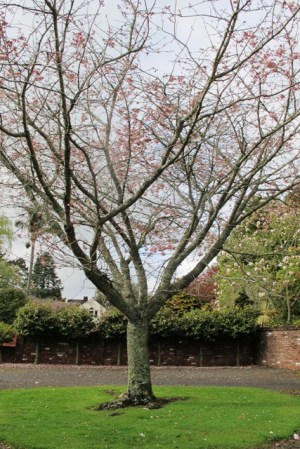
Pearly Shadows - but allow 15m spacings long term

Pearly Shadows – but allow 15m spacings long term

Spacing is an issue. I looked at our Prunus Pearly Shadows which would make a handsome phalanx specimen with its upright Y-shaped growth. A phalanx relies on each tree standing in its own space. As soon as they mesh together, you have something more akin to a forest. While not a particularly large tree, the extent of the canopy on a free standing, mature Pearly Shadows is in fact 15 metres. I paced it out. Yet planting out at final spacings would simply look mingy and dwarfed in the early years. Sure you can plant closer and plan to go through in due course removing every second tree to give the remaining ones a chance but that is not without risk and considerable expense. You would have to fell very carefully so the falling branches and trunks do not cause damage. If you don’t take out the stump, roots and all, you run the real risk of opening up the remaining trees to armillaria – honey fungus, which will take hold in the rotting stump and move on to healthy neighbouring root systems, usually killing the host.

Then there is the problem of maintaining the grass below. If you like the formality of the phalanx, then odds on you won’t want rank, long grass beneath. But mowing around all the trunks is fiddly and you certainly couldn’t manage the formal striped effect. Using a weed eater is risky in the wrong hands because of the likelihood of damaging the bark on the trunk and maybe ringbarking the tree. Spraying will leave ugly, rank brown grass.

When I thought about phalanxes, I came to the conclusion that they are a lot harder to do well than initially appears to be the case and are decidedly impractical in the mid to long term. If you go for a more random planting, it won’t spoil the effect if some specimens fail to thrive. In the short term, you could achieve a copse, in the long term a woodland. You could manage some level of uniformity by keeping to one plant genus – say, all maples or all magnolias, without keeping to the same plant variety. But then I would say that. I am happy to sacrifice the instant appeal of a formal planting in order to achieve a higher level of plant interest. I would much prefer to look at a collection of different maples, rather than serried rows of the same one.

Each to their own, but I would only plant a phalanx if I was tarting up a property to sell.

The humble origins of the ornamental phalanx may lie in commercial plantations

First published in the Waikato Times and reprinted here with their permission.

Garden lore

If you have a flowering cherry (prunus) with large areas which haven’t bloomed this spring, it is likely it has witch’s broom. Those branches will sprout much denser foliage than the rest of the tree and will take over the tree if left unchecked. Mark the base of the affected branches (spray on paint cans are good for this) and cut them out in summer which is the time for pruning these trees. Cherry trees of Japanese origin are particularly vulnerable to this affliction and if you don’t do anything about it, you will end up taking out the entire tree because it will not flower at all.

“The best way to get real enjoyment out of the garden is to put on a wide straw hat, hold a little trowel in one hand and a cool drink in the other, and tell the man where to dig.”

Charles Barr
(about whom information is hard to find, beyond this particular quote).