Sydney inner city suburbia

I mentioned in my last post that I was heading to Sydney last week to meet our new granddaughter. Not having lived in a city – or even a town – for over 40 years, I find wandering suburbia a great deal more interesting than is perhaps true for most others. In this case, my visit was in the area of Croydon Park where our daughter lives. It is an older suburb on the outer reaches of the zone referred to as ‘the Inner West’.

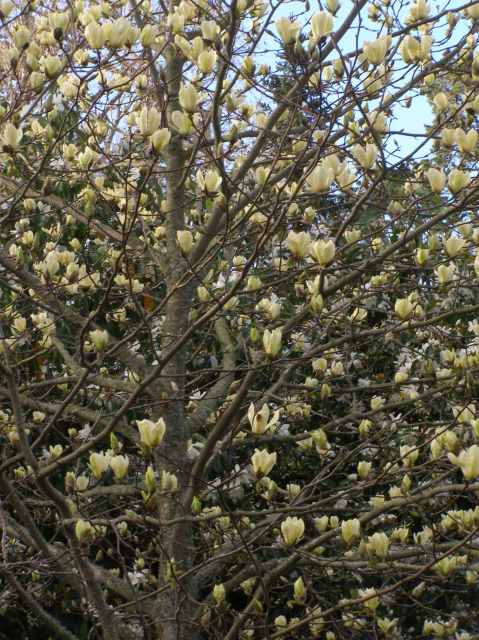
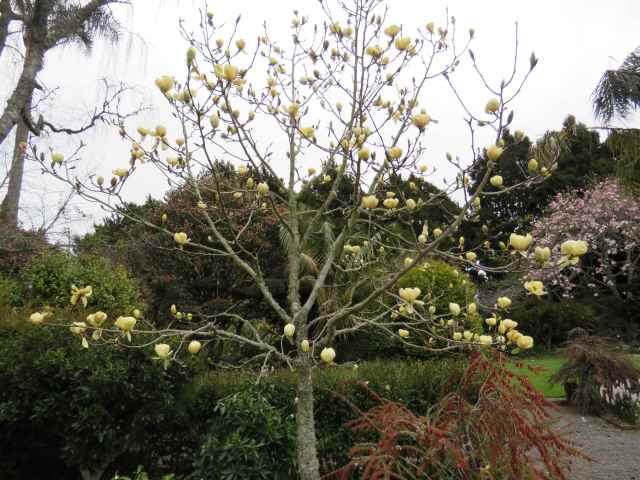
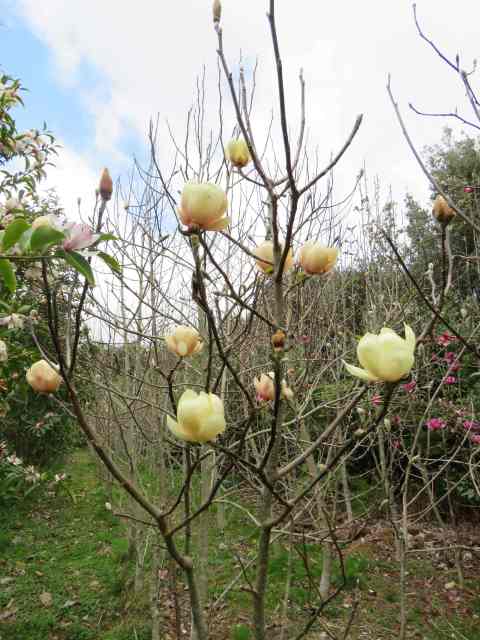
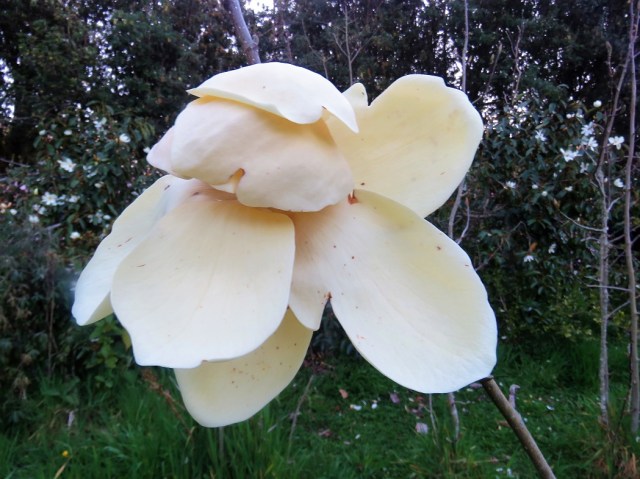
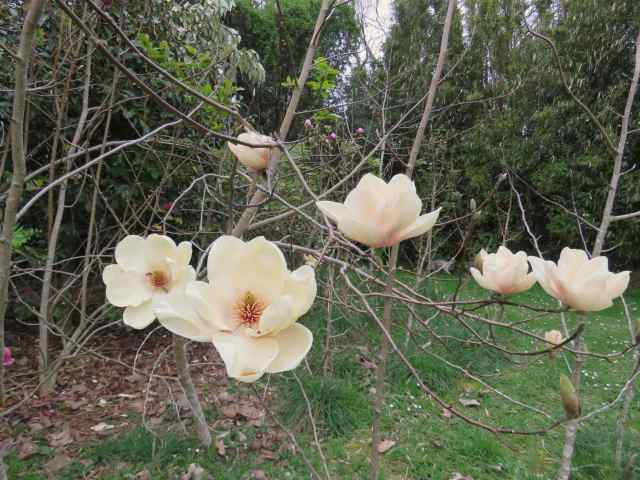
Just the one variety of magnolia and a pretty ordinary one at that

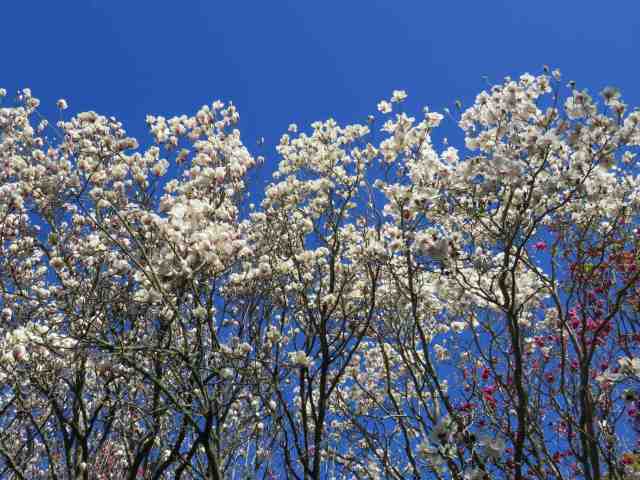
I hoped to play spot the magnolia, it being the right season. I did indeed spot the one, or rather the many specimens of the only one I saw in flower. They were all about the same age so I guess the local garden centre only stocked the one rather ordinary soulangeana 15 or 20 years ago when they were planted.

Flashes of red in the distance turned out to be a poinsettia

I had a brief moment of excitement when I spotted flashes of red from a distance and I thought it might be Magnolia ‘Vulcan’. But no, as soon as I drew closer I realised it was a poinsettia, presumably one of those Christmas poinsettia in little pots that they had planted in the garden after the festivities were over. That is a frangipani on the right which tells you something about their mild winters and hotter summers.

Camellia ‘Volunteer’

I did find one specimen of Mark’s Camellia ‘Volunteer’ in the next street over in my quest to spot the Jury plants. They don’t have camellia petal blight in Australia so the brown flowers are most likely caused by botrytis. But they weren’t big on gardening in Croydon Park so I turned my attention to the houses instead.

Identical houses, street after street

It wasn’t long before I realised I was looking at the same 1930s house in many guises. I did an online search to look at the history to see if I could find a reason why there was an entire suburb built in the same house – two modest front gables and a small front porch, all on pretty small sections for the time. I couldn’t find a reason and came to the conclusion that it was just 1930s spec* housing, presumably all with an identical internal floor plan.

To this day, in Aotearoa NZ, we have been driven by the desire to have a house that looks different to our neighbours. True, they may look very similar and are uniformly painted grey these days -maybe with a daring red trim – but they are not identical floor plans and external design. Sydney is different and I noticed neighbouring suburbs with slight variations in design but the same uniformity, house by house by house.

I started to take note of the renovations of these houses down the years, some with mixed results. It seems that Croydon Park residents want their home to look different, even if they are all the same design. Indulge me, as I take you through 90 years of identical houses.

As far as I could work out, these are well-maintained examples in what must be close to original condition. There was variation in the verandah posts.

Rendering or plastering clearly became popular at some point because many of the houses had been re-coated, sometimes just the front facade and sometimes all over. And, to be honest, I have seen more attractive red brick than the one used in this suburb.

Maybe a 1970s renovation on the left hand house? The front verandah has been closed in, aluminium windows installed and every vestige of original detail stripped off to turn it into an charmless, utilitarian box.

Again, the detail has gone, bar the vaguely decorative security grating on the windows. I asked daughter if this was a high crime area, given the houses that had security screens and she said that she didn’t think it was at all. So maybe just paranoia.

In more recent times, the suburb has become a little more desirable and the renovations are more… aspirational, shall I say? I did like the warm golden shade the render has been painted, the retention of original detail and the fence design to complement the house.

Modestly aspirational, perhaps? I feel it is a mistake to remove the detail of what I call the original eyebrows over the front windows.

More aspirational but looking sharp. At least it is painted white with black trim, not grey.

And here is the latest version – all original details removed, larger front windows, contemporary planting and painted grey (of course).

Then there are the houses that have been extended at the back. These are not on large sections so they need to go up to get much more floor space.

And E X T E N D E D indeed.

Typical of an older suburb which is undergoing rapid redevelopment, there was quite a lot of activity knocking down the old cottages and building McMansions in their place. I feel this photo is a fair representation of the change in space demanded in modern times, although it is rather better architecturally than the ones which were modelled more on the faux-Florida style – all in tasteful grey or taupe, of course.

*Spec housing is the shorthand term in our country for housing built by property speculators for immediate sale.

*NB Daughter and her partner do not live in one of these houses. Their property is way more interesting architecturally being part of a conversion of a 1920s art deco commercial building. It has a small back yard that they have turned into something interesting, albeit with insufficient space for one of her father’s magnolias.

Palms are a great deal more popular than magnolias

Marking Matariki

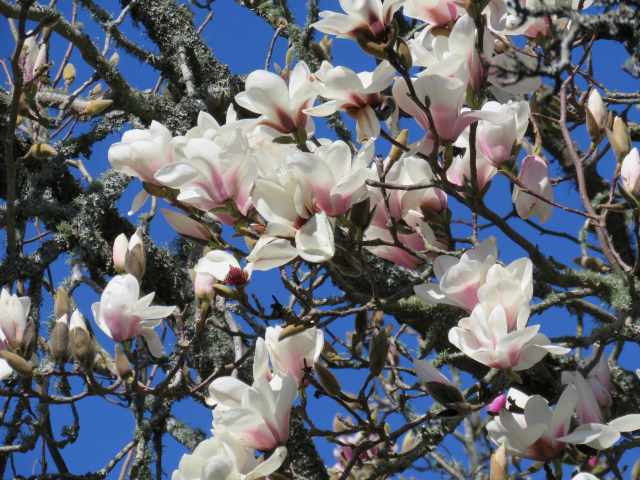
My personal marker of Matariki – our maunga, Mount Taranaki, and Magnolia campbellii.

Our second official marking of Matariki, the Māori New Year, has been a curiously moving experience for me and for many others, it seems. It became a statutory holiday last year for the first time, one of eleven paid days off, alongside Christmas, Easter and the increasingly irrelevant monarch’s birthday which bears no connection whatever to the actual birth day, be it Edward V111, Elizabeth 11 or Charles 111. Curiously, I have only just discovered that it was the aforementioned Edward who moved the official date to June (he was born in November) in the hope of better weather for the day. Let that not affect those of us in the former colonies; finer weather be damned. We still keep to the midwinter date of the first Monday in June. But I digress.

I have written about Matariki before   in the context of the start of a new year and my wonder that, in pre-European times, Māori arrived at a time for celebrating the occasion that corresponds very closely to the winter solstice and the European convention for New Year on January 1, except that it is six months apart, as befits a different hemisphere where the seasons are reversed. The timing of Matariki is determined by the rising of the star cluster known elsewhere as the Pleiades.

Our kauri which is the Māori name for what is botanically Agathis australis, one of this country’s most venerated trees. They can live well over 1000 years so ours is a mere baby at just 60 years. Sadly, most of the oldest trees in this country were felled in just a few decades after European settlement in the mid 1800s.

While most of our statutory holidays in this country are simply paid days off – welcomed by wage-earners and deplored by business-owners – Matariki is bringing a welcome character of its own. It is not just about the start of another year. It is about honouring the past and especially those who have died in the past year, celebrating the present and looking with hope to the year ahead. I see resistance to attempts to commercialise the day in the manner that Easter has become more about chocolate eggs, bunnies and hot cross buns than about the story of Christ. Matariki is our unique celebration here in Aotearoa New Zealand and the occasion this year has been dominated by Māori voices and a Māori perspective on marking the end of one year and the start of another. I have found it an affirming and positive experience.

Magnolia campbellii against the snow
Drawing back from the camera zoom, you may be able to spot a very small white peak to the left of the trunk of the tree fern, the magnolia and a veritable United Nations of plants dominated by our native tree fern in the foreground.

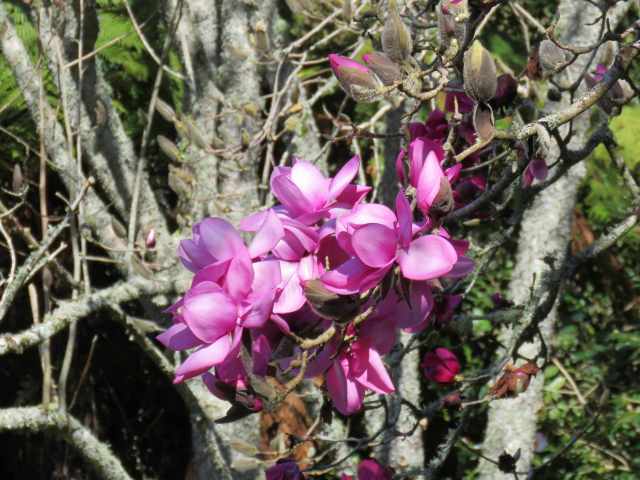
Even before we started to mark Matariki officially, I saw this time as the start of a new gardening year. For me, the opening of the Magnolia campbelllii brings fresh promise in the middle of winter. I did think that I should be illustrating this post with photos of native plants in the garden, entering into the spirit of this special time. We grow a surprisingly large number of native plants but always integrated with other plants from around the world. And as we were walking around the garden with friends from Auckland yesterday, I was rather too distracted to focus on singling out specimens of indigenous flora. I may make it a project next year.

Self-sown tree ferns. We have five different species in this country; I think we have four of the five species seeding in our garden but I am a bit vague about the differences on a couple of them. They are more prized overseas than here where we take them for granted.
I have my own personal celebration of Matariki this year. I am off to Sydney on Tuesday to meet the newest member of our family – a small granddaughter who is way too young to realise that she brings together the threads of Aotearoa (her mother), France (her papa) and Australia (her birthplace). This means there won’t be a post next Sunday

Ngā mihi o Matariki, te tau hou Māori

Happy Matariki

I think those are one of our native gahnia grasses (cutty grass) edging a pond in the Wild North Garden. With Ralph carrying out his usual photobombing intrusion.

What makes a garden? The wild garden debate.

‘Wild’ gardening may be all the rage in the UK these days but it is not a discussion that we are rushing into with any enthusiasm in Aotearoa New Zealand. Maybe we are a bit sensitive in this country to the status of weeds, given that so many of our biological time bombs are garden escapes. Or maybe not. There is a possibility that the majority of homeowners in this country still prefer a neatly maintained section with tidy borders, sharp lines and an immaculate lawn.

We call this our ‘Wild North Garden’ but it would not pass the test of a wild garden in more purist circles

Whatever the case, I found this article interesting. We will gloss over the fact it is in The Telegraph, a UK publication of somewhat questionable political affiliations; it does seem to have some good gardening pieces. I will park Alan Titchmarsh to one side because I think he is a spokesperson for a past generation of gardeners. It was Monty Don’s comments that interested me because some of us are familiar with his garden through BBC’s Gardeners’ World and I would have described much of his garden as being ‘naturalistic’ in style, verging on ‘wild gardening’ at times. It seems that ‘wild gardening’ in the UK is a great deal wilder than I had thought.

“It is as though a so-called ‘wild’ garden that mimics natural conditions is somehow worthier and more moral than one in which mankind’s creative skills are more obviously played out.

“This is puritanical nonsense.  If you want a truly wild garden then simply walk away. Leave any patch of ground completely untouched by human hand and it will happily become whatever it wants to be.

“The result might be beautiful and richly satisfying as well as very good for wildlife of all kinds, but it will not be a garden.”.

Monty Don in The Telegraph
This was the first deliberately wild or naturalistic garden I had seen, in Marlborough back in 2008. While looking very natural, the whole area had been recontoured and replanted, using native plants of the area. I loved it and how it sat in its wild landscape, even though it was not pretty and contained no elements traditionally associated with gardens. At the time, I wondered if it was a garden or a landscape; now I am happy to describe it as a garden.

I think he makes a useful distinction. I see he has been on this topic for a while. The best in show title at Chelsea Flower Show last year was won by a so-called wild garden created by two people who describe themselves as “passionate ecological restorationists”, rather than gardeners. I can’t read the whole article about Monty Don questioning whether their display was actually a garden at all because I am not willing to sign up to The Telegraph, even though they offer the first month free. I have my own standards when it comes to media. Ecological restoration is a different kettle of fish, to my mind. It involves eco-sourcing plant material (limiting plants to those sourced from local plant populations), keeping to native plants only with a purist vision of returning land to how we think it may have been in earlier times, usually prior to European settlement. Aesthetics are not a factor when it comes to ecological restoration, although the end result may well be visually pleasing to some.

Yes, we do ‘garden’ this area, but differently to other areas.

Of course, many of our weeds in this country are native wildflowers in the UK so rewilding with those may have a prettier result without being tainted by the connotations of rampant, invasive pest plants. We are a bit thin on pretty- flowered, native perennials and annuals in this country, although we have a wealth of beautiful flowering trees and shrubs and some splendid grasses.

Our personal take on wild gardening here at Tikorangi would not meet the purity test. Not by a long shot. We started the Wild North Garden with a mix of both native plants and exotics and have continued with that. We still carry out weed control. We have to in our conditions or it would deteriorate into a weedy mess in a single season. But we don’t remove every weed as we attempt to in the more tightly managed areas of the garden.

Wild gardening is NOT a case of shutting up an area and letting Nature take over, as some assume. It is not an excuse for lazy gardening. It is a different way of managing an area, a lighter hand, way less emphasis on tight control and instead viewing an area through different eyes with different expectations.  

Simple solutions, not man-made focal points

We have shunned contrived ‘focal points’ and garden features that are clearly made by human hands. The simple bridges and a couple of bench seats are the only man-made structures although, in reality, the whole area has been reshaped, re-formed and planted by human hands. We do a lot of lifting and limbing to get view shafts and a sense of distance in the area. There are no defined borders or garden beds but we continue to add plants that we think can blend in, add interest, compete with competition from other plants and survive with minimal maintenance. There is no deadheading, seasonal cutting back or staking. Management of the area – which our property title tells me is close to 4 acres or a hectare – is light-handed but manage it we do.

We do a lot of lifting and limbing of trees and shrubs to create view shafts and vistas while keeping a more natural feel.

That is what we are calling wild gardening. At a personal level, when I am leading people through the garden, I always finish up in the Wild North Garden and as I walk down the hillside to enter it, I can feel myself breathing out and relaxing. I find I talk less and more quietly. It feels different to every other area of the garden and very, very different to the more tightly maintained, detailed areas. I love that different feel.

Regenerating native vegetation on a roadside bank just north of the Tongaporutu Bridge. it was beautiful enough in the morning light to make me stop the car to look but it is not a garden.

I am with Monty Don, though. I think, by definition, a garden requires a human vision, a sense of aesthetics and human hands in its creation and ongoing management. Nature can be very beautiful and natural environments can nourish the human spirit or even take one’s breath away; Nature can establish and support an extensive ecosystem if given the opportunity. But that does not make it a garden. Wild gardening or naturalistic gardening is a human attempt to find the meeting ground between a garden and the natural environment that also fulfils a purely human aesthetic.  

This is from one of our most favourite gardens ever – Wildside in North Devon. Most of Keith Wiley’s remarkable garden is anything but wild – it is highly detailed naturalistic plantings. This was a new area he was just starting to expand into and it had that loose, soft feeling that I associate with wild gardens.

← Back

Thank you for your response. ✨

A pleasing project

Gardening here tends to come down to routine maintenance, emergency response (usually storm damage and fallen trees) and new projects. Projects are the most interesting but we have done all the large projects we planned so we are down to smaller ones now. It gives a break from routine maintenance which, by definition, is never-ending.

Opening up a new, main path to link the Avenue Gardens to the Summer Gardens

The latest project was getting the central path in to the Summer Gardens from the Avenue Gardens. It was always on the drawing board but sometimes it takes a bit longer to think through how best to achieve a good result. After three years of somewhat desultory thought, it was remarkably straightforward in the end. I was stuck on the idea that it had to be straight ahead, centred from the main Court Garden. The breakthrough came when Mark pointed out that while one end needed to be dead straight, where it came through to the avenues didn’t need to be. We could curve it so that the visual end-point was a large tree – a sterile Prunus campanulata, as it happens. That was the compromise that made sense to me.

Lloyd and Zach set about removing plants that were in the way. Digging out about five solid camellias to create an opening in the hedge was the biggest job although removing some rather large roots from another tree also took some muscle. Lloyd, being a man of precision, set about levelling the path, laying a base course for drainage and moving leftover cream-coloured limestone and shell gravel to match the path surfaces in the Summer Gardens. Where we transitioned to the woodland area, he spread coarse woodchip and we will let leaf litter build over it.

The line between the whitish gravel and the woodchip is a little stark at the moment, but otherwise, it all looks as if it has always been there and that is our goal – avoiding the look of something glaringly new in a well-established garden. The concrete post is still under debate. It is a relic from times past and Lloyd, who has already dug one out previously and therefore knows just how deeply those posts are bedded in the soil, has delegated this one to Zach, if we want it gone. I will wait and see if it annoys me over time.

A view shaft in creation was a nice surprise

I am delighted by the fact that there is now a view shaft from the Court Garden through to the Avenue Gardens – a leafy tunnel that leads to light from both directions.

Freshly replanted and in two sections now, the back border features gossamer grass and cardoons

The end border of the Summer Gardens was never a feature border, just a softening backdrop. When we prepared to reopen the garden in 2020, I wasn’t sure what to do with it so I bunged in a whole lot of yellow Wachendorfia thyrsiflora and a selected blue agapanthus. It was pretty enough for three years but never a permanent planting. They are now gone to compost. In a job that I thought would take me about a week but Zach accomplished in a day, (oh to be young and strong!) the border was stripped out and replanted so the dominant plants are now our native wind grass or gossamer grass,  Anemanthele lessoniana, and giant silver cardoons. Well, some of the cardoons are quite small because we were dividing the three I bought in last year, but they grew at an astonishing rate so I am hoping they all survive to be large this summer.

Planting in May, 2019. The white tassels are the flowers on miscanthus.

Then it was onto the Miscanthus ‘Morning Light’ in the Court Garden. When I planted this garden in 2019, I had drawn it all out on graph paper and thought I had the plant spacings right. I didn’t. We did one major thinning two years ago but still the miscanthus were getting too big and were planted without sufficient space between.

A senior staffer from one of the public gardens contacted me a few months ago to see if we had any spare miscanthus. He was struggling to find enough large plants to fill a big space. Why yes, we had plenty to share and it was a perfect solution. Because we had warning, Zach lifted and divided a few surplus plants from elsewhere, heeling them into the vegetable garden, ready for when we needed them.
Loading out the surplus miscanthus. Some of the clumps were so large, they needed at least two to lift.
This week a team of six descended upon the area and efficiently dug out all the large miscanthus and loaded them out. I think there were 33 large clumps and when I say large, I mean they could be chopped into at least four, some maybe eight to ten sizeable clumps to replant and still give instant impact this spring and summer. There should have been enough to furnish a large area.

The next day, Zach replanted the divisions he prepared earlier but at wider spacings and fewer in number. Job done for another few years and very painless it was, with many hands.

I think this was late afternoon light rather than morning light, but no less pretty for that.

What amazes me is that this plethora of Miscanthus ‘Morning Light’ all descend from just one small plant that Mark bought originally. It was still just one plant, albeit a large clump, when I first lifted it and started dividing it in 2017. We have just kept dividing since. In those six intervening years, that one original plant has now yielded several hundred sizeable clumps. Astonishing, really.

When your gardening life lacks a handy takahē or two

Time for the winter clean-up in the Court Garden

I have spent the last week on my knees. Not praying, you understand, but grooming the large grasses in the Court Garden. “What you need,” said Mark, helpfully, “is a takahē.” He had read or heard somewhere that in the wild, takahē  get right into the crown of grasses and clean the debris and dead patches out. That would be a fine thing. Besides, takahē  would look very handsome browsing amongst the chionochloa although we might have muzzle Ralph.

Takahē (photo credit: John Barkla via Wiki Commons)

The takahē is a large, flightless bird belonging in the group unromantically named swamp hens or rail. The North Island takahē  was likely extinct by the time European settlers arrived although the South Island takahē is something of a miracle story. It, too, was thought to be extinct by the end of the nineteenth century until its rediscovery in a remote Fiordland valley in 1948. Latest figures show there are 440 live takahe, every one known individually, as a result of human intervention to save this handsome bird from extinction. There are now enough for breeding pairs to be cautiously relocated to safe sanctuaries which are free from predators.  Their status has been changed from Nationally Critical to Nationally Vulnerable so they are a shining success story of saving a species in a country where we have managed to lose too many due to human settlement.

Ralph, wondering about his lack of ability to fly

I fear Ralph would deal to any that crossed his path. Given that his biggest regret in life is his failure to master the art of flying despite all his best efforts, I do not think he would be able to resist taking down a ground bird. Indeed, dogs are one of the biggest threats to takahē, along with contracted shooters who can’t tell the difference between a pukeko and a takahē.

Pukeko which we have in abundance in this country
Takahē – spot the difference? (Photo credit Judy Lapsley Miller via Wiki Commons)

In the absence of such handy helpers, it is I who is on my knees with my trusty tools. My theory is that the native grasses we have which have a reputation of not being long lived as garden plants have an issue with a build up of debris that rots down and keeps the centre of the plant so wet that it can rot out. This is of course because our native grasses are all evergreen so they don’t shed their spent foliage. The amount of debris I pulled out from the large toe toe (Austroderia fulvida) was prodigious and there was certainly evidence of growing tips rotting out beneath the debris so I am hoping that the plants will heave a sigh of relief and stay healthy.

I probably cleaned out a third the volume remaining in dead and spent foliage – our native toe toe or Austroderia fulvida

I wrote about cleaning up the grasses last year so in brief summary, it is:

  • Deciduous plants like the miscanthus get cut to the ground when the feathery plumes all start to fall over and lose their charm.
  • Semi-deciduous plants which just look scruffy and awful – particularly the calamagrostis – also get cut to the ground.
  • Evergreen grasses – which are all our natives plus the non-native Stipa gigantea – are dead-headed and individually groomed to remove spent foliage. The exception is the smaller carexes, particular C. buchananii and C. comans. These just get left alone with excess seedlings thinned out. They are such enthusiastic seeders that if any of them kark it, there are plenty there to take over and fill the space.
  • The advice to leave these plants until spring in order that birds may find winter feed belongs in the northern hemisphere where most of their birds are grain feeders and winters are so cold that birds can die of starvation. Our winters are mild enough that there is plenty of feed and almost all of our native birds are nectar or fruit feeders.
Two different named phormiums (flaxes) backed by Miscanthus ‘Morning Light’. We have just lost the names of the flaxes but they are very good.
Astelia chathamica looks a bit like a silver flax but is a different plant family. With Ralph emerging by the Elegia capensis

While I was down on my hands and knees, I also groomed the native flaxes and astelias growing in that garden, cutting off spent and damaged leaves at the base and they look a whole lot better for that. And I thinned the Elegia capensis, knocking off some of the new shoots that are appearing beyond their allotted space. No wonder it all felt quite a major clean-up this year.

Mark often refers to gardening as the act of tidying Nature. But after our discussions on the takahē, he noted that my recent efforts were ‘not so much tidying Nature in this case, as filling in an ecological gap left when humans squeezed out the birds that would have done this in the past’.

Have chionochloca. Just lack takahē.