No problems with petrochem development in Taranaki????

Don't worry. No probs here in Taranaki. Apparently.

Don’t worry. No probs here in Taranaki. Apparently.

It has been an interesting week with the Petroleum Summit in Wellington. Lesser folk have conferences, but this was, apparently, a summit. Interesting snippets were reported. Alarming snippets, even.

1) Minister of Energy, Phil Heatley, was reported as saying of protesters at the summit: “They will have arrived in cars and buses like everyone else and they are extreme”. “They are not really New Zealand. They have concerns but they are not really middle-class New Zealand”. “Protesters are against everything so don’t worry about them too much.”

The subtext might well be: “Our government only represents the middle class voter. These people aren’t going to vote for us so who cares about them?” It is such a breathtakingly naive statement that it must reflect his thinking.

But oh, we do get so irritated by that old chestnut of a simplistic argument: “You drive a car so you are a hypocrite if you ever complain. Lie back and think of Mother England and let the companies do what they wish.” As my partner says, he owns a gun but that doesn’t mean he thinks war is a good thing. The Minister reinforces the view that you are either with the companies – ergo progressive – or you are The Enemy. There is middle ground. It is possible to be critical of some of the companies’ practices without being opposed to oil and gas extraction in its entirety.

2) Still with our man at the Beehive, Minister Heatley assured the petrochemical delegates: “We like you. National likes you and we like what you do and we very much like what you do in Taranaki for the last 100 years, pretty much under the radar, with really no problem.” Right-o then. No probs. (Both those quotes from the Taranaki Daily News, Sept 20).

3) Mr Heatley’s government minions appear to be taking the same line. One Nick Hallett (chief adviser in the resources policy unit of the business, innovation and employment ministry – no capital letters used in the Dom Post where this was reported on Sept 20) is reported as saying that a way of convincing the wider country might be “getting Taranaki to go and speak to other Councils”. Best take care, Mr Hallett, that you chose the Right People from Taranaki to carry out that particular task. I can recommend just the person to do that job – ref point 6. You certainly may not be wanting to send any of the concerned lawyers who appear to be alarmed at the changing nature of contracts.

4) The Stratford Press of September 12 had an interesting article. A meeting of eight Taranaki law firms was convened to discuss concerns at some of the contracts they were seeing their landowner clients signing. “Once the agreement is signed, it is signed,” Mr Philip Armistead from Thomson, O’Neil & Co is quoted as saying, sounding a warning that the potential impact of not understanding what is being signed could be huge. “I have seen agreements where, for laying pipelines, access is also granted to land other than where the pipeline is being laid; some clauses in access agreements provide consent for other associated activities forever; and some limits the companies’ liability should something go wrong.” It used to be that a Federated Farmers contract was used as the basis for access but now there is an escalating trend for oil and gas companies to push their own agreements which are written to favour the company.

5) Board member for NZ Oil and Gas, Paul Foley, has no doubts that there needs to be better public relations for the petrochem industry to counterbalance the increasing levels of scrutiny and protest and, if the Dom Post reported him correctly on September 20, he knows who should be responsible for that PR push – the Government! In other words, the taxpayer should pay for PR to make the public more sympathetic, to discredit any objections and to force locals to grin and bear it.

6) Arguably the most outrageous of all were the comments to the summit by the CEO of Taranaki Regional Council, Basil Chamberlain, as reported in the Taranaki Daily News on September 20. He heads the body that is tasked with monitoring the petrochemical activities in Taranaki. He was apparently a “popular” speaker. I am sure he was, if the reporting was even halfway accurate. “In his address, Mr Chamberlain said oil and gas had a 150-year history here but was still seen as a ‘visitor’ in contrast to agriculture which had ‘full citizenship status’. ‘This status needs to change,’ he said”.

“In short, putting greenhouse gas emissions arguably aside, at this regional scale, across land, fresh water, air or coastal resources, the industry has negligible adverse impacts,” Mr Chamberlain is reported as saying.

Where does one even start? Probably with the breathtaking inappropriateness of the CEO of the monitoring body taking on a role of strong advocate for and supporter of the very companies his organisation is meant to be monitoring. Surely, the Taranaki Regional Council should be seen to be neutral on the matter? This is not the first time Mr Chamberlain has spoken out in support of the industry in Taranaki.

It is of course wilfully brazen to compare major companies, many with a strong multinational holding, to the traditional activity of family farming. Chalk and cheese come to mind.

7) How wonderfully ironic that the very same paper that lead its front page with Mr Chamberlain’s comments also ran a story on page 3 that very same day. There is a bit of a problem with contaminated soil at a Kapuni well site which has had to be trucked out of the province for specialist disposal. “Cleanup of the long-standing contamination at Kapuni well sites started with soil containing hydrocarbons and metals from fluids produced from the KA2 well site,” the paper tells us. It appears that this is the first of four sites to be cleaned up with reasonable urgency. “In the past, fluids from well operations were intermittently released into pits …. (which were) unlined… common industry practice at the time.” These days steel tanks are used, but one wonders how much residue is sitting round on old sites. It is not a comforting thought. But Mr Chamberlain (ref point 6 above) has told the industry that adverse effects are negligible so obviously nobody needs to worry. And Mr Heatley, (ref point 2 above) says there is really no problem.

And still, the local residents get ignored. Taranaki Regional Council certainly doesn’t care about them, even though they are ratepayers. And this National Government doesn’t give a toss either, if Mr Heatley’s comments are any indication. We are just part of the “negligible adverse impacts”.

I can’t be middle class after all. Not according to Mr Heatley. Clearly I’m not really a New Zealander either. In fact I don’t count at all because I am not such a fan of what is happening around me.
Orchids as garden plants

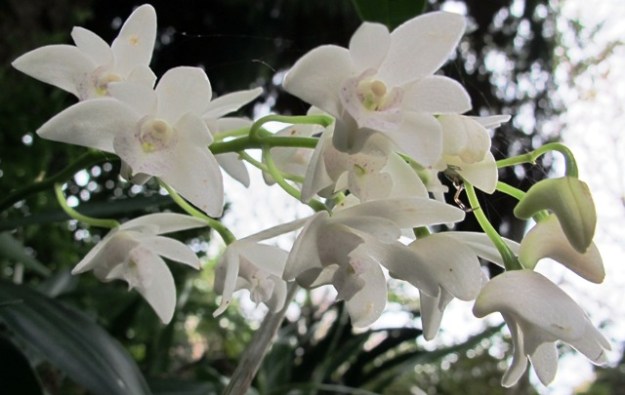
Referred to here as the Aussie dendrobes - dendrobiums

Referred to here as the Aussie dendrobes – dendrobiums

We are at the peak of orchid season in the garden. There can be few plants which carry the aura of luxury and exotica accorded to orchids. They belong to a huge and complex family, second only to the daisy family in number and go well beyond the common cymbidium. Yet they are not a plant that is common in New Zealand gardens.

Besotted by calanthes

Besotted by calanthes

The calanthe orchids are particularly rewarding as garden plants but you need to take the long view. We use them mainly as woodland plants. The blooms are a bit frost tender. Some we had on the margins were once hit by a memorable late frost but that was a one-off event. After about five decades of building them up, we have large swathes or drifts. In fact we have so many that a gardening ingénue who saw them recently drew the conclusion that they must be an unusual but easy bedding plant. Ah, no. But for those who have the time and inclination, they are a very rewarding branch of the family. Over time, they form a string of back bulbs below ground and can be increased from these.

For orchid enthusiasts who want the technical data, we understand that it is mostly forms of striata that are showiest for us. We have a pale lemon one which flowers in early spring and a much brighter yellow form that comes later. We used to have them under different species names but have come to the conclusion that they are more likely just different striata forms. Note: I have now been informed that the pale yellow calanthe shown is in fact Calanthe ‘Higo’ (C. sieboldii x C. aristulifera) which makes sense to us. We also use the white C. arisanensis but alas we failed with a lovely lilac species and appear to have lost it. All of these are evergreen varieties, though I understand there are deciduous species as well. The fresh spring leaves are large and could, at a pinch, be thought of as looking like pleated hosta leaves. A fair number of garden visitors over the years have asked us about the yellow flowered hostas. (Hint: hostas only flower in white or shades of lilac to purple.)

The Australian dendrobiums make compact, clumping plants with many smaller flowers and are pretty as a picture in the subtropical woodland areas. They combine very well with bromeliads and ferns and are an easy care garden plant. We have them in pinks, lilacs, white and yellow. We don’t know much about the hardiness of these. Ours are in positions where they never get frosted but they will get cold and they never turn a hair. They are probably similar to cymbidiums in hardiness.

Cymbidiums give long lived blooms, even outdoors

Cymbidiums give long lived blooms, even outdoors

DIY bamboo stake

DIY bamboo stake

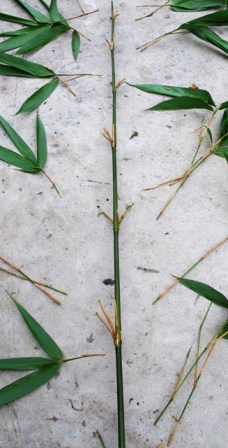
Cymbidiums are the usual florist’s choice and are surprisingly easy as garden plants, given the right conditions. All of ours are grown in the ground, not containers. We don’t get florist quality blooms but they last an amazingly long time in flower and put on a splendid show as long as I remember to stake the flower spikes at the right time. I see I started photographing the flower spikes a full two months ago and those same flowers are now a little weather beaten but still showy. These days I harvest stems of green bamboo which still have convenient leaf axils because I can gently engage the flower spikes in the leaf axils and don’t have to tie each one which makes staking much faster and more discreet. I admit this only works if you have a convenient stand of bamboo to harvest.

The jury is still out on whether we can get the disa orchids naturalised by the stream. They were fine for the first two seasons but the proof of the pudding is in the five to ten year cycle – whether they are still strong and flowering after that time. At this point it is not looking good. The native English field orchid, Dactylorhiza maculata, has gently ticked on here for decades but is romping away more enthusiastically now we are trying cooler, damper positions. We didn’t succeed with the masdevallias (though we probably didn’t try very hard) and the tropical orchids like phalaenopsis (moth orchids) won’t do as garden plants for us.

One of the easiest orchids to grow - pleiones

One of the easiest orchids to grow – pleiones

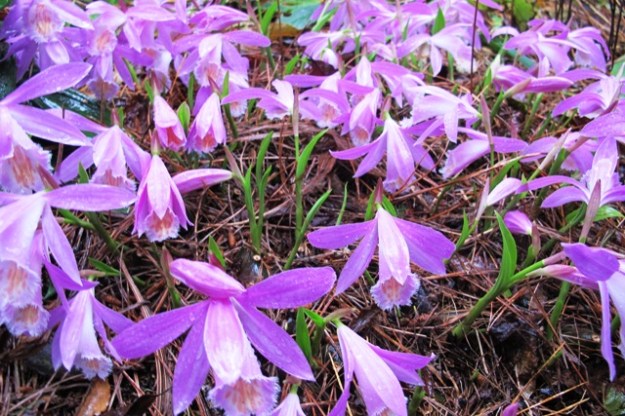
This week it is the pleiones which are the stars. Their flowering season is nowhere near as extended as some of the other orchids, but they form pretty carpets, are not at all tender and are dead easy to increase. Most bulbs will make one or two offsets a year. Along with the dactylorhiza, they are deciduous, becoming dormant in autumn. The yellow pleiones want more of a winter chill and have gradually died out for us but we have an abundance of purest white ones and an array of lilacs and purples.

These are not generally plants that you will find offered for sale at garden centres (which may be why they are not often seen in gardens). You probably need to find your nearest Orchid Society and enquire about sales tables. Orchid enthusiasts tend to be a different breed. At the risk of making sweeping generalisations, Orchid Society people are more often collectors than gardeners. More than any other horticultural group we have come across, orchid people have well above average technical knowledge and like to show off their treasures in bloom. They are also generous and encouraging to any novice who shows an interest. Much of our collection has come from Orchid Society people over the years. We cannot speak highly enough of them as a repository of knowledge about a very complex plant genus.

For details on how to multiply calanthe orchids, check out our earlier Outdoor Classroom on the topic.

First published by the Waikato Times and reprinted here with their permission.

Plant Collector: Magnolia laevifolia “Velvet and Cream”

Now renamed Magnolia laevifolia

Now renamed Magnolia laevifolia

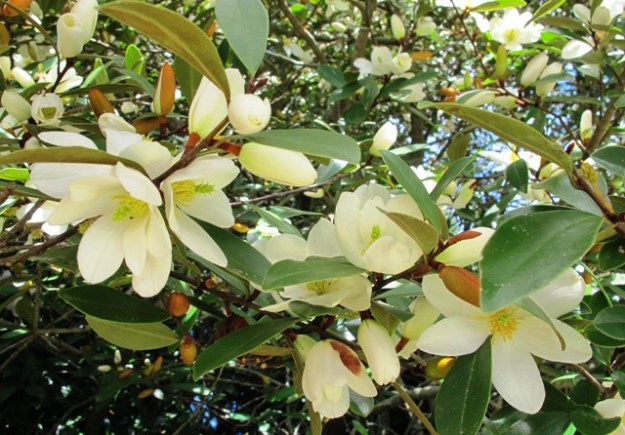
The naming of this plant is a complicated story. It was and still is widely sold as Michelia yunnanensis. It then had a fling with the name Magnolia dianica but is now Magnolia laevifolia. There are sound reasons for the changing name but it makes it confusing. In this country, it is almost a certainty that you will find it sold under its original name of M. yunnanesis. Michelias have now been reclassified as magnolias. Though evergreen, their foliage is much finer than the tough grandiflora types we normally associate with evergreen magnolias.

“Velvet and Cream” is a particularly good flowered form first released by former Cambridge nurseryman, Peter Cave. It has larger flowers in a beautiful cup form. M. laevifolia sets seed so prolifically that every man and their dog has raised seedlings and named them – some are better than others. Grown in open conditions with full sun, plants will stay bushier and more compact but generally these plants are a little slow to get established but eventually make small trees around the 3 metre mark if not trimmed. They are generally sold as fragrant, though I have yet to find one that has more than just a hint of perfume.

First published in the Waikato Times and reprinted here with their permission.

Garden lore

If you are digging a new garden in a grassed area, you will save yourself a lot of trouble if you deal to the grassy cover from the start. You can spray the grass with glyphosate to kill it. Wait three days after spraying before you dig. Alternatively, you can skim the top layer of turf off to a depth of 5cm and stack the layers upside down to rot down. This will give you fertile topsoil to spread back on the garden in due course. Or, if you are digging deep enough, you can spread the top layer at the bottom of the trench, preferably upside down, and cover it with soil to stop the grass from regrowing.

Cicely: When I see a spade, I call it a spade.
Gwendoline: I am glad to say that I have never seen a spade. It is obvious that our social spheres have been widely different.

Oscar Wilde, The Importance of Being Earnest (1895)

The Illustrated Guide to Ducks and Geese and other Domestic Fowl

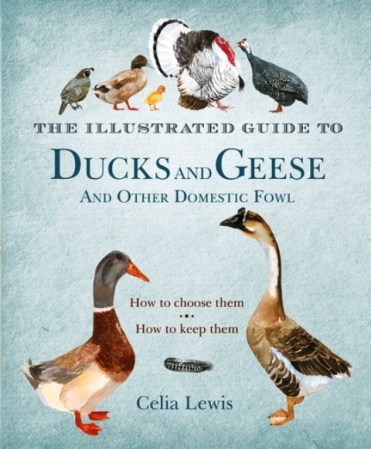
This is intended as a reference book but is actually the most delightful coffee table book I have seen in a while, even for people who have no plans to raise ducks, geese, guineafowl, peafowl, quail or turkeys on their piece of land. That is because all the illustrations, of which there are a generous number, are charming watercolour paintings, many of which might be lovely framed on the wall. One could describe them as the avian equivalent of botanical art in that they aim for accuracy.

The supporting text is interesting, user friendly and well organised. There is information on each type of bird (including profiles and illustrations on a whole lot of different ducks and geese – who knew there were so many?) with guidelines on good practice for rearing them at home to eating stage. We have resident quail in our garden which delight us, as do our resident wild ducks so I am less motivated by the food production side. But of course these birds have long been part of the human diet and it is sentimental to eat chicken while waxing eloquent on the charm of more beauteous members of the ornithological population. I am not experienced or qualified to pass comment on the quality of the advice beyond saying that it looks credible, is based on experience, has references for further research if required and there certainly looks to be good information to get you started. It includes a chart on common ailments from bumblefoot through avian flu to scaly leg and more. It is a quality hardback from an English author and publisher and I will be keeping my review copy because it is such an attractive and engaging book. There are earlier companion titles on chickens (more our style) and pigs.

The Illustrated Guide to Ducks and Geese and other Domestic Fowl by Celia Lewis. (Bloomsbury; ISBN: 978 1 4081 5264 5)

First published in the Waikato Times and reprinted with their permission.