Living in petrochemical heartland

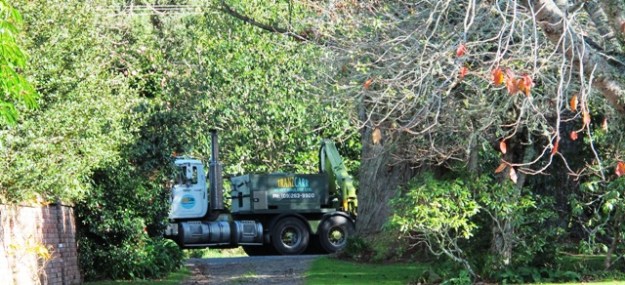
Heavy transport passing our entrance

Heavy transport passing our entrance

Because we live in the country, free farming newspapers appear in our letterbox. They can be surprisingly interesting, even to a non farmer like myself. An article in the latest Farmers Weekly (Sept 10) caught my attention. The chief executive of the NZ Petroleum Exploration and Production Association was reported.

“Chief executive David Robinson says ‘passionate’ climate change campaigners had set out to create a bleak picture of the industry….

There had been exploration in NZ for more than 100 years and industry had been working ‘extremely well’ in and around farming country in Taranaki for several generations.

Good relationships had been formed, characterised not only by compensation for farm access and improved entranceways.”

Really?

I am sure the industry is pleased with how well things are going around the farming country in Taranaki. That is because locals are, in the main, astonishingly polite and stoic. But I wonder if those industry people have even bothered to ask local residents how well it is working for them? In fact, I doubt that they could even find one local resident who would say that their life has been enhanced by the developments but they could find many whose lives have been adversely affected.

What really beggars belief is the rewriting of history. The bully-boy tactics employed by some of the petrochemical men is still very recent. I wish David Robinson had been a fly on the wall when a sick, elderly man in his seventies from down the road sat at our dining room table and explained why he had signed a consent for Fletcher Challenge (a planned development in the heart of Tikorangi that we actually managed to stop). You see, he’d been told that if he didn’t sign, they’d hop over the fence to his neighbour’s property and he didn’t trust his neighbour. He thought he’d have more control if it was on his own place. And pitching neighbour against neighbour was common practice, compounded by confidentiality agreements.

I sat in public meetings and heard the same petrochem men tell bare-faced lies.
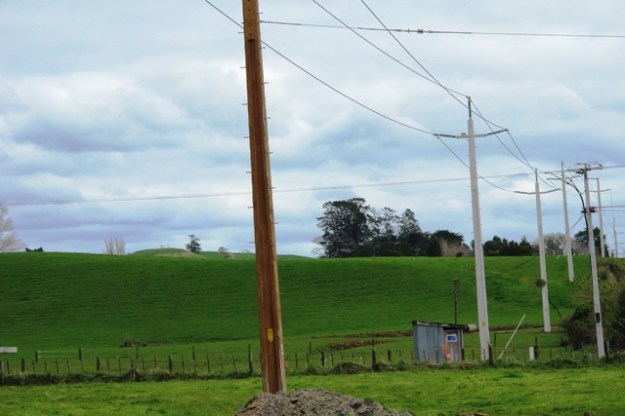
New power pylons marching over the landscape, solely to service the petrochem industry

New power pylons marching over the landscape, solely to service the petrochem industry

I wish David Robinson had been present when another neighbour wistfully said to me earlier this year that she just wished the company would come and sit in her lounge and see what they now look at out their window. See, they built their dream home on family land with soaring views across farmland to the sea. Now they are the closest house to a major industrial development which is undergoing construction 24/7 and that is what they see and hear from their lounge.

Because we protested so publicly about the earlier Fletcher Challenge proposals, the accompanying seismic survey saw the helicopters on a flight path directly above our house. The choppers started as early as 5.30am in the morning, even on Good Friday, and continued all day. It was highly illegal flying over our house with loads suspended below and we believe it was also deliberate intimidation by subcontractors. There was nothing we could do. We don’t forget.

Around that time, another neighbour from up the road who had a lot of well sites on his farm rang me and said he couldn’t speak out publicly because he was in so deep with the companies but I should stick to my guns. I still recall his telling comment: “If I knew then what I know now, I would never have let them in at the beginning”.
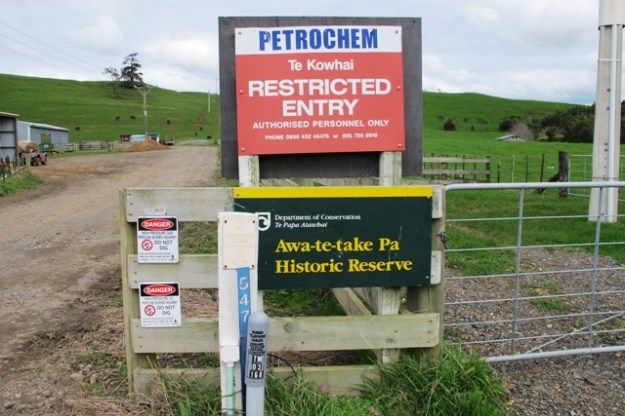
The site of the Otaraua protest

The site of the Otaraua protest

When Otaraua hapu staged a protest over many weeks on Ngatimaru Road a couple of years ago, the company involved simply did not have a clue how deeply insulting it was to turn up with a slab of beer for them. Otaraua had declared their occupation site drug and alcohol free and I recall a gentle kuia saying to me: “What next, beads and blankets?” Because of course the unspoken implication in the beer was that they were Maori so they would be partying and boozing.

It is not a proud history of cooperation at all. At least that bully-boy stuff is not as common these days. I think we have three, maybe four companies operating around our area. We are in Todd territory ourselves, and for that we are grateful. There are conversations around the area as to which company is better to deal with and there appears to be some consensus that we are lucky to be in Todderangi. They don’t bully, they are courteous and communicative. But that communication is simply telling us what they are going to do – the next intrusions on our formerly quiet country area. The impact remains very high.

Our quiet country roads here are now like main highways with large amounts of traffic and constant heavy trucks. Every one passes along one of our road boundaries and about 50% of them pass along two. And lucky us, the roads are being upgraded so the traffic can travel even faster. We have adjacent properties, separated by the main access route – there are many times now when crossing that road is downright dangerous.

Cos every farmer yearns for an "improved entranceway" like this bisecting the farm?

Cos every farmer yearns for an “improved entranceway” like this bisecting the farm?
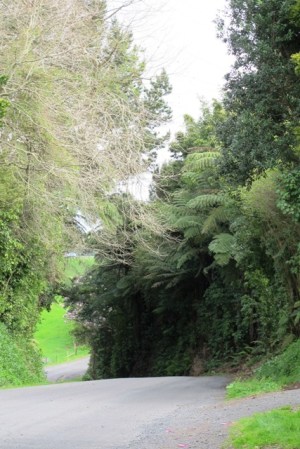
The "improved entranceway" opens from this small country road

The “improved entranceway” opens from this small country road

The photo above is of the neighbour’s “improved entranceway”. It meets a small country road. Because every farmer covets an “improved entranceway” like this, don’t they, Mr Robinson? Except it is not the entranceway to the farm, it is a security controlled access to a major well site development and it actually bisects the farm.

Compensation for farm access is mentioned as a benefit. I don’t know what the current going rate is for compo but it certainly used to be pathetically low. It is hard to find out the figures because usual practice is for the companies to lock the landowner into a confidentiality agreement.

I do know that the most recent going rate for a seismic survey shot hole was $12 (2012 prices). For that, the company’s contractors get to bring a drilling rig onto your property and from then until the explosive charge is detonated, which may be a couple of weeks later, the affected paddocks can’t be grazed. This causes problems for farmers’ grazing cycles. Then there are the helicopters working on the survey, any hour of the day, any day of the week. For $12 a shot hole? Ridiculous. Seismic surveys are one of the most intrusive aspects for the largest number of people.
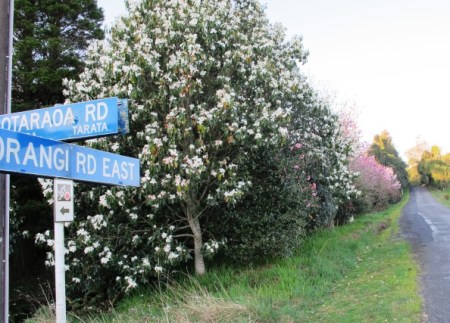
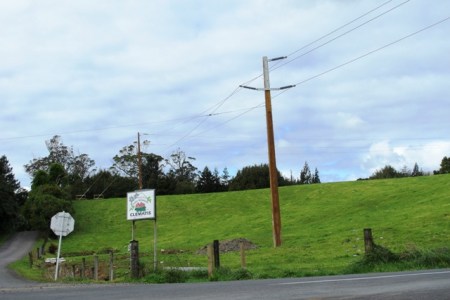
To the left is one of our road boundaries. Below right is the neighbour across the road. Until earlier this year, it was well treed, including mature kahikatea and tawa. That was all cleared to make way for huge power pylons to bring a secure power supply to the petrochem developments. We are lucky. We can’t see this from our property but others are not so fortunate. Their rural outlooks now feature pylons marching across the landscape. And guess what, the stringing of the wires was done by helicopter. It felt like Apocalypse Now living here on those days.

So please don’t tell us that everything is hunky dory here and always has been because it isn’t. There is just nothing we can do about it. Mr Robinson might do better to come and talk to locals here, rather than only talking to companies and to the overly sympathetic councils in Taranaki. I very much doubt that the elected councillors understand at all what the impact is like for locals. They are just thrilled to accept financial gifts for civic projects which are some distance away in New Plymouth. And councils have abdicated any planning role. Basically what they do is approve applications from the companies.

All that is without even touching on the environmental impact of oil and gas extraction and the controversial practice of fracking.

In the meantime, I offer drive-by tours of the petrochemical developments in my local area to anyone that is interested. You can see very clearly what the negative effect is for locals. And frankly, nobody seems to care much at all about that and Mr Robinson reinterprets history to give a rosy glow to petrochemical development in Taranaki.

For an earlier post on this same topic, check “Tikorangi – the new Texas?”
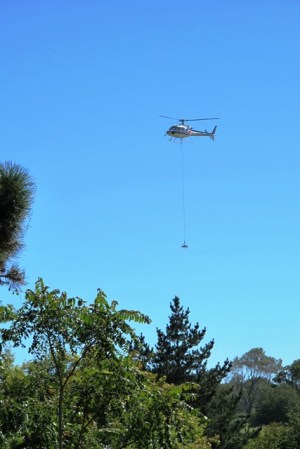
Helicopters are part of it all

Helicopters are part of it all

Reviewing accepted garden practice

Lawncare - one of the worst culprits in environmental vandalism

Lawncare – one of the worst culprits in environmental vandalism

I caught most of an extended interview with Fiona Eadie on National Radio last Monday. She is the head gardener at Larnach’s Castle just outside Dunedin. For me, the most interesting aspect was when she commented that much of our traditional gardening practice is bad. Just bad. Hear the clanging of bells, dear gardening readers. Change is coming.

It has been interesting to see the speed at which criticism of modern dairying practice has gathered momentum. It used to be that farmers held a pretty unassailable position, immune to criticism. Not any longer – environmental practices are coming under the microscope and the sure sign of pressure is the growing defensiveness in the sector.

Expect the same thing to happen in gardening. We have been talking about garden practices here for quite a long time and gently changing our ways. A trip to the UK a few years ago was a wake-up call. In the gardening sector, there was a lot more talk and action on beneficial gardening and sound environmental practice. It comes through most of the UK gardening programmes we get here (the main reason we subscribe to Sky) and also through their garden print media. It is a snowball that is gathering size and speed.

It may not be that long before a near perfect lawn is no longer a badge of honour but a sign that you are an environmental vandal. There is a direct correlation – the better your lawn, the worse your environmental score card. You cannot achieve that perfection without major intervention in the form of very frequent mowing (twice a week, I just read someone claim), removing all clippings which means you have to apply nitrogen based fertiliser frequently (once a month, the aforementioned lawn owner said) spraying, scarifying, summer watering and generally maintaining a complete monoculture. At its most extreme, even the worms are poisoned off. After all, worm casings spoil the green velvet. In fact none of this is good practice at all. While we appreciate the restful green interlude that lawns give, we have long since abandoned anything other than mowing with a mulcher mower and a bit of judicious hand weeding. Our lawns are less than perfect but at least they are non toxic. Greater purists abandon lawns altogether but that is a step too far for us.

Roses need considerable intervention to stay lush through summer

Roses need considerable intervention to stay lush through summer

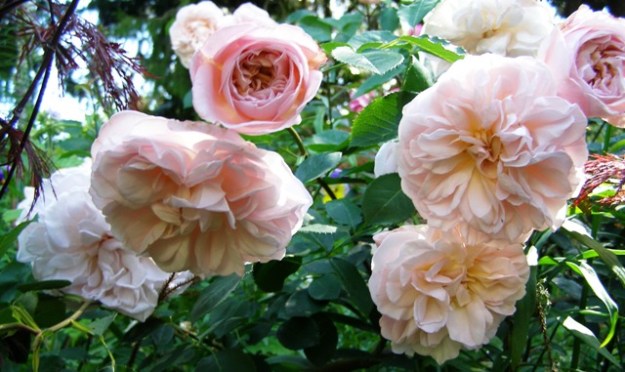
Similarly, perfect luscious looking roses without a hint of disease in high summer and autumn may become an advertisement for your bad practice rather than a sign of care. You can’t achieve that state without regular spraying and heavy supplementary feeding and watering. The healthy buxus hedge in urban areas may be frowned upon in due course now that the dreaded blight has taken such firm hold. A healthy appearance is likely to be a sign of regular chemical intervention.

Gardeners have substantially reduced the use of sprays, in part because the Government has placed so many restrictions on the availability of many that were in routine use. That happened because many are either highly dangerous or downright environmentally bad. So the gardener who told me she drenched her alpines weekly with fungicide to keep them alive in lowland conditions may soon be accused of bad practice rather than cleverness in keeping such plants alive and healthy outside their natural habitat. At least we have moved on (I hope) from the Paraquat days when that highly toxic weekiller was used interchangeably with the much safer glyphosate. Mark remembers a neighbour in our Dunedin days whose Friday routine was to spray all edges, paths and any visible weeds with Paraquat. We have been frowning at brown sprayed edges for years – not a good look in a garden and not good practice.

I hope we will see a change from the rampant consumerism promoted by many garden centres sooner rather than later. Fertiliser use needs a good hard look. Frankly it is no more acceptable to routinely use chemical fertilisers in the garden than it is to saturate farmland in the quest for increased production. The very notion that the slow release bubble fertilisers, some of which are encased in a non biodegradable coating, are suitable for garden use is a shocker. They are developed for container growing (and are expensive) but I have seen garden centres promoting their use in garden situations.

My local garden centre has a major display at its entranceway of heavy duty plastic bags filled with all manner of mulches and mixes. It is one thing buying the occasional bag of seed raising mix or potting mix. It is quite another to load large numbers of these prepackaged consumable commodities onto your trailer so you can fill your new raised bed with a soil mix trucked halfway across the island and then mulch with peastraw shipped from a similar distance in the other direction.

It’s all about sustainability – making sure that our quest for beauty in our gardens does not come at the cost of degrading the environment. We have a long way to go with this debate in New Zealand but it was heartening to hear Fiona Eadie bringing a similar message. Maybe the time has come to review practices we have taken for granted and to take steps to ensure that our gardens actually enhance nature instead of wounding it.

First published in the Waikato Times and reprinted here with their permission.

Garden Tours. A Visitor’s Guide to 50 Top New Zealand Gardens

The first thing I did on receiving what claims to be a garden visitor guide was to look at the contents to see who was included. There were some… ‘interesting’ inclusions and indeed exclusions. The entire east coast from Hawkes Bay to Poverty Bay has been bypassed.

The second thing I noticed is that a number of the public gardens got to write their own text which seemed an interesting authorial and editorial decision in what purports to be a guidebook – ergo independent.

Five minutes. It took just five minutes of dipping in to the book to realise that at times the author was writing about places she had not visited. I phoned a few friends whose gardens are included and they confirmed that she had never been there, a point not disputed by the publisher when queried. She carried out interviews by long distance phone calls and email from her UK base. No matter how hard you try (and the author has worked hard on this book) you can only tell so much from photographs and it was her failure to get to grips with matters of scale and proportion that alerted me to the fact she had only ever seen photos of some of the gardens at least.

In fact if you read the intro, the starting point for the book was the photo library of UK photographer, Steven Wooster. The author also makes the telling comment: “…each (garden owner) has approved the text written about their garden”. So much for independent commentary, then. It is still a mystery to me how she can write over 2000 words (10 pages including photos) on some gardens which I suspect she may never have seen in person. Others are much briefer – presumably the owners were less forthcoming on the phone.

So, had we been approached to have our garden included in this book, how would we have responded, knowing that the author had never visited? We would probably have agreed. What is not to like about free publicity written with the appearance of great authority when you even get to approve the text before publication?

The photographs are patchy. Some are lovely. Too many are not, where the light and shade are all wrong and the shadows too deep. Some of the selections fail to give a full picture of the garden and some fail to connect with the text – a problem which results from using existing photos as the starting point. I recognised some photos from earlier use in other publications.

The bottom line is that this book should have been called: “Fifty NZ Gardens I Have Visited” by Steven Wooster (he at least did visit all of them) with Michele Hickman. To publish it as a visitor guide is outrageous. Would you expect to buy a guide to 50 top restaurants where the author had not visited them all but had written the text and had it approved by the restaurant proprietors? Of course you wouldn’t. The same goes for 50 Top Wines or 50 Top B&Bs. So why would you want to pay $49.99 for this one on gardens?

Does it matter? Well, yes it does if I can pick it up within five minutes of starting to look at the book. And saddest of all, was the resigned acceptance I heard from some other garden owners. “It shouldn’t happen, but I guess it does.” Why do we settle for so much less when it comes to garden writing?

Postscript:

The author writes of one garden that it “… stands as a welcome rest from the sometimes anxious quest to make the definitive New Zealand garden, spurning the temptation (italics mine) to realise its European formal outline in native plants and minimising the contrast (or compromise) of English garden style which marries informality with formality.”

That passage is certainly packed with judgements. I have yet to find myself surrounded by angst-ridden gardeners frantically clipping, shaping and pleaching native plants. Cos, like, that’s just such a cliché these days, innit? Can there really ever be such a thing as a definitive New Zealand garden? Many might think that softening the austerity of a stark formal garden is a considerable enhancement, not a compromise. And is the only English style that is to be acknowledged the Arts and Crafts genre? English gardening embraces so much more. How about Capability Brown and landscape gardening on a grand scale? Woodland gardening? Naturalistic gardening?

Of another: “… a garden which showcases the genre with brio. The entranceway… announces the dramatic change of register to full-on subtropicalia.” Subtropicalia? Really? I admit I thought brio was a typo until I googled it – a musical term denoting vibrancy. Or something.

I have been to both these gardens. I wonder if the author has.

Garden Tours. A Visitor’s Guide to 50 Top New Zealand Gardens by Michele Hickman, photography by Steven Wooster. (Random House; ISBN: 978 1 86979 992 2) Reviewed by Abbie Jury

Plant Collector: Erythronium revolutum

The transient delight of dogs tooth violets - Erythronium revolutum

The transient delight of dogs tooth violets – Erythronium revolutum

Of all the fleeting seasonal delights, the dogs tooth violets or erythroniums might take the award for ephemera. They are so pretty and dainty and they are here today and gone pretty soon after. We probably only get ten days out of them in flower and a bad bout of weather can knock the display for the year. But we still get a great deal of pleasure from them. The flowers are like nodding hats while the compact foliage is often gently mottled or marbled in green and maroon.

There are about 20 different species, all in the Liliaceae family, but some of them just won’t perform in our climate. Many prefer cooler conditions and dry summers. As far as we know, what we have are mainly seed raised E. revolutum which is native to the west coast of USA. They thrive in humus rich conditions on woodland margins where the soil stays moist and there are reasonable light levels. The corms are interesting, being long and narrow and alarmingly easy to snap in two when disturbed. They find their own depth, often burrowing down quite deep, out of harm’s way.

First published in the Waikato Times and reprinted here with their permission.

Garden lore

A partial quote this week, relevant to changeable spring weather, which I noted some years ago from none other than Billy Connelly: “There is no such thing as bad weather,” he boldly asserted on television. He went on to blame television weather presenters for continually referring to sunny days as “good” and rainy days as “bad”, causing depression in people who live in high rainfall areas.

“There is no such thing as bad weather. There are only the wrong clothes.”

Tikorangi The Jury Garden

The time to hard prune camellias and rhododendrons is running out so do it right now before spring advances further. That way, the plants will still be able to flush with new growth on what remains. If you leave pruning and shaping camellias too late, you end up cutting off most of next year’s flower buds. However, you do have to sacrifice this year’s rhododendron flowering if you are wanting to cut plants back hard. If you leave it until after blooming, you are more likely to kill the plant instead. Timing is of the essence. Birds are nesting so check before you murder their babies as collateral damage with your pruning efforts.

Published in the Waikato Times and reprinted here with their permission.