Repetition – unifying a garden or downright dull?

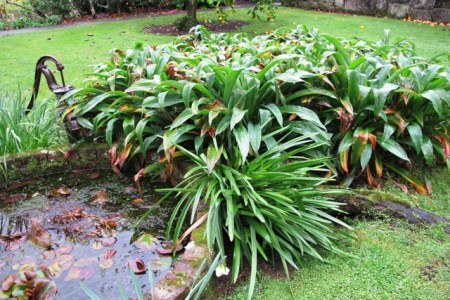
A surfeit of renga renga lilies repeated throughout your garden is highly unlikely to unify it

A surfeit of renga renga lilies repeated throughout your garden is highly unlikely to unify it

How often have you heard the advice to repeat the same plant in your garden to achieve continuity? It has almost achieved truism status though I would argue that this is one piece of so-called garden wisdom that too few people ever question. In fact I would go so far as to suggest that you are better to cast that piece of clichéd advice out to the wilderness and ignore it.

I don’t know where it originated, though I would hazard a guess it was from within the landscape sector. Now it is just repeated mindlessly as a golden rule.

The first time I was aware of a plant being repeated through a garden was with Dahlia Bonne Esperance. It is a baby dahlia with pink daisy flowers and increases readily (lights should be flashing here for you, dear Reader) and it featured throughout this person’s garden. Far from giving continuity, in fact it looked like a cheap, gaudy dot plant (as in dotted around everywhere). Therein lies the problem. When the advice is dispensed so glibly that you should repeat a plant to give continuity, there never seems to be any corresponding advice as to what types of plant are most effective. And in the absence of such advice, too many gardeners fall upon an option that is cheap to start with and easy to increase.
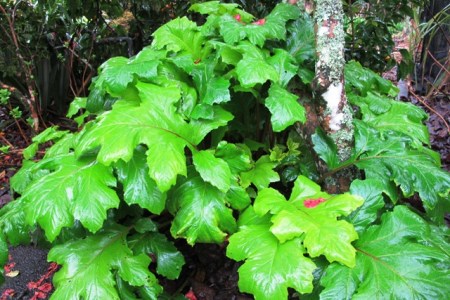
Acanthus mollis or bears' breeches - too close to weed status to be a desirable repeat planting

Acanthus mollis or bears’ breeches – too close to weed status to be a desirable repeat planting

I am sorry to say that many plantings of renga renga lilies are not going to enhance and unify your garden. The same goes for mondo grass, liriope, catmint (nepeta), the dreaded aluminium plant (lamium), common hostas which bulk up readily, Acanthus mollis, or Ligularia ‘Britt-Marie Crawford’. They are just going to look boring and repetitive when used again and again throughout.

Truly, you can have too much, even of a good thing. I have seen gardens which suffer from the ABC syndrome (another bloody clivia), or the oh no, TMBBH trait (too many big blue hostas). You need a deft hand and very good eye to make it work well.

There may be a difference between large and small gardens here. It is a long time since I have had a small garden but I can see that restricting the plant palette and using a repeating motif could help mitigate the bitsy effect so many gardens suffer from. But if you are determined to repeat a plant, try and make it a choice one. Trilliums are good. Paris, too. Though there is a possibility that the originator of the recommendation was thinking more in terms of pencil cypress or topiary yew – a woody plant rather than a perennial. I am fairly sure he or she was not thinking of Dahlia Bonne Esperance or renga rengas.

In a large garden, hmmm. As far as I am concerned, a large garden succeeds better when it has distinct changes of mood and style. To repeat a plant or plants throughout renders it too much the same and that is when large gardens become rambling, indistinct, and not very memorable. Unless you want to be remembered as, “Oh, that was the garden with all the orange clivias/acanthus mollis/buxus hedging/catmint/day lilies.” (Strike out those which do not apply.) We prefer to aim for different groups of plants in different areas, rather than mixing and matching throughout or streaming one particular plant through the lot.

That said, there are exceptions. We are steadily drifting English snowdrops throughout (on the grounds that you can’t have too many fleeting seasonal wonders and they are satisfyingly compatible with most situations – and transient, not year round). Mark has observed before that it is rhododendrons that form a backbone of continuity to our garden. But it is not just the one rhododendron that we have repeated. While we favour the nuttalliis (the rhodo equivalent of trilliums, one could say), we have multiple different varieties used in different combinations throughout. I don’t think that is what is meant by repeating a plant for continuity.

If I have failed to convince you that the interest in a garden lies in different plant combinations, interesting plants and variety, then I would at least make a plea for considering seedling variation. Mark and I looked at a planting in a garden – a hillside of red rhododendrons all the same. They will be showy in flower and look unified in conformity when not in bloom. They are also, to our eyes, dull, utility and public sector amenity planting (and it was a public garden too). What sets a private garden apart is the opportunity and scope to detail such a planting. Had it been done in seedling raised rhododendrons (collected from the same parent plant), there would have been the overall unity but subtle variation to add interest. The same goes for a range of plants – from pohutukawa to hostas. Raising them from seed takes time but gives interest and detail which is lacking when you order in a mass of one plant only.

But then we never have been fans of mass planting and massed display. The devil may be in the detail but so is the gardening interest.
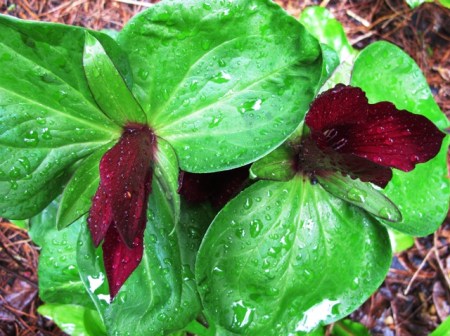
If you are determined to unify through repeat planting, at least pick something with bragging rights - desirable dark red trilliums, perhaps

If you are determined to unify through repeat planting, at least pick something with bragging rights – desirable dark red trilliums, perhaps

First published in the Waikato Times and reproduced here with their permission.
Tikorangi Notes: Friday 7 September, 2012

Just another unnamed seedling, as we say here

Just another unnamed seedling, as we say here

Latest posts:
1) Repeating plants throughout the garden – does this unify the garden? Maybe not….
2) Magnolia Burgundy Star – a useful fastigiate form and great red flowers.
3) Garden lore – a quote on colour from Edward Augustus Bowles, possibly even more relevant now than in 1914 when he wrote it. And this week’s handy hint on boiling water instead of weedkiller.

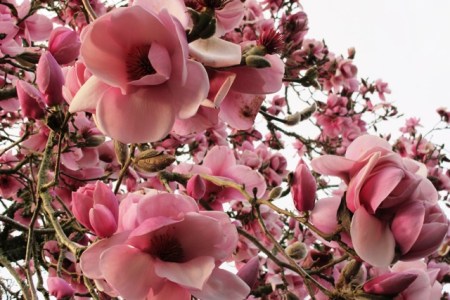
The mid season magnolias are simply magnificent. While there is an abundance of other seasonal colour in the garden – flowering cherries, spring bulbs left, right and centre, camellias, Kurume azaleas, hellebores, early rhododendrons, even humble little polys and prims – the magnolias hold centre stage. The early varieties have all been, done and gone now. The mids are at their peak, the late varieties are opening. If you have been planning a visit to see the magnolias, you might be wise not to leave it much longer past this weekend.

More Iolanthe

More Iolanthe

Plant Collector: Magnolia Burgundy Star

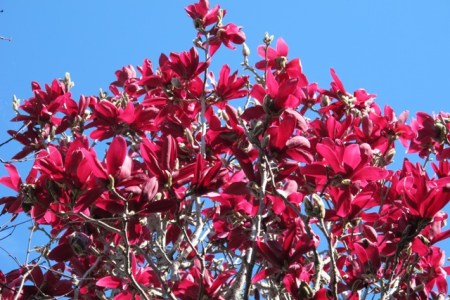
Magnolia Burgundy Star in full glory

Magnolia Burgundy Star in full glory

It is perhaps not widely realised that New Zealand leads the world when it comes to red magnolias, both in terms of breeding them and in the intensity of colour we get. We put this down to a combination of soil conditions and light. What flowers with good rich colour here can look pretty washed out and murky at times in the UK and Europe. New Zealanders tend to take the red colours for granted while magnolia enthusiasts overseas turn green with envy.

This one is Burgundy Star. It forms a narrow pillar shaped tree, not wider than two metres maximum. Because of this shape (described as fastigiate), it makes a splendid feature where space is limited, such as beside driveways. It gives height without much width. The flowers are towards the stellata (or star) magnolias in form but much larger and with firmer petals so they don’t get as floppy. And red. The stellatas are predominantly white, sometimes tinged pink. Because it sets flower buds down the stem, the season is extended. Magnolias which only set buds on the tips have a big display and are then pretty much over for the season.

Any of the deep coloured magnolias look best when planted in a position where the flowers are viewed with the light shining from behind.

First published in the Waikato Times and reprinted here with their permission.

Garden lore

I fear I am a little impatient of the school of gardening that encourages the selection of plants merely as artistic furniture, chosen for colours only, like ribbons or embroidery silk. I feel sorry for plants that are obliged to make a struggle for life in uncongenial situations because their owner wishes all things of those shades of pink, blue or orange to fit in next to the grey or crimson planting.

Edward Augustus Bowles My Garden in Spring (1914)

If you don’t want to use chemical weedkillers, boiling water can be a simple alternative, particularly between pavers or on cracks or joins in concrete. The boiling water not only kills weeds instantly, it also sterilises the soil to reduce more weed seeds germinating in the area. However, don’t use it near the base of plants that you want to continue growing. Obviously you need to be extremely careful and avoid carting the hot water jug when you have pets or small children around. Wearing covered footwear is also a good safety precaution.

Tikorangi Diary Friday August 31, 2012

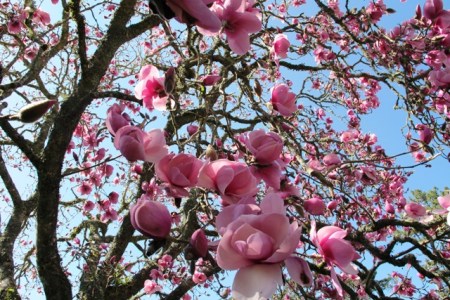
There is rather a lot of Iolanthe looking glorious

There is rather a lot of Iolanthe looking glorious

It is magnolia time here. All the mid season varieties are opening now, including the original Iolanthe beside our driveway. As this tree now measures over 15 metres across, there is a whole lot of Iolanthe on display. If you are planning a garden visit to see the magnolias, do not delay. Our garden is open every day. If we are not around, there is an honesty box.

LATEST POSTS
1) Plant Collector this week is Corylopsis pauciflora – a dainty primrose yellow witch hazel which is but a fleeting seasonal wonder here, though delightful while it lasts.
2) Move over Martha Stewart. The new generation has come of age in the world of gardening and lifestyle. Lynda Hallinan’s book on a year of country living is a cracker.
3) Garden lore this week – a quote from Anne Raven on the frustrating nature of a day’s gardening and some advice on using wood ash as fertiliser.
4) More feeding tui, this time in Prunus Te Mara. Another brief YouTube clip.

A NOTE TO SUBSCRIBERS
For historic reasons, I have two websites, closely linked. We are moving to integrate them into one site (www.jury.co.nz) which is where new posts now go. At this stage I am linking through from this site but in due course http://www.abbiejury.co.nz will disappear. What I can’t do is to transfer subscriptions over from one site to the other. If you wish to continue receiving new posts via email, you will need to subscribe at the jury site. Please do. Alternatively, if you are a Facebook user, if you go to www.facebook.com/thejurygarden and “like” the page (as Facebook lingo goes), you will get the links posted to your Facebook page on Fridays.