Reviewing accepted garden practice

Lawncare - one of the worst culprits in environmental vandalism

Lawncare – one of the worst culprits in environmental vandalism

I caught most of an extended interview with Fiona Eadie on National Radio last Monday. She is the head gardener at Larnach’s Castle just outside Dunedin. For me, the most interesting aspect was when she commented that much of our traditional gardening practice is bad. Just bad. Hear the clanging of bells, dear gardening readers. Change is coming.

It has been interesting to see the speed at which criticism of modern dairying practice has gathered momentum. It used to be that farmers held a pretty unassailable position, immune to criticism. Not any longer – environmental practices are coming under the microscope and the sure sign of pressure is the growing defensiveness in the sector.

Expect the same thing to happen in gardening. We have been talking about garden practices here for quite a long time and gently changing our ways. A trip to the UK a few years ago was a wake-up call. In the gardening sector, there was a lot more talk and action on beneficial gardening and sound environmental practice. It comes through most of the UK gardening programmes we get here (the main reason we subscribe to Sky) and also through their garden print media. It is a snowball that is gathering size and speed.

It may not be that long before a near perfect lawn is no longer a badge of honour but a sign that you are an environmental vandal. There is a direct correlation – the better your lawn, the worse your environmental score card. You cannot achieve that perfection without major intervention in the form of very frequent mowing (twice a week, I just read someone claim), removing all clippings which means you have to apply nitrogen based fertiliser frequently (once a month, the aforementioned lawn owner said) spraying, scarifying, summer watering and generally maintaining a complete monoculture. At its most extreme, even the worms are poisoned off. After all, worm casings spoil the green velvet. In fact none of this is good practice at all. While we appreciate the restful green interlude that lawns give, we have long since abandoned anything other than mowing with a mulcher mower and a bit of judicious hand weeding. Our lawns are less than perfect but at least they are non toxic. Greater purists abandon lawns altogether but that is a step too far for us.
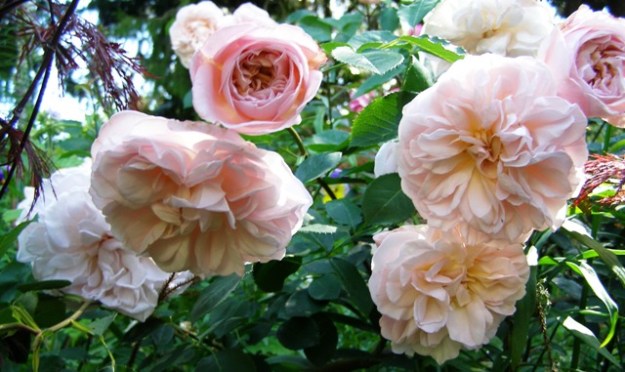
Roses need considerable intervention to stay lush through summer

Roses need considerable intervention to stay lush through summer

Similarly, perfect luscious looking roses without a hint of disease in high summer and autumn may become an advertisement for your bad practice rather than a sign of care. You can’t achieve that state without regular spraying and heavy supplementary feeding and watering. The healthy buxus hedge in urban areas may be frowned upon in due course now that the dreaded blight has taken such firm hold. A healthy appearance is likely to be a sign of regular chemical intervention.

Gardeners have substantially reduced the use of sprays, in part because the Government has placed so many restrictions on the availability of many that were in routine use. That happened because many are either highly dangerous or downright environmentally bad. So the gardener who told me she drenched her alpines weekly with fungicide to keep them alive in lowland conditions may soon be accused of bad practice rather than cleverness in keeping such plants alive and healthy outside their natural habitat. At least we have moved on (I hope) from the Paraquat days when that highly toxic weekiller was used interchangeably with the much safer glyphosate. Mark remembers a neighbour in our Dunedin days whose Friday routine was to spray all edges, paths and any visible weeds with Paraquat. We have been frowning at brown sprayed edges for years – not a good look in a garden and not good practice.

I hope we will see a change from the rampant consumerism promoted by many garden centres sooner rather than later. Fertiliser use needs a good hard look. Frankly it is no more acceptable to routinely use chemical fertilisers in the garden than it is to saturate farmland in the quest for increased production. The very notion that the slow release bubble fertilisers, some of which are encased in a non biodegradable coating, are suitable for garden use is a shocker. They are developed for container growing (and are expensive) but I have seen garden centres promoting their use in garden situations.

My local garden centre has a major display at its entranceway of heavy duty plastic bags filled with all manner of mulches and mixes. It is one thing buying the occasional bag of seed raising mix or potting mix. It is quite another to load large numbers of these prepackaged consumable commodities onto your trailer so you can fill your new raised bed with a soil mix trucked halfway across the island and then mulch with peastraw shipped from a similar distance in the other direction.

It’s all about sustainability – making sure that our quest for beauty in our gardens does not come at the cost of degrading the environment. We have a long way to go with this debate in New Zealand but it was heartening to hear Fiona Eadie bringing a similar message. Maybe the time has come to review practices we have taken for granted and to take steps to ensure that our gardens actually enhance nature instead of wounding it.

First published in the Waikato Times and reprinted here with their permission.
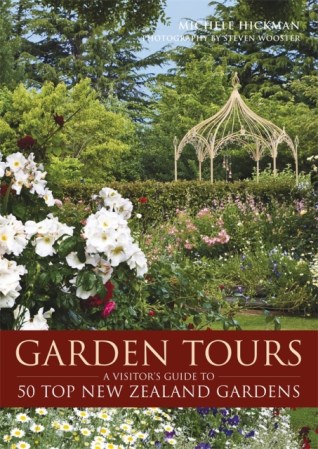
Garden Tours. A Visitor’s Guide to 50 Top New Zealand Gardens

The first thing I did on receiving what claims to be a garden visitor guide was to look at the contents to see who was included. There were some… ‘interesting’ inclusions and indeed exclusions. The entire east coast from Hawkes Bay to Poverty Bay has been bypassed.

The second thing I noticed is that a number of the public gardens got to write their own text which seemed an interesting authorial and editorial decision in what purports to be a guidebook – ergo independent.

Five minutes. It took just five minutes of dipping in to the book to realise that at times the author was writing about places she had not visited. I phoned a few friends whose gardens are included and they confirmed that she had never been there, a point not disputed by the publisher when queried. She carried out interviews by long distance phone calls and email from her UK base. No matter how hard you try (and the author has worked hard on this book) you can only tell so much from photographs and it was her failure to get to grips with matters of scale and proportion that alerted me to the fact she had only ever seen photos of some of the gardens at least.

In fact if you read the intro, the starting point for the book was the photo library of UK photographer, Steven Wooster. The author also makes the telling comment: “…each (garden owner) has approved the text written about their garden”. So much for independent commentary, then. It is still a mystery to me how she can write over 2000 words (10 pages including photos) on some gardens which I suspect she may never have seen in person. Others are much briefer – presumably the owners were less forthcoming on the phone.

So, had we been approached to have our garden included in this book, how would we have responded, knowing that the author had never visited? We would probably have agreed. What is not to like about free publicity written with the appearance of great authority when you even get to approve the text before publication?

The photographs are patchy. Some are lovely. Too many are not, where the light and shade are all wrong and the shadows too deep. Some of the selections fail to give a full picture of the garden and some fail to connect with the text – a problem which results from using existing photos as the starting point. I recognised some photos from earlier use in other publications.

The bottom line is that this book should have been called: “Fifty NZ Gardens I Have Visited” by Steven Wooster (he at least did visit all of them) with Michele Hickman. To publish it as a visitor guide is outrageous. Would you expect to buy a guide to 50 top restaurants where the author had not visited them all but had written the text and had it approved by the restaurant proprietors? Of course you wouldn’t. The same goes for 50 Top Wines or 50 Top B&Bs. So why would you want to pay $49.99 for this one on gardens?

Does it matter? Well, yes it does if I can pick it up within five minutes of starting to look at the book. And saddest of all, was the resigned acceptance I heard from some other garden owners. “It shouldn’t happen, but I guess it does.” Why do we settle for so much less when it comes to garden writing?

Postscript:

The author writes of one garden that it “… stands as a welcome rest from the sometimes anxious quest to make the definitive New Zealand garden, spurning the temptation (italics mine) to realise its European formal outline in native plants and minimising the contrast (or compromise) of English garden style which marries informality with formality.”

That passage is certainly packed with judgements. I have yet to find myself surrounded by angst-ridden gardeners frantically clipping, shaping and pleaching native plants. Cos, like, that’s just such a cliché these days, innit? Can there really ever be such a thing as a definitive New Zealand garden? Many might think that softening the austerity of a stark formal garden is a considerable enhancement, not a compromise. And is the only English style that is to be acknowledged the Arts and Crafts genre? English gardening embraces so much more. How about Capability Brown and landscape gardening on a grand scale? Woodland gardening? Naturalistic gardening?

Of another: “… a garden which showcases the genre with brio. The entranceway… announces the dramatic change of register to full-on subtropicalia.” Subtropicalia? Really? I admit I thought brio was a typo until I googled it – a musical term denoting vibrancy. Or something.

I have been to both these gardens. I wonder if the author has.

Garden Tours. A Visitor’s Guide to 50 Top New Zealand Gardens by Michele Hickman, photography by Steven Wooster. (Random House; ISBN: 978 1 86979 992 2) Reviewed by Abbie Jury

Plant Collector: Erythronium revolutum

The transient delight of dogs tooth violets - Erythronium revolutum

The transient delight of dogs tooth violets – Erythronium revolutum

Of all the fleeting seasonal delights, the dogs tooth violets or erythroniums might take the award for ephemera. They are so pretty and dainty and they are here today and gone pretty soon after. We probably only get ten days out of them in flower and a bad bout of weather can knock the display for the year. But we still get a great deal of pleasure from them. The flowers are like nodding hats while the compact foliage is often gently mottled or marbled in green and maroon.

There are about 20 different species, all in the Liliaceae family, but some of them just won’t perform in our climate. Many prefer cooler conditions and dry summers. As far as we know, what we have are mainly seed raised E. revolutum which is native to the west coast of USA. They thrive in humus rich conditions on woodland margins where the soil stays moist and there are reasonable light levels. The corms are interesting, being long and narrow and alarmingly easy to snap in two when disturbed. They find their own depth, often burrowing down quite deep, out of harm’s way.

First published in the Waikato Times and reprinted here with their permission.

Garden lore

A partial quote this week, relevant to changeable spring weather, which I noted some years ago from none other than Billy Connelly: “There is no such thing as bad weather,” he boldly asserted on television. He went on to blame television weather presenters for continually referring to sunny days as “good” and rainy days as “bad”, causing depression in people who live in high rainfall areas.

“There is no such thing as bad weather. There are only the wrong clothes.”

Tikorangi The Jury Garden

The time to hard prune camellias and rhododendrons is running out so do it right now before spring advances further. That way, the plants will still be able to flush with new growth on what remains. If you leave pruning and shaping camellias too late, you end up cutting off most of next year’s flower buds. However, you do have to sacrifice this year’s rhododendron flowering if you are wanting to cut plants back hard. If you leave it until after blooming, you are more likely to kill the plant instead. Timing is of the essence. Birds are nesting so check before you murder their babies as collateral damage with your pruning efforts.

Published in the Waikato Times and reprinted here with their permission.
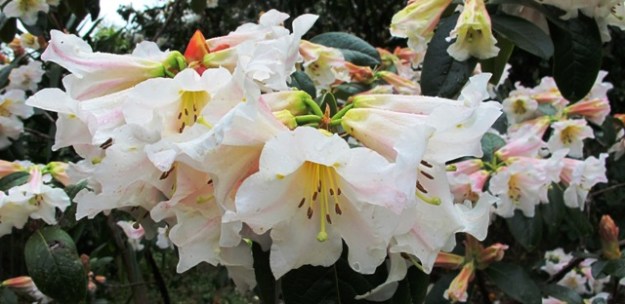
Repetition – unifying a garden or downright dull?

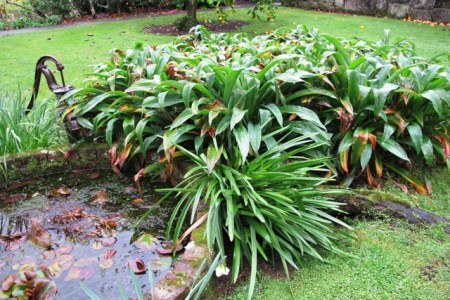
A surfeit of renga renga lilies repeated throughout your garden is highly unlikely to unify it

A surfeit of renga renga lilies repeated throughout your garden is highly unlikely to unify it

How often have you heard the advice to repeat the same plant in your garden to achieve continuity? It has almost achieved truism status though I would argue that this is one piece of so-called garden wisdom that too few people ever question. In fact I would go so far as to suggest that you are better to cast that piece of clichéd advice out to the wilderness and ignore it.

I don’t know where it originated, though I would hazard a guess it was from within the landscape sector. Now it is just repeated mindlessly as a golden rule.

The first time I was aware of a plant being repeated through a garden was with Dahlia Bonne Esperance. It is a baby dahlia with pink daisy flowers and increases readily (lights should be flashing here for you, dear Reader) and it featured throughout this person’s garden. Far from giving continuity, in fact it looked like a cheap, gaudy dot plant (as in dotted around everywhere). Therein lies the problem. When the advice is dispensed so glibly that you should repeat a plant to give continuity, there never seems to be any corresponding advice as to what types of plant are most effective. And in the absence of such advice, too many gardeners fall upon an option that is cheap to start with and easy to increase.

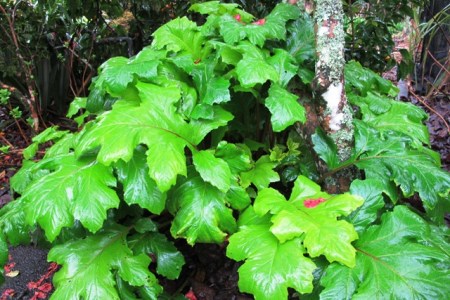
Acanthus mollis or bears' breeches - too close to weed status to be a desirable repeat planting

Acanthus mollis or bears’ breeches – too close to weed status to be a desirable repeat planting

I am sorry to say that many plantings of renga renga lilies are not going to enhance and unify your garden. The same goes for mondo grass, liriope, catmint (nepeta), the dreaded aluminium plant (lamium), common hostas which bulk up readily, Acanthus mollis, or Ligularia ‘Britt-Marie Crawford’. They are just going to look boring and repetitive when used again and again throughout.

Truly, you can have too much, even of a good thing. I have seen gardens which suffer from the ABC syndrome (another bloody clivia), or the oh no, TMBBH trait (too many big blue hostas). You need a deft hand and very good eye to make it work well.

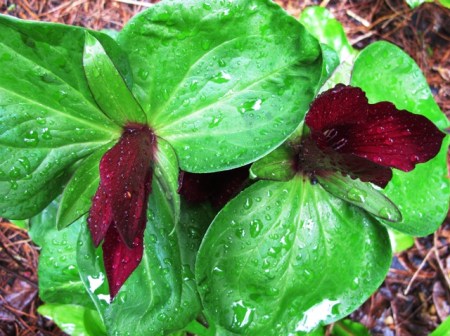
There may be a difference between large and small gardens here. It is a long time since I have had a small garden but I can see that restricting the plant palette and using a repeating motif could help mitigate the bitsy effect so many gardens suffer from. But if you are determined to repeat a plant, try and make it a choice one. Trilliums are good. Paris, too. Though there is a possibility that the originator of the recommendation was thinking more in terms of pencil cypress or topiary yew – a woody plant rather than a perennial. I am fairly sure he or she was not thinking of Dahlia Bonne Esperance or renga rengas.

In a large garden, hmmm. As far as I am concerned, a large garden succeeds better when it has distinct changes of mood and style. To repeat a plant or plants throughout renders it too much the same and that is when large gardens become rambling, indistinct, and not very memorable. Unless you want to be remembered as, “Oh, that was the garden with all the orange clivias/acanthus mollis/buxus hedging/catmint/day lilies.” (Strike out those which do not apply.) We prefer to aim for different groups of plants in different areas, rather than mixing and matching throughout or streaming one particular plant through the lot.

That said, there are exceptions. We are steadily drifting English snowdrops throughout (on the grounds that you can’t have too many fleeting seasonal wonders and they are satisfyingly compatible with most situations – and transient, not year round). Mark has observed before that it is rhododendrons that form a backbone of continuity to our garden. But it is not just the one rhododendron that we have repeated. While we favour the nuttalliis (the rhodo equivalent of trilliums, one could say), we have multiple different varieties used in different combinations throughout. I don’t think that is what is meant by repeating a plant for continuity.

If I have failed to convince you that the interest in a garden lies in different plant combinations, interesting plants and variety, then I would at least make a plea for considering seedling variation. Mark and I looked at a planting in a garden – a hillside of red rhododendrons all the same. They will be showy in flower and look unified in conformity when not in bloom. They are also, to our eyes, dull, utility and public sector amenity planting (and it was a public garden too). What sets a private garden apart is the opportunity and scope to detail such a planting. Had it been done in seedling raised rhododendrons (collected from the same parent plant), there would have been the overall unity but subtle variation to add interest. The same goes for a range of plants – from pohutukawa to hostas. Raising them from seed takes time but gives interest and detail which is lacking when you order in a mass of one plant only.

But then we never have been fans of mass planting and massed display. The devil may be in the detail but so is the gardening interest.

If you are determined to unify through repeat planting, at least pick something with bragging rights - desirable dark red trilliums, perhaps

If you are determined to unify through repeat planting, at least pick something with bragging rights – desirable dark red trilliums, perhaps

First published in the Waikato Times and reproduced here with their permission.