Tikorangi Notes: Friday 7 September, 2012

Just another unnamed seedling, as we say here

Just another unnamed seedling, as we say here

Latest posts:
1) Repeating plants throughout the garden – does this unify the garden? Maybe not….
2) Magnolia Burgundy Star – a useful fastigiate form and great red flowers.
3) Garden lore – a quote on colour from Edward Augustus Bowles, possibly even more relevant now than in 1914 when he wrote it. And this week’s handy hint on boiling water instead of weedkiller.

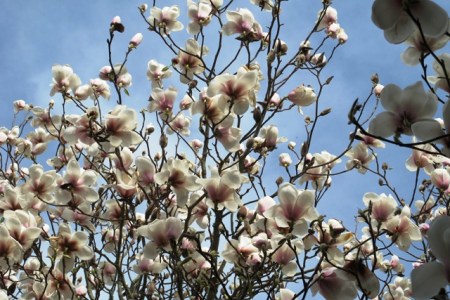
The mid season magnolias are simply magnificent. While there is an abundance of other seasonal colour in the garden – flowering cherries, spring bulbs left, right and centre, camellias, Kurume azaleas, hellebores, early rhododendrons, even humble little polys and prims – the magnolias hold centre stage. The early varieties have all been, done and gone now. The mids are at their peak, the late varieties are opening. If you have been planning a visit to see the magnolias, you might be wise not to leave it much longer past this weekend.
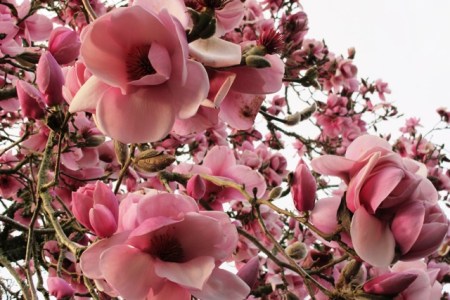
More Iolanthe
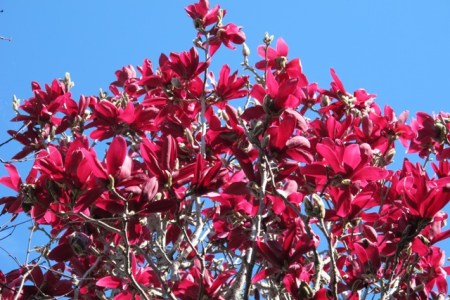
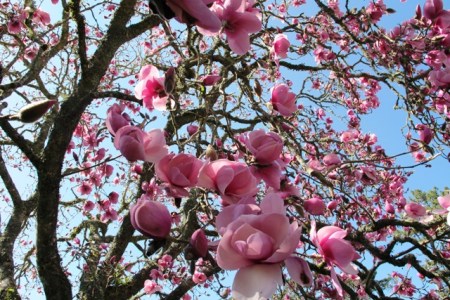
More Iolanthe

Plant Collector: Magnolia Burgundy Star

Magnolia Burgundy Star in full glory

Magnolia Burgundy Star in full glory

It is perhaps not widely realised that New Zealand leads the world when it comes to red magnolias, both in terms of breeding them and in the intensity of colour we get. We put this down to a combination of soil conditions and light. What flowers with good rich colour here can look pretty washed out and murky at times in the UK and Europe. New Zealanders tend to take the red colours for granted while magnolia enthusiasts overseas turn green with envy.

This one is Burgundy Star. It forms a narrow pillar shaped tree, not wider than two metres maximum. Because of this shape (described as fastigiate), it makes a splendid feature where space is limited, such as beside driveways. It gives height without much width. The flowers are towards the stellata (or star) magnolias in form but much larger and with firmer petals so they don’t get as floppy. And red. The stellatas are predominantly white, sometimes tinged pink. Because it sets flower buds down the stem, the season is extended. Magnolias which only set buds on the tips have a big display and are then pretty much over for the season.

Any of the deep coloured magnolias look best when planted in a position where the flowers are viewed with the light shining from behind.

First published in the Waikato Times and reprinted here with their permission.

Garden lore

I fear I am a little impatient of the school of gardening that encourages the selection of plants merely as artistic furniture, chosen for colours only, like ribbons or embroidery silk. I feel sorry for plants that are obliged to make a struggle for life in uncongenial situations because their owner wishes all things of those shades of pink, blue or orange to fit in next to the grey or crimson planting.

Edward Augustus Bowles My Garden in Spring (1914)

If you don’t want to use chemical weedkillers, boiling water can be a simple alternative, particularly between pavers or on cracks or joins in concrete. The boiling water not only kills weeds instantly, it also sterilises the soil to reduce more weed seeds germinating in the area. However, don’t use it near the base of plants that you want to continue growing. Obviously you need to be extremely careful and avoid carting the hot water jug when you have pets or small children around. Wearing covered footwear is also a good safety precaution.

Tikorangi Diary Friday August 31, 2012

There is rather a lot of Iolanthe looking glorious

There is rather a lot of Iolanthe looking glorious

It is magnolia time here. All the mid season varieties are opening now, including the original Iolanthe beside our driveway. As this tree now measures over 15 metres across, there is a whole lot of Iolanthe on display. If you are planning a garden visit to see the magnolias, do not delay. Our garden is open every day. If we are not around, there is an honesty box.

LATEST POSTS
1) Plant Collector this week is Corylopsis pauciflora – a dainty primrose yellow witch hazel which is but a fleeting seasonal wonder here, though delightful while it lasts.
2) Move over Martha Stewart. The new generation has come of age in the world of gardening and lifestyle. Lynda Hallinan’s book on a year of country living is a cracker.
3) Garden lore this week – a quote from Anne Raven on the frustrating nature of a day’s gardening and some advice on using wood ash as fertiliser.
4) More feeding tui, this time in Prunus Te Mara. Another brief YouTube clip.

A NOTE TO SUBSCRIBERS
For historic reasons, I have two websites, closely linked. We are moving to integrate them into one site (www.jury.co.nz) which is where new posts now go. At this stage I am linking through from this site but in due course http://www.abbiejury.co.nz will disappear. What I can’t do is to transfer subscriptions over from one site to the other. If you wish to continue receiving new posts via email, you will need to subscribe at the jury site. Please do. Alternatively, if you are a Facebook user, if you go to www.facebook.com/thejurygarden and “like” the page (as Facebook lingo goes), you will get the links posted to your Facebook page on Fridays.

Plant Collector: Corylopsis pauciflora

Corylopsis pauciflora - short flowering season in our climate, but charming

Corylopsis pauciflora – short flowering season in our climate, but charming

This dainty delight is in full bloom now and a good reminder of why I like having a large garden. It is so pretty in flower for a maximum of two weeks in late winter or early spring. For the remaining fifty weeks of the year, it is an anonymous looking shrub. If you only have a small garden, you need plants that work a bit harder than that to justify their space. But for those two weeks when its light, arching branches are clothed in pale lemon witch hazel flowers (it is a member of the witch hazel family, Hamamelidaceae), it has an understated grace and charm. It is also pleasantly scented. When the flowering finishes, saw toothed leaves in dull greeny bronze will take over.

C. pauciflora is one of the more compact species, making maybe 1.5m high by 2m wide. These are hardy, deciduous shrubs from cooler parts of Asia and Japan and are best suited to open woodland areas (in other words, humus rich and semi shaded). We also have C. willmottiae ‘Spring Purple’ which has similar delicate primrose blossom but with purple new growth. It has yet to come into bloom here but it grows to twice the size so it needs a fair bit of space for its 14 days of glory. The flowering period appears to be extended in colder climates.

First published in the Waikato Times and reprinted here with their permission.