Tikorangi Notes: Thursday 23 August, 2012

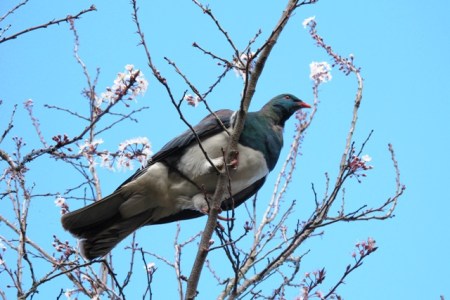
We hesitate to proclaim our garden as being full of birdsong. Heaven help me if I ever read yet another garden description where the owners claim their place as “a tranquil haven filled with birdsong”. It is such a cliche and frequently said birds are but blackbirds, thrushes and sparrows. But we do have a garden filled with birds and this week I was lucky enough to chance upon this kereru (native wood pigeon) feeding on plum blossom. They are rarely so obliging at posing for a photo shoot. For a 58 second video of this event, check out Kereru at Tikorangi, the Jury Garden.

If you are keen on magnolias, or even just pretty flower pictures, I am updating the magnolias regularly on our Facebook page http://www.facebook.com/thejurygarden and also on Twitter (@Tikorangi). I alternate between describing the magnolias as floral skypaper or magnolia porn. It is such a glorious time of year here and there are few, if any plants, to rival the magnolia for an over the top statement when in full bloom.

Tikorangi Tui tui tui

Latest posts: Friday 17 August, 2012

1) Be bold with colour. White is not always right. Safe, but often dull.
2) The first a new series: Garden Lore. Quotes and hints – random and eclectic maybe, but I hope interesting and helpful.
3) Plant Collector this week is on pretty little Camellia Sweet Jane.
4) My first ever video on You Tube – two minutes of many tui in one of our campanulata cherry trees plus birdsong.

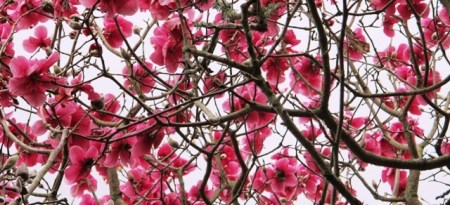
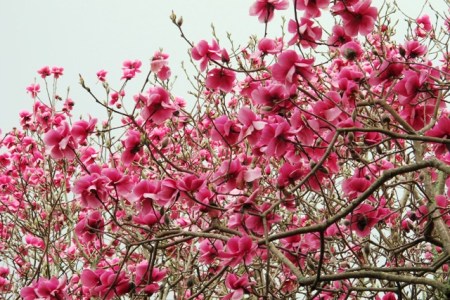
I figured yesterday, as I took these photos, that some (though fewer in number these days) favour floral wallpaper in their home. Here we have floral skypaper instead. Sometimes I worry that many of my magnolia photographs are taken from below, looking up to the sky whereas other people’s magnolia photos are taken looking down on the individual blooms. The reason is that so many of our magnolias are now achieving quite some stature so our close up view does tend to be looking upwards at them. But no matter which way you look at them, magnolias make a breathtakingly lovely display. We still have many which are just opening their first blooms or not even showing colour yet and we look forward to the season continuing right through September. Our early display, in full bloom now, is heavily dominated by the stronger coloured reds, purples and deepest pinks – the two photos here of unnamed seedlings – which we grow so well here. We appear to get deeper colours here than other parts of the world which is presumably related to soil conditions and to the quality of very clear, pure light we have. Mid and later season magnolias are more inclined to the pales and whites.

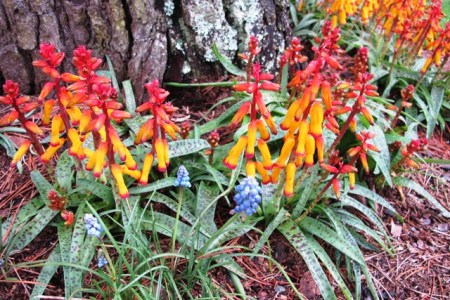
As a contrast to the candy pinks, I photographed the lachenalias and muscari (grape hyacinths) below which nestle in around the trunk of one of our old pine trees. The muscari evoke childhood memories for me. I admit that Lachenalia aloides is not my favourite lachenalia – they are a little garish, looking maybe as if they made from plastic and sold at a cheap store but they provide a cheerful splash of colour in a naturalised setting.

Be bold with colour. White is not always right.

My first ever video upload (two minutes of a mass of tui in a campanulata cherry tree) and notes on the magnolias in flower have just been posted on www.jury.co.nz (our garden website).
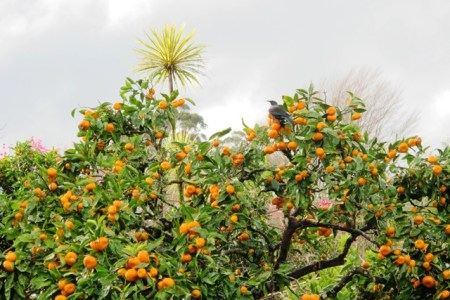
Winter colour on the mandarin tree - and food for tui

Winter colour on the mandarin tree – and food for tui

It was most refreshing this week to receive an email from a reader seeking recommendations on a suitable sasanqua camellia for a hedge. “Anything but white,” was her request. I liked her instantly. White flowered camellia hedges can indeed look pretty and fresh but have become such a cliché in this country (especially as nine out of ten white sasanqua hedges are Setsugekka). It is most unusual for someone to specify colour.

We have a curious obsession with white flowers in this country. Why is Iceberg still the biggest selling rose here? Probably followed by the white Margaret Merrill or Rose Flower Carpet White. They are good plants but are they much better than other coloured options? No, they are just white. According to the Rose Flower Carpet agents, the coloured ones are much more popular overseas and it is mostly NZ that prizes the white. My informant put this down to our mild climate here and the fact that we are never snowbound. “If you spend months of the year looking at a white landscape,” he said, “the last thing you want is a garden of white flowers.”

I think it is conservatism. For the same reason, the trend is to have a near absence of colour on interior walls of the house (usually off white because pure white can be too stark and clinical to live with). Too often we play it safe in the garden. The garden backdrop of green is, for some curious reason, perceived as colour neutral and into that we drop another neutral in the form of white flowers. Call it serene, restful, stylish and sophisticated if you wish. In the right hands and at its best, it is. In lesser hands, it can be bland and dull. But safe. You can always be confident that your garden will be perceived by some as being in good taste if you keep to white, maybe with just the occasional colour thrown in as a feature (but just one colour, mind).

Fewer try the monochromatic scheme in other colours – though it is of course bichromatic (is there such a word?) because they are all plus green. Sissinghurst has its purple border, Hidcote its red border and both are beautiful in full summer bloom, but in NZ we tend to keep to white.
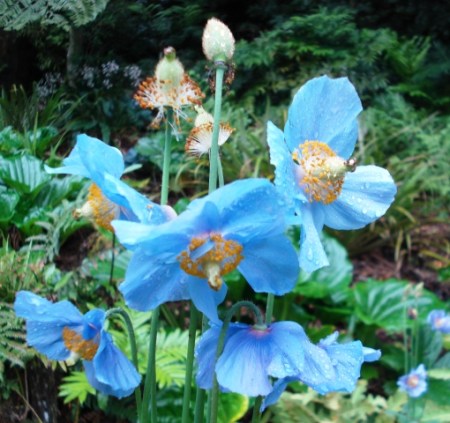
You can never have too much blue in the garden - especially if it is meconopsis

You can never have too much blue in the garden – especially if it is meconopsis

My first ever colour managed garden was to be all pinks, blues and whites. It looked pretty, but flat. Mark stood looking and said, “You need a touch of yellow.” He was so right. These days that garden remains predominantly pink, blue and white but it is the lemon and cerise (the latter, a surprisingly common colour in flowers) that give it some zing. Hence my choice of the Gertrude Jekyll quote below. Pastel gardens tend to be very feminine but they can be a little too “pastelle”, bordering on bland unless you get it absolutely right.

If you are unsure, go back to the colour wheel. It is touches of the opposite colour that will provide contrast. So yellow will be highlighted by purple, red by green and blue by orange. It does work. That said, I think blue flowers and foliage fit in with everything and you can never have too much blue in a garden. There is no theory to back that one up so it is entirely my personal opinion.
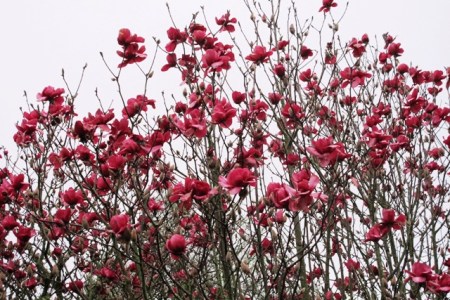
Colour to brighten a gloomy day - Magnolia Vulcan

Colour to brighten a gloomy day – Magnolia Vulcan

On a wintery day, however, I don’t want pastels or unrelieved green. Give me colour. The mandarin trees are a bright spot on a gloomy day, especially when populated by tui sucking the juice from damaged fruit. Most of our early flowering magnolias are in strong colours and can lift the spirits wonderfully with their over the top displays. The early flowering campanulata cherries lean to bright candy pink and cerise colours which are certainly a startling colour combination with the bright gold narcissi in bloom. There is no subtlety in any of those but I am not going to trade them for refined white flowers instead.
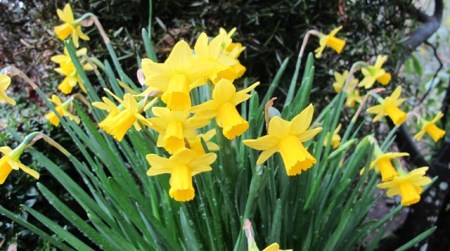
There is nothing subtle about the bright yellow of early narcissus

There is nothing subtle about the bright yellow of early narcissus

First published in the Waikato Times and reproduced here with their permission.

Garden lore

It is a curious thing that people will sometimes spoil some garden project for the sake of a word. For instance, a blue garden, for beauty’s sake, may be hungering for a group of white lilies, or for something of palest yellow, but it is not allowed to have it because it is called the blue garden and there must be no flowers in it but blue flowers…. My own idea is that it should be beautiful first, and then just be as blue as may be consistent with its best possible beauty.

Gertrude Jekyll Colour in the Flower Garden (1908)

016-copy
Dealing to moss

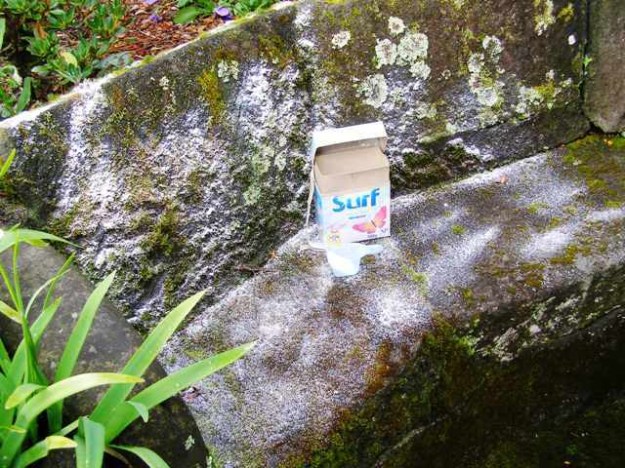
The easiest way I know to kill moss growing in the wrong places is to lightly sprinkle soda ash. This is in fact powdered washing soda (sodium carbonate or Na2CO3 for the scientifically inclined) and you can buy it from bulk bins. Cold Water Surf is often recommended and does work. I am guessing Cold Water Surf contains a relatively high proportion of soda ash as a water softener because it works much better than the budget washing powder I tried. Having found what the active ingredient is, I now prefer to use straight soda ash without the unnecessary extras. It is non toxic and occurs naturally so, as far as I know, is not going to harm the environment. It kills moss overnight though you then have to wire brush the dead moss off hard surfaces or rake it out of lawns. Experiment lightly – it doesn’t take a lot to be effective.

Published in the Waikato Times and reprinted here with their permission.

Plant Collector: Camellia Sweet Jane

Sweet little Sweet Jane

Sweet little Sweet Jane

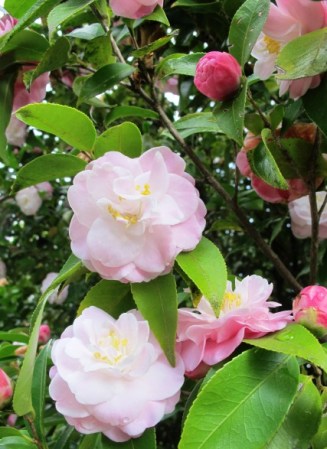
How pretty Camellia Sweet Jane looks at the moment. The flowers are darker pink on the outer petals fading to the faintest blush in the centre with a hint of golden stamens. It is a full flower, described in the camellia world as a peony form and it only measures about 5cm across so it is classified as a miniature. Yes it gets petal blight, but there is such a generous bud set that it still manages a good display over time. It came to this country in the 1990s from Australian breeder Ray Garnett. Readers who know their camellias may be surprised to learn that one of its parents is C. transnokoensis.

In that nineties rage for miniature camellia flowers, many people assumed that the bushes would also stay obligingly small. Few do. Our Sweet Jane, unclipped, is now about 3.5 metres tall and that is true for many of those small flowered varieties like Cinnamon Cindy and Gay Baby. But they do at least have correspondingly small leaves and are easy to clip if you want them kept lower. Camellias only need clipping once a year after flowering, or twice if you are after a tighter form.

We used to grow Sweet Emily Kate commercially. It came from the same breeder and its flower is arguably prettier (and pleasantly scented). Now that we are no longer selling it, I will admit it was a wonderful nursery plant and could look good if well cared for as a container plant but I’ve never seen it looking good planted out in the garden and left to its own devices. Sweet Jane is a much superior plant.

First published in the Waikato Times and reprinted here with their permission.