Tikorangi Notes: Friday 15 June, 2012

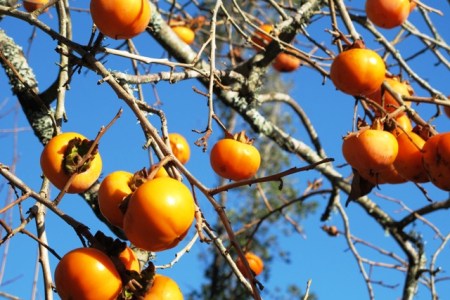
And the winner for colour this week - the persimmons

And the winner for colour this week – the persimmons

Latest posts:

1) The sweet smell of daphne in winter (though the showiest is D. genkwa which has no scent at all).

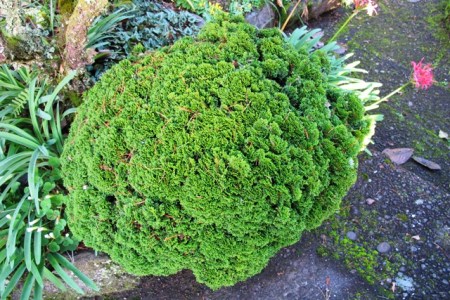
2) Good things come in small packages and may take a long, long time to reach maturity. Chamaecyparis obtusa “Caespitosa”

3) Taking another look at your common or garden radish (of the European persuasion).

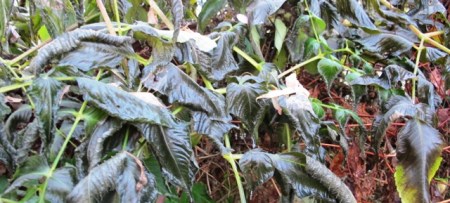
What a difference a week makes... frost damage

What a difference a week makes… frost damage

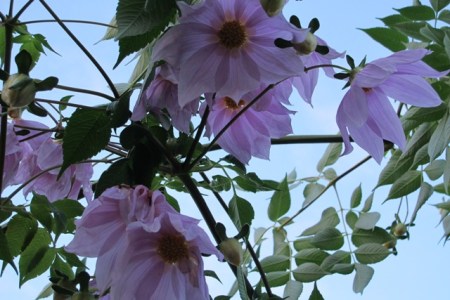
What a difference a few days can make. Last Friday, I wrote about the tree dahlias. One frost and now they are mush and over for the year. Frosts are an unpredictable event here. Some years there are none (or no visible frost at least), other years we might get two or three rippers. It was a ripper on Wednesday. On the bright side, there has been remarkably little damage and our run of calm, sunny weather continues. We are making great progress in the garden and I am thinking about perennial combinations and more active management to keep them looking good. Mark and Lloyd entertained themselves bringing an old shed across the road to convert into a pigeon house. Lloyd is now replacing the door and re-roofing it. I am hoping new sides will be next so by then there will only be the framework and the window left of the original.

The sweet smell of daphne in winter

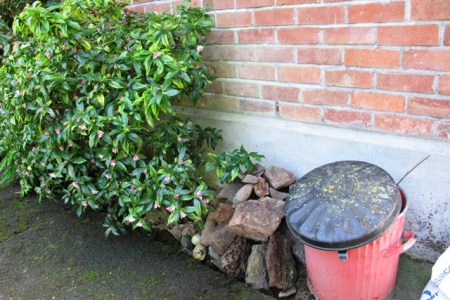
Daphne odora - happy around the back by the rubbish tin.

Daphne odora – happy around the back by the rubbish tin.

We have never forgotten the nursery colleagues who told us that their range included lemon trees and daphnes “because you can sell a lemon tree to pretty much every household and everybody has to replace their daphne every five years or so”. I had never thought about it before, but they were right. Most New Zealand gardens have at least one of each and daphnes do not rank up there as long lived plants. But we wouldn’t be without them in the winter garden.

While there are upwards of 60 different species in the wild, in terms of garden plants in this country, generally you have a choice of odora, odora or odora with occasional breaks for D. bholua and if you are really lucky, you might spot the little ground hugging D. cneorum (with its silent c), the dainty D. x burkwoodii, or the remarkable blue D. genkwa. You may buy your odora by many other names, but if it has typical daphne foliage and flowers, it is just an odora selection. The flowers are generally small and a mix of lilac pink and white with a range of subtle variations. Some are darker, pinker or even pure white. I bought one that was reputedly apricot but that was wishful thinking with the description.
The good and the bad of the Himalayan Daphne bholua

The good and the bad of the Himalayan Daphne bholua

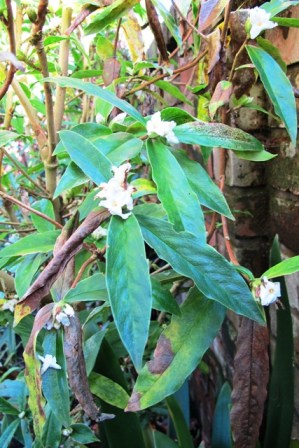
We have a bit of a love-hate relationship with the Himalayan Daphne bholua. In our opinion it has the best and strongest fragrance of all and it has a long flowering season. Its upright habit of growth means it fits into borders and beside paths well. That is the good side. On the down side it suckers (spreads underground), seeds much too freely and is dispersed by birds so has weed potential. It also becomes very scruffy with time. It is semi deciduous which means it is neither one thing nor the other – it drops some leaves and those that hang on often look messy. The form is ugly and it can get quite large after a few years if you don’t stay on top of the pruning. So it is not a plant of great beauty at all, but its scent is superb. Hide it at the back of the border in behind more attractive plants so that it can wow you with its fragrance.

The blue flowered Daphne genkwa from China is remarkable. For most of the year it is just an anonymous willowy shrub. It is fully deciduous, so drops all its leaves in autumn. Then in late August, all those whippy growths burst into lilac blue flowers down their length. It is a wondrous sight. Some claim a light perfume, but I think that is imagination. It is just one of the loveliest shrubs you will ever see in flower. Alas, it is difficult to propagate (it is generally done from root cuttings) and can be difficult to get established so it is not common. However, it is still produced commercially and a good garden centre may be able to order it in for you. Plant it where it has good light, good drainage and plenty of space so it won’t need trimming. I killed a well established plant by cutting it back and I wasn’t that brutal. I loved it so much I bought three replacements and these will be planted with plenty of space so they should never need pruning.
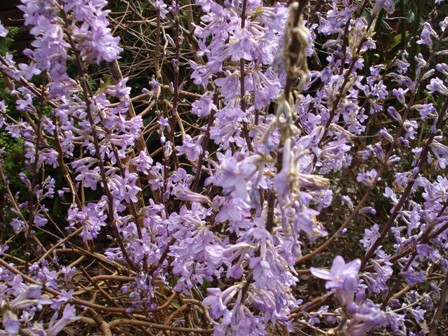
Deciduous, lacking scent and blue lilac but it is probably the most spectacular - Daphne genkwa

Deciduous, lacking scent and blue lilac but it is probably the most spectacular – Daphne genkwa

Growing tips: daphnes are not suitable plants to grow in containers. Mostly they look unhealthy and straggly because it is hard to get the potting mix right. It is much easier to keep them lush and healthy planted in the garden, even more so if you pick a position out of full sun. The odoras and bholua are often a good choice for the more shaded house borders. While they need good light levels, they are quite happy with little or no direct sun.

Daphnes prefer rich loamy conditions, neither acid nor alkaline. They won’t love you if you put them in waterlogged conditions either so look for spots with good drainage which never get bone dry either. Keep them mulched with compost or leaf litter.

While Daphne bholua will accept hard pruning, most other types won’t. You are better to take a bit more care and think more about pinching out new growth to encourage bushiness and shaping with secateurs, rather than hacking bark hard all over.

Because they are winter flowering, finding locations near to where you walk in winter means you will get more benefit. This is one of the few plants with such strong scent that you will pause and look for the source so plant it where that can happen. Only D. genkwa is spectacular in flower, so they are wasted in more removed locations. Round the back of house near the rubbish bin is a handy location for us though we have quite a few other plants all over the place.

First published in the Waikato Times and reprinted here with their permission.

Plant Collector: Chamaecyparis obtusa ‘Caespitosa’

Chamaecyparis obtusa 'Caespitosa' is a little honey bun of a plant... after 50 years

Chamaecyparis obtusa ‘Caespitosa’ is a little honey bun of a plant… after 50 years

I can’t help but think that if conifers had user-friendly common names, they might have staged more of a revival as desirable plants. There is nothing easy about this name. Even the pronunciation of ‘Caespitosa’ is problematic. But it is the cutest little honey bun of a plant. We once produced a line of these to sell. After about 7 years, they measured no more than 10cm across. It is difficult to sell tiny gems like that. After 50 years or more, the ones in our rockery are about 40cm high and 50cm wide. They are like dense mushrooms and have never been clipped or shaped in any way. I sometimes clean out some of the dead debris in the middle and I clip off the occasional larger leafed stem but that is all the care these plants get.

The reason I clip off any odd looking foliage is because this is a bit of a freak seedling derived from what was a timber tree in its native Japan – commonly referred to as the Hinoki Cypress, though it would be more correct to refer to it as the Hinoki False Cypress because chamaecyparis are known as false cypress. It is obviously highly variable and prone to throwing sports because there are a host of different named selections. Such sports can revert to larger and stronger growing forms which is why it pays to clip out any peculiar, larger foliaged branches on a dwarf like this.

This is such a wonderfully tactile plant. The instinct is to pat it as you pass and it completely dense and firm. ‘Caespitosa’ was raised from seed before 1920 in England so it has been around for a while. It is still seen as a gem for alpine gardens. Cold climate gems that also tolerate the mild humid conditions that have here are not common.

First published in the Waikato Times and reprinted here with their permission.

Grow it yourself: European radishes

I still associate radishes with encouraging young children to garden. The little red globes of the European radish grow so rapidly that you can be eating them in just over three weeks which gives a wonderfully quick result, even if the flavour may not be to littlies’ taste. If you haven’t had a look at radishes in recent years, you may be surprised by the range now available. There are long thin ones, large and small globed ones and colours range through reds, pinks, whites and bicolours to pure gold (Radish Zlata from Poland) and the Black Spanish Radishes which are black skinned with white flesh. And that is without even considering the oriental radish varieties.

The common garden radish has a bit of a split personality. It is almost exclusively served as a salad vegetable in this country though there is no reason why you cannot cook with it, in a similar manner to other root vegetables, albeit being of rather small stature. However it is a brassica which explains why it is better as a cool season crop. In mild areas, radishes can be grown right through winter. Yet it is a root crop, unlike most brassicas, so it does not want soils rich in nitrogen which encourage too much leafy top growth at the expense of the roots.

Sow seed directly into finely tilled soil and cover lightly to a depth of a centimetre. They will need to be thinned out after germination to allow room for the roots to develop. Pick them young. They soon get woody and too peppery so are best pulled, washed and stored in the fridge if you have too many. And you can always try Hugh Fearnley Whittingstall’s unlikely fresh radish dish – serve with softened but not melted butter and lashings of salt. No Heart Foundation tick for that one.

First published in the Waikato Times and reprinted here with their permission.

Tikorangi Notes: Friday June 8, 2012

Latest posts: Friday 8 June, 2012

A distinct flurry of new posts this week.

1) In praise of ornamental oxalis (or wood sorrel, if you prefer). Contrary to popular opinion, not all oxalis are bad.

2) In the garden this fortnight – mostly about bulb meadows.

3) Pruning roses made simple. We may not spray our roses here but I do prune them.

4) The Bad Tempered Gardener from the Welsh borderlands. An interesting book by a contact made on Twitter. Truly, I am so delighted that my time on Twitter is not all in vain.

5) I had been wondering (in a somewhat desultory way, as one does) what would be the next hot vegetable trend when the penny dropped: Cavolo nero (Tuscan black kale) of course.

6) Plant collector this week are the inverted icecream cones of Picea albertiana ‘Conica’.

7) At last, a reference on organic gardening without the smoke and mirrors. It us just a pity it is geared to English gardening conditions. Organic Gardening Bible by Bob Flowerdew reviewed. Does not the author have a wonderful name?

9) Nothing to do with gardening and all to do with food with lashings of history and culture: The Food of Spain by Claudia Roden.

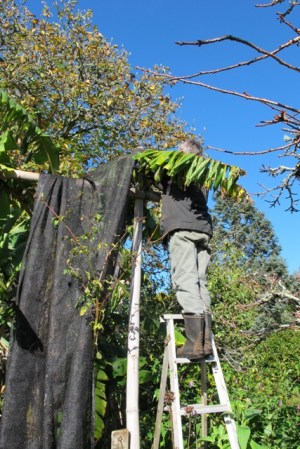
Two weeks from the shortest day - time to cover the banana

Two weeks from the shortest day – time to cover the banana

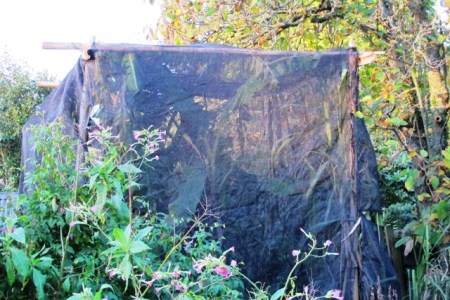
While it is only two weeks until the shortest day, winter has yet to bite here as can be seen from the lilac tree dahlia at the top. Indeed when it snowed heavily in Christchurch a few days ago, our temperature was still in the warm teens (Celsius, dear American readers, we measure our temperatures in Celsius). But in anticipation of cold snaps that we know will come, Mark has finally got around to re-erecting his Theatre of the Banana. This particular fruiting banana is the one and only plant we wrap up for winter. Really we are not that warm but he tells me that there are a few fruit forming on it and I am sure he is aiming for us to achieve self sufficiency in bananas at some time in the future.

Done. I call it the Theatre of the Banana

Done. I call it the Theatre of the Banana