In praise of ornamental oxalis (or wood sorrel, if you prefer)

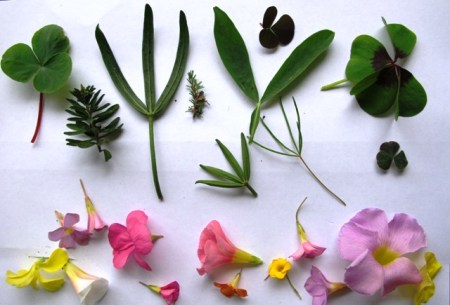
Oxalis show considerable variation in leaf form (and in flower colour)

Oxalis show considerable variation in leaf form (and in flower colour)

Most people shudder at the mere mention of oxalis. The bad reputation of a few has tarnished the entire population. We would not be without the cheerful sight of them blooming from early autumn through winter, but the most common reaction from others is complete dismissal. I have even resorted to their colloquial name overseas – wood sorrel. It sounds so much prettier and more acceptable than oxalis.

Over the years, we have gathered up around 30 different ornamental varieties but these are a mere drop in the bucket. The oxalis family is huge. In the wild, the number of different species is into the late hundreds. That is not to say that they are all of great merit. Nor are they all bulbs. Equally, not all are invasive.

O. deppei "Iron Cross" grows and flowers in the opposite seasons to most ornamental varieties

O. deppei "Iron Cross" grows and flowers in the opposite seasons to most ornamental varieties

Most oxalis are native to either South Africa or South America, though it is the former that gives us the majority of varieties which have garden merit. Most are triggered into growth by late summer rain, so they come into flower around this time of year. The two notable exceptions we have in our collection are both from South America. Oxalis deppei “Iron Cross” (named for the markings on its leaves) is from Mexico and going dormant now, to return to growth at the start of November. O. triangularis, with its triangle shaped leaves in deep burgundy, is Brazilian and also flowers in summer. I bought this one at a car boot sale where I commented that it was an oxalis that I did not have. “No,” protested the vendors. “It is not an oxalis. It is a triangularus.” I didn’t argue.

Some of these oxalis are perfectly safe in the garden. I can vouch for this after decades of growing them in the rockery where they have never threatened to become a weed. Others are downright dangerous. Turn your back and they will invade at alarming speed. Such wayward habits don’t mean you have to shun them. Keep them in pots. You can either plunge the pot into the garden (which reduces the need to water it), or have a collection on a sunny doorstep. Oxalis only open their flowers in the sunshine. When they have ceased being attractive, you can move the pots out of sight for the rest of the year. We have not had problems with them setting seed so as long as the bulbs are confined, they rarely escape.
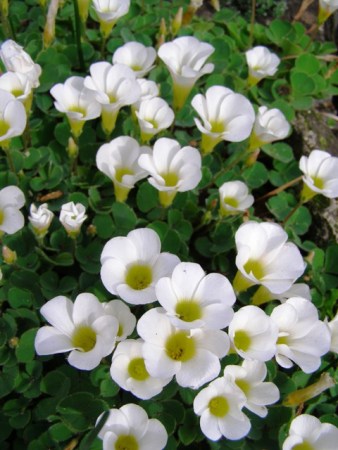
My all time favourite - O. purpurea alba
My all time favourite - O. purpurea alba

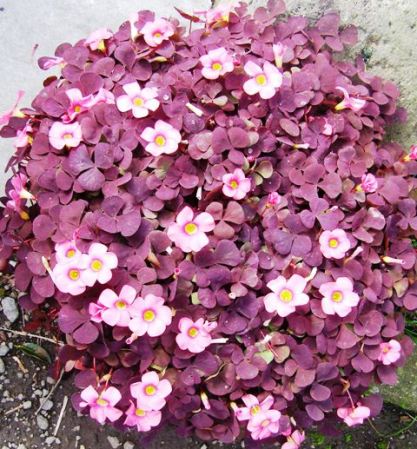
Same species but different form and very different behaviour. Keep O. purpurea "Nigrescens" confined to a pot

Same species but different form and very different behaviour. Keep O. purpurea "Nigrescens" confined to a pot

My all time favourite is the pristine white O. purpurea alba. It has an exceptionally long flowering season and is extremely well behaved in the garden. A mat of this plant opening up its large blooms to the sunshine is a delightful sight. Each flower has a golden eye. Purpurea is a variable species. The green form (same clover-like leaves but with large pink flowers) also has an excellent length of flowering but I haven’t had it long enough to know whether it is garden safe or not so I still keep it in pots. The reason for my caution is that O. purpurea ‘Nigrescens’, highly desirable for its deep burgundy foliage and big pink flowers, is dangerous. I have seen it invade an Auckland garden on heavy clay. It was as bad as the weedy varieties, just more ornamental. Keep it confined at all times.

My second place favourite is the lavender O. hirta. We also have a bright pink form of it, but the pastel lavender is prettier. This has very different foliage – trailing clusters of leaves. The range in leaf form is surprising. O. fabaefolia is often called the rabbits’ ear oxalis because its leaves look like pointed rabbits’ ears. It has a big yellow flower but a very short season.
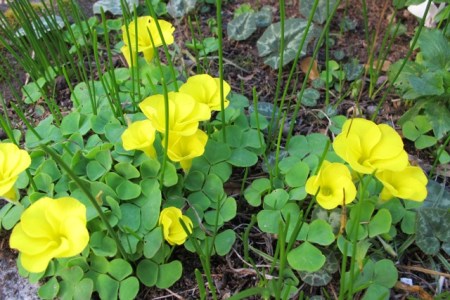
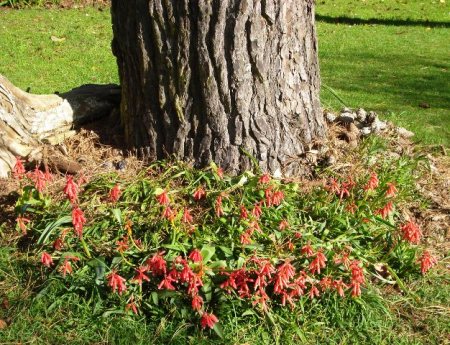
O. luteola - an excellent garden variety

O. luteola - an excellent garden variety

Oxalis luteola, with its neat mat of clover-like leaves and masses of sunshine yellow blooms over many weeks, is another tried and true garden plant here. It has never been a problem in the rockery and gently grows amid other plants without ranging far afield. O. lobata is like a miniature form of O. luteola and equally garden safe.

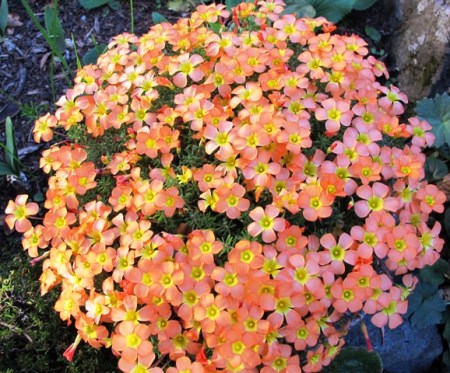
Oxalis flower in colours from white, through the full gamut of pinks and lavenders to the crimson red of O. braziliensis, yellow, and apricot-orange tones. The well known O. versicolour has a pointed bud which is candy striped pink and white, like a traditional barber’s pole, though in the sun the flowers open to white. It is the only one I know which is showier when it is not open.
Oxalis (or wood sorrel, if that sounds better) are easy and fun to grow for a bit of cheer as the autumn draws in.

We keep O. eckloniana in a pot plunged into the garden

We keep O. eckloniana in a pot plunged into the garden

Growing oxalis in containers:

If in doubt, keep oxalis confined to pots in sunny positions.
• Pots can be plunged in the garden to reduce watering.
• Repot every year or two.
• Empty the pot onto newspaper and choose only the best looking bulbs. You will see which varieties have dangerous tendencies – either masses of tiny bulbs or long runners with too many bulbils attached. Throw the rest out with household rubbish to prevent any escaping.
• Free draining potting mix is recommended.
• If you have used a commercial potting mix, it will have fertiliser already added. If you are not repotting every year, the time to feed is as the bulbs are coming in to growth.
• Wide, shallow pots give the best display.
• Keep pots dry when bulbs are dormant to stop them from rotting out.
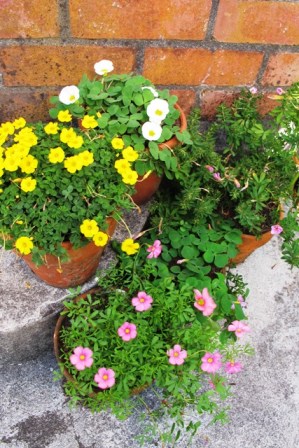
Perfect for sunny doorsteps

Perfect for sunny doorsteps

Dealing to the weedy ones:

There are no easy answers when it comes to getting rid of the weedy oxalis in gardens and lawns. O. corniculata is a creeping plant which doesn’t have a bulb so it can be weeded out. It spreads rapidly from seed and matures quickly so it pays to be vigilant and to dispose of plants in the household rubbish to avoid dispersing the seed. It can be green or red-brown in leaf and has tiny yellow flowers.
The pink or yellow flowered weedy bulb forms are more problematic, especially if they are growing through other plants. Glyphosate will kill them eventually, if you keep applying it every time you see leaves reappearing. I have never tried Death to Oxalis but it appears to need frequent reapplications as well. If you can lift all the other plants out of the garden border, you can sieve the soil or even replace it all. If you cover the area in black plastic and let it bake throughout a hot summer, it will sterilise the soil to some extent. Failing that, you just have to be persistent and vigilant, getting rid of every little bit you see.
First published in the Weekend Gardener and reproduced here with their permission.
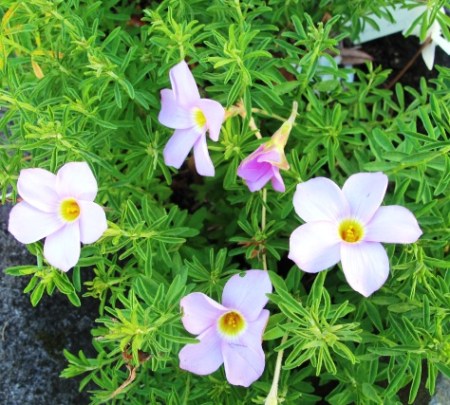
O.hirta lavender - second place favourite
O.hirta lavender - second place favourite


O.massoniana - massed in a wide, shallow container in full sun

O.massoniana - massed in a wide, shallow container in full sun


O. polyphylla shows very different foliage
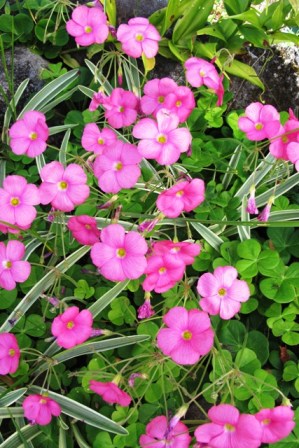
O. polyphylla shows very different foliage


O. bowiei - bold and showy very early in the season

O. bowiei - bold and showy very early in the season
In the garden this fortnight: June 7, 2012

A fortnightly series first published in the Weekend Gardener and reproduced here with their permission.

Naturalising bulbs in conditions of rampant grass growth

Naturalising bulbs in conditions of rampant grass growth

Meadows of naturalised bulbs are a complete delight and a contrast to the highly cultivated type of garden most of us have. But they are best suited to places where there isn’t vigorous grass growth and regular rain. This means that good dairy country like Taranaki is by definition not suitable for bulb meadows. All that grass overpowers and hides them. But we are undeterred. Mark has been working on a bulb hillside in recent years where we have a native microlaena grass (probably M. stipoides) which is much finer and less vigorous than introduced pasture and lawn grasses. He likes the bulbs on a hill because it is possible to get closer and to look up at the flowers from a pathway. He is very pleased with how the dwarf narcissi, species cyclamen, colchicums, snowdrops (mostly Galanthus S. Arnott) and pleione orchids have settled in over the last three years and started multiplying. The bluebells (hyacinthoides) are more robust and build up well in open areas under the trees where we can control the grass with a weed-eater. The exercise is getting the last grass trimming round done before the bulb foliage is too far through the ground with flower spikes formed.

Lachenalia bulbifera

Lachenalia bulbifera

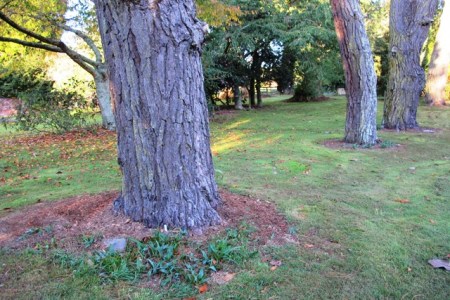
In a different area of the garden, in recent years I have been planting surplus bulbs around the trunks of large trees where the grass won’t grow because the ground is too dry and poor. These are ideal conditions for some bulbs and the lachenalias from South Africa, stronger growing dwarf narcissi like the bulbocodiums and peacock iris (Moraea villosa) don’t mind at all. There is plenty of light because these trees have dropped all their lower limbs over time. It is not quite the meadow we would like with big drifts, but it is what we can manage in our climate.

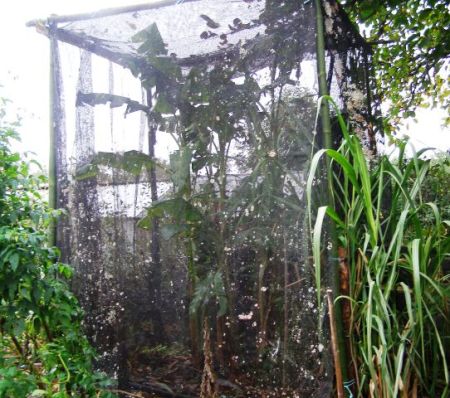
The Theatre of the Banana

The Theatre of the Banana

Top tasks:

1) Get the winter cage erected around the bananas. They are the only plants we wrap up for winter but we are very marginal banana growing territory and we are willing to work at trying to get a home grown banana crop. I refer to the construction as the Theatre of the Banana.

2) Sort out the compost heaps. We make quite large quantities of compost but at the moment, the waste is accumulating faster than we are layering it into compost piles. We work a three heap system – the heap we are currently using, the heap that is curing and the one we are building. At the moment there seems to be enough for two new compost heaps.

Outdoor Classroom – pruning roses

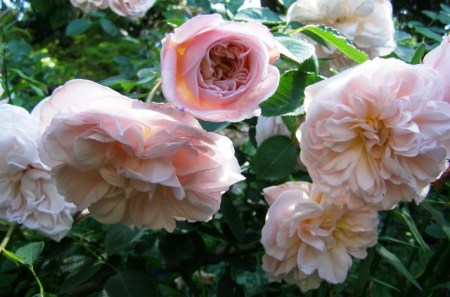
Cymbeline

Cymbeline

One size does not fit all with roses but there are some rules that apply to most rose types. Pruning stimulates growth so in colder areas, it is best left until later in August to avoid new growth getting frosted. In warmer areas, timing does not matter – from now on is fine.


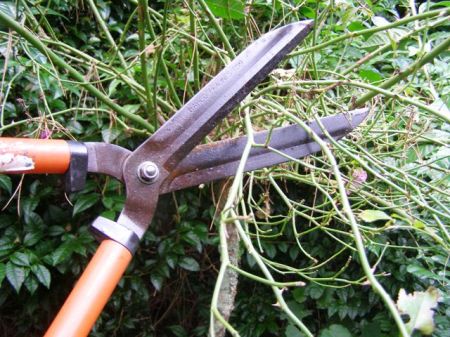
1) Bushy roses with lots of fine, twiggy growth (some standard roses are of this type also) can be given the once over shear with hedge clippers. It doesn’t look the tidiest when the cut ends then die back to the nearest leaf bud, but once they come into leaf there is little visible difference and it is much faster.


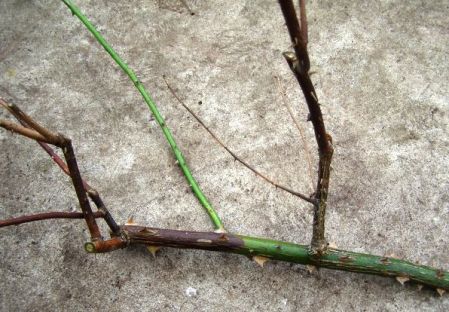
2) For more careful pruning, cut out stems with dieback, seen here in the dark brown stems.


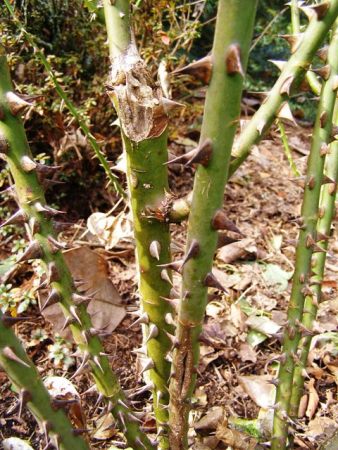
3) Cut out stems which show damage or cross and rub against each other, shown here in the two centre stems. The rubbing damages the bark and makes the plant more vulnerable to diseases getting in. Because roses do best with light and air movement, it is usually advisable to keep the middle of the plant open. Remove any spindly, weak stems.


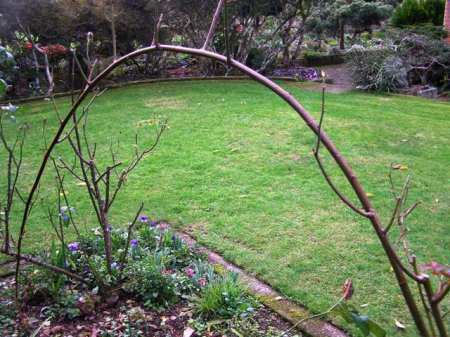
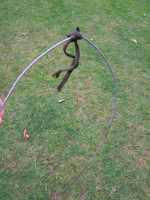
4) Some roses put on very long, whippy growths. Where space allows, arching these growths over and tying them down (I use hoops of wire and a soft tie) forces all the buds along the stem into growth and greatly increases the floral display. Similarly, tying a climbing rose to a horizontal line, encourages that stem to flower all the way along rather than just on top.
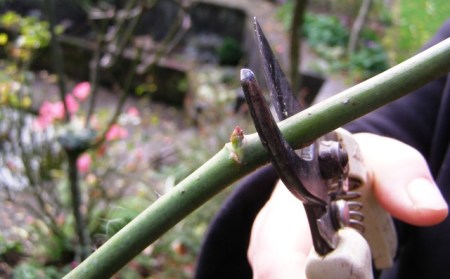


5) Shorten the remaining stems back to a leaf bud (if you leave too much past the bud, it will die back to that level anyway) and pick a leaf bud on the outside of the stem. This is because the new shoots will follow that direction and you want them growing away from the plant and not crisscrossing the middle. Angling the cut away from the bud encourages the water to run off. Make sure your secateurs are sharp and cut cleanly, not crushing the stem.


6) All advice is to use a copper spray after pruning to help fight fungal diseases. We have yet to do this (we don’t spray our roses at all) but the advice comes consistently from those who know more about roses. It will also help reduce the build-up of lichens and mosses on the stems and the base. Copper hydroxide is different to copper oxychloride so follow the application rates on the packet and do it at winter strength.

The Bad Tempered Gardener from the Welsh borderlands

Veddw, the garden of Anne Wareham and Charles Hawes (photo copyright Charles Hawes)

Veddw, the garden of Anne Wareham and Charles Hawes (photo copyright Charles Hawes)

Anne Wareham (photo credit Charles Hawes)

Anne Wareham (photo credit Charles Hawes)

Anne Wareham had my attention from the first page of her book, bravely titled “The Bad Tempered Gardener”. Her second sentence opens:

I have to make my way in a world which is totally alien to me. A world where people are inevitably passionate, always ‘green’ and always terribly concerned about the little furry things….

She continues:

I began to get tired of hearing every garden described as ‘lovely’. I visited many of them and often found them to be banal and uninspired. I began to wish for writers who would tell the truth about the gardens and gardening and found only ‘garden stories’ and discussions of gardening techniques…. The problem is the fond idea that gardening is inevitably nice but dull…. ”

What is interesting about Anne Wareham’s work is that this is contemporary thinking about gardening from a hands-on perspective. I have also been reading Vita Sackville West’s collated newspaper columns from the early 1950s. She is renowned for creating the garden at Sissinghurst. There has been a proud tradition of garden writing by gardeners – Russell Page, Beth Chatto, Penelope Hobhouse and other great names, particularly in the world of English gardening. Not to put too fine a point on it, they are all either elderly or dead. Where is the current thinking?

Garden writing at this time seems to fall into three categories. There are academic treatises out of institutions where gardening has been hijacked by higher status landscape design. Then there are all the novice wannabe books which are of no interest at all to the serious gardener. All that breathless naivety and ingenuous enthusiasm wears very thin if you are not in the target demographic. The rest tends to be either prosaic description or praise in purple prose. There is no attempt at critique and very little in the way of ideas.

Apparently it is the same in the UK though I did think that the writer of the BBC Gardening Blog was guilty of gross hyperbole when he or she babbled of this book that: “Everyone, but everyone has been talking about possibly the most controversial book ever written about gardening.” It is not that radical and actually slots quite nicely into the tradition of garden writing. It is thought provoking and a breath of fresh air.

That said, it is not highly polished and the forty five chapters stand independently, almost as if they are a collation of pieces published previously, though there is no reference to this being the case. So there is not a cohesive argument but more a case of recurring themes. What I can tell about this book is that there is a great deal of thinking time that has gone into formulating the ideas and opinions. The author has two acres of intensive garden which she started from scratch and two acres of woodland which she maintains with her husband. Much of gardening is repetitive and takes little concentration so there is a lot of solitary thinking time. It takes one to know one. It is how I operate so I recognise it in someone else. And I have never before read a book where I have so often felt as if I was in conversation with the author. I kept wanting to say: “Exactly. I wrote about this very thing here.” Whether it is water maintenance, show gardens, rose gardens, scented plants, the impact of devaluing the garden visit experience by bringing it under the amateur and charitable banner, the hyperbole of garden descriptions – this is all familiar territory.

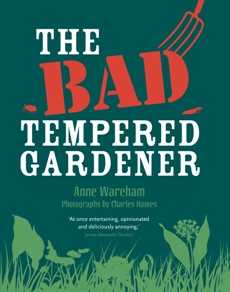
The Bad Tempered Gardener by Anne Wareham

The Bad Tempered Gardener by Anne Wareham

Thought provoking chapters are interspersed with short pieces on plants. These have little relevance in New Zealand. Erigeron is that highly invasive daisy that is actually on the banned list here. Tulip mania has never struck this country in the European manner (to buy fresh bulbs every season seems profligate). Alchemilla mollis is not the easy, frothy plant here that it is in the UK. These are just little interludes, breathing spaces, between the more opinionated pieces. Of interest are the chapters on the creation of her own garden, Veddw, on the Welsh border and the principles which drove her in design and plant selection. We are not in agreement on plants, but that is fine. To disagree with a well thought out and strongly held position challenges one’s own thinking.

Best guess is that the author has cultivated a certain prickly persona. I doubt very much that she is inherently any more bad tempered than the rest of us. The title of her book is probably as much a nod to the late Christoper Lloyd (he of Great Dixter fame) with his book titled “The Well-Tempered Garden” and maybe to Germaine Greer. Readers here may not be aware of the latter’s enthusiasm for gardening. She wrote a newspaper column under the pseudonym of Rose Blight and a collation of these were released in book form under the title of “The Revolting Gardener”.
Indeed, I am wondering about extending the theme with my own book – “The Opinionated Gardener”. Don’t hold your breath, however. I am unlikely to find a publisher any time soon.

I sourced my copy through Amazon though Touchwood Books or good bookshops will be able to order it in. As far as I know it is not on the shelves in this country.

The Bad Tempered Gardener by Anne Wareham. Photographs by Charles Hawes. (Frances Lincoln Ltd; ISBN: 978 0 7112 3150 4).

The reflecting pool at Veddw (instructions are in the book). Photo credit: copyright Charles Hawes

The reflecting pool at Veddw (instructions are in the book). Photo credit: copyright Charles Hawes

First published in the Waikato Times and reproduced here with their permission.

Grow it Yourself: Cavolo nero (Tuscan black kale)

Buffy, the contrary cat, tries to convince us that kale is delicious

Buffy, the contrary cat, tries to convince us that kale is delicious

Cavolo nero - photo Joe Mabel

Cavolo nero – photo Joe Mabel

In the odd world of fashionable vegetables, Cavolo nero ranks high enough to be showing in trendy recipes, putting it above even options like cardoon and burdock. It is a kale, a member of the brassica family, but coming from Italy and being of an interesting appearance, it is seen as a sophisticated option. It does not form a heart but instead has very long leaves in a palm-like formation, heavily crinkled or puckered (like a Savoy cabbage) and blackish green in colour. We tried growing kale one season but found it tough and unappealing. Mark commented that there may be reasons why our forbears preferred other brassicas to kale. Our cat at the time, the contrary Miss Buffy, confounded us by eating the cooked kale we rejected, but that should not be taken as an affirmation of taste and texture. Kale is very hardy and reliable in conditions where even other brassicas struggle.

Despite its unusual appearance and trendy reputation, Cavolo nero is a typical brassica – cold hardy, will hold in the winter garden but best avoided for mid summer growth because it is just as vulnerable as others in the family to white butterfly and aphids. You are unlikely to find plants for sale so will almost certainly have to start with seed. You can source seed from Italian Seeds Pronto or Kings Seeds. If you are really keen, you could try an early spring sowing for harvest two months later though it is more commonly sown in late summer to grow through autumn and to hold in the garden for winter harvest. Frosts are reputed to intensify and sweeten the flavour, somewhat akin to swedes, but some of us think this may have more to do with wishful thinking.

First published in the Waikato Times and reproduced here with their permission.