Plant Collector: Chamaecyparis obtusa ‘Caespitosa’

Chamaecyparis obtusa 'Caespitosa' is a little honey bun of a plant... after 50 years

Chamaecyparis obtusa ‘Caespitosa’ is a little honey bun of a plant… after 50 years

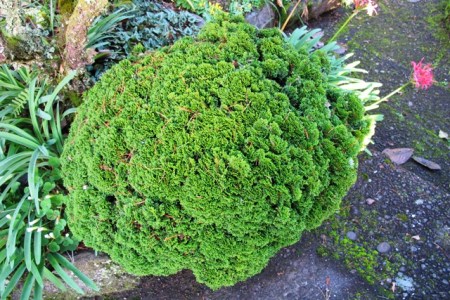
I can’t help but think that if conifers had user-friendly common names, they might have staged more of a revival as desirable plants. There is nothing easy about this name. Even the pronunciation of ‘Caespitosa’ is problematic. But it is the cutest little honey bun of a plant. We once produced a line of these to sell. After about 7 years, they measured no more than 10cm across. It is difficult to sell tiny gems like that. After 50 years or more, the ones in our rockery are about 40cm high and 50cm wide. They are like dense mushrooms and have never been clipped or shaped in any way. I sometimes clean out some of the dead debris in the middle and I clip off the occasional larger leafed stem but that is all the care these plants get.

The reason I clip off any odd looking foliage is because this is a bit of a freak seedling derived from what was a timber tree in its native Japan – commonly referred to as the Hinoki Cypress, though it would be more correct to refer to it as the Hinoki False Cypress because chamaecyparis are known as false cypress. It is obviously highly variable and prone to throwing sports because there are a host of different named selections. Such sports can revert to larger and stronger growing forms which is why it pays to clip out any peculiar, larger foliaged branches on a dwarf like this.

This is such a wonderfully tactile plant. The instinct is to pat it as you pass and it completely dense and firm. ‘Caespitosa’ was raised from seed before 1920 in England so it has been around for a while. It is still seen as a gem for alpine gardens. Cold climate gems that also tolerate the mild humid conditions that have here are not common.

First published in the Waikato Times and reprinted here with their permission.

Grow it yourself: European radishes

I still associate radishes with encouraging young children to garden. The little red globes of the European radish grow so rapidly that you can be eating them in just over three weeks which gives a wonderfully quick result, even if the flavour may not be to littlies’ taste. If you haven’t had a look at radishes in recent years, you may be surprised by the range now available. There are long thin ones, large and small globed ones and colours range through reds, pinks, whites and bicolours to pure gold (Radish Zlata from Poland) and the Black Spanish Radishes which are black skinned with white flesh. And that is without even considering the oriental radish varieties.

The common garden radish has a bit of a split personality. It is almost exclusively served as a salad vegetable in this country though there is no reason why you cannot cook with it, in a similar manner to other root vegetables, albeit being of rather small stature. However it is a brassica which explains why it is better as a cool season crop. In mild areas, radishes can be grown right through winter. Yet it is a root crop, unlike most brassicas, so it does not want soils rich in nitrogen which encourage too much leafy top growth at the expense of the roots.

Sow seed directly into finely tilled soil and cover lightly to a depth of a centimetre. They will need to be thinned out after germination to allow room for the roots to develop. Pick them young. They soon get woody and too peppery so are best pulled, washed and stored in the fridge if you have too many. And you can always try Hugh Fearnley Whittingstall’s unlikely fresh radish dish – serve with softened but not melted butter and lashings of salt. No Heart Foundation tick for that one.

First published in the Waikato Times and reprinted here with their permission.

Tikorangi Notes: Friday June 8, 2012

Latest posts: Friday 8 June, 2012

A distinct flurry of new posts this week.

1) In praise of ornamental oxalis (or wood sorrel, if you prefer). Contrary to popular opinion, not all oxalis are bad.

2) In the garden this fortnight – mostly about bulb meadows.

3) Pruning roses made simple. We may not spray our roses here but I do prune them.

4) The Bad Tempered Gardener from the Welsh borderlands. An interesting book by a contact made on Twitter. Truly, I am so delighted that my time on Twitter is not all in vain.

5) I had been wondering (in a somewhat desultory way, as one does) what would be the next hot vegetable trend when the penny dropped: Cavolo nero (Tuscan black kale) of course.

6) Plant collector this week are the inverted icecream cones of Picea albertiana ‘Conica’.

7) At last, a reference on organic gardening without the smoke and mirrors. It us just a pity it is geared to English gardening conditions. Organic Gardening Bible by Bob Flowerdew reviewed. Does not the author have a wonderful name?

9) Nothing to do with gardening and all to do with food with lashings of history and culture: The Food of Spain by Claudia Roden.

Two weeks from the shortest day - time to cover the banana

Two weeks from the shortest day – time to cover the banana

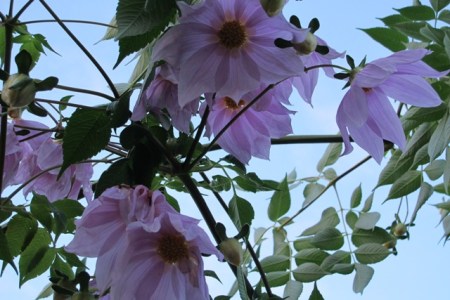
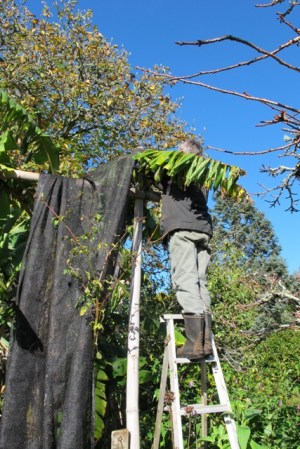
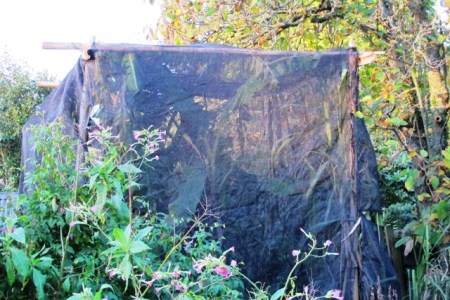
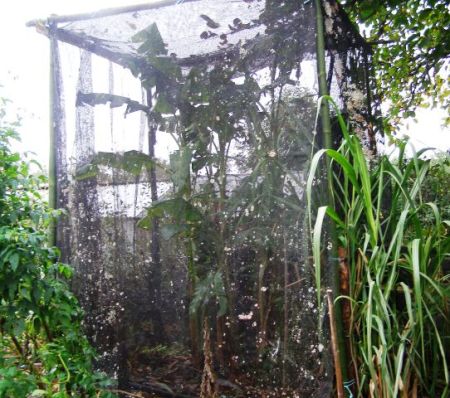
While it is only two weeks until the shortest day, winter has yet to bite here as can be seen from the lilac tree dahlia at the top. Indeed when it snowed heavily in Christchurch a few days ago, our temperature was still in the warm teens (Celsius, dear American readers, we measure our temperatures in Celsius). But in anticipation of cold snaps that we know will come, Mark has finally got around to re-erecting his Theatre of the Banana. This particular fruiting banana is the one and only plant we wrap up for winter. Really we are not that warm but he tells me that there are a few fruit forming on it and I am sure he is aiming for us to achieve self sufficiency in bananas at some time in the future.

Done. I call it the Theatre of the Banana

Done. I call it the Theatre of the Banana

In praise of ornamental oxalis (or wood sorrel, if you prefer)

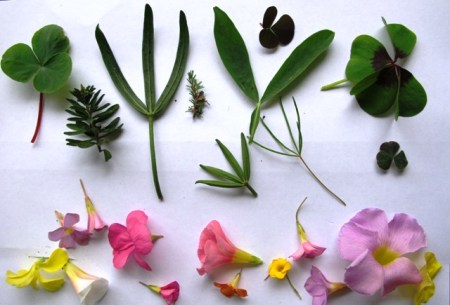
Oxalis show considerable variation in leaf form (and in flower colour)

Oxalis show considerable variation in leaf form (and in flower colour)

Most people shudder at the mere mention of oxalis. The bad reputation of a few has tarnished the entire population. We would not be without the cheerful sight of them blooming from early autumn through winter, but the most common reaction from others is complete dismissal. I have even resorted to their colloquial name overseas – wood sorrel. It sounds so much prettier and more acceptable than oxalis.

Over the years, we have gathered up around 30 different ornamental varieties but these are a mere drop in the bucket. The oxalis family is huge. In the wild, the number of different species is into the late hundreds. That is not to say that they are all of great merit. Nor are they all bulbs. Equally, not all are invasive.

O. deppei "Iron Cross" grows and flowers in the opposite seasons to most ornamental varieties

O. deppei "Iron Cross" grows and flowers in the opposite seasons to most ornamental varieties

Most oxalis are native to either South Africa or South America, though it is the former that gives us the majority of varieties which have garden merit. Most are triggered into growth by late summer rain, so they come into flower around this time of year. The two notable exceptions we have in our collection are both from South America. Oxalis deppei “Iron Cross” (named for the markings on its leaves) is from Mexico and going dormant now, to return to growth at the start of November. O. triangularis, with its triangle shaped leaves in deep burgundy, is Brazilian and also flowers in summer. I bought this one at a car boot sale where I commented that it was an oxalis that I did not have. “No,” protested the vendors. “It is not an oxalis. It is a triangularus.” I didn’t argue.

Some of these oxalis are perfectly safe in the garden. I can vouch for this after decades of growing them in the rockery where they have never threatened to become a weed. Others are downright dangerous. Turn your back and they will invade at alarming speed. Such wayward habits don’t mean you have to shun them. Keep them in pots. You can either plunge the pot into the garden (which reduces the need to water it), or have a collection on a sunny doorstep. Oxalis only open their flowers in the sunshine. When they have ceased being attractive, you can move the pots out of sight for the rest of the year. We have not had problems with them setting seed so as long as the bulbs are confined, they rarely escape.
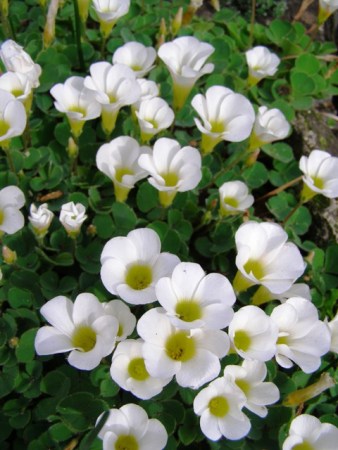
My all time favourite - O. purpurea alba
My all time favourite - O. purpurea alba

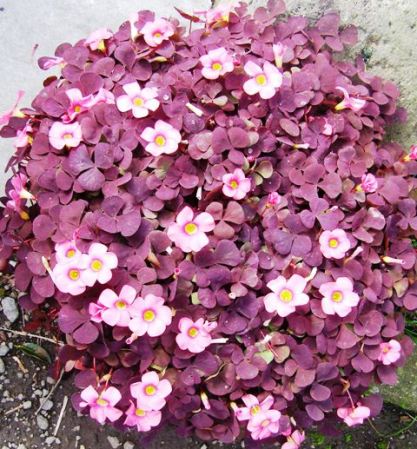
Same species but different form and very different behaviour. Keep O. purpurea "Nigrescens" confined to a pot

Same species but different form and very different behaviour. Keep O. purpurea "Nigrescens" confined to a pot

My all time favourite is the pristine white O. purpurea alba. It has an exceptionally long flowering season and is extremely well behaved in the garden. A mat of this plant opening up its large blooms to the sunshine is a delightful sight. Each flower has a golden eye. Purpurea is a variable species. The green form (same clover-like leaves but with large pink flowers) also has an excellent length of flowering but I haven’t had it long enough to know whether it is garden safe or not so I still keep it in pots. The reason for my caution is that O. purpurea ‘Nigrescens’, highly desirable for its deep burgundy foliage and big pink flowers, is dangerous. I have seen it invade an Auckland garden on heavy clay. It was as bad as the weedy varieties, just more ornamental. Keep it confined at all times.

My second place favourite is the lavender O. hirta. We also have a bright pink form of it, but the pastel lavender is prettier. This has very different foliage – trailing clusters of leaves. The range in leaf form is surprising. O. fabaefolia is often called the rabbits’ ear oxalis because its leaves look like pointed rabbits’ ears. It has a big yellow flower but a very short season.
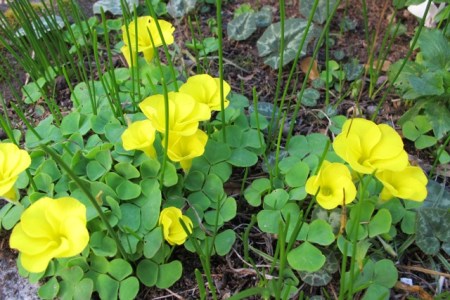
O. luteola - an excellent garden variety

O. luteola - an excellent garden variety

Oxalis luteola, with its neat mat of clover-like leaves and masses of sunshine yellow blooms over many weeks, is another tried and true garden plant here. It has never been a problem in the rockery and gently grows amid other plants without ranging far afield. O. lobata is like a miniature form of O. luteola and equally garden safe.

Oxalis flower in colours from white, through the full gamut of pinks and lavenders to the crimson red of O. braziliensis, yellow, and apricot-orange tones. The well known O. versicolour has a pointed bud which is candy striped pink and white, like a traditional barber’s pole, though in the sun the flowers open to white. It is the only one I know which is showier when it is not open.
Oxalis (or wood sorrel, if that sounds better) are easy and fun to grow for a bit of cheer as the autumn draws in.

We keep O. eckloniana in a pot plunged into the garden

We keep O. eckloniana in a pot plunged into the garden

Growing oxalis in containers:

If in doubt, keep oxalis confined to pots in sunny positions.
• Pots can be plunged in the garden to reduce watering.
• Repot every year or two.
• Empty the pot onto newspaper and choose only the best looking bulbs. You will see which varieties have dangerous tendencies – either masses of tiny bulbs or long runners with too many bulbils attached. Throw the rest out with household rubbish to prevent any escaping.
• Free draining potting mix is recommended.
• If you have used a commercial potting mix, it will have fertiliser already added. If you are not repotting every year, the time to feed is as the bulbs are coming in to growth.
• Wide, shallow pots give the best display.
• Keep pots dry when bulbs are dormant to stop them from rotting out.
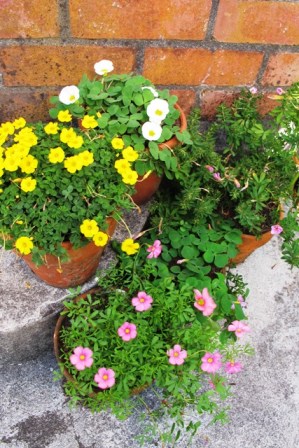
Perfect for sunny doorsteps

Perfect for sunny doorsteps

Dealing to the weedy ones:

There are no easy answers when it comes to getting rid of the weedy oxalis in gardens and lawns. O. corniculata is a creeping plant which doesn’t have a bulb so it can be weeded out. It spreads rapidly from seed and matures quickly so it pays to be vigilant and to dispose of plants in the household rubbish to avoid dispersing the seed. It can be green or red-brown in leaf and has tiny yellow flowers.
The pink or yellow flowered weedy bulb forms are more problematic, especially if they are growing through other plants. Glyphosate will kill them eventually, if you keep applying it every time you see leaves reappearing. I have never tried Death to Oxalis but it appears to need frequent reapplications as well. If you can lift all the other plants out of the garden border, you can sieve the soil or even replace it all. If you cover the area in black plastic and let it bake throughout a hot summer, it will sterilise the soil to some extent. Failing that, you just have to be persistent and vigilant, getting rid of every little bit you see.
First published in the Weekend Gardener and reproduced here with their permission.
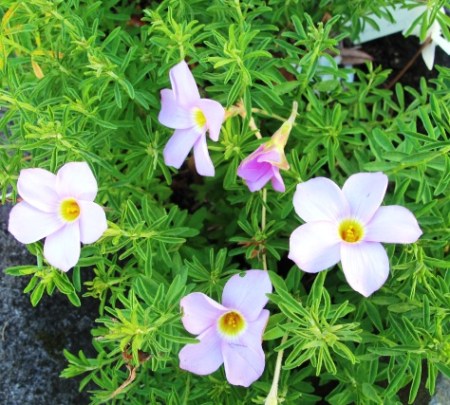
O.hirta lavender - second place favourite
O.hirta lavender - second place favourite


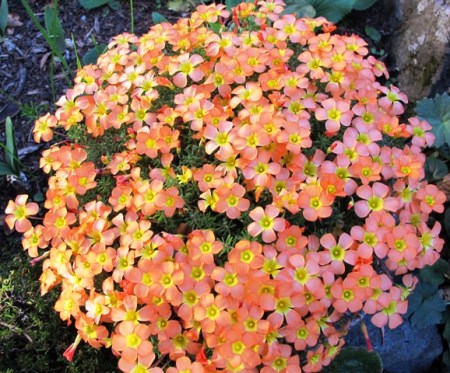
O.massoniana - massed in a wide, shallow container in full sun

O.massoniana - massed in a wide, shallow container in full sun


O. polyphylla shows very different foliage
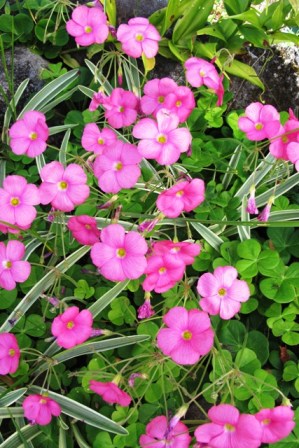
O. polyphylla shows very different foliage


O. bowiei - bold and showy very early in the season

O. bowiei - bold and showy very early in the season

In the garden this fortnight: June 7, 2012

A fortnightly series first published in the Weekend Gardener and reproduced here with their permission.

Naturalising bulbs in conditions of rampant grass growth

Naturalising bulbs in conditions of rampant grass growth

Meadows of naturalised bulbs are a complete delight and a contrast to the highly cultivated type of garden most of us have. But they are best suited to places where there isn’t vigorous grass growth and regular rain. This means that good dairy country like Taranaki is by definition not suitable for bulb meadows. All that grass overpowers and hides them. But we are undeterred. Mark has been working on a bulb hillside in recent years where we have a native microlaena grass (probably M. stipoides) which is much finer and less vigorous than introduced pasture and lawn grasses. He likes the bulbs on a hill because it is possible to get closer and to look up at the flowers from a pathway. He is very pleased with how the dwarf narcissi, species cyclamen, colchicums, snowdrops (mostly Galanthus S. Arnott) and pleione orchids have settled in over the last three years and started multiplying. The bluebells (hyacinthoides) are more robust and build up well in open areas under the trees where we can control the grass with a weed-eater. The exercise is getting the last grass trimming round done before the bulb foliage is too far through the ground with flower spikes formed.

Lachenalia bulbifera

Lachenalia bulbifera

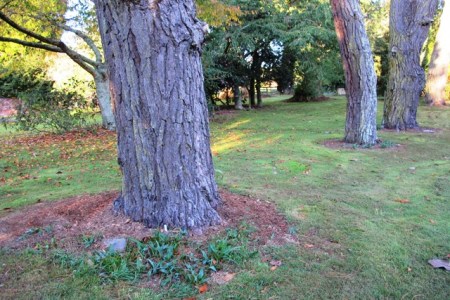
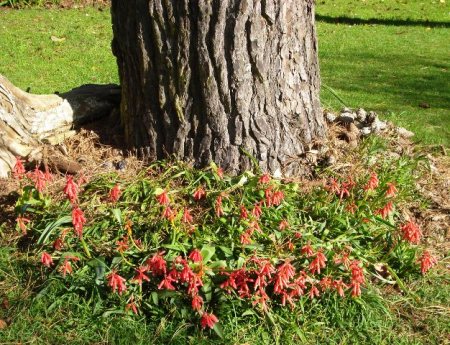
In a different area of the garden, in recent years I have been planting surplus bulbs around the trunks of large trees where the grass won’t grow because the ground is too dry and poor. These are ideal conditions for some bulbs and the lachenalias from South Africa, stronger growing dwarf narcissi like the bulbocodiums and peacock iris (Moraea villosa) don’t mind at all. There is plenty of light because these trees have dropped all their lower limbs over time. It is not quite the meadow we would like with big drifts, but it is what we can manage in our climate.

The Theatre of the Banana

The Theatre of the Banana

Top tasks:

1) Get the winter cage erected around the bananas. They are the only plants we wrap up for winter but we are very marginal banana growing territory and we are willing to work at trying to get a home grown banana crop. I refer to the construction as the Theatre of the Banana.

2) Sort out the compost heaps. We make quite large quantities of compost but at the moment, the waste is accumulating faster than we are layering it into compost piles. We work a three heap system – the heap we are currently using, the heap that is curing and the one we are building. At the moment there seems to be enough for two new compost heaps.