First published in the Weekend Gardener and reproduced here with their permission.
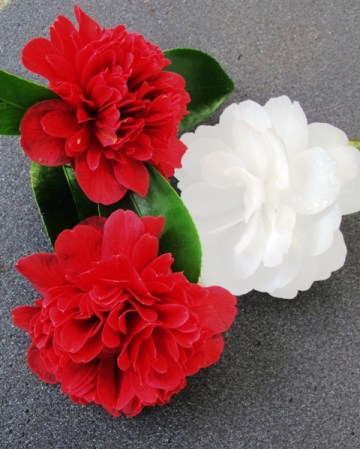
White ‘Early Pearly’ is one of the most beautiful of the sasanquas, while red ‘Takanini’ is a japonica which flowers from early to late in the season.
There is always something magical about the first flowers and camellias are no exception. They seem fresh and new, heralding the progression of seasons. While the main camellia season is from late winter to mid spring, the earlier varieties bring colour to the late autumn and early winter garden. Early flowers also escape the curse of camellia petal blight which affects mid and later season varieties.
Early camellias fall into three groups: the sasanquas, early flowering species and a few japonica types and hybrid camellias which have an exceptionally long flowering season, continuing from early to late.

We particularly enjoy the charming sasanqua ‘Crimson King’, seen here as a mature shrub with a graceful, arching form.

Camellia sasanqua ‘Bonanza’ is a bright spot of colour on a grey day
The sasanqua camellias originate in Japan and are renowned for being sun tolerant, having smaller leaves and being suitable for clipping to hedges. While some are slow to get going as garden plants, over time they can make graceful, airy, large shrubs. They mass flower and most are scented, in a mossy, slightly sweet sort of way. Their blooms are softer and lack the defined form and substance of most later flowering camellia types. This is an advantage when the flowers fall and break up quickly, rather than leaving a sludge of brown at the base of the plant. While white sasanquas have been particularly popular for some years, they also come in a whole range of pinks to red tones and bi-colours. We prefer the coloured ones for a splash of winter cheer in the garden when there is not a lot else in flower.
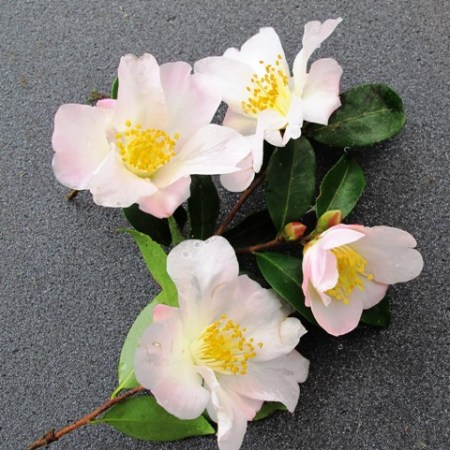
‘Fairy Blush’ is a scented hybrid with a very long flowering season.
There are a range of early flowering species but these are unlikely to be found for sale these days. The most useful of them for us, are dainty little C. brevistyla and C. microphylla which offer potential as replacements for buxus hedging and are a great deal prettier than box when in flower.
There are some japonica and hybrid camellias which have remarkably long flowering seasons. In the reds, ‘Takanini’ flowers early, middle and late and should be readily available. Later season blooms develop an unusual purple hue. ‘Roma Red’ is a new release and not as widely available, with its formal flowers in mid red. ‘Mimosa Jury’ is a perfect formal in pretty pink and shows good weather hardiness. ‘Fairy Blush’ is a scented, small flowered pale pink and white miniature bloom with an exceptionally long season. These varieties open their first flowers with the sasanquas but continue long after they have finished and will still have flowers when the late season varieties are on show.

For perfection in a bloom, it is hard to go past the formal shape of Camellia ‘Mimosa Jury’ which has the added benefit of showing good weather tolerance without marking badly.
GROWING CAMELLIAS IN CONTAINERS
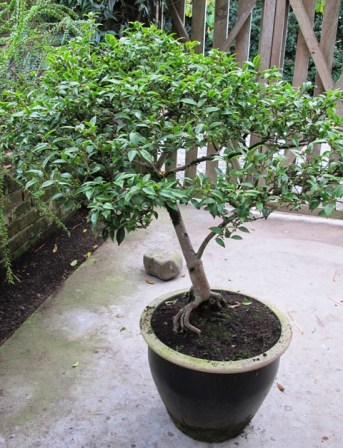
Camellia ‘Itty Bit’ is a dwarf variety that has been kept in a pot here for 20 years
All camellias can be grown for a year or two in a pot but you are fighting nature if you want to keep a larger growing variety long term. Plants need repotting every two years to keep them healthy and lush. Unless you are root pruning and shaping the plant regularly, larger growing varieties will soon get too big to handle.
Do not make the mistake of thinking that small flowers mean the plant is small growing and vice versa. You are better to start with varieties with words like “compact”, “dense growth”, “dwarf”, or “slow growing” in their description. Where heights are given, pick those of 100cm or under (and remember that heights are almost always understated on plant labels).
We have had Camellia minutiflora in a succession of containers for about twelve years. We have a miniature “Itty Bit” which has been featured in a container for at least twenty years. On the other hand, it is clear that “Spring Festival” is going to be too large after only three years.
Rules of thumb are not to drown a small plant in an over large pot, to ensure that the pot has plenty of drainage holes at the base and to use a good quality potting mix with slow release fertiliser. Feed by top dressing after the first year and repot with fresh mix after two years.
WHITE SASANQUA CAMELLIAS
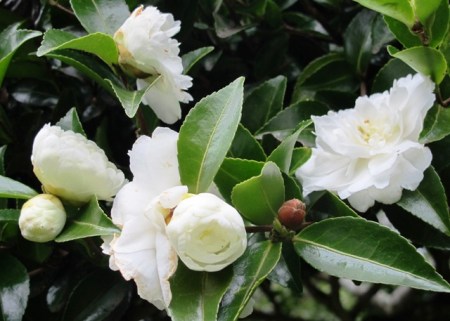
There is a range of sasanqua camellias in white. ‘Silver Dollar’ has a long flowering season and is an excellent option for a more compact hedge.
While ‘Setsugekka’ is the best known white sasanqua in this country, it is not the only one. For perfection in a sasanqua bloom, it is hard to go past ‘Early Pearly’ with its formality in that shape that resembles a water lily. It is unusual to see a formal flower in sasanquas. ‘Silver Dollar’ is a smaller, bushier growing white with a mass of pompom flowers over a long season. It makes an ideal lower hedge option, able to be clipped to about a metre high. ‘Mine No Yuki’ is a slow growing variety, though will ultimately get large if it is not clipped (ours is at least 3 metres high and spans 4 metres wide, though that is after about 50 years). ‘Weeping Maiden’ grows rapidly to give a quick result with its arching growth and masses of large, single white blooms with golden stamens.
CAMELLIA PETAL BLIGHT
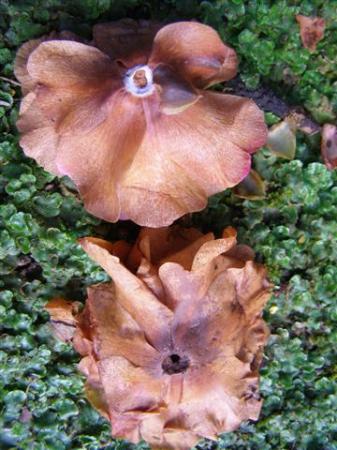
Camellia petal blight shows in the top flower as a distinctive white ring whereas the lower flower has been spoiled by botrytis.
If you have been thinking that your mid season camellia display is not what it used to be, you will be right. Camellia petal blight has taken firm hold and cut the display to a fraction of what it used to be.
We have always had botrytis in New Zealand. It is the fungus that turns camellia flowers dark brown and mushy, especially in long periods of damp weather. Petal blight is different. It turns the flowers to a paler coloured mush, spreading through each bloom rapidly. A brown mark one day can cover most of the flower the following day. If you turn the affected bloom over and remove the calyx (the small cap holding the petals together at the end of the stem), you will see a white fluffy ring, indicating camellia petal blight. If it is dark and greyish, it is botrytis. Unfortunately, blighted flowers often hang on the bush rather than falling cleanly. Petal blight is a great deal more rampant than botrytis.
There is no cure and it will take many years before we see resistant varieties on the market. It does not usually take hold before late June or July, so the early flowering camellias can get through with their mass display unaffected.
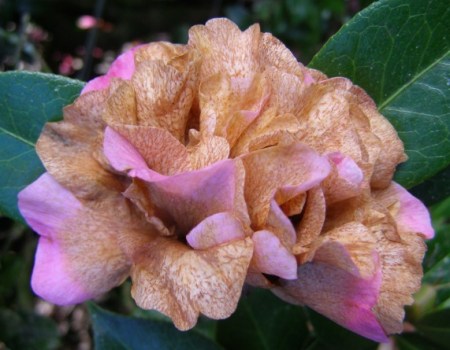
The ugly face of camellia petal blight which affects mid and later season blooms.
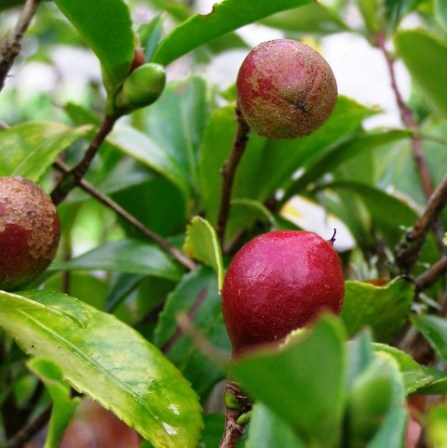
Camellia species can be grown from seed. There will be some seedling variation in the plants but they are usually close enough on appearance for hedging purposes. These are last year’s red seed pods on C. microphylla.
COMPACT CAMELLIA HEDGING
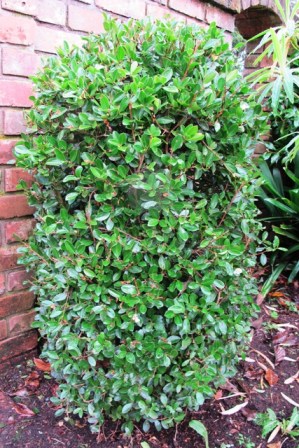
Camellia species brevistyla and microphylla offer an option as buxus hedging replacement and can be grown from seed. This plant is C. brevistyla.
Simply the best camellias we have found as a potential replacement for buxus hedging are C. brevistyla and C. microphylla. These two species are very hard to tell apart and must be closely related. Their leaves are a little larger than buxus but they clip very tidily and are a good dark green. Both species have pure white single flowers very early in the season. C. brevistyla is a little slower growing and smaller but its flowering is over quickly. We have built up C. microphylla as replacement hedging for our own garden.
These species may be hard to source but if you can find a parent plant, they can be raised easily from seed. Both set seed freely. Ask at your botanic gardens. Both species were sold in the past by Camellia Haven in Papakura.

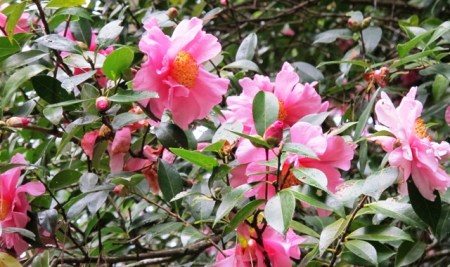
There is nothing special about the individual blooms on Camellia sasanqua ‘Showgirl’, but at the time when it flowers, there is nothing to rival its showiness.
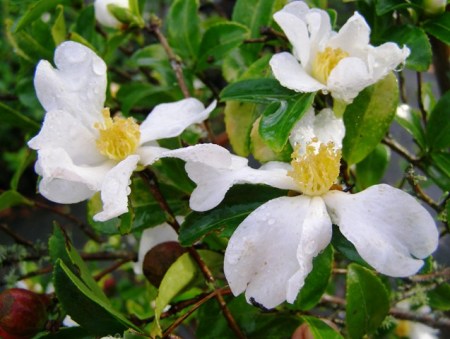
The dainty flowers on both C. microphylla and C. brevistyla are almost identical but last longer on the former, seen here.
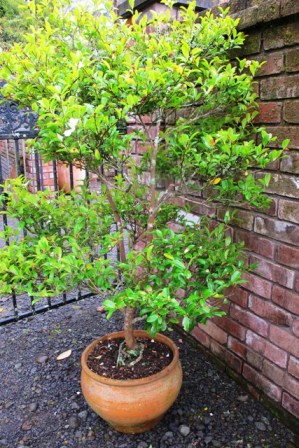
C. microphylla has been kept clipped and shaped in containers for at least 12 years.