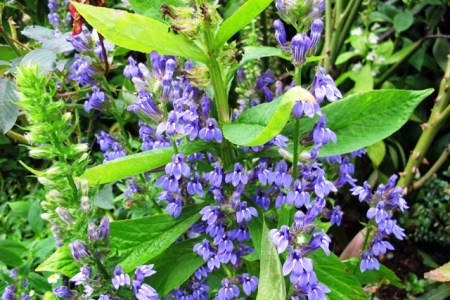
A perennial lobelia from North America - but which one?
Lobelias, I thought. I will do lobelias this week. Now you may quite possibly have led a full and happy life without putting any thought to lobelias. My interest had been desultory at best, but as soon as I started to delve a little, I uncovered a whole lot more.
Lobelias go well beyond that little, mounding blue annual that is a summer stalwart. Yes it comes in white and purple as well but it is usually blue. That handy little plant is Lobelia erinus, hailing from southern Africa. If you garden with bedding plants, you start afresh each year with organised plantings. Or if you are more cottage garden oriented, you just let one plant go to seed and it will naturalise and reappear around the place the following spring in an obliging but gentle sort of way. It is just a handy filler – nothing too exciting about that.
It was quite exciting, in a botanical sort of way, when we were given Lobelia gibberoa. This one hailed from mountain gorilla territory in central and eastern Africa. Indeed, if you get your eye in for footage of those gorillas in the mist, you may see them browsing amongst things that look a little like palm trees or even our tree ferns. Lobelia like we had never seen it before. It rockets upwards at about two metres a year, forming rosettes of big tropical leaves on top. Apparently it stops when it gets to about 5 metres high. Ours rocketed up but we rather lost interest when we realised it was not going to impress us with a magnificent display of bright blue flowers on its huge flower spike. The flowers were negligible and inconspicuous but the plant was a magnet for white fly and red spider so we didn’t worry when it succumbed to a cold, wet winter.
Sometimes you will see Lobelia aberdarica offered for sale. It is another lobelia mega herb, a little more cold hardy, though from a similar geographical area and it too has huge leaves growing in rosettes. However, it clumps closer to the ground rather than on top of its trunk though it seems to share the same huge flower spike with underwhelming flowers.
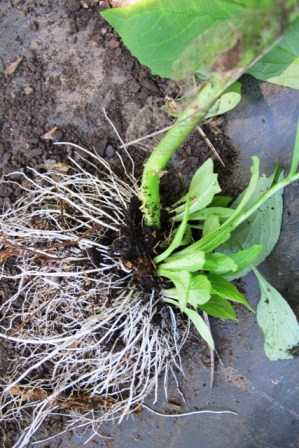
The North American perennial lobelias are very easy to lift and divide
No, it was the unequalled display of the perennial, clumping lobelias from North America which made me sit up and take notice. We have had these for years here. They form neat little rosettes at ground level and put up metre high flower spikes which, in the past, have all then proceeded to fall over. I think what made the difference this season is that I had divided most of the plants, splitting up the crowns and spreading them around. And in these rejuvenated beds and borders, there were sufficient other plants to hold the flower spikes up. In this process, I had still managed to keep the colours separate. We have pale blue and mid blue, rich purple, cerise pink, white and even red. This year we had lots of blues and they have been a real feature.
As summer perennials, these are excellent garden plants for sun to semi shade. They’re easy. If you have a pure red one, it is likely that it will prefer damper conditions, even water’s edge. It is a different species, though still from USA.
I thought I would try and decode the species. Ha! There are somewhere up to 400 different ones. It is a huge family and many of what we have appear to be hybrids between different species. So we won’t confuse matters.
What became really interesting was the long history of lobelias in traditional herbal medicine. We come to this topic from a botanical angle which makes it really scary (identification is often wrong). But those American lobelias promise a cure for pretty much everything, though they can also be highly toxic. Lobelia inflata, also known as Indian tobacco, does not carry the alternative common name of puke weed or the equally charming vomitwort for nothing. But from snake bites to pleurisy to bronchial difficulties, it can be just the ticket. Best guess is that it is what Billy Connelly was given in the shaman’s tent on a recent Route 66 TV programme.
Be careful, should you happen to be suffering from syphilis, that it is Lobelia siphilitica that you harvest for a natural cure. I didn’t delve far into the history of syphilis in the indigenous American people around 400 years ago, but it is believed that this disease was introduced to Europe by sailors with Christopher Columbus.
The problem is that siphilitica and inflata are different species but look very similar and I have no idea whether our plants here are one, the other or a hybrid of the two. Nor am I confident that any research has been done to ascertain whether they are interchangeable in herbal medicine.
For sheer optimism, I loved the website dispensing advice on using lobelia as a herbal treatment. “Always consult your Health Professional to advise you on dosages and any possible medical interactions” it said. Yeah right. I am sure I am surrounded by health professionals who are far better than I am on botany, understand chemistry and have a deep knowledge of traditional medicines. I will just keep using these charming perennials as garden plants.
First published in the Waikato Times and reproduced here with their permission.
-39.042098
174.300314


 Tikorangi The Jury Garden