Learning about lobelia

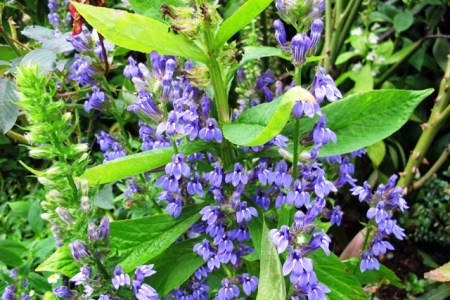
A perennial lobelia from North America - but which one?

A perennial lobelia from North America - but which one?

Lobelias, I thought. I will do lobelias this week. Now you may quite possibly have led a full and happy life without putting any thought to lobelias. My interest had been desultory at best, but as soon as I started to delve a little, I uncovered a whole lot more.

Lobelias go well beyond that little, mounding blue annual that is a summer stalwart. Yes it comes in white and purple as well but it is usually blue. That handy little plant is Lobelia erinus, hailing from southern Africa. If you garden with bedding plants, you start afresh each year with organised plantings. Or if you are more cottage garden oriented, you just let one plant go to seed and it will naturalise and reappear around the place the following spring in an obliging but gentle sort of way. It is just a handy filler – nothing too exciting about that.

It was quite exciting, in a botanical sort of way, when we were given Lobelia gibberoa. This one hailed from mountain gorilla territory in central and eastern Africa. Indeed, if you get your eye in for footage of those gorillas in the mist, you may see them browsing amongst things that look a little like palm trees or even our tree ferns. Lobelia like we had never seen it before. It rockets upwards at about two metres a year, forming rosettes of big tropical leaves on top. Apparently it stops when it gets to about 5 metres high. Ours rocketed up but we rather lost interest when we realised it was not going to impress us with a magnificent display of bright blue flowers on its huge flower spike. The flowers were negligible and inconspicuous but the plant was a magnet for white fly and red spider so we didn’t worry when it succumbed to a cold, wet winter.

Sometimes you will see Lobelia aberdarica offered for sale. It is another lobelia mega herb, a little more cold hardy, though from a similar geographical area and it too has huge leaves growing in rosettes. However, it clumps closer to the ground rather than on top of its trunk though it seems to share the same huge flower spike with underwhelming flowers.
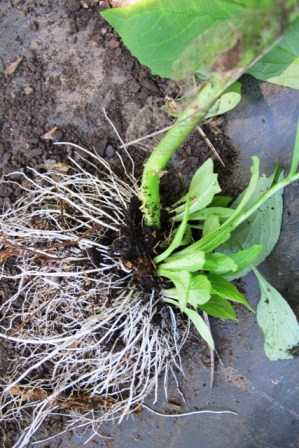
The North American perennial lobelias are very easy to lift and divide

The North American perennial lobelias are very easy to lift and divide

No, it was the unequalled display of the perennial, clumping lobelias from North America which made me sit up and take notice. We have had these for years here. They form neat little rosettes at ground level and put up metre high flower spikes which, in the past, have all then proceeded to fall over. I think what made the difference this season is that I had divided most of the plants, splitting up the crowns and spreading them around. And in these rejuvenated beds and borders, there were sufficient other plants to hold the flower spikes up. In this process, I had still managed to keep the colours separate. We have pale blue and mid blue, rich purple, cerise pink, white and even red. This year we had lots of blues and they have been a real feature.

As summer perennials, these are excellent garden plants for sun to semi shade. They’re easy. If you have a pure red one, it is likely that it will prefer damper conditions, even water’s edge. It is a different species, though still from USA.

I thought I would try and decode the species. Ha! There are somewhere up to 400 different ones. It is a huge family and many of what we have appear to be hybrids between different species. So we won’t confuse matters.

What became really interesting was the long history of lobelias in traditional herbal medicine. We come to this topic from a botanical angle which makes it really scary (identification is often wrong). But those American lobelias promise a cure for pretty much everything, though they can also be highly toxic. Lobelia inflata, also known as Indian tobacco, does not carry the alternative common name of puke weed or the equally charming vomitwort for nothing. But from snake bites to pleurisy to bronchial difficulties, it can be just the ticket. Best guess is that it is what Billy Connelly was given in the shaman’s tent on a recent Route 66 TV programme.

Be careful, should you happen to be suffering from syphilis, that it is Lobelia siphilitica that you harvest for a natural cure. I didn’t delve far into the history of syphilis in the indigenous American people around 400 years ago, but it is believed that this disease was introduced to Europe by sailors with Christopher Columbus.

The problem is that siphilitica and inflata are different species but look very similar and I have no idea whether our plants here are one, the other or a hybrid of the two. Nor am I confident that any research has been done to ascertain whether they are interchangeable in herbal medicine.

For sheer optimism, I loved the website dispensing advice on using lobelia as a herbal treatment. “Always consult your Health Professional to advise you on dosages and any possible medical interactions” it said. Yeah right. I am sure I am surrounded by health professionals who are far better than I am on botany, understand chemistry and have a deep knowledge of traditional medicines. I will just keep using these charming perennials as garden plants.

First published in the Waikato Times and reproduced here with their permission.
Grow it yourself: cabbage

Cabbages are part of the brassica family, which includes broccoli, cauli and Brussels sprout. This means they are gross feeders (gross meaning greedy or hungry in a gardening context, not revolting) growing best in heavily fertilised soils, rich in nitrogen. To hold up their large heads on a single stem requires a good root system in firm soil so get the ground right from the start. You can plant for most of the year in warmer areas, though we avoid summer for the brassica family to avoid problems with white butterfly. Cabbage can be grown from seed sown directly into the ground or from small plants. Don’t get too carried away – consider how many cabbages you want to eat. They can be difficult to give away. Every plant is also going to need about half a metre clearance all round to give it space to grow. Cabbages take two to three months to mature so planted now, will be ready in winter.

However, for those of us are who are less than enthusiastic about large heads of cabbage with lots of white stalky centre bits (there is only so much cole slaw and stir fried cabbage one can eat), there is a much larger range available now for the home gardener. There used to be a choice of large red, green or crinkly savoy. Now there are a number of mini growing varieties available with heads around 1kg instead of up to 4kg for the larger types. There are also conehead types with softer leaves, assorted quick maturing Chinese cabbages and even the Italian Cavolo nero (which is more like kale). Check out the Kings Seeds catalogue for a good range which might encourage a rethink on the role of this vegetable garden standby.

For the record, we do not for one minute think there is any truth to the current theory that white butterflies are territorial so can be discouraged by eggshells on sticks. Wishful thinking.

First published in the Waikato Times and reproduced here with their permission.

An award, not a rum deal.

I am thrilled to accept the ALCOHOL SPRONSORSHIP PRESS AWARD for the week, administered by NZ media star Steve Braunias, for my work on the Penguin and Tui story (More Bad Penguin). It is not that we are rum drinkers. It is just that I think it might be the greatest highlight in my writing career to date, supplanting my pride at being voted second most popular writer (beaten only by the TV reviewer) in the local paper some time ago. Fame and rum await, if not fortune.

An award, no less – as opposed to a rum deal.

I am thrilled to accept the ALCOHOL SPRONSORSHIP PRESS AWARD for the week, administered by NZ media star Steve Braunias, for my work on the Penguin and Tui story below (More Bad Penguin). It is not that we are rum drinkers. I think it might be the greatest highlight in my writing career to date, supplanting my pride at being voted second most popular writer (beaten only by the TV reviewer) in the local paper some time ago. Fame and rum await, if not fortune.

Tikorangi Notes: Friday March 2, 2012

Latest posts Friday March 2, 2012
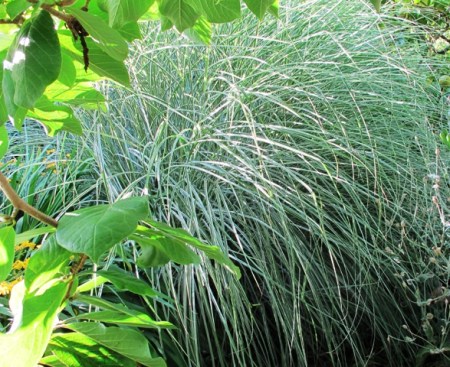
1) Space limitations in the Waikato Times this week means there is only one new post from there at this time – Gardening with grasses. Shun the contrived use of dwarf grasses forced into an unnatural role as an edger but use them instead in mixed plantings with perennials with a debt to the prairie style of gardening.

2) Judging by the visitor statistics to my website this week, it seems unlikely that anyone has missed the piece on what looks mighty like plagiarism + Penguin + Sally Cameron + Tui garden guides Round Two – More bad Penguin. It resulted in an immediate recall of a second book in the series (Tui NZ Vegetable Garden). There seems to be a bit of debate about whether it is entirely the author’s fault or whether the publisher must also bear some of the blame. Frankly, I think Penguin has to take some of responsibility – at the very least for choosing such an ill equipped author in the first place. Too many corners cut in trying to get that series of books onto the market.

3) In the absence of other original posts all I can do is to recommend a YouTube clip which was the source of great delight to me this week. A lawnmower who learns to dream big. And in case you think that was computer generated trickery, we have the rather more mundane clip which shows it is … real. Remote controlled flying lawnmower.
We are not optimistic that our Walker mower has the capacity to fly.

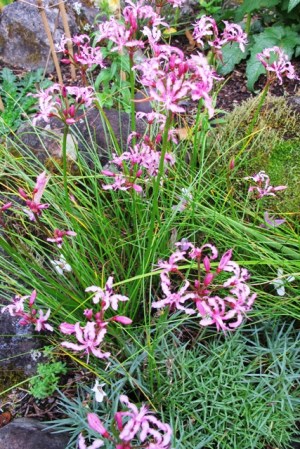
Nerine filifolia

Nerine filifolia

Looking out the window this morning at the swimming pool, Mark commented that clearly the swimming season was over for the summer and at least I had had a swimming season whereas he had not even been in this year! The only consolation about the most disappointing summer we can ever recall is that we were not alone. Most of the country has been similarly afflicted and indeed, our daughters in Sydney and Canberra tell us the same thing! Shared disappointments are so much easier to cope with. And gardeners move on. Autumn is here. The autumn bulbs are starting – Haemanthus coccineus with its red paintbrush blooms, the lovely blue Moraea polystachya, cyclamen, Rhodophiala bifida and the first of the nerines. Nerine filifolia is evergreen with us and is simply the daintiest, most charming little rockery nerine you are likely to see. I potted some to sell a couple of years ago and not a soul wanted to buy them so these days we just keep them to delight ourselves.