Tikorangi Notes: Friday 20 January 2012

Latest Posts: Friday January 20, 2012

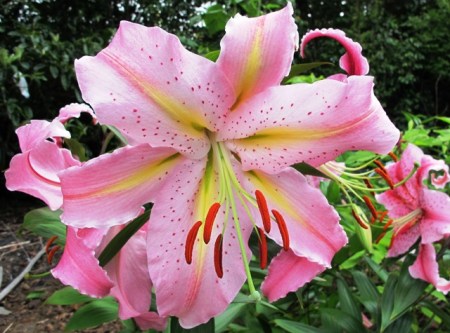
1) How lovely is the golden-rayed lily of Japan? The auratum lilies (of which we have many) are just opening here.

2) Of matters related to social class and social conscience (or basil, cardoon and lawns, to put it in gardening terms).

3) Grow it Yourself – cardoon (warning: it needs space).

4) Tikorangi – the new Texas? What intensive petrochemical development next door actually means to us.

5) Lovely lily, lily love – the first instalment of photos this week in a new album of lilies currently in flower here posted on our Facebook garden page.
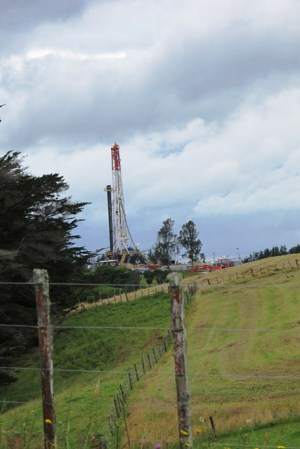
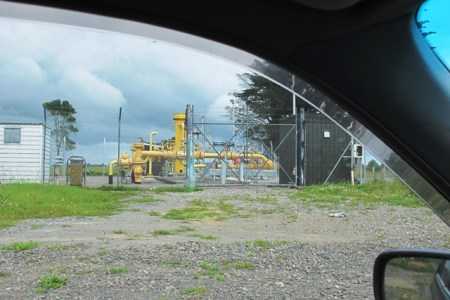
Just up the road - on the neighbouring property, in fact

Just up the road - on the neighbouring property, in fact

Tikorangi Notes: Friday January 20, 2012

Our indifferent summer continues, the lilies are opening and the clematis look great. I am working in the rockery and we hear there are to be at least another 22 wells drilled in the close environs. Yes folks, we live in the proud energy heart of New Zealand, the new Texas of the Long White Cloud. Taranaki may be dairy heartland with one of the best growing climates possible, but we embrace the boom and bust of the petrochemical industry with unquestioning fervour. It is just a shame that a fair amount of it is centred right in Tikorangi where we live. To raise any objections is to be a sad-sack, a Luddite or worse – a greenie who stands in the way of progress and employment.

Over the years I have devoted a lot of time and energy to trying to get measures to mitigate the impact of the petrochemical industry on local residents. I don’t actually blame the private companies who will do as much or as little as is required of them in any given situation. And to be fair to the company involved next door to us, they have never employed the intimidatory and bullying tactics we saw in the past with other companies. In fact they are unfailingly courteous and do their utmost to keep us informed and to act on any concerns. But the bottom line is that their activities impinge heavily on residents close to their sites.

I hold the councils to account – the District Council and the Regional Council. And they have never done anything at all to inspire any confidence in their planning (what planning?) or in the rigour of their monitoring. No, they think it is great because it keeps the money flow going and they appear to do all they can to remove any impediments to the companies.
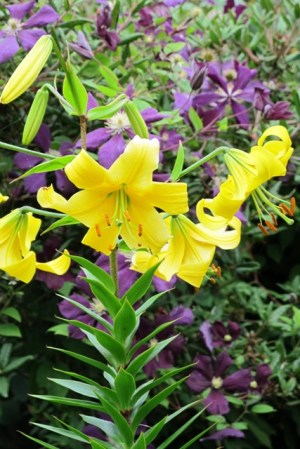
So we have learned to roll with the punches and take the long view. We can’t see the sites from our garden – even if that is because we have so many trees. I can generally avoid having to drive past the sites because most of them are up the road from us. We have adapted to the gradual increase in heavy traffic, much of which runs along our two road boundaries. I don’t want to be able to hear the site work either and most of the time I can’t. If fracking nearly the entire sub strata of the area where we live causes problems down the track as many around the world fear, we will cross that bridge when we come to it.

We are circling the wagons and looking inwards. Oil and gas is a finite resource. The Jury family were settled here and planting trees long before that resource was even discovered. I anticipate that we will still be settled and planting trees after the resource has been used up.

In the meantime we smell the lilies.
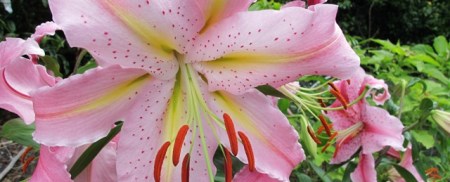
Plant Collector: The golden-rayed lily of Japan (Lilium auratum)

The wonderfully fragrant auratum lily hybrids - hybridising and raising from seed keeps the plants healthy and reduces problems with virus

The wonderfully fragrant auratum lily hybrids - hybridising and raising from seed keeps the plants healthy and reduces problems with virus

The golden-rayed lily of Japan – what a beautifully evocative common name. We grow quite a few lilies here but it is the auratum hybrids that are the mainstay of our summer garden. These are the results of decades of breeding, first by Felix Jury and now by Mark. This particular pink one is a pleasing new selection from that breeding programme. There is no commercial gain in breeding these auratums. The aim is to extend the colour range and vigour so they perform better as plants in our own garden as well as keeping them free of virus, which is common. We also prefer outward facing flowers (rather than the upward facing blooms used in floristry) because that gives more protection from the weather.

The hybrids are bigger and showier than the species. This flower is over 30cm across so not for the shy or retiring gardener. The species are predominantly white with yellow or red streaks and crimson spotting. Hybridising extends that colour range into pure whites, white with dominant yellow markings, reds and pinks. We also want strong growing plants that can hold themselves up without needing to be staked every year and which will keep performing under a regime of benign neglect (which means digging and dividing every decade, not every second year). We grow them both in sun and on the woodland margins – wherever there are reasonable light levels, good drainage and soil rich in humus.

Auratums are offered for sale as dormant bulbs from time to time but they don’t like being dried out and dessicated so try and find ones which are plump and firm.

Saving the best for last: oh, the fragrance. The auratum lilies are one of the flowers I cut to bring indoors. A single stem has multiple blooms and can scent a large room all by itself. I remove the pollen which will stain everything it falls upon.

First published in the Waikato Times and reprinted here with their permission.

Of matters related to social class and social conscience

Cardoon - the next trendy crop for basil sophisticates?

Cardoon - the next trendy crop for basil sophisticates?

I have fun with Twitter, the social networking stream where you have be very brief and succinct and most interaction takes place with strangers. Not that gardening tweeps (the lingo says a participant is a tweep, not a twit or twitterer) are generally inspiring, witty or memorable. But Twitter delivered me two gems this week of a horticultural bent.

The first tweet linked me through to a column from the Dominion Post discussing baby names – which has nothing whatever to do with gardening unless you draw the long bow and comment on the growing popularity of flower names such as Lily and Poppy. Goodness, maybe Daphne is due for a recall. Mark suggested when our daughters were born that we could go for Astelia or Aciphylla – the latter being a spiky native plant and his favoured option, even more so if we chose the botanical reference Dieffenbachii as the poor wee mite’s middle name. But I digress. That column by Dave Armstrong referred to the “basil growing classes”. I laughed out loud. As a definition of middle class, urban, somewhat leftwing New Zealand, the basil growing classes seemed wonderfully apt. There is a limit to how versatile basil is and there is only so much pesto one can eat. Salads of sweet tomatoes, sliced fresh mozzarella and basil leaves are equally delightful but the price of mozzarella (the white stuff cocooned in water, not the nasty long life stuff) limits how often this appears in our household. I can remember that there was indeed Life Before Basil in this country – a time when only those who had backpacked through Italy had been introduced to the seductive fragrance of freshly picked basil leaves. Now it is a defining herb of the middle classes here and to grow your own makes you trendier.

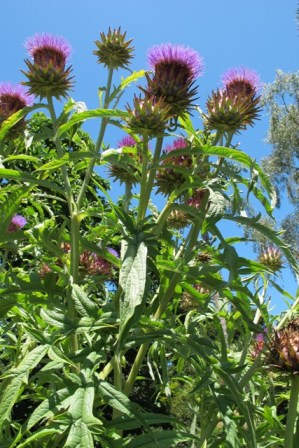
Cardoon flowers are showier than basil flowers

Cardoon flowers are showier than basil flowers

So, if your children bear names like Oliver, Samuel and Amelia, you probably drive an urban SUV but your husband bikes to work, you have tomatoes in a grow bag, a worm farm and pots of basil growing, consider yourself one of the basil growing social class. In which case I have a hot tip – cardoon is my prediction for the new basil. It is sufficiently obscure to be interesting. It is extremely decorative in the garden. It is edible. We have eaten it. To be honest, we weren’t blown away by it (not like Florence fennel) but it is fine. In case you want to know more, instructions for growing it are below.

But I was ever so slightly crushed this week when Mark asked me to Google burdock. He was debating about what to do with the small plants he had growing after being enticed to buy seed from Kings Seed Catalogue. In fact we decided on balance that burdock is probably not worth the garden space, has dangerous weed potential, does not sound particularly tasty at all and has a very low yield to space required. But there, amongst the burdock information was the one line: Burdock: peeled leaf stalks are parboiled and used as a substitute for cardoon.

Wow. Some have never even heard of cardoon. Some don’t know that cardoon is edible. Some are still at the experimental stage of determining how edible it is. It is not yet showing up in any cookbooks I have seen, even though I receive review copies of many of the latest publications. But it is already such a staple in some people’s diets that they have found a substitute for it? I am amazed. My advice is to not delay if you wish to catch the wave of cardoon as a fashion crop. I will try and be earlier with my next prediction.

The second tweet was not so much as a source of amusement as vindicating a stance we have been taking here for some time. An American tweep, @InkandPenstemon, posted the comment: “The static monoculture of a lawn is never more unattractive than when it is exposed in the winter.”

We prefer to talk about grass rather than lawns these days

We prefer to talk about grass rather than lawns these days

It has felt a little lonely at times, standing on our high horse bemoaning the obsession with the perfect lawn. At last I am seeing more talk challenging the high value we place on completely unsustainable and environmentally unfriendly lawn maintenance. There is a column in the latest NZ Gardener by Steve Wratten on this very topic. The author just happens to be Professor of Ecology at Lincoln University. He goes further than we do in that he eschews the motor mower in favour of an electric mower. I will own up to the fact that we use a pretty damn fancy lawnmower and we use it extensively. Because we have an open garden, there are standards we feel obliged to maintain and mowing large areas of grass is part of that. Perhaps we could offset that against the fact that our car usually gets to leave the garage only once or twice a week?

I make no apology for continuing a public crusade. We should not be embracing gardening values which are environmentally damaging and the worst one of all is the perfect lawn. A smooth monoculture of a single species of grass is a completely unnatural state of affairs which can only be maintained with chemical intervention. If you insist on killing off the earthworms as well (as some do to avoid the surface being pocked by worm casts and tilled by birds), your crimes against nature are compounded exponentially. It is time we questioned this particular gardening value.

The irony is that it is probably the very same basil growing classes who are likely to wise up to this situation and act upon it in the first wave of concern. Clearly there is a lot to be said for basil as a defining social measure.

Earlier articles on lawn care here include “What does your lawn say about you?” from 2011 and “The lawn as a political statement” from 2006.

First published in the Waikato Times and reprinted here with their permission.

Grow It Yourself: Cardoon

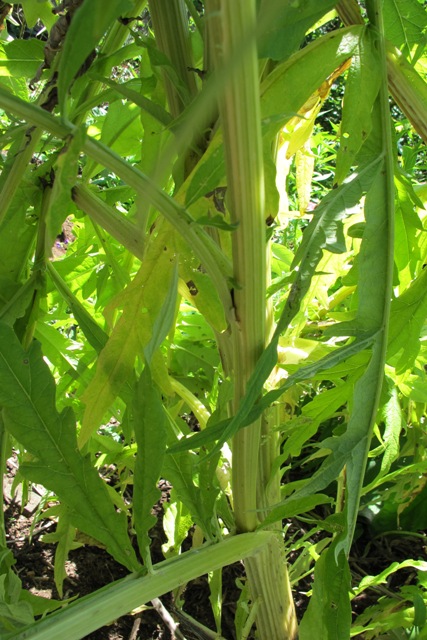
Cardoon stems resemble giant celery but only in looks

Cardoon stems resemble giant celery but only in looks

The edible cardoon is Cynara cardunculus and it is very closely related to the globe artichoke, though less well known. To be honest, it falls into the novelty class of vegetables, to be grown by those with plenty of space and a sense of curiosity though it is a sufficiently handsome plant to justify a place in the summer border. The flower is a good indication that it is a relative of the thistle – all belong to the asteracae family. Cardoon is native to the Mediterranean and North Africa and in the wild is a great deal pricklier than modern cultivated selections. Its homeland and its silver toned foliage both give a hint that it is a plant adapted to hotter, drier conditions though we have found it exists quite happily on the margins of the vegetable garden. It would benefit from being staked in our wetter climate. It is a perennial and reaches over 1.5m high and about a metre wide so it needs space.

Cardoon is a traditional vegetable in its homeland areas. Most commonly eaten are the leaf stems which are harvested in winter and early spring, before the plant sets flowers. These look a bit like celery and are always cooked before eating. The young flower buds are also eaten in southern Italy. I will admit that we have only tried eating it once and we parboiled it. It was not an exciting experience though it was perfectly acceptable in an anonymous green sort of way. I will try again this winter, using it braised and in soups. Its value may lie in giving a fresh alternative in late winter when other greens are sparse. It is also a source of natural, vegetarian rennet and some artisan cheese makers in this country have returned to this traditional usage.

First published in the Waikato Times and reprinted here with their permission.

Tikorangi – the new Texas?

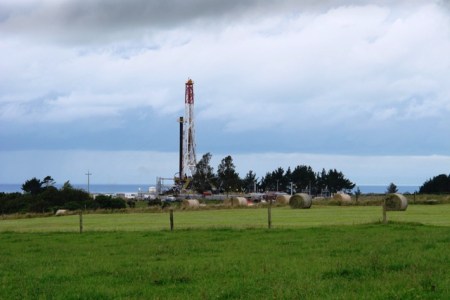
Next door - not quite the Tikorangi locals signed up for when they settled here

Next door - not quite the Tikorangi locals signed up for when they settled here

I can’t honestly say we are thrilled to learn of the deal between Todd Energy and Methanex which will see up to 25 wells drilled to frack the sub strata of the area where we live. Tikorangi isn’t very big and the first three wells are next door to us, with more scheduled to follow on the same site.

But we are pretty much alone in that. Industry thinks it is wonderful. Most Taranaki locals think it is wonderful because it brings jobs and money. The mayor thinks it’s wonderful. Somewhat disturbingly, the CEO of the regional council thinks it is wonderful (I say disturbingly because that is the body tasked with regulating and monitoring the industry’s activities and it is clear that they are very kindly disposed to the key players). The editor of the local paper thinks it is wonderful – which indicates that the paper will maintain its position of being the PR mouthpiece for the energy industry.
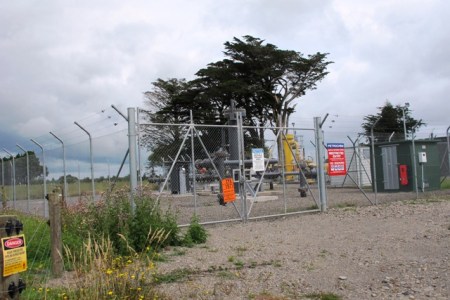
The bottom line is that the oil and gas industry may well be good for the national economy. It is certainly very good for the regional economy and means we have a superior class of cafe and restaurant in New Plymouth.

An increasingly common sight in our landscape

An increasingly common sight in our landscape

But there ain’t nuthin’ good for the locals who live by the sites. Nothing. At. All. They are ugly, industrial sites in the middle of rolling, green countryside. Drilling is noisy. The increase in traffic, especially heavy transport, has been major over the years. Flaring is abominable – flaring being the exercise of cleaning up the wells and testing the flows by igniting the gas. Considering there is nothing good for the environment in drilling either, I am somewhat surprised that the industry continues to get away with flaring. Don’t even try and tell me that anything I can do to reduce carbon emissions will help the planet – not when I live in an area where flaring takes place.

Over the years we have seen changes and some for the better. The first well drilled next door to us, maybe three years ago, was flared for many weeks on end. It was so bright, we could see the glow as we drove out of New Plymouth, 25km away. It lit our house all night. But worse was the noise – the constant, unabated, low grade roar which meant that living here was like living on the flight path to Heathrow, but this was 24/7. When you have lived for years in the relative silence and total darkness of the country, flaring has a huge impact on quality of life.

Flaring was greatly reduced for the second well on the same site and I am hopeful that the third currently being drilled (we can hear the rig grinding away in the quiet of the night and the morn), may see flaring reduced further.

Less high handed bullying from the companies is another change. We are lucky. We are dealing with Todd Energy who appear to be one of the better companies to deal with. I had thought the divisive bully-boy tactics of the petrochemical cowboys were in the past now (though only the relatively recent past) until I saw the media statements coming from another company on another site.

But we have also seen changes in the way the councils handle consents and the winding back on the definitions of affected parties. It is very difficult to convince councils that you are an affected party now and if you acquiesce and sign the agreement for one well, essentially you have signed away all rights to object in the future.

I have met with successive mayors and councils over about fifteen years, pleading with them to be more proactive in planning to mitigate the negative effects. They are terribly concerned and sympathetic and nothing happens. Planning, such as it is, remains completely reactive.

I have tried to get District Council to require, as part of the consents process, that sites be screened from public view by planting. I think they should only be visible from the air. High security industrial sites have no place in a rural landscape. Nothing has happened.

Today’s newspaper, where both District and Regional Council hail all the positive benefits of the economic boom gives me no confidence at all that any negative aspects will be even be acknowledged, let alone addressed.

I try not to look but in this case, it is both sides of the road. They should be screened from view.

I try not to look but in this case, it is both sides of the road. They should be screened from view.

So the gentle area where we live, a soft rural landscape with reasonably high density population and a solid core of very longstanding families, both Maori and Pakeha, will just roll with the changes as we have for the past decades. We will be the guinea pigs for fracking here. We will let you know if it does cause earthquakes or contaminate our water supplies. The ground below us is about to be fracked in every direction. We will adapt to the increase in traffic though we probably all hope that the ridiculous practice of laying gas pipelines down our roads and verges won’t happen again (how to cause maximum disruption to the largest number possible and completely without apology!) We will grit our teeth and only complain when the noise incidents get beyond the pale. And some of us will wait.

I think it likely that in a decade or two, all the viable reserves of oil and gas beneath us will be gone. The companies will pull out. The multitudes of small industrial sites I try not to look at will be reclaimed by long grass and then by other vegetation. Processing plants will be mothballed. The traffic will reduce and peace will return. I have to take the long view because the juggernaut that is the petrochemical industry rolls on unchecked in Taranaki in the short term.

The adjacent house is, I understand, still occupied by a very long term Tikorangi resident

The adjacent house is, I understand, still occupied by a very long term Tikorangi resident