Tikorangi Notes: Friday November 25, 2011

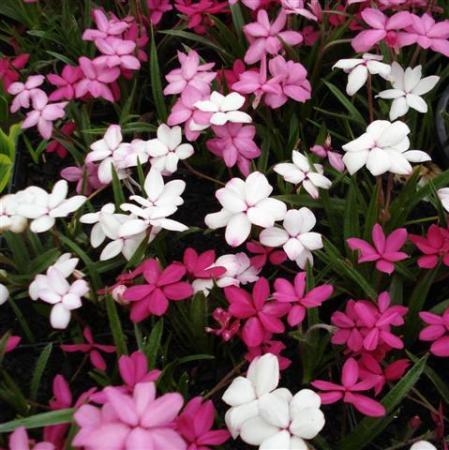
It is rhodohypoxis time

It is rhodohypoxis time

Latest Posts: Friday November 25, 2011
1) Why would gardening be exempt from fashion? Abbie’s column. It never has been before, but in keeping with modern times, the cycles of fashion are moving ever faster.
2) Yet another lightweight NZ gardening book. Even indexes are expendable these days, apparently.
3) Plant Collector this week: Dracophyllum latifolium or neinei, a seriously cool small tree and a native at that.
4) 100 Gardens by Jamie Durie (Australia’s pin-up boy of landscaping). More about ideas for outdoor spaces than gardening as such.
5) Grow it Yourself – melonsthis week. Preferably rock but water will do at a pinch.
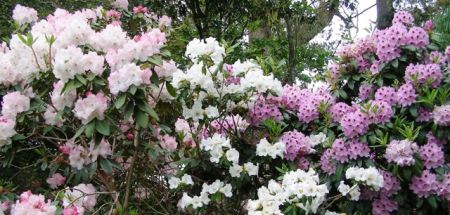
Rhododendron Elizabeth Titcomb to the left, Blue Pacific to the right and R. lindleyi (Ludlow and Sherriff form) caught in their cleavage, as Mark describes it – though nearly strangled might be a better description.

Our unusually cool spring is continuing here, which does at least mean that the spring flowering has been extended way past the usual time. At least the roses have finally opened. We are not the greatest of climates for roses – they don’t appreciate our high humidity – so the first spring blooms are all the more welcome as the bushes are still full of healthy, lush foliage. As the season progresses and black spot strikes, the plants start to look ever more sparse. One can spray roses, of course (and many do) but we choose not to. If a rose plant can not survive and perform without spraying, it ends up in the incinerator.
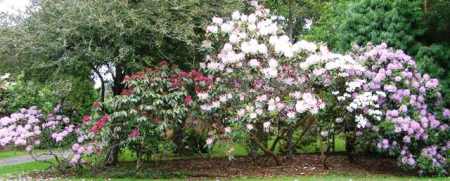

From left: Caroline Allbrook, Olin O. Dobbs, Elizabeth Titcomb, R. lindleyi and Blue Pacific – a swathe of pink and purple across one side of our carpark.

A New Zealand Guide to Growing Year Round by Dennis Greville

Same author-photographer, similar content but different publisher to last week’s book “Salads Year-Round”. This one is more encyclopaedic in range but certainly not in detail (there is not even an index at the back of the book which seems a major oversight), the writing is a little more personal and the photos are a little smaller and more illustrative rather than sumptuous. But it is another of the style of edible garden book we have come to expect in this country – encapsulated in the bold claim on the front cover: “self sufficient in no time”. Yes folks, you too can be self sufficient in fruit and veg with next to no experience and very little effort – it is all so easy peasy. Just buy these books that NZ publishers keep churning out for you. A low grade, lightweight cover, allied to the lack of index, means that this one was clearly never destined for longevity on the gardening bookshelf.

A New Zealand Guide to Growing Year Round by Dennis Greville (Hyndman Publishing; ISBN: 1877382 68X) reviewed by Abbie Jury.

First published in the Waikato Times and reprinted here with their permission.

Plant Collector: Dracophyllum latifolium (or neinei)

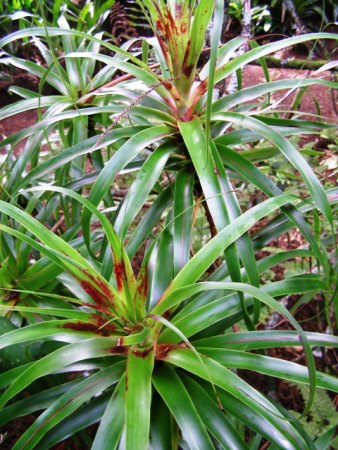
This is a seriously cool small tree to have in the garden. What is more, it is a native. It is often referred to as a grass tree because the long, thin leaves grow in tufts at the tips of branches but Mark has always thought of them as being like the trees from a Dr Seuss picture book with their wavy candelabra branch structure.

D. latifolium is reasonably widespread across the upper half of the North Island, occurring naturally as far south as North Taranaki but you don’t see a lot of them in the wild. They are an under canopy tree but not in dense forest as they prefer more light and less competition. In a garden situation, this tends to translate to woodland conditions – never too wet but never drying out and with filtered light. They are happier in company, so even though they are curious enough to warrant pride of place, they don’t want to be specimen trees standing alone. Apparently they have been recorded up to 10m high in the wild but our specimens have never got much over 2.5m in several decades.

The particularly curious Dracophyllum latifolium

It is now thought that our dracophyllums originated in Australia and arrived here (presumably by wind blown seed) a mere few million years ago, since when they have evolved into 40 different species. They have alkaloids in the foliage which make them unpleasant to browsing animals and these also inhibit fungal growth so the fallen leaves don’t break down but instead form long lived carpets beneath the tree.

The trick to gathering seed is all in the timing. Gather it too early and the seed will not be ripe. If you leave it too late, the seed pod will have dehisced – cracked open on the tree and released the seed. If you do gather seed, sow them immediately in seed trays and be patient. We do not get seedlings sprouting up naturally in our garden, despite having several trees.

First published in the Waikato Times and reproduced here with their permission.

100 Gardens by Jamie Durie.

Jamie Durie is the pin-up boy of Australian landscaping who has also made inroads into the USA. But this is not a book about gardening. It is a book about designed outdoor living spaces which have a few plants included. Sumptuous set design, frequently for the rich, beautiful and probably famous, not a how-to manual. It is an ideas and inspiration book largely comprised of full page or double page photographs of 100 different outdoor spaces he has designed around the world. The man is a human dynamo and versatile – which is to say the spaces look different, avoiding a “signature style” which can make them all look very same-y. There is minimal text but the sumptuous photography tells the story. I admit I spotted a few gabions, there are coloured feature walls and I must warn readers that he is clearly the undisputed King of the Scatter Cushion. Let that not discourage you from a good ideas book if you are seeking inspiration, particularly where space is tight and you want outdoor living areas which show panache. Just be aware that it is dry climate living done with a hefty budget.

100 Gardens by Jamie Durie (Allen and Unwin; ISBN 978 1 74237 890 9) reviewed by Abbie Jury.
First published in the Waikato Times and reproduced here with their permission.

Grow it Yourself – melons

The melons offer an annual challenge here because timing is of the essence. All melons like a hot summer so the further north you are, the more successful you will be. They also have a relatively long growing season of at least 3 months and you need heat at the end of the season to get sweet fruit. The trick is getting them out at the optimum time – early enough to get well established but not so early that they get checked in growth by inclement spring weather.

Melons grow on a vine, similar to a pumpkin or a courgette, each plant taking up at least a square metre. If you want to grow them vertically up a trellis, you will probably have to construct little hammocks for each fruit to support the weight. Because of the long growing season requirements, it is usual to put them out as small plants rather than starting from seed. You can try and hasten the initial settling in process by using a cloche or by planting into black plastic (which helps the ground to heat up more quickly). Mark has tried a new approach this year of building fresh compost beds in mounds for the melons, using grass clippings to generate initial heat. Ever the vigilant gardener, he has measured the temperatures and the mounds are sitting at around 35 degrees during the day, dropping to 18 degrees at night. He is hoping this is enough to really kick start the crop this year. It also has the advantage of supplying plenty of nutritious, organic material which the plants require.

Plants need to be well established and running profusely by Christmas if you are to have any hope of a decent harvest and even then, you are relying on a warm, dry autumn. So do not delay planting if you want to try growing them.

Water melons are a little more successful in marginal climates, though many of us may think they are a poor second to a good rockmelon.

First published in the Waikato Times and reproduced here with their permission.