Tikorangi Notes: Thursday July 29, 2011

New Zealand Woman's Weekly on magnolias - Burgundy Star, Black Tulip and Fairy Magnolia Blush in the photos

New Zealand Woman's Weekly on magnolias - Burgundy Star, Black Tulip and Fairy Magnolia Blush in the photos

I think I have only bought the NZ Woman’s Weekly twice in my life – both times because I knew gardening stories of interest to us were included. It bills itself as “NZ’s No.1 Royal Mag” and I just think I am not amongst their target demographic. But it is very popular so the colourful double page spread on magnolias this week, written by Denise Cleverley, was gratifying to see, given that it focuses quite heavily on our Jury magnolias.

Schefflera septulosa - distinctly worse for the frost

Schefflera septulosa - distinctly worse for the frost

An abnormally heavy frost this week has left us ruefully contemplating the damage. In colder climates, plants are better acclimatised to lower temperatures but here it tends to be so mild that they are not hardened off and extreme events can cause a lot of damage. How much is damage which the plants will outgrow and how much is loss by death will become clearer soon. It is not so bad in the garden where there is a lot of protection afforded by the trees but under the shade cloth in the nursery and out in the open, it is a bit of a sorry sight. Schefflera septulosa does not normally sport the brown velvet look. I think Mark ranks it as the second worst frost he has ever seen here – a ground frost of around -5.5 degrees.

Mark has been experimenting in his glasshouse with passive heating. He hopes to apply this on a larger scale in the near future (I think this means a much larger glasshouse in a new location) partly because he is determined to grow more tropical fruit including his beloved pineapples. He has moved in some largish containers of water and has built a compost heap from dung and straw in the glasshouse. Fortunately it no longer smells and it does appear it is working to raise the temperature and to prevent it losing all the heat overnight. I am just looking forward optimistically to future harvests.

The white sapote - now a winter fruit staple here

The white sapote - now a winter fruit staple here

However, we don’t need a glasshouse for the white sapote or casimiroa edulis which we can grow in a protected position outdoors and which rewards us with a very good crop of ripe fruit in mid winter. They have the texture of a ripe rock melon and taste a little like vanilla custard – delicious.

The weekly blurb on plant sales highlights Hippeastrum aulicum this week (I felt the need of something bright and cheerful on the coldest day of the year) and one of my most favourite camellias – dainty little C. minutiflora.

And on a very cheerful note, yesterday I was offered a new garden writing contract. Not with our local paper, the Taranaki Daily News, which is determined to press on without me but that is fine because the new contract offers a much better platform. Until it is signed and sealed, I won’t say with whom but it feels good to be back in the mode of thinking about regular contributions and deadlines. It will be three pieces a week which will then appear as a regular feature on our website.

Tikorangi Notes: July 18, 2010

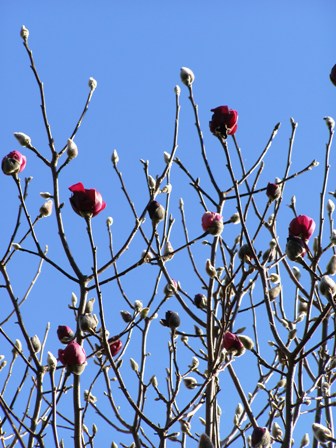
Magnolia Black Tulip is just starting to open

Magnolia Black Tulip is just starting to open

Latest posts:

1) Clean and green in New Zealand? Not as much as we claim and, alas, not at all if you look at the common treatment of our rural road verges.

2) Digging and dividing clivias – one in the Outdoor Classroom series of step by step guides.

3) Mid winter photos – on our new Facebook page: http://www.facebook.com/thejurygarden I have to admit, however, that I have not been out with the camera on the rain sodden days when we threaten to wash away and there have been rather a lot of those lately. We had a massive 237ml in June alone (or about 9½ inches for those still on imperial measurements) and we won’t be far off that in the first half of this month. Our winters can be wet. But the snowdrops don’t mind and it has only been the two hailstorms that have damaged the early magnolia blooms.

4) Nothing whatever to do with gardening (but I am guessing some readers also have other interests), I have just launched a separate website devoted to book reviews of a non gardening nature: www.runningfurs.com For some years, I have reviewed books, firstly for the Taranaki Daily News but these days for the Waikato Times. I have always had a particular interest in children’s books and in New Zealand fiction. I went back to the children’s books a few years ago because I thought we might be lucky enough to receive the gift of a grandchild at some time in our lives and our book collection could do with updating. There is no sign of any grandchildren any time soon, but I keep the best books and pass on the others. These reviews, along with a few on books for adults, did not sit with the gardening websites so I have not done anything with them before. But the advent of The Naughty Corner by Colin Thompson made me want to table these reviews for others – it is quite the funniest picture book I have read in a long time.
So much for clean and green….

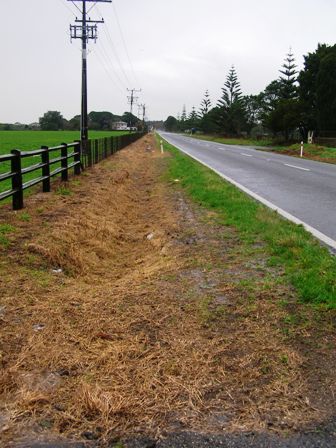
The ugly sight of roadside spraying

The ugly sight of roadside spraying

Mark regularly despairs at the state of our rural roadsides, expostulating at the cavalier use of herbicides and the ugliness of sprayed areas which then create a blank canvas for weeds to colonise quickly. “How,” he asks, “can we pretend to be clean and green in our country when people see these road verges?”

This particular example is from down the road, more or less. We suspect it is the farmer trying to eradicate bristle grass but in fact bristle grass got established in the first place here because it is an early coloniser on sprayed areas. Alas our councils regularly get in on the act, too. In days gone by, rural roads used to have wide gravel shoulders which were graded from time to time. Now the maintenance regime is such that the road edges have been recontoured to slope sharply downwards at the side – the idea being that this moves the water off the road quickly but it also means that cars can no longer move off the road safely. And it is all to be kept free of vegetation, which is done by spraying.

We designated our road verges no-spray zones – which can be done by ringing the local council. We would rather maintain our own property frontages which we plant extensively and mow. It stops any contractors swooshing around with herbicides. The year they sprayed all our belladonna lilies was too much for us. It is not that we are opposed to sprays in principle. But Mark uses herbicide spraying to target spot weeds and generally it can be achieved in an unobtrusive, near invisible way.

The scorched earth approach to dealing with rural road verges needs to be revisited. It is bad environmental practice and it looks downright ugly – not a good advertisement at all for our country.

Tikorangi Notes: Sunday 10 July, 2011

Latest posts: Sunday 10 July, 2011

1) Prole drift (further comment on trends in NZ gardening)

2) Tikorangi Diary Friday July 8 (subtitled: what we have been up to with a smattering of garden hints which may be useful)

3) Growing garlic based on Mark’s experience. I was going to say our experience but that would be the royal we. Growing garlic and indeed all fruit and veg is entirely Mark’s domain, as writing is mine.

It is persimmons set against the winter sky this week, instead of Magnolia Vulcan

It is persimmons set against the winter sky this week, instead of Magnolia Vulcan


Tikorangi Notes: Sunday 10 July, 2011

Winter in our neck of the woods tends to be wet but comparatively mild. This year has been particularly mild with the warmest May on record and a warm June to follow. But wet. We can continue to garden in all the fine spells and because we have such free draining soils, the ground rarely gets too sodden to work. And light is our other defining feature – we keep the same astonishing clarity of light all year here. Most New Zealanders take our blue as blue skies and bright sunlight for granted and it is not until you visit countries with very low winter light levels that you realise our winter light is quite extraordinary. It is what makes the magnolias so wonderful here and despite July being our coldest month, more magnolias and michelias are opening blooms. We usually have a wonderful display of the early red magnolias towards the end of July and then flower through to mid September (longer for the michelias).

In the rainy, sodden times, I have been getting to grips with social media – as in Twitter and Facebook. This is a challenge for me (and one which entirely bypasses Mark who does not even know where the on switch to the computer is located). I enjoy the brevity and simplicity of Twitter but Facebook has been a bigger challenge. However, we reached our magic number of 30 “likes”, as one says in Facebook parlance, so we now have our own designated url: facebook.com/thejurygarden It takes a certain amount of mental energy and time to manage all these on line connections but it does appear to be the way of the present and maybe the future. Facebook seems to offer a good platform for current pretty pictures. If you feel inclined to visit our new facebook page and tick the like box, it apparently helps in establishing a profile beyond just our standard webpages.

Prole drift in New Zealand gardening

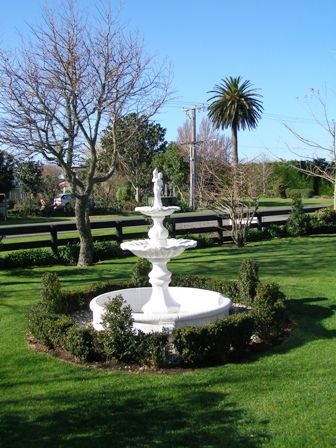
The rococo styled fountain has drifted down the road from us

The rococo styled fountain has drifted down the road from us

Prole drift. I had never heard of it until last week but I was greatly amused by it. The usual example of prole drift is the devaluing of status suffered by the Burberry plaid when it was embraced with gusto by the chavs of the UK (referred to, apparently, as a downmarket demographic). The SUV is undergoing a similar slide in status. The classic Range Rover slipped a little when Japanese manufacturers started making more reasonably priced models. But those new generation sports utility vehicles still came with a reasonably hefty price tag and appealed to the wealthy middle classes who wanted to look as if they were forever whipping up to the ski fields, whether or not it was true. “The four wheel drive is so handy – eliminates the need for chains, don’t you know.” In those early days, such vehicles were often referred to as urban tractors or Remuera shopping baskets. These days they are just as likely to be Manukau or Pakuranga Tractors. There is a certain inevitability that the status symbols of the privileged will be coveted just as much by those a little lower, or indeed much lower, on the socio economic ladder.

But as I pondered prole drift, it occurred to me that it is a remarkably good description of much of New Zealand gardening. In an earlier column, I asked whether there was such a thing as the New Zealand garden. I came to the conclusion that there are certainly some defining characteristics. At that time, I wrote:

It must be something in our egalitarian heritage which has many New Zealanders taking the ideas of the large, historic gardens – especially in Britain though sometimes from wider Europe – and attempting to re-create something similar here. We seem to be oblivious to the fact that the vast majority of the great gardens of Europe and Britain were established and maintained by the wealthy and the powerful who could afford to pay gardeners to actually do the work. So we go for high maintenance gardening styles (clipped hedges, a touch of topiary, sweeping lawns, mixed borders, buxus enclosures around statuary) – all the trappings of the gentry and the nobility which our forbears were so keen to leave behind.

Prole drift! That is what it is: prole drift. We are still at the stage of wanting the status and class (prounounced something akin to claarss) and thinking that if we embrace the status symbols of those further up the social scale, somehow the mystique of privilege will envelop us as well. It is not our egalitarian heritage after all. It is covetous envy and has resulted in scores of mini-Sissinghursts and even mini-Villandrys with barely a smidgeon of originality. Buxus hedges in abundance, tightly clipped, filled with either neat and decorative vegetables (which makes it a potager), citrus trees (which makes it Italianate), colour toned perennials or annuals in formal style (French parterres) or a froth of artfully casual blooms lifted by the mandatory white cosmos or foxgloves (which passes for English cottage style but tightly corseted by encircling low hedges) , with accents of clipped topiary balls or pyramids, even the occasional knot garden, all ornamented with obelisks, Lutyens styled garden seats, pergolas, formal avenues, laburnum arches, and… marble garden features. Diana, perhaps, something armless or a small fountain.

The funny thing is that so far so good – this heavily derivative style of prole drift gardening has indeed been accorded status and recognition in this country and, scarily, is often equated with style, superior taste and class. It remains to be seen what happens as it continues its drift sideways and downwards.

The evolution of a New Zealand style of gardening better suited to our conditions (geographic, climatic, botanic, cultural and financial) will continue. Genuinely original gardens shine and in time, we may see a decline in popularity of the current prole drift styles.

Random piece of information: just beyond Hoi An in Vietnam, on the road to Danang are the Marble Mountains. These are mined and the local craftsman can create whatever you desire and to whatever scale you wish. What is more, they will then pack it and ship it to your home. On the day we visited, the striking memory was of the carved American eagle, but the factory was full of repro classical statuary. You too can order your greatest desire – and at third world prices. They were doing a roaring trade in the classical figures. I am afraid I still subscribe to the view that if you can’t have an original (and the British museums got first dibs on a large quantity of them), then you are better off to have nothing.

Repro classical statuary to your heart's desire from the Marble Mountains near Hoi An in Vietnam

Repro classical statuary to your heart's desire from the Marble Mountains near Hoi An in Vietnam

A final few words about the rococo fountain: it belongs to Pat. I do not for one minute think that Pat believed that this recent installation in her front garden would elevate her social status. It is equally unlikely that she has looked into the rococo forbears of her fountain. No, she bought it because
a) she really liked it
b) it was cheap
and c) she has a very obliging husband who was willing to install it for her. I just think that the fountain may have drifted as far as it can – it may have reached its ultimate destination.