

The combination of foliage and colours brings life to the Bamboo Forest
 I wrote in my last column about the brave and grand visions of Bob Cherry in Australia. I recently revisited another garden which never fails to surprise me and it is considerably closer to home. Paloma is Clive and Nicki Higgie’s creation at Fordell, just on the other side of Wanganui. It, too, takes in a sweeping vision on a scale which is not common. It is not a pretty garden in the accepted sense. I can’t recall seeing any roses there. There is a distinct lack of frothing perennials. I think I am on safe ground when I say that there are no clipped buxus hedges defining the spaces. In fact, Paloma has avoided pretty much all of the modern clichés of good gardening. But it is an outstanding garden.
Beginning with a blank canvas but reasonably extensive land with interesting contours (they are farmers), Clive and Nicki started by sourcing pretty much every interesting plant they could find back a decade or three when specialist nurseries still existed. They lean to the exotic plant side from preference. So from the start, palms, cycads, large, tree-like succulents, rare trees and bamboo dominated but the plant collection has gone way beyond those families. They were certainly pushing the boundaries of what could be grown in their climate right from the start but, as plants mature, micro climates change and the tender plant material looks completely at home these days.

The Garden of Death - social history and toxic plants, not a memorial
When you are building plant collections from the start, it is natural to group families of plants in the situation that best suits them. With the passage of time, those groupings mature to different themed areas but it takes advanced skills to turn those collections into a garden. The owners in this case describe the garden as having distinct zones which include the well established Palm Garden (a very good collection of palms), the Jardin Exotique (a strong Mediterrranean influence, named for Nicki’s French heritage), the remarkable Bamboo Forests and two arboreta. I am not even going to try and draw a word picture of this expansive garden. It is an ongoing project but, being in distinct zones and project-based, it does not fall into the rambling but-wait-there-is-more trap of some large gardens.
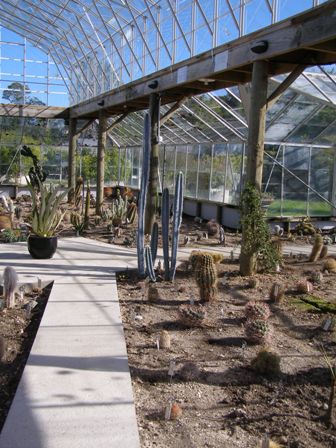
The recent Desert House project
The large desert house is a new installation, made necessary by the gift of a huge collection of well established cacti and succulents. A traditional earth labyrinth (dug by hand) is nearing completion. Clive is having a great deal of fun building the new Garden of Death. This is not to be confused with a pet graveyard. Rather, it is a unique environment for another themed plant collection which is focussed on poisonous plants and their social histories. With a touch of whimsy, they refer to it as the GoD garden.
It is that sense of whimsy which gives Paloma its special character. Those of us who count Clive as a friend tend to be in awe of his productivity and his wide range of practical skills. This is not a garden where money is spent bringing in outside contractors and tradesmen. Clive must be the ultimate D.I.Y. man, the epitome of that New Zealand ethos. But this is not about cobbling together a walkway or putting in a bit of retaining wall. He builds. He welds. He creates. In the early days of making the garden, those creative energies were primarily directed into projects using the plants. These days the bulk of the planting is done, 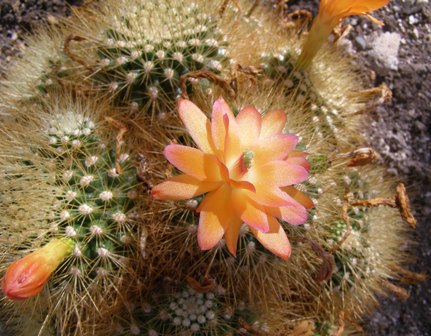 although the arboreta are ongoing projects. An arboretum, by the way, is a deliberate collection of different trees (not to be confused with a forest or a plantation) and, being Latin, the singular is arboretum but only the determined and the fortunate have the plural of arboreta. Garden maintenance is always necessary but it is hardly creative so I would guess that the creative instincts have found new direction in sculptural installations and building. There are neither classical repro statues nor kitset octagonal summerhouses here. Paloma is characterised by one-off originals, at times combined with strong colour, occasionally provocative, often quirky.
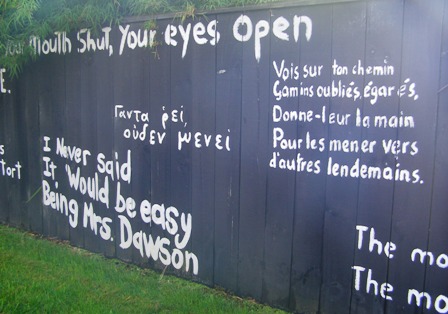
Wit and whimsy on arrival at Paloma
If you only enjoy visiting gardens that look like your own, you may find Paloma disconcerting from the moment of arrival at the simple board fence which has been transformed with whimsical writing. But if you like the challenge of being stimulated rather than soothed on a garden visit, the multiple layers and complexity of this garden environment will be a surprise. I do like a garden where you can’t take it all in on the first visit.
Paloma is not a seasonal garden in the usual manner so there is no single best time to visit. For more information, check out their website (www.paloma.co.nz) , email them (paloma@paloma.co.nz) or phone 06 342 7857.

Turning plant collections into a garden - Paloma


 Tikorangi The Jury Garden