Plant Collector: Frangipani

The intoxicating fragrance of frangipani (or plumeria)

The intoxicating fragrance of frangipani (or plumeria)

Alas, these frangipani are not growing in our own garden. We were in Sydney last week where they are common in home gardens. We have two plants here which we have managed to get to a good size in pots and we plan to give them optimum conditions in the hottest possible, sheltered position at the front of the house because the fragrance is just to die for. I am sorry we don’t have the exotic rosy pink and yellow form, but only the more common white with a golden centre, more correctly known as Plumeria rubra var. acutifolia but frangipani will do just fine, thank you. There are dark red forms too.

Despite the fact that they are common in the Pacific islands and throughout Asia, frangipani originate from Central America (think Mexico, Venezuela and the Caribbean) and therein lies the problem – they are tropical but we are not. They are of the large deciduous shrub to small tree class, but very sappy plants so more akin to some of the larger euphorbias in growth. They will grow happily in pretty tough conditions as long as they never get cold or waterlogged.

What is often called the Australian frangipani is a totally different plant. It is an evergreen tree, usually very large though there are some smaller selections becoming available, and is in fact Hymenosporum flavum. Being a Queensland forest tree, it is not quite as tropical as plumeria but neither is it as exotic and attractive in bloom. We will keep to the plumeria and hope for that unmistakable scent of the tropics in summer.

In the Garden this week: March 18, 2011

Freezing surplus tomatoes

Freezing surplus tomatoes

• Now that the heat of summer has passed and we are getting into autumn, you can be thinking about planting woody trees and shrubs. Novice gardeners get inspired in spring but more experienced gardeners know that mid autumn is an optimum planting time. It gives plants a chance to get their roots established before the spring flush and the threat of a dry summer. Hedges, specimen trees, avenues and orchards – start frequenting your favourite garden centres to see what they have available. There is no rush. You are better to plant when we have had a few days of good rain and there is a six to eight week spell of good autumn planting weather.

• Garden centres are advertising spring bulbs. Remember when planting bulbs that most do not need super rich soils. Good drainage is the critical aspect so they don’t rot out when dormant. Light, friable soils are more hospitable than great clods of dirt but lay off the fertilisers. Digging in some leaf mulch or a little compost is all that most bulbs require. In the wild, many bulbs have evolved to survive in quite difficult conditions and mollycoddling can result in too much leafy growth to the detriment of flowers.

• You can do autumn cuttings of plants like fuchsias, pelargoniums, vireya rhododendrons and perennials which don’t clump so need to be increased by cuttings – dianthus (pinks), oenothera (evening primrose), erysimum (wallflowers) and the like. These types of plants root easily and don’t generally need rooting hormone. Use firm wood from this season’s growth and reduce the leaves by about half to stop the cutting drying out too quickly.

• You have pretty much missed the boat now on sowing root crops for winter because they need a longer growing season. If you have space, you could try carrots but they will only make baby grade. However, you are fine to continue planting brassicas, Florence fennel (finocchio), peas, winter spinach, winter lettuce and quick maturing Asian greens.

• If you have an abundance of tomatoes, we have found the easiest way yet to prepare them for freezing. Wash them, cut out any damaged bits and the central stem area. Pile them into big roasting dishes and bake in the oven until cooked. Cool. Drain off the clear liquid (tasty as juice or frozen for soups). Pull off the skins which are now very loose. Freeze in small containers. They become concentrated and ideal for using later in the year.

• As long as you can get a hosepipe within reach, it should safe to sow new lawns after the next good rain.

Redoing the strawberry patch step-by-step with Abbie and Mark Jury.

A step by step guide by Abbie and Mark Jury first published in the Taranaki Daily News and reproduced here with permission as a PDF.

New Outdoor Classrooms are uploaded fortnightly.

Plant Collector: Castanospermum australe

A mission requiring the tall extension ladder - gathering the Castanospermum australe flowers

A mission requiring the tall extension ladder - gathering the Castanospermum australe flowers

It was just a little difficult to photograph the orange pea flowers on the castanopsermum, owing to the fact that they are at least 10 metres up the tree and beyond the limit of my camera’s zoom. Getting this photograph entailed Mark on the end of the extension ladder cutting a branch to bring down to ground level. The tree itself is probably getting closer to 20 metres now, though it has taken several decades to get there. I was slightly alarmed to see that it has the potential to reach 40 metres high in its natural habitat of east coast Australia, particularly Queensland, but I doubt that it will reach that in our cooler climate, or indeed in my lifetime.

The common names for this plant are Black Bean Tree (on account of its large black seeds held, as legumes are, in a pod) and Moreton Bay Chestnut. Indeed castanea means chestnut in Latin and that is where it gets its name from. It has always been much on my conscience that many years ago when we sold a few of these (and painfully slow they were, to get grown to saleable size), in my ignorance I assumed that the common name of Moreton Bay Chestnut meant the seeds were edible. They can be eaten – if you are Aboriginal and understand the painstaking process of rendering toxic seeds edible (a bit like karaka berries in this country). Lacking that knowledge, poisoning is more likely. As the tree takes some time to flower, I am hoping that my incorrect plant labels will long since have faded into oblivion so nobody tries eating the seeds.

The tree is evergreen and has handsome, pale green, large pinnate leaves – pinnate meaning divided like a feather. Should it outgrow its space here, apparently the timber is attractively grained like walnut.

Learning to garden with shade – the woodland

Raised beds can be desirable, but not in tanalised timber

Raised beds can be desirable, but not in tanalised timber

When you start a new garden, especially on a blank canvas, it is hard to imagine dense shade and sheltered conditions. Fast forward some years and the picture changes dramatically. If you have planted trees and larger growing shrubs, your open, sunny conditions change gradually to the point where you realise the whole micro-climate has altered and the sun-lovers like roses and lavender are struggling. You either cut back or remove large plants to regain the earlier, open conditions or you change your style of gardening. Most larger, more mature gardens move naturally into woodland or shade gardening.

In their simplest form, woodlands are a natural occurrence – but not here. Our native forests are just that – forests. In their natural state, they can be near impenetrable and are more akin to cool climate jungles. I have seen the bluebell woods in flower in Scotland and they were enchanting. A carpet of blue, spread beneath comparatively small deciduous trees which were just breaking dormancy. I can’t recall what the trees were – chestnut, maybe, or sycamore, possibly oak – I was more charmed by the bulbs growing wild. I have only seen the flowering of the English snowdrops in photographs. A particularly memorable image showed a dense carpet of snowdrops beneath the graceful, slender trunks of the white barked birches. However, I can tell you that in general, British and European forests are quite open. You can walk through them without needing a slasher and tramping boots as you do in our forests. Robin Hood and his merry men could probably move through Sherwood Forest without having to keep to tracks. While there are conifers growing which are evergreen, the vast majority of other trees are deciduous. This means that light gets through in winter and early spring and that there is a seasonal carpet of leaf mulch below. In their predominantly dry summers, the shade inhibits the rampant growth we expect here.

But gardening is not about reproducing nature. It is about reinterpretation. Those natural woodlands, which are essentially a shade meadow garden full of wild flowers, peak for maybe two weeks of the year. We are not going to be happy with that in a home garden. England’s wonderful grand dame of gardening, Beth Chatto, has planted her woodland in a succession of spring flowering bulbs which extends the display but even so, by early summer, there was nothing left to see. I was still sufficiently inspired to return home and do the same in one small area. Here, I had to make sure there was no grass and the ground surface is bare soil and light leaf litter. And I can tell you that in a small triangular area about eight metres long and five metres at its widest, it took hundreds of bulbs – snowdrops (galanthus), Cyclamens coum and repandum, assorted dwarf narcissi, rhodohypoxis and lachenalias. The sheer volume of bulbs required rules it out for most gardeners.

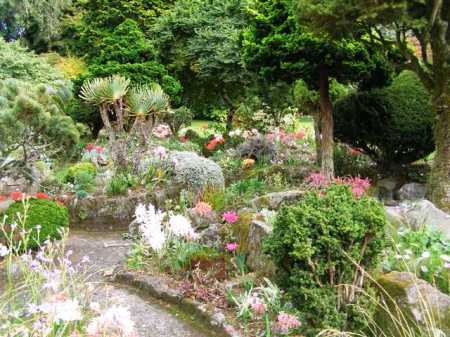
The allure of the woodland garden path

The allure of the woodland garden path

Shade gardening is the option for extending display and keeping some definable form in a garden. With huge trees here, dating back to 1880, we have a lot of shade garden, usually referred to as woodland. The basic principles of gardening still apply – it is the variations in foliage, form, height and colour that give interest. Achieving it under a canopy of foliage is different to being out in the open. There are three obvious keys to remember.

Firstly, few plants are happy in dense shade. There is nothing else for it. You have to lift and limb – raise the canopy sufficiently high to allow filtered light below. The trunks of the trees are a feature in their own right and if you want to garden below, getting a four metre vertical clearance will allow space and light to give the plants a chance.

Secondly, there will be a great deal of root competition from established trees. In fact it can be damned difficult chiselling out a hole large enough to plant into and even then, there is little chance of many plants thriving when they are competing for space, nutrition and moisture. That is why many bulbs do so well – because they can cope with harsh conditions and little soil. Clivias, too, will foot it in this environment, as will some of the plectranthus, but many other shade plants such as hostas are never going to be happy and healthy. We get around this in some areas by building informal, raised beds and moving in soil and compost to get the plants established. Ponga lengths and fallen branches still look natural but spare me from the idea of tantalised timber. I don’t like the look of tantalised timber anywhere in a garden but it is even more incongruous in woodland. Casual and natural are the words to remember here.

Thirdly, woodlands are usually dry, a fact many people fail to realise. That is because when you have large trees, their massive root systems suck up the water, leaving little for smaller plants. Often the canopy of foliage and branches will deflect the rainfall away. You really do not want to be creating a garden where you have to water regularly so it is better to choose plants from the start which will take dry shade. Fortunately, the fact that they are growing in shade hugely reduces their water requirements (little evaporation from the sun) so even hostas, which are generally regarded as needing plenty of water, can thrive in dry shade once established.

You can manage flowers and colours for most of the year in a woodland garden - a tricyrtis or toad lily

You can manage flowers and colours for most of the year in a woodland garden - a tricyrtis or toad lily

I will return at a later date to plant options for shade or woodland gardening but here, we are strongly of the view that mass planting of herbaceous material in a shade garden is even duller than mass planting in a formal garden (where the structure and straight lines give form). Give us variety and mixed plantings. The aforementioned clivias are fantastic plants but you only want so much of their strappy foliage and predominantly orange flowers. Combine them with filmy ferns and the extravagance of the massive, split leaves of Monstera deliciosa (the fruit salad plant) and you have a combination with some zing.

It is possible to garden with flowers in woodland and to have colour for most of the year. And, a huge bonus for most, weed growth slows in the shade so you don’t have to be so vigilant on the weeding front. The invitation of a winding path into the woodland can be so much more mysterious and full of promise than the open, sunny section, but, like all forms of gardening, it does not just occur of its own accord.

You have to make it happen.