Let there be cake

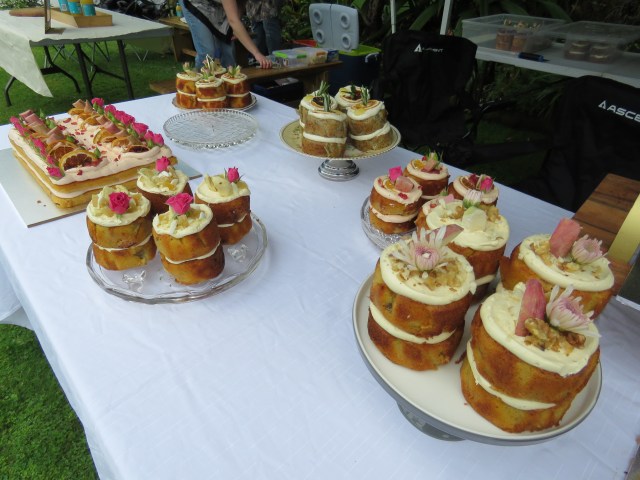
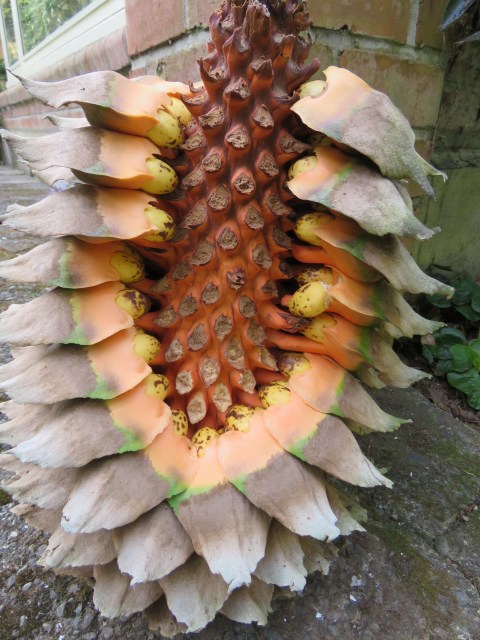
Not my efforts. I do not make cakes like this. These cakes are all the work of Rose Lawrence from the Garden Cake Kitchen

And lo, there will be cake.

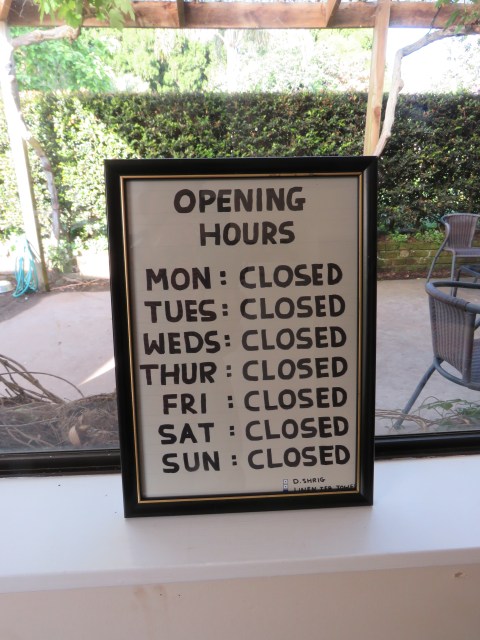
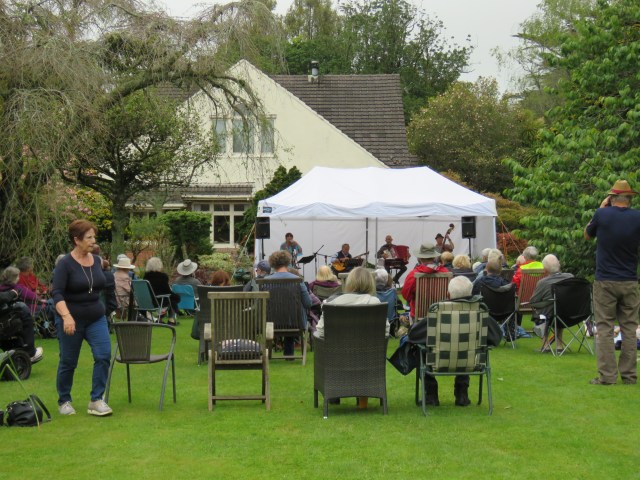
On the first Sunday of the garden festival – 30 October – Rose from the Garden Cake Kitchen will have her wares for sale during the afternoon concert by La Mer. French Cafe-style music blended with gypsy swing and extravagant cake on our front lawn – what could be better? I admit that it would be better if we could guarantee a fine day because the concert is weather dependent, but that is beyond our control, alas.

Rose describes her cakes as “botanical-inspired, perfectly imperfect, and even more delicious than they look!” Rest assured that we will be carrying out some quality control testing.

To be honest, I am not even sure how one serves a slice of cake from this type of construction but fortunately, I will not be serving cake personally.

Rose will be selling her cakes by the slice and there will be a limited amount of gluten-free and vegan slices as well.

If you are coming to the Centuria Taranaki Garden Festival over that weekend, please join us on our front lawn. There is plenty of room. I have just posted a second video of La Mer’s music on my Facebook page here, to capture of the flavour of the music as well as the cakes.

The Sunday morning Nature Journaling workshop with Jennifer Duval-Smith has sold out but there are still a few spaces left in her other three worksops – Meadows and Wildflowers on Saturday 29 October, Grandeur and Glory of the Rhododendron on Tuesday 1 November and Flowers of the Early Summer Garden on Saturday 5 November. For more details and bookings, go to the festival website.

IThe festival website is https://www.gardenfestnz.co.nz/ or you can find it on Facebook and Instagram.  

Looking at finer detail

I picked a sampling of the smaller bulbs currently in flower yesterday morning, just before the rain returned

I was thinking about writing about rhododendrons this week. The big-leafed Rhododendron macabeanum that was *temporarily* heeled into the Iolanthe garden years ago, pending relocation to a more suitable spot, is looking absolutely splendid. It is clearly in its forever home where it is. And the firecracker R. spinuliferum never fails to delight me, but the rain has returned, interfering with photo opportunities. Apparently four consecutive fine days is all we can expect. Besides, for all the grandeur and stature of the fine rhododendrons, it was the simple sight of a few flowering bulbs down in the Wild North Garden that gladdened my heart more.

A simple sight on an ongoing project but one that is delighting us all. Red valottas, moraeas and a dainty little yellow bulb that I have forgotten the name of but belongs to that babiana, sparaxia, valotta group of bulbs.

Have I mentioned before how much we love gardening with bulbs? Of course I have. The Wild North Garden is now largely the project of our garden apprentice, Zach. I give him surplus bulbs from the more cultivated house gardens that we think may be able to bed in and compete in the more naturalistic environment and he plants them where he thinks they may thrive.

The Narcissus bulbocodium were planted planted just last week but have already opened up their flowers

Zach has also been tidying and replanting the area where the fallen giant gum tree laid waste when it fell in Cyclone Dovi last February. Because there are enough trees and shrubs in the area that will recover over time, we have taken advantage of the more open conditions to thread rivers of surplus bulbs through below.

This is another gum tree – you can tell by the characteristic twist in the trunk – but fortunately it survived Cyclone Dovi and its falling neighbour.

Wilder areas need tough, robust bulbs that are capable of surviving competition. That means bluebells, snowflakes (leucojum), snowdrops, some of the vigorous smaller narcissi and lachenalias, peacock iris (Moraea villosa), valottas and the like.  The more delicate, pernickety bulbs are given prime positions in well-tended areas like the rockery where we can guard them from being out-competed by stronger plants.

Moraea villosa and bulbocodiums in the rockery
There are too many freesias but we will relocate some and they are pretty on their day.

The most interesting bulbs also have back-ups kept in pots, sometimes in a covered house. They don’t get a lot of love and attention but the conditions mean they are more likely to survive and enable us to replenish the garden when they may have died out or to extend existing plantings. This is particularly true of some of the more interesting lachenalias, especially the blue forms.

Somewhere I have the name of this yellow tulip species. I am just not sure where. It does not exactlyy thrive here but it does keep returning each spring as long as it is given its own space. The white daffodil behind is ‘Thalia’.

It takes ongoing attention to keep the detail in a garden and it is the high level of detail that brings both Mark and me most pleasure and interest on a daily basis. Vistas, views and big pictures – a beautiful magnolia in full bloom or the aforementioned R. macbeanum – are great but they are only part of the gardening experience.

“Why do you like the dwarf narcissi?” Ruud Kleinpaste once asked Mark’s dad, Felix. when in the garden filming a story on magnolias for the TV garden programme hosted by Maggie Barry.

“Because they are small,” Felix replied.

I know exactly what he meant. I did, however, pop out briefly in the rain to snap the macabeanum for readers who prefer bigger, showier pictures.

Rhododendron macabeanum
The macabeanum was not supposed to stay in this position because it will grow a great deal larger over time but we will work around that as need be.

New directions with camellias

This is a longer piece than I usually post on this site but it was written for and first published by the Royal Horticultural Society (UK) annual journal of the Rhododendron, Camellia and Magnolia Group, 2022.

C. sasanqua ‘Crimson King’ showing the typical open, graceful form many sasanquas have as they mature

I married into a camellia family. Both Les Jury and Felix Jury were recognised in their day as making significant contributions to the camellia world with their new cultivars. Both worked with Camellia japonica and hybrids to create plants that were self-grooming (dropping spent flowers rather than having them hang onto the bush) and breeding out the tendency for stamens to turn black as blooms aged. Hugely popular in New Zealand, camellias ranked second only to roses in sales figures.

My own mother was not as keen. True, she described a young plant of Felix’s C. x williamsii ‘Rose Bouquet’ as being like growing an herbaceous paeony in a climate which did not favour the growing of any paeonies at all, but it was clear she saw it as second best. Memorably, she once declared that the trouble with camellias was that they were all red, white or pink blobs with shiny green foliage. With more experience, I now realise she was only thinking of C. japonica and hybrid camellias. I do not think she ever met the species or had anything to do with C. sasanqua.

We have a large garden with many camellias used in a variety of situations. I have never counted them but it will be in the hundreds, not the tens. When Mark started plant breeding, he followed in the footsteps of his father and his uncle and chose camellias first. They are right at home in our climate so we have camellias as feature plants, background plants, hedges both informal and clipped, windbreaks and as a backbone plant repeated throughout the garden.

The unsightly appearance of petal blight on japonicas, reticulatas and many hybrids. It looks marginally better on red blooms but a great deal worse on pale and white blooms.

The arrival of camellia petal blight – Ciborinia camelliae – was nothing short of devastating. Our massed displays of C. reticulata, C. japonica and hybrids blooming in winter and spring disappeared as petal blight took hold and now they are just a memory. Petal blight is common throughout the world. Is it only Australia that remains free from it now? It took a trip to the International Camellia Convention in southern China in 2016 for us to realise that our particular climatic conditions mean that the impact of blight here is arguably at the very worst end of the scale. We are humid and mild with regular rainfall and plenty of wind to spread the spores far and wide – ideal conditions for any fungal ailment. In the drier conditions of China, it was nowhere near as big a problem as here and talking to growers from around the world, they don’t suffer the same level of impact as we do.

In our particular location, it is bad enough for me to say that we haven’t and wouldn’t plant a C. japonica, a large flowered hybrid or a C. reticulata now. There is no point. Flowering has become sparse and all that early breeding for plants which are self-grooming does not work for these vulnerable camellias so the display is now pale brown blighted blooms or blooms in the process of being blighted with just a few lovely flowers to remind us of times past.

Camellia minutiflora

All is not lost, but we have done a serious re-think. Fortunately, Mark had always been interested in miniature flowered camellias with a strong personal preference for the simplicity of singles and semi doubles. They mass flower and each bloom only lasts a couple of days so they fall before blight takes hold. We also like the species and had already set out to build a collection of most that are available in this country. Some of the species bring in a wider range of growth habits and foliage than are seen in commercial camellias. In fact, some don’t even look like camellias as most people know them. We are so besotted with little C. minutiflora  that we have several in the garden; what came to us as C. puniceiflora doesn’t look like a camellia at all and only aficionados would identify the pink flowered form of C. sinensis and the assorted yellow species we have as camellias.

The dainty flowers of C. minutiflora

We also have a good representation of autumn flowering varieties from the C. sasanqua group, which are not affected by the blight. In the days when the large flowered C. japonica were favoured, with a particular preference for the perfection of formal doubles like ‘Dreamboat’ and scores of others, the attitude to C. sasanqua was bit dismissive. They lack the solid petal texture and defined form in their blooms and are slower to establish, as nursery plants at least. In New Zealand, they were largely seen as utility hedging, best in white and even better if C. sasanqua ‘Setsugekka’. The white ‘Setsugekka’ hedge became a cliché.

Tastes can change. Now we appreciate the C. sasanqua cultivars for their mass display in autumn through to early winter, preferring that looser flower structure and simplicity. Added to that, as mature plants, most have a naturally graceful form that is easy to tidy up and enhance to create a feature plant even when not in bloom. Shapes are important all year round and shapes with good, healthy foliage that are also hardy, reliable and low maintenance are not to be disdained.

We give a lot more thought to our camellia plants these days. Many are invaluable for shelter and wind breaks. Flowers are a bonus. But not every camellia plant is valuable. If they are not flowering at all well, are not pleasing to the eye as a shrub and are not filling a useful purpose, we have no qualms about removing them. These plants used to at least fulfil one of those functions – that of mass flowering.

Lifting and limbing – finding the natural shape of a plant and highlighting it – Camellia ‘Tiny Princess’
Camellia ‘Dreamboat’

We do a lot of what we call lifting and limbing here. In a mature garden, raising the canopy and letting light in is ongoing. What sets lifting and limbing apart from simple pruning is that it is more focused on making the most of the natural shape of the mature plant. Mark is the master of this but my skills are improving. More time is spent standing and looking, then tracing where branches go than actually cutting and there is much going up and down the ladder. It is very satisfying to find the most pleasing forms within a plant and to highlight the shape by removing extraneous growth. Added to that, it is a one-off activity that just needs a bit of occasional maintenance in future years. It is possible to remove a lot without a plant looking massacred, as long as clean cuts close to the trunk or branch are made.

Cloud pruned ‘Mine-no-Yuki’

Our garden is very light on ornamentation. We don’t go in for sculptures, statuary, pots or a plethora of trellises and archways, preferring to use key plants as focal points, along with natural vistas. Mark’s cloud-pruned camellias are particularly fetching. He started on Camellia sasanqua ‘Mine-no-Yuki’ which was so huge that its weeping growth was blocking a pathway. The initial shaping took him several days up and down the ladder which was hard on his knees. He must have removed well over half the jumbled plant but found the most pleasing shape beneath. We keep it clipped to flat- topped cloud shapes. It only needs trimming once a year to maintain that form and that is a simple job that takes a couple of hours with hedge clippers. ‘Mine-no-Yuki’ is not good in bloom here. We get a few days of pristine white blooms before they get weather damaged; from then on we get a display of brown and white flowers. As a clipped, evergreen shrub it makes a splendid feature all year round.

I differentiate between clipping and pruning. Pruning is done with a pruning saw and secateurs; clipping is carried out with trimmers, be they hand-held hedge clippers or motorised trimming blades. Good pruning is a higher grade skill because the aim is to get into the plant and shape it without the work being visible – ‘blind pruning’, an older colleague used to call it. Hacking is bad pruning.

Left to right: ‘Elfin Rose’, C. puniceiflora, C. trichoclada and C. gauchowensis. All are clipped once a year.

We don’t clip many plants – ours is not a garden modelled on the clipped and corseted Italian genre – but we have a few that we like to use as punctuation points in the garden. Inside our entrance, we have a small grouping of camellias that we clip tightly once a year. The shape of each has been entirely determined by following their natural growth habit and exaggerating that. So C. gauchowensis is a plump, rounded pillar, C. puniceiflora a three tier cake stand and the somewhat insignificant C. trichoclada is a flat plinth. They are backed by the cloud pruned C. x hiemalis ‘Elfin Rose’.

Cloud pruned ‘Elfin Rose’

The problem with clipping is that it cuts every single outside leaf that then turns brown on the cut edge. This does not matter when the clipping is being done on plants with very small leaves and it is not generally a problem on the C. sasanqua cultivars which have a somewhat softer leaf. It matters a great deal if the clipping candidate has the tough, shiny, leathery leaves common to the C. japonica types. I drive past a clipped white C. japonica hedge from time to time and it simply looks awful when it has been freshly cut. I wonder if the owners went to buy the aforementioned ‘Setsugekka’ (which would have been much more successful) but the garden centre had sold out so they talked them into a white japonica instead? It was not a good choice. Keep your clippers away from C. japonica varieties is my advice; reach for secateurs instead and forget any ideas of tight-clipped shapes.

Our preferred hedging options. Left to right: C. microphylla, ‘Fairy Blush’and C. transnokoensis

We have camellia hedges ourselves but all are small leafed varieties that clip tightly to make a dense barrier over time, looking sharp-edged and smart. We also select for small single flowers that drop cleanly and break down quickly, thereby avoiding the brown sludge that large, heavy textured flowers can create when they fall. The three camellias we have used for hedging are ‘Fairy Blush’, C. transnokoenis and C. microphylla. ‘Fairy Blush’ is our first choice where we want dense hedges to around 1.5 or 1.8 metres high. It is a C. lutchuensis hybrid, the first camellia Mark ever named and the one that remains our all-time favourite with its exceptionally long flowering season. Unlike its scented parent, it is fully tolerant of sun and open conditions (C. lutchuensis is inclined to yellow in the foliage in full sun), very free flowering and, en masse, it exudes a delightful scent on warmer, sunny days.

Camellia ‘Fairy Blush’ as a clipped hedge.

We have never grown much buxus hedging here but when the threat of box blight loomed (mercifully, it has still not reached us and we don’t have the buxus caterpillar in New Zealand), Mark took the opportunity to rip out a couple of box hedges and replace them with C. transnokoensis. I think the blight might just have been an excuse really, because the main reason was that he thinks hedges should be more than just green walls; they should also contribute to the eco-system and plants that flower and attract bees and butterflies do more than just act as a visual divider. C. transnokoensis has excellent small foliage and tiny white blooms but its flowering season is much shorter than ‘Fairy Blush’ and it is taking longer to become dense in its growth.

When it comes to tight clipping, timing is important. We tend to clip hard in early to mid-spring, just as the new growth is being made. If it gets left later, the next season’s flower buds will have set and clipping will be at the expense of next season’s flowering. Sometimes we get to the C. sasanqua plants earlier; in our relatively mild climate, we have more latitude and can garden through winter without risk. We only clip once but we are fine with the softer, woolly look that develops as the seasons progress. If you want a sharper look, do the hard spring clip and then follow up in summer, but just with a light prune to tidy up the wayward fresh growths.

C. microphylla will be kept lower as an undulating wave hedge, between 30cm and 70cm high.
Camellia microphylla backed by C. yuhsienensis

C. microphylla has an even shorter season in bloom and flowers in late autumn for us but we selected it less for its white, starry blooms and more for its very compact habit and small leaves which lends it to tighter clipping where we want low, undulating hedges in the area we call the Wave Garden. It is taking some time to grow and clip into the tight growth we want, particularly because the plants Mark had raised from both cuttings and seed languished, unloved, in pots in the nursery for longer than they should have. It took us a while to plan and then plant the garden they were destined to grace. Healthier plants would have taken off faster but we can see it will work exactly as planned.

Camellia yuhsienensis used as punctuation points, backed by Mark’s ‘Fairy Magnolia White’
It is possible to remove a lot of plant without it looking as though it has been brutally attacked if pruning is considered and careful. This is getting C. yuhsienensis back to a manageable size.

Overall, we do more pruning than clipping and that is aimed at keeping some key plants from growing to their full potential. Essentially, we are trying to contain them to a certain size. We have used the lesser-known species, C yuhsienensis, as punctuation points with winter interest along the summer gardens. We love its open, starry blooms which are lightly scented and reminiscent of a michelia as well as the heavy-textured foliage which many people fail to identify as a camellia. It is not self-grooming and it is one of the few camellias I am willing to go through and brush off spent blooms which is a sign of how much it pleases me. Left to its own devices, it will reach 2.5 to 3 metres high by 2 metres wide in our conditions, getting somewhat more open as it grows. I am keeping these to around 1.6 metres high and a metre wide and that is done on a single, perfectly straightforward annual prune with secateurs and sometimes a handsaw. Each plant is reviewed individually as I work out which branches I want to take out entirely and which ones I just want to shorten. It sounds more onerous than it is in practice but my aim is always that the pruning not be visible to other people’s eyes.

Camellia yuhsienensis
A top-worked hybrid of Mark’s we named ‘Pearly Cascade’ which is unlikely to still be in cultivation. While the flower is not special, the slow, spreading growth habit kept it small and made it an ideal candidate for training to a feature plant.
A top-worked (high grafted) weeper. This came to us as ‘Nuccio’s Pink Cascade’ but that may not be an accurate name.

We have a few high-worked standard camellias, grafted a metre or so up a single, strong trunk. These are not easy to do so certainly not widely available commercially here, if at all these days. Our plants date back to when we still had a plant nursery and specialised in unusual options. The weepers are just left to weep. These are ‘Quintessence’ and one that came to us ‘Nuccio’s Pink Cascade’ but I am now doubting that name because I can’t find it on line. I scrapped all the weeping ‘Sweet Emily Kate’ specimens because the exceptionally pretty flower did not atone for the dreadful yellowed foliage.

Our other standards are slow growing hybrids from Mark’s breeding programme that are not commercially available. The natural characteristics of being both slow and dense in growth is what makes them easy to maintain. Trying it with stronger growing varieties would mean a whole lot more work fighting nature to keep the desired shape.

When we removed the garden beds around the top of the sunken garden, we retained the eight camellias and three dwarf maples as clipped and shaped character plants.

Mark is not a lollipop or pompom man. He likes these camellias clipped to low, flattened domes –  mushroom shapes he calls them, or maybe umbrellas. Again, we clip or prune just once a year and that is sufficient to keep these as statement plants.

An espaliered sasanqua camellia from another person’s garden.

I have never gone in for espalier. I am not so keen on that level of extended fiddle-faddling, myself.  But I stopped to photograph a very well-established espalier done with C. x hiemalis ‘Elfin Rose’ in a garden down the road. Unfortunately, the flowering was finished for the season so you will just have to imagine how pretty it looks with the bright pink blooms and deep forest-green foliage. It has been trained on a readymade trellis fan and is kept clipped to make a dense screen which is only about 30cm deep.

In days gone by, I used to keep a small collection of trained and clipped camellias in large containers to move around to particular locations. Each one was treated differently to emphasise individual characteristics. The reason I planted them all out or gave them away was simply because I decided that, in a garden as large as ours, having large plants in pots that need regular watering, feeding, repotting and root pruning was too much work. I prefer to work on plants already growing in the ground but the container approach may work for other situations.

Camellia ‘Fairy Blush’ again

We used to view camellias as a low maintenance, undemanding but top performing utility plant in our garden. That changed with petal blight. Now their roles have changed. We treat each plant individually and give them a lot more attention but that is what makes gardening interesting for us. We wouldn’t be without them. It may be putting a brave face on it, but I am not sure I miss those days when they were largely big blobs of white, pink or red on shiny green foliage. Times change and we just change our gardening ways to meet the new situation.

In memory of times past when we used to have mass displays of blooms like this. We refer to this one as ‘Mimosa’s sister’, not because Mark’s mother ever had a sister but because it is a sister seedling to ‘Mimosa Jury’ that Mark’s father bred and named for her.

More rain!

Heading down into the park, the flood waters are visible to the left

The rain started late on Tuesday and as I write this on Saturday, it seems to be stopping. Firstly, heartfelt sympathies to those up and down the country who have been badly affected – particularly the Nelson area and Northland where extensive damage has occurred.

The stone bridge is beneath that water

It isn’t the biggest flood we have had here but it is sizeable. We cope with our floods with resigned equanimity because they don’t threaten our house or property. We are not slip-prone and the house will never get flooded. The water comes up and up and then, because we have brilliant drainage on our volcanic soils, it goes down just as quickly when the rains stop. Others are not so lucky and we would be a great deal more stressed if we were faced with the devastation I see in other parts of the country.

What we refer to as the high bridge, which is not so high at the moment. Ralph is unphased by getting wet which makes a change from aquaphobic Dudley dog who heads indoors at the first raindrop.
Standing on the bridge, looking upstream

It is a huge issue in New Zealand where most settlement is around the coastline and often at the mouths of rivers so on the natural flood plain areas. It seems highly possible, if not probable, that torrential deluges are to become more common with climate change. This is not a comforting thought.

Confined indoors, I realise how much we live our lives out in the garden. I cleaned the oven instead and all I can say about that is my double width de Longhi wall oven is brilliant to use but was clearly designed by an Italian man who had never cleaned an oven in his life. I am not sure what to do with my time next if the weather doesn’t clear.

Maybe it is a good day to gather magnolia petals for a couple of jars of pickled magnolias. I was surprised last year at how easy these are to make and how delicious they are. They would be perfect to accompany rice paper rolls but we had already eaten them before I remembered to make the rolls again. If you want to try this at home, younger, smaller petals are best. They don’t keep their colour in the pickle so a pretty mix is not necessary. Keep to deciduous magnolias; michelia petals are not a nice flavour.

Out in the garden, I must acknowledge the resilience of the Dutch iris. These are not my favourite plant by any measure but the narcissi are bent double from the heavy rain, the magnolias and michelias are shedding petals everywhere, the camellias are browning on the bush while the Dutch iris stand firm and tall, unmarked by the rain. In the right place, they are a lovely addition to the early spring garden.

May the sun return for everyone this week. There is work to do in the garden.

The confluence of two streams entering our property. Despite the rain, you can see the stream to the right is reasonably clear water. This is because it has a long distance of riparian planting filtering the run-off before it enters the stream. The stream to the left is unfenced, unplanted and the water is running straight off grazed farmland, washing topsoil to the sea.

Rays of golden sunshine

The narcissi tell us spring is here, irrespective of what an arbitrary calendar says.

A representation of those narcissi currently flowering

We once went to the National Daffodil Show when it was held in our local town. Alas, despite trawling through my files, I can not find the photos I took to convey the nature of the show. It was beautifully staged and moderately spectacular – in a daffodil-y sort of way. It was also an interesting insight into how those who breed and show daffodils are on a different trajectory. Bigger was undeniably better, extraordinarily long stems topped with enormous flowers, split corollas galore, a lot of different colour combinations and novelty variants. These were blooms grown to be staged as cut flowers. The little dwarf and miniature types were confined to one very small and somewhat insignificant table.

Our interest in narcissi begins and ends with them as garden plants or naturalised in a meadow situation. I cut some simply for photos yesterday. Because we over-heat our house in winter, we don’t generally cut flowers to bring inside where they immediately wilt and die. And those big show daffodils don’t make good garden plants in our conditions. The heavy heads pull them over and heavy rain and spring wind knocks the blooms about too much.

Peeping Tom at the front – reliable, tough and maybe a little too enthusiastic in its rate of increase. We do seem to have rather a lot of it.
These will be named varieties from the 1950s because they are a relic of original planting done by Felix and Mimosa when they started the garden here.

We don’t have a single big King Alfred type often favoured by people wanting to planting swathes of daffodils. Amongst other things, they flower later in the season. We prefer the early flowering types because they are largely done and dusted before the narcissi fly are on the wing.

Cyclamineus type

Our narcissi flower over a reasonable period of time and some are still to show any colour at all. While we probably have a respectable collection of named dwarf varieties (Tête-à-tête, Jetfire, x Odorus, Twilight, Beryl, Peeping Tom and others), many of those we grow are unnamed, controlled cyclamineus crosses that Mark and his father before him have done to increase numbers. It takes a lot of bulbs to naturalise around the garden and the plant budget here has never stretched to buying bulbs by the hundreds or even thousands needed to put on a good show. We could not afford to garden on the scale we do if we had to buy all the plants.

I have never unravelled the different narcissi groups in detail. We grow the hooped petticoats – N. bulbocodium – in lemon and the later flowering bright yellow but they are not my favourites. The bright yellow is showy but increases somewhat too readily, the lemon (citrinus) may need a bit more love than it gets here to flower well.

I would like to say Ralph is tiptoeing through the daffodils but I would be lying. His movements are more akin to thundering.

I love the look of Narcissus poeticus but it doesn’t love us so the best we can manage is the poeticus hybrid ‘Beryl’. We have some from the triandrus, jonquilla and tazetta groups but the reason why our collection is heavily dominated by cyclamineus types is because they are the best performers in our conditions. The ones with swept back petals are a particular delight for me.

Managed meadow! Planting on the slope gives and even better view from the path below.

It isn’t necessary to have big King Alfred types for meadow situations. I think our smaller dwarf ones are just as showy but we plant in clumps and drifts rather than scattered single bulbs and they flower before all the spring grass growth that would drown them. We need to get the timing right for mowing or strimming the meadow grass before the foliage comes through but otherwise, they are self-maintaining. And what a joy they are at this time of the year as the snowdrops of winter fade.

The bad news is that most daffodils sold commercially in this country are of the later flowering King Alfred type – big strong growers with big heads. The smaller growing ones are sometimes available in garden centres but you may have to search to find much of a range, or start raising your own from seed.

These are the largest varieties we grow. The manky first one of the left may be Narcissus pseudonarcissus double, then Silver Chimes, I don’t know what the next one is, the centre one with white petals may be the Narcissus pseudonarcissus (the wild daffodil), then Peeping Tom and Narcissus x Odorus.
Mid-sized dwarf varieties including Twilight, Twinkle, Jetfire and unnamed seedlings
And the littlies with bulbocodiums to the left