Tried and True – Helleborus orientalis

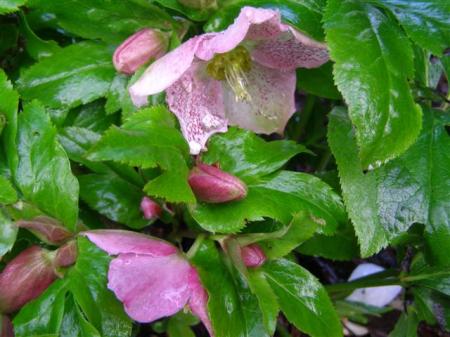
Helleborus orientalis - gentle and understated garden performers

Helleborus orientalis - gentle and understated garden performers

  • Winter flowering.
  • Require very little care and maintenance.
  • An undemanding plant for filling spaces.
  • Very hardy evergreen.


Helleborus orientalis are not from the exotic Orient. In fact they are native to areas of Turkey and Greece which may explain their tough constitution. They are often called winter roses, presumably because they flower in winter and are easy to grow. Their link to roses is as remote as their link to the Orient. They are an enormously obliging and gently understated plant, with pretty cup flowers which face downwards. These are not plants for deep shade – keep them to the margins of bush or woodland or even the open because they need reasonable light levels and can cope with full sun. Easy-care plant and leave specimens, they don’t appreciate being lifted and divided but are happy to be left to their own devices with the occasional feed.

There has been an explosion of different hellebore cultivars on the market in recent years, many of them orientalis hybrids. Some of the frilly doubles are very pretty, some are just average doubles. The really good dark maroon and slate colours will be better if you live inland and can give colder conditions. The simplest seedling forms are just single flowers in shades of pink, white and green, with or without freckles on the inside. Floating blooms in a glass bowl is the usual method of displaying them once cut.

Helleborus orientalis sets seed freely but the seed will not come true to its parent and you will get considerable variation. Push hoe or weed out surplus germinating seed to prevent too much competition. Aphids can make the spent flower head their home so it is often advisable to deadhead once at the end of the flowering season in spring. We cut off all the old foliage in mid autumn which gets rid of any lingering aphids and also exposes the pretty flowers to view before the fresh foliage appears.

Tikorangi notes: December 31, 2010

LATEST POSTS: Friday 31 December, 2010

1) A pink flowered cordyline from Australia – C.petiolaris in Plant Collector this week.

2) Decoding the jargon of garden design and probably ensuring that I remain off somebody’s Christmas card list – Abbie’s column.

3) Garden tasks this week including dealing with the explosion of blight and mildew we can expect with current high humidity levels.

The colours of a New Zealand Christmas - at least in the upper half of the North Island

The colours of a New Zealand Christmas - at least in the upper half of the North Island

TIKORANGI NOTES: Friday 31 December, 2010

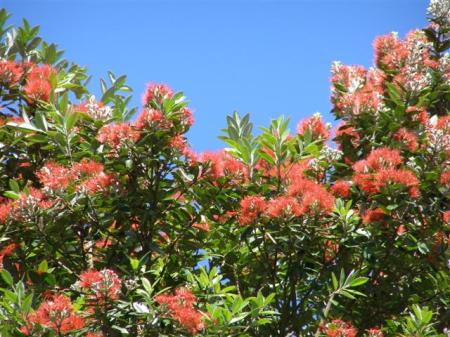
The colours of a New Zealand Christmas – a clear blue sky and the red pohutukawa flowers. It was a bit of a close-run thing this year with a week of dreary weather and far too little sun in the lead-up, the roses taken out by too much rain and the Christmas lilies looking distinctly weather-marked but the day dawned fine and we could lunch outdoors.

After a visit to friend and colleague Glyn Church today, we are thinking that we should be using more hydrangeas in the summer garden, particularly the smaller growing lace-cap serrata types. Glyn has a fine collection of hydrangeas but it was the serrata that kept attracting our attention.

Plant Collector: Cordyline petiolaris

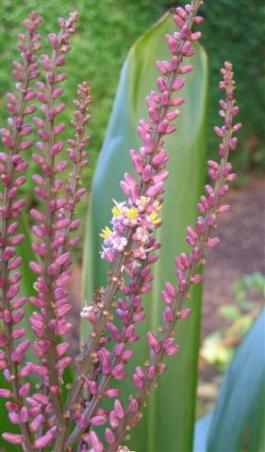
The Paris pink and yellow flowers of Cordyline petiolaris

The Paris pink and yellow flowers of Cordyline petiolaris

I have been waiting for weeks for these cordyline flowers to open and finally it is starting to happen. It is not that they are overly spectacular, more that they are an unusual Paris pink in colour with golden centres. In due course, they will turn to eye-catching red berries which hang on for a long time and are widely regarded as the more spectacular feature. Though it should be added that the wide, spatula-shaped leaves measuring up to 8cm across are also eyecatching.

Cordylines are of course what we commonly refer to as cabbage trees but the family is a little larger and geographically more widespread than our iconic native species, C. australis. This is an Australian species which occurs in the rain forests of northern New South Wales and Queensland. Our loyal cabbage tree moth whose offspring caterpillars chew the leaves of our native cabbage trees to shreds does not appear to like our Australian neighbours and consequently the foliage stays clean which is a distinct bonus in a garden plant. However, its flowers lack the heady summer fragrance of our native forms. The plant is somewhat hardier than its subtropical origins suggest, though it won’t tolerate heavy frosts. Given moist, sheltered conditions, it is not difficult to grow and will eventually reach about 5 metres high, keeping leaves down most of its length. It can be propagated relatively easily from stem cuttings or raised from seed.

Decoding the jargon

Setting the standard for garden rooms – Sissinghurst

A newsletter from a gardening organisation arrived a few days before Christmas and I duly read it, coming across the following statement (warning: do not let your eyes glaze and brain disconnect before the end). “Outstanding gardens manage to respond to the genius loci using borrowed landscape, natural landform and native plants – often mixed with exotics – to create stunning indigenous compositions of form, line, texture and colour.”

Borrowing the jargon, shall we unpack that statement? Though I prefer to use the term decode because it is somewhat like a secret code.

Outstanding gardens manage to – that bit is fine.

respond to the genius loci – had to get out the dictionary for this. Loci is, more or less, a place or locality. Google then helped me track down the term genius loci which apparently dates back to early Roman times and means the protective spirit of a place. Latterly the term seems to have been adopted by the landscape architecture fraternity although it might be easier to understand if they simply referred to the well known words of English poet and writer, Alexander Pope who took an interest in garden design. He put it rather more simply when he wrote in 1731 (a mere 280 years ago), “Consult the genius of the place…” which has come to be interpreted as the principle that design should always be relevant to the location and natural environment. This of course assumes that your particular location has some genius loci attached to it but it is a little hard to see how much genius loci you can lay claim to if your lot in life is a small, flat, urban section with a house, be it large or small, plonked fair and square in the middle. Some of us are blessed with quite a bit more genius loci than others.

using borrowed landscape – that is the view of the neighbours’ properties, assuming you have neigbours with views worth borrowing.

natural landform – silly me. I thought that was part of the genius loci.

and native plants – I can’t quite work out whether this is using the already existing native plants in your own genius locus extending to your neighbours’ genius loci which would be a little limiting because it then tends to apply only to those whose patch is on the boundary of a national park, scenic reserve or at least a patch of native bush. Alternatively it may be that native plants are mandatory and pre-eminent in outstanding gardens. While advocating strongly for the use of native plants in tandem with exotics, I think this statement takes the position of native plants considerably further than is common in this country.

… – often mixed with exotics – yes, we are allowed to embellish with introduced plants (exotics are the vast majority of what we grow in this country. Even our lawn grasses are heavily dominated by exotics, as are all our fruit trees and vegetables). I don’t know what the word often is in there for because you would be hard pressed to find any environment in this country, be it natural or contrived, which does not have introduced plants in it. Even our national parks are invaded by weeds.

to create stunning – stunning… hmm. There is a very emotive word. Quality can be measured and evaluated. Emotional response is a matter of individual opinion.

stunning, indigenous compositions of form, line, texture and colour. I will let the compositions of form, line, texture and colour go, though I can think of clearer ways of defining good gardening as a combination of excellent design and skill with plants. But, indigenous compositions? Puh-lease. Indigenous – occurring naturally or native to the land. Gardening, by definition, is not indigenous. It is an imposition on the landscape, occasionally a natural landscape but more often a landscape already heavily altered by man.

So what I think the original statement says is: outstanding gardens make the most of their natural environment, using a variety of plants and really good design. At least, I hope that is what it says. There is no author named so I can’t check.
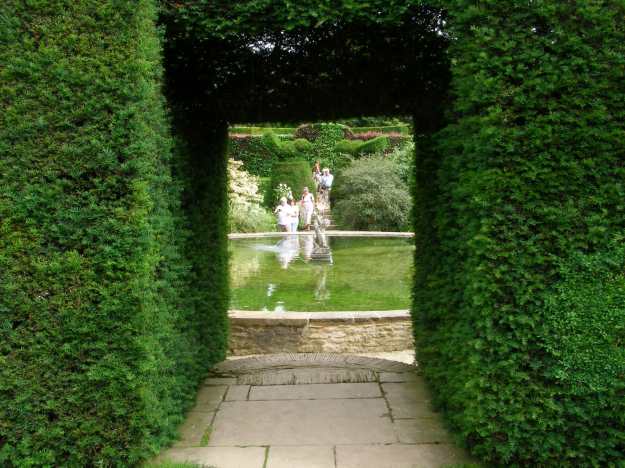
The classic garden door frame and passage at Hidcote – best in a garden with plenty of space, perhaps

Just a little further on in the same piece, there is the sweeping statement: “Gardens should be a series of outdoor rooms and should have walls, exits/ entries or passages between the rooms. Rooms should be well defined so the viewer is not distracted by what is going on in the next room although they might be tantalized at some point.”

What happened to open plan living, I ask??? Are we to be forever locked in to that format of the early twentieth century evident in the great English gardens of Sissinghurst and Hidcote? Do not get me wrong. We were very impressed by Hidcote when we visited, but perish the thought that all New Zealand gardens must follow the formula if they want to be seen as very good gardens. There are other styles of garden design. A woodland garden will never be a series of rooms with tight structure. A flowing landscape garden in the manner of Capability Brown relies on open spaces, not rooms. Must a tiny town section redefine itself as an area of poky little rooms surrounded by high walls? All those walls blocking out distraction can be damned oppressive, not to mention expensive if done in permanent landscape materials like brick, plastered concrete block or stone. Or high maintenance if done in clipped tall hedging with the added problem that all those hedge plant roots reaching out into the flower borders. It is also very difficult to accommodate large trees in those rooms, let alone worrying about the place of the genius loci in such a heavily contrived design.
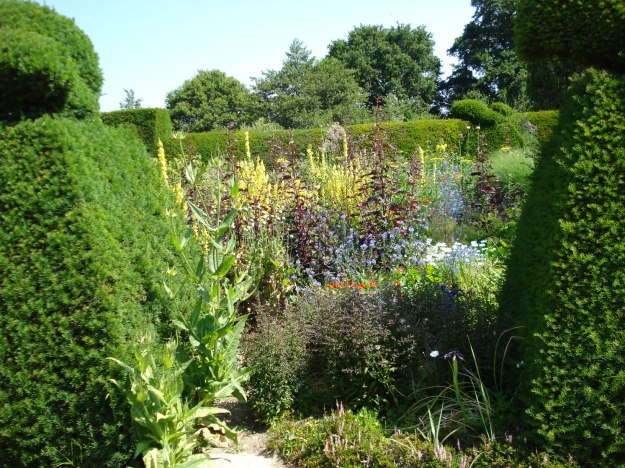
Must the defined spaces of garden rooms, seen here at Great Dixter, become mandatory in good New Zealand gardens?

I could not disagree more. Garden rooms are but one device, one way of achieving a desirable end point. The underpinning principle is surely that a good garden should never be revealed in its entirety at first glance. There should be surprises to be discovered, changes of mood and variations in light and shade. The design should entice you to explore further. Using different types of plants in different ways is not only practical in that you have varying growing conditions but it also punctuates the changes.

If you stand back and look at your garden and decide that it is rambling, then it is likely that you lack that sense of design and flow as well as changes of mood. If you have repeated the same plants (oft claimed as a device to give continuity but actually more often, simply dull), then you exacerbate the sense of rambling lack of form.

Just as there is more than one way to skin a cat (not that I have ever wanted to subject a poor moggy to that exercise), there are more ways to design a garden than depending on tightly defined and enclosed garden rooms. After all, a mark of a good garden is surely a degree of originality?

In the Garden: Friday December 31, 2010

• There is a rumour that now Christmas guests have mostly headed home, summer is going to return. There were hollow laughs of disbelief from our house guests when we talked about the drought, the earlier hot temperatures and the fact that we started swimming in late November. Personally, I lean to the theory that it was the disaffected surfers from down the coast conspiring to keep the best points of Taranaki secret, lest we be inundated by fans. At least the drought is over and our lawns are green again.

• All the rain means high humidity levels which encourages every nasty fungal spore to multiply. Keep a very close eye on your tomatoes, cucumbers, potatoes, courgettes and the like and take action immediately you spot blight. We don’t worry about mildew (seen as white powder) at this time of the year because the plants will generally grow out of it. You can get a certain distance taking off the affected leaves and stems but remove them entirely from the site. It is safer to put them out in the rubbish than to trust your compost, unless you know you make a hot mix. Cold composting doesn’t kill the fungal spores and you will merely be spreading it. Keep conditions as open as you can around the affected plants. A spray with copper is the recommended treatment for blight (follow the instructions on the container), and you can use baking soda for mildew if you wish (a teaspoon to a litre of water).

Clematis - pretty as a picture but junk those that are prone to mildew

Clematis - pretty as a picture but junk those that are prone to mildew

• Given that we usually have high levels of humidity in our area, we are leaning to the removal of some ornamental plants that consistently turn a silvery colour, indicating powdery mildew. Some clematis are far more vulnerable than others. We have given up persisting with ones that get affected every year and have dug them out in favour of varieties that show good resistance. The same goes for roses.

• Seed sown vegetables will probably need thinning in the veg garden. Most of these thinnings can be eaten as micro veg and they are delicious at the juvenile stage. If you don’t thin the rows, there won’t be sufficient space around individual plants to allow them to reach a decent size.

• Mark was amused to read a recent column in our local paper where the writer mentioned summer employment jobs in his youth. One was separating the Greenfeast peas from the Onward variety. Despite the fact that the writer’s university days were a long way back, these two varieties of peas remain Mark’s recommendations as the best to grow here. Over the years, he has tried many other varieties but now falls back on the tried and true. The bean crop here has not been up to its usual standard but the pea harvests have been abundant – far more than even I could ever eat raw from the garden. That said, it is the wrong season to plant peas now. Wait until early autumn to sow the next crop. Mildew will hit summer pea crops hard.

• Outdoor Classroom next week will be on the topic of summer care of apple trees, in case you are puzzled by what to do with yours.