Construct your own Christmas tree (version one)

1) Inspired by a tree she saw in London, presumably made with pampas plumes, Camilla fancied trying an alternative to the traditional pine branch or the tacky tinsel alternative. As pampas is now banned in this country, we used toetoe plumes. Gathering the toetoe was the most difficult part of construction, especially with all the recent rain.

2) We were fortunate to be given a permanent metal base in the shape of a pyramid but you could construct your own from bamboo or a similar material. It needs to be fairly stable to work with easily. You need five or six vertical struts in order to be able to achieve a circular effect. Do not make it too wide if it needs to fit through a conventional door to get it inside when finished.

3) We wove additional horizontal supports into the frame at 20cm intervals using flexible lengths of old grape vine prunings.

4) Starting from the base, tie groups of about three toetoe plumes at a time, forming the bottom layer of the skirt. It needs to be sufficiently dense not to see through. We tied firmly with neutal coloured wool, securing the plumes to the frame and the rings of grapevine.

5) Layer additional skirts on top. Trim the surplus stems of each layer. It took us four layers to reach the top.

Kevin, Sharon and our Christmas tree

Kevin, Sharon and our Christmas tree

6) When it came to decorations, we decided less was more and just adorned our tree with a Trade Aid angel, the historic Jury family Christmas lights which need rewiring each year to work and the red and silver Spotlight reindeer (known here as Kevin and Sharon) at the base.

Postscript
I recall the “Christmas is over in London” photo blog our daughter Camilla wrote as she wandered the streets of Maida Vale recording the slightly sad sight of Christmas trees put out for green waste collection. I found “Christmas is over in Tikorangi”. Mark said he would dispose of the carbon content of the toetoe Christmas tree. It looked disturbingly like a dead sheep when I came across it.

The second model DIY Christmas tree using the same frame but covered in grape vines is less inclined to moult and lacks the Pacifica charm of the toetoe, but is a more durable option.

In the Garden this week: Friday December 24, 2010

• Dear Santa, thank you for the pre-Christmas gift of rain. But enough is enough. Water tanks are overflowing, the grass is growing again and we really could do with a return to sunshine and warmer temperatures for the Christmas and New Year break.

• Watch for an explosion of fungal ailments in the humid conditions, especially on tomatoes, cucurbits and potatoes. Roses will also suffer but they can grow out of it whereas vegetables can succumb entirely. It will almost certainly be necessary to get a copper spray on when the weather dries out. If you would rather try baking soda, a level teaspoon per litre is the recommended dose. The big problem with baking soda is that you have to spray a great deal more frequently – probably weekly.

• The wet weather means that you can still lift and divide many clumping perennials even now. Most of them are in full growth, so as long as you make sure they don’t dry out, they will recover quickly. Replant into well cultivated, tilled soil enriched with compost.

• Grapes need thinning out. We keep to one bunch per side branch. More is not better and you can over crop grapes, leading to inferior fruit. Trim back laterals. If they get too heavy, they can break away too easily and you will lose your bunches of fruit. You also want the plant to concentrate its energy on the fruit, rather than the excessive leafy growth.

• If you have not mulched your garden beds and were alarmed at the recent dry spell, this week’s rain has probably raised the moisture levels sufficiently for you to get a layer of mulch on now. We much prefer vegetative mulches which break down and get incorporated into the soil over time – compost, leaf litter, bark or shredded wood waste and the like. Inert mulches like stones, gravel or lime chip do work to keep the soil moist and suppress weed seeds to some extent but they are not suitable for gardens that you want to dig over or replant at any time and they certainly do nothing to add nutrients or texture to the soils. They are best for areas you don’t actually garden and even then, they are a bit of a mission to keep clean unless you have a handy blower vac.

• Keep up with deadheading (basically anything that has finished flowering) and try and stay on top of the weeds which will have been triggered into rapid germination and growth by the rains.

• If you had a problem with silver leaves on rhododendrons last year and haven’t sprayed this spring, check underneath the leaves for something that looks like dirty threads. These are the thrips which suck the chlorophyll out of the leaves. Photinia and honeysuckle both harbour thrips too. If you are going to spray, it needs to be a systemic insecticide so the plant sucks it into its system (as opposed to a contact one which only kills insects where it touches). Bands soaked in neem oil secured around the trunk are getting good reports. If you want to make your own, soak a strip of old woollen carpet in neem and then secure it around the main stem with the carpet pile inwards. Thrips don’t usually go away of their own accord. You either need to change the growing conditions, kill the insects or remove the host plants altogether.

Plant Collector: Cornus kousa var. chinensis

Pink and white all over - Cornus kousa var. chinensis

Pink and white all over – Cornus kousa var. chinensis

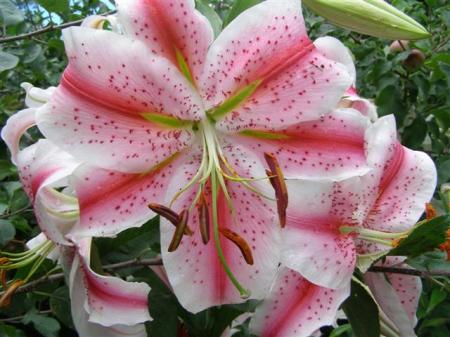
The cornus are a big family, commonly referred to as dogwoods. In our climate where we can grow most plants, cornus are not as widely featured as in other areas of the world because we are really too damp and too mild for most of them. They perform much better in a drier, continental climate with hot summers to ripen the wood, sharp seasonal change to trigger the autumn colours for which many are renowned and a good winter chill. Our C. kousa has had its hiccups in life (dieback threatened it a couple of years ago, possibly due to wet roots) but it battles on and in early summer the pink and white flowers are a seasonal delight, albeit a little brief. The welcome rain this week shortened its season.

Curiously, the flower is actually the dull, nubbly bit in the centre. What look like four pink and white petals are actually bracts – in other words specialised leaves which protect the flower buds, so not petals at all. This is common to all the dogwoods and to many other plants as well, including lacecap hydrangeas. Kousa is common in Japan and also found in Korea but Glyn Church tells me the form we grow in New Zealand is actually the one from central China, collected in 1907. After several decades, ours is a narrow, columnar tree about six metres high. When we were last in England, we saw many hybrids between C. kousa and C. nuttallii, some with spectacular, large flowers which were very showy indeed. Kousa shows resistance to anthracnose which has decimated the cornus display overseas and the new hybrids are, in part, an attempt to breed resistance to the disease.

Cornus kousa can age to deep pink

Cornus kousa can age to deep pink

Tikorangi Notes: Friday 17 December, 2010

Straight after the rains, the zephyranthes appeared this week

Straight after the rains, the zephyranthes appeared this week

LATEST POSTS: Friday 17 December, 2010

1) Cornus prefer a drier, continental style of climate to our mild, humid conditions but Cornus kousa var. chinensis flowers prettily at this time of year.

2) Water features can be more of a challenge than many gardeners appreciate when they decide to install one – Abbie’s column.

3) A week out from Christmas and we give our hints for garden tasks in this busy week.

TIKORANGI NOTES: Friday 17 December, 2010
While seven or eight weeks without rain may be nothing unusual for other parts of the world, here it has us in serious trouble so the 25ml that has fallen so far this week has been hugely welcome. Not enough, but it is at least a start. And that is all it took to bring the pretty copper and yellow zephyranthes into flower. These gently seed down beside our driveway and flower intermittently in the gravel for an extended period throughout summer.

The pitfalls and perils of garden water features

It may be a natural stream in our park but it is hardly an easy care water feature

It may be a natural stream in our park but it is hardly an easy care water feature

Water is an important inclusion in any garden, or so the common wisdom says. We laughed when Joe Swift on BBC Gardener’s World commented that he hated water features because they were rarely maintained. Water is difficult to manage well.

A natural stream might seem the best option for the lucky ones and on a fine day, the mountain brook that bounces its way through Ngamamaku Garden is indeed a source of envy for many of us. The trouble is that with our torrential downpours, natural streams can quickly become raging torrents which take out all your plantings. Tony has long since given up using treasures in his stream-side plantings. They disappear in the flood torrents. We have the upper reaches of the Waiau Stream running through our park and again, it is charming and a great asset. Because we control the flood waters by some simple but time honoured techniques (a weir and a flood channel), we don’t get the scouring but it takes constant management to prevent it all silting up and regular, heavy work to keep the water weeds under control – particularly oxygen weed and Cape Pond Weed.

Ponds – are ponds easier? Possibly the larger your pond, the more self maintaining it becomes though you generally need fish (commonly goldfish) to keep the mosquito larvae at bay. By definition here, a lake is sufficiently large to allow water skiing, or at least canoeing. If it is not of that dimension, it is a pond. Maybe a large pond, but a pond. By the time your pond has shrunk below about a metre square or round, it can’t really be called a pond any longer. A puddle, perhaps, or a basin? If you have a natural pond fed by a spring, it may stay fresher and relatively stable through the seasons. Home made ponds can be difficult. Firstly they are prone to developing leaks and that is a terminal condition unless you remedy the problem – which is never easy to do. Shallow ponds are problematic because the water heats up and that encourages algae growth. If it is too deep (somewhere about 40cm), you have to fence it. Basically a pond, by definition, is a static body of water which will therefore go stagnant. And homemade ponds are often lined in polythene which is really hard to manage so it is not visible in any way at any time – folds of polythene just look really tacky.

The formal pond that depends on pristine water quality shrieks out money. I have seen a couple and essentially they are the same as running a swimming pool – dependent on a full filtration system and frequent vacuuming. I have a few ethical issues with their sustainability and personally that swimming pool look does not strike me as aesthetically pleasing. It is all a bit too Beverley Hills. If you are going to have something that looks akin to a swimming pool, it may as well combine function with form and be a swimming pool. I also particularly dislike the hum of the pump as a background sound in the garden. To do it properly, you need a silent pump. The same goes for any water feature which relies on moving water to a part of your property where it does not naturally occur. Circulating the water does at least solve the problem of it becoming stagnant but it is a fraught activity, more often prone to lapses in taste and poor management. Fountains? A matter of taste. Repro classical fountains don’t do it for me. I have seen enough of the real thing in European gardens, which is where they belong – usually in the gardens of royalty or at least wealthy nobility. The increasing democratisation of the classic fountain hasn’t done much for its aesthetics. They are just a little “Look at me! Look at me!” in the average New Zealand garden. Leave them for Versailles.

The overseas fashion for rills or narrow canals has been slower to catch on here. I think the origins for these lie in Islamic gardens – the requirement to wash before frequent prayers. In recent years, English garden designers rediscovered them and you see the ribbon of lawn bisected with the water channel, often only 20cm wide. Hmmm. The words drainage channel and lacking in purpose spring to mind so we will say no more on the topic.

Mark has a mantra that design features in a garden need a logic to them, they need to make sense in the context. So creating a naturalistic waterfall cascading down from a dry hillside is a contradiction in itself. The fountain in the formal garden is not pretending to be natural – it is all about the imposition of human will and design on nature. The waterfall is trying to simulate a natural event so it needs to be as close to seamless as possible, not, as more often happens, a feature plonked in to “add interest” with little regard to logical context. Being able to hear the pump thrumming away as it circulates the water makes it even worse.

None of the above is to deny that it is possible to do water features well and when they are done well, they are a welcome addition to the garden, whether it be a reflecting pool, the sound of a babbling brook or cascading water, a formal design feature or a modest goldfish pond. The mistake is to think that they are mandatory and once in place, that they need no attention. And I own up to the fact that we have a formal goldfish pond which is severely afflicted by algal bloom at the moment.

The simplest type of water feature - in this case a stone millwheel with a bung in the base so it can be drained and refilled easily

The simplest type of water feature - in this case a stone millwheel with a bung in the base so it can be drained and refilled easily

A word on safety: we have all had it drummed in to us that children can drown in as little as 7.5cm of water, which means they can drown in a puddle, really. We were told by an inspector some years ago that the reason so many little ones drown in swimming pools is because they are attracted by the blue colour that is the norm and that once in, they instinctively try to reach the bottom to stand up. Vertical sides also make it near impossible to get out. These aspects do not generally apply to garden water features but if the safety aspects worry you, it may be better to dispense with the feature altogether rather than try and net it over.

If you absolutely must have water and your garden is small, a large container with some sort of plug or bung system to enable drainage is probably the most easy-care solution. You can then replace the water when the mosquito larvae start swimming around or it all turns green and yukky. If you plan anything more ambitious, think carefully before you start and be prepared to maintain it.

How ironical is it that one of the very best examples of gardening we have seen internationally is Beth Chatto’s dry garden in the UK? The dry, gravel garden at Hyde Hall nearby is also shaping up brilliantly. Mind you, both are in very arid, stony areas. Similar plants would rot out in our higher rainfall and humid conditions. But generally it is better to garden with the conditions and not to feel that one simply must introduce a water feature to counteract the dry areas.