Setting the standard for garden rooms – Sissinghurst
A newsletter from a gardening organisation arrived a few days before Christmas and I duly read it, coming across the following statement (warning: do not let your eyes glaze and brain disconnect before the end). “Outstanding gardens manage to respond to the genius loci using borrowed landscape, natural landform and native plants – often mixed with exotics – to create stunning indigenous compositions of form, line, texture and colour.”
Borrowing the jargon, shall we unpack that statement? Though I prefer to use the term decode because it is somewhat like a secret code.
Outstanding gardens manage to – that bit is fine.
… respond to the genius loci – had to get out the dictionary for this. Loci is, more or less, a place or locality. Google then helped me track down the term genius loci which apparently dates back to early Roman times and means the protective spirit of a place. Latterly the term seems to have been adopted by the landscape architecture fraternity although it might be easier to understand if they simply referred to the well known words of English poet and writer, Alexander Pope who took an interest in garden design. He put it rather more simply when he wrote in 1731 (a mere 280 years ago), “Consult the genius of the place…” which has come to be interpreted as the principle that design should always be relevant to the location and natural environment. This of course assumes that your particular location has some genius loci attached to it but it is a little hard to see how much genius loci you can lay claim to if your lot in life is a small, flat, urban section with a house, be it large or small, plonked fair and square in the middle. Some of us are blessed with quite a bit more genius loci than others.
… using borrowed landscape – that is the view of the neighbours’ properties, assuming you have neigbours with views worth borrowing.
… natural landform – silly me. I thought that was part of the genius loci.
… and native plants – I can’t quite work out whether this is using the already existing native plants in your own genius locus extending to your neighbours’ genius loci which would be a little limiting because it then tends to apply only to those whose patch is on the boundary of a national park, scenic reserve or at least a patch of native bush. Alternatively it may be that native plants are mandatory and pre-eminent in outstanding gardens. While advocating strongly for the use of native plants in tandem with exotics, I think this statement takes the position of native plants considerably further than is common in this country.
… – often mixed with exotics – yes, we are allowed to embellish with introduced plants (exotics are the vast majority of what we grow in this country. Even our lawn grasses are heavily dominated by exotics, as are all our fruit trees and vegetables). I don’t know what the word often is in there for because you would be hard pressed to find any environment in this country, be it natural or contrived, which does not have introduced plants in it. Even our national parks are invaded by weeds.
… to create stunning – stunning… hmm. There is a very emotive word. Quality can be measured and evaluated. Emotional response is a matter of individual opinion.
… stunning, indigenous compositions of form, line, texture and colour. I will let the compositions of form, line, texture and colour go, though I can think of clearer ways of defining good gardening as a combination of excellent design and skill with plants. But, indigenous compositions? Puh-lease. Indigenous – occurring naturally or native to the land. Gardening, by definition, is not indigenous. It is an imposition on the landscape, occasionally a natural landscape but more often a landscape already heavily altered by man.
So what I think the original statement says is: outstanding gardens make the most of their natural environment, using a variety of plants and really good design. At least, I hope that is what it says. There is no author named so I can’t check.
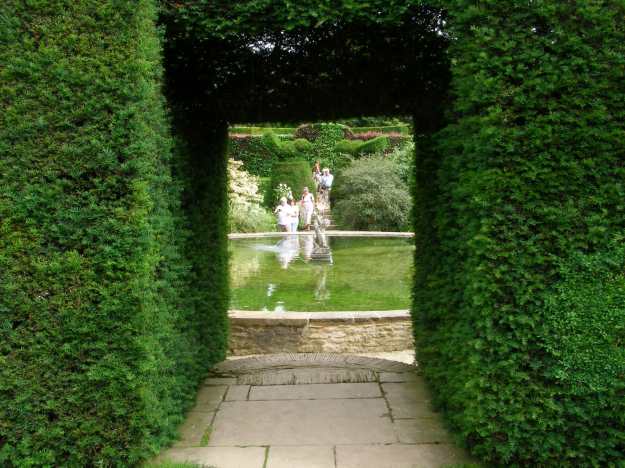
The classic garden door frame and passage at Hidcote – best in a garden with plenty of space, perhaps
Just a little further on in the same piece, there is the sweeping statement: “Gardens should be a series of outdoor rooms and should have walls, exits/ entries or passages between the rooms. Rooms should be well defined so the viewer is not distracted by what is going on in the next room although they might be tantalized at some point.”
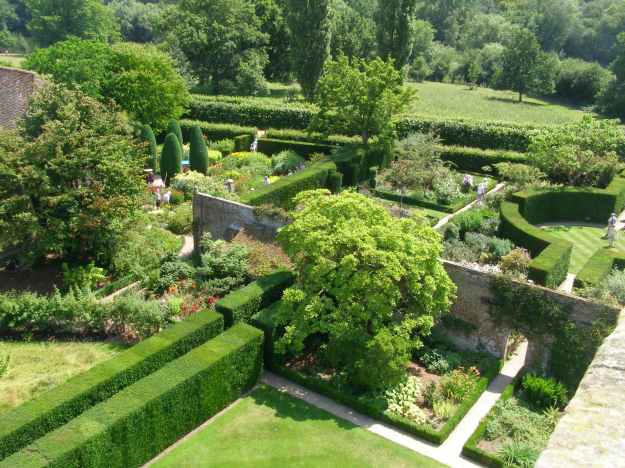
What happened to open plan living, I ask??? Are we to be forever locked in to that format of the early twentieth century evident in the great English gardens of Sissinghurst and Hidcote? Do not get me wrong. We were very impressed by Hidcote when we visited, but perish the thought that all New Zealand gardens must follow the formula if they want to be seen as very good gardens. There are other styles of garden design. A woodland garden will never be a series of rooms with tight structure. A flowing landscape garden in the manner of Capability Brown relies on open spaces, not rooms. Must a tiny town section redefine itself as an area of poky little rooms surrounded by high walls? All those walls blocking out distraction can be damned oppressive, not to mention expensive if done in permanent landscape materials like brick, plastered concrete block or stone. Or high maintenance if done in clipped tall hedging with the added problem that all those hedge plant roots reaching out into the flower borders. It is also very difficult to accommodate large trees in those rooms, let alone worrying about the place of the genius loci in such a heavily contrived design.
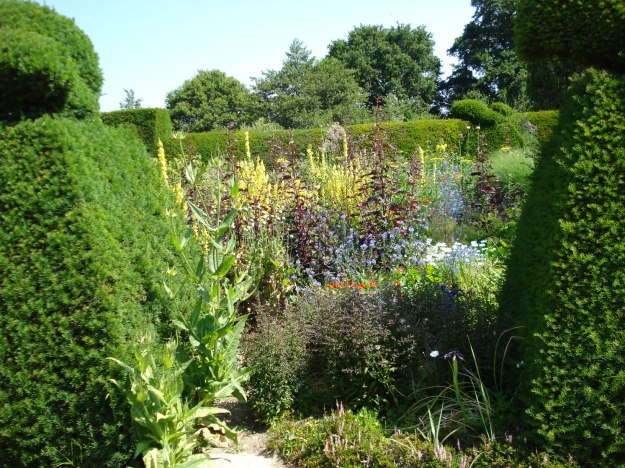
Must the defined spaces of garden rooms, seen here at Great Dixter, become mandatory in good New Zealand gardens?
I could not disagree more. Garden rooms are but one device, one way of achieving a desirable end point. The underpinning principle is surely that a good garden should never be revealed in its entirety at first glance. There should be surprises to be discovered, changes of mood and variations in light and shade. The design should entice you to explore further. Using different types of plants in different ways is not only practical in that you have varying growing conditions but it also punctuates the changes.
If you stand back and look at your garden and decide that it is rambling, then it is likely that you lack that sense of design and flow as well as changes of mood. If you have repeated the same plants (oft claimed as a device to give continuity but actually more often, simply dull), then you exacerbate the sense of rambling lack of form.
Just as there is more than one way to skin a cat (not that I have ever wanted to subject a poor moggy to that exercise), there are more ways to design a garden than depending on tightly defined and enclosed garden rooms. After all, a mark of a good garden is surely a degree of originality?