Tikorangi Notes: Friday, 19 November 2010

Latest posts: Friday November 19, 2010
1) The romantic Moorish gardens of Andalucian Spain and the likely debt to it shown in modern, western gardens – Abbie’s column.
2) Manfreda maculosa – an herbaceous plant with a singularly dramatic flower spike topped with a rather anticlimactic flower.
3) Tasks in the garden this week include getting swan plant seeds sown without delay.

Tikorangi Notes: Friday November 19, 2010

Looking more cottage garden than rockery this week

Looking more cottage garden than rockery this week

A particularly good verbascum for our conditions

A particularly good verbascum for our conditions

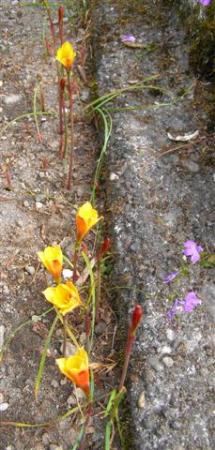
Drought is a relative matter. About three weeks without significant rain here and farmers are already fearing drought while gardeners are worrying about the dry. A light volcanic soil does not help because it dries out quickly but our rains are usually so predictable that we never have to water the garden. I have been pottering in the rockery, excavating a highly decorative but dangerously invasive equisetum (horse tail rush). A mere ten months or so and it was already making an escape for it, including between the rocks. Plants that burrow underground and pop up some distance away can be unnerving but the speed at which this equisetum was doing it indicated downright dangerous tendencies. Strictly one for a pot, I think, and even then it may be on borrowed time. The rockery is looking more like a cottage garden at this time of the year. Most of the spring bulbs have finished flowering but the splendid large flowered yellow verbascum (name unknown) gives some presence and height in November. One or two plants are left to set seed each year and it conveniently perpetuates itself.

The Moorish Gardens of Andalucian Spain

Moorish gardens of Southern Spain - the Alhambra &

Moorish gardens of Southern Spain - the Alhambra &

I didn’t really know what to expect of gardens in the south of Spain, although Glyn Church had told me that the Alhambra and Generalife in Granada was simply amazing. What really caught me unawares was the depth of history. Our country is still so much of the New World that gardens of a mere fifty or sixty years in age are often described as heritage or historic. Indeed I have heard people claiming that their garden is “mature” after about 15 years.

Traditional courtyard garden - this one in Toledo

Traditional courtyard garden - this one in Toledo

Andalucian gardens in the south of Spain had Roman ruins, overlaid with the Moorish exotica and wealth, reworked by the Christian kings – marching down the centuries, layer upon layer. It was the Moorish influence which was completely new to me and that, apparently, is unique to the area. The Moors were the Arabic Moslems who crossed the seas and controlled large tracts of southern Europe for many centuries before they were defeated and expelled in the late 1400s. The Spanish gardens are known for the use of small intimate spaces rather than the huge water gardens of Islamic Persia and India. Ah ha! The origin, I suspect, of garden rooms in the modern, western garden.

All the Moorish gardens are restorations. While the palaces survived, the gardens certainly didn’t though I guess a certain amount of archaeological evidence remained, along with sufficient pictorial record to enable a reasonable level of accuracy in reconstruction.

The exotic chorisia in the palace gardens at Seville

The exotic chorisia in the palace gardens at Seville

There has been no effort to maintain the original plantings and indeed these gardens don’t have a whole lot of plant interest. In Spain’s hot, dry climate (even in autumn, it was consistently 35 degrees), only a limited range of plants can be grown. There is a heavy emphasis on buxus, cypresses, citrus, roses, grandiflora magnolias and annuals for colour. The only plants to stop me in my tracks were a colourful bramble (which would likely be a noxious weed here) and the sight of chorisias in full flower in the palace gardens of Seville. Chorisias are South American (so a later introduction) and in flower rather look like trees full of exotic orchids. I have seen one flowering in Auckland though I don’t think our summers are hot enough to allow our plant at home to reach its potential.

The Moorish gardens were all about creating formal, but intimate spaces cooled by water and shade where the nobility could take refuge from the heat. So the emphasis is on structure and hard landscaping to give the form. In a climate where it is too harsh to grow lawn grasses, paths and terraces are usually paved, often with pleasingly subtle mosaics and interesting detail. What impressed me about these fine gardens were the gracious proportions and the flow from one area to another.

Shadows add another dimension in a country of unrelenting sunshine

Shadows add another dimension in a country of unrelenting sunshine

At the Alcazar de los Reyes Cristianos in Cordoba (that is the palace of the Christian monarchs), the majority of the gardens were much more recent but the Moorish flavour remains, just as it does in the breathtaking nearby mosque cum cathedral. In a climate where sunshine hours exceed 3000 per year, the purpose of using vertical accents (mostly cypresses) to create a picture in shadows made sense. I have seen the technique copied without much success. I think it worked in Cordoba because they have so much bright sun that the shadows are really deep and welcome, because there were wide avenues left open to frame the shadows and because even on a cloudy day, there was enough strength in the design for it to work without any shadows at all.

These gardens have nothing to do with the peasantry. It was all for the nobility, usually royalty with deep pockets. In such a dry climate, the use of water for aesthetic purposes is in itself a statement of power. Nowhere was this more evident than at the Alhambra and Generalife, an entire complex of palaces, forts, towers, gardens, water features and even a village, all enclosed by fortified walls. Now one of Spain’s premier attractions, gardens and palaces have undergone major restoration. Interestingly, the palaces were modelled on similar principles to the gardens. They were not huge and the rooms were comparatively intimate, user-friendly even. Small interior courtyards and gardens were a frequent inclusion, usually with a water feature – a small fountain or pool with rill. It was the open rooms and galleries that really took my fancy. These had open sides, defined by Moorish arches, and an overhead roof – presumably to keep the sun out but to encourage as much air movement as possible. What wouldn’t I give for a Moorish garden room? The Alhambra was set on a promontory with views across to the neighbouring medieval village (the Albaycin) and surrounding hills and both gardens and palaces made use of the device of framing views, of drawing the eye outwards from these intimate and delightful small enclosures.

Coping with unexpected rain - a French visitor improvises at the Alhambra

Coping with unexpected rain - a French visitor improvises at the Alhambra

It rained on the day we visited. While clearly a most unusual event (few of the visitors were prepared for rain), we felt grateful because it cooled the air temperature on what could have been an oppressively hot seven hour visit and it bestowed a misty romanticism on the vistas which took my breath away.

What can we learn from the Moorish gardens of Andalusia? First and foremost, the sheer folly of trying to emulate garden styles rooted in a completely different climate and time and on a scale we can only dream about. It is one thing to extract ideas such as the garden room and the creation of gardens as a series of intimate spaces – a technique which has had a profound influence on western gardening. It is quite another thing to try and transfer the whole genre to a modern, New Zealand setting where it is alien. Leave them in the south of Spain – Moorish arches are more likely to look naff and tacky set against a backdrop of our wooden or summit brick bungalows. Similarly, the transplanting of the idea of the rill or narrow canal to a different garden concept rarely works. These tended to have a practical role in Islamic life (washing before frequent prayers) and were part of the engineering feat of moving water around a site long before electric pumps.

Garden rooms and galleries to die for - this one at the Alhambra and Generalife

Garden rooms and galleries to die for - this one at the Alhambra and Generalife

To transpose the rill or narrow canal in isolation is to ignore the wider context. Turning your back on the lushness and range of plants we can grow here in favour of a few cliched varieties is boring. But we can learn from the old masters when it comes to understanding the importance of getting the proportions right – especially in formal gardens – of making sure that garden rooms are not claustrophobic but that they combine intimacy with an invitation to explore further, of being bold when it comes to allowing sufficient width for paths and avenues, and of valuing the quality of materials when it comes to hard landscaping. Above all, the Andalucian gardens combined form and function, underpinned by aesthetics and logic. That alone is a lesson worth learning.

Plant Collector: Manfreda maculosa

Manfreda maculosa - looking rather more dramatic in the photograph than in reality

Manfreda maculosa - looking rather more dramatic in the photograph than in reality

Manfreda maculosa is a very curious plant, not the least because it has a spectacular flower spike topped with singularly unspectacular flowers. The stem of the bloom can be well over 2 metres tall and is strong enough to hold itself up with staking. It appears in late spring as something of a surprise because the plant itself is low to the ground with just a few fleshy leaves spotted with burgundy. The first time it flowered for us, I waited in anticipation, expecting something showy and exotic. It is neither – browny green tubular flowers with exceptionally long brown stamens, giving a rather ragged appearance. Apparently it is renowned for attracting humming birds to your garden. What a shame we have no humming birds in this country.

This manfreda is also called the Texas tuberose or Spice Lily and it does indeed hail from southern Texas and Mexico so is somewhat tender. It tends to run below ground so when it gets hit hard in a cold winter, it is capable of sending up fresh shoots in spring. I have it planted in a mixed border situation and thin out the surplus runners from time to time. It just sits harmlessly as part of the herbaceous plantings until it gets a rush of blood and sticks out its outrageous flower spike.

In the Garden this week: November 19, 2010

• Get swan plants in without delay, especially if you are sowing seed. Ideally you want the plants to be growing strongly before the influx of summer monarchs appear, laying eggs which hatch into very hungry caterpillars. This may mean covering them at some stage or culling early eggs.
• In our climate, both potatoes and tomatoes generally need regular sprays with copper to keep blights at bay. If you don’t, you risk losing the plants. An application every few weeks is recommended, especially after rain. Warmth and humidity can lead to an explosion of fungal ailments.
• Do not delay on dealing to onehunga weed in lawns. This prickly weed can make life miserable for children in summer and if left unchecked, will spread alarmingly. The recommended treatment appears to be Prickle Weed Killer and I am told that if you spray now and again in February or March, you can pretty well eliminate the problem. This is not organic and we don’t know of any organic alternative, short of getting on your hands and knees and weeding the lawn.
• It is still fertilising time. With most plants in full growth, their ability to draw up the fertiliser and gain maximum benefit is at its peak. Cheap and cheerful fertilisers like our locally made Bioboost, blood and bone or nitrophoska blue are all that are needed for the garden, along with compost.
• Top priority for planting out in the vegetable garden are the crops that need a long growing season – the aubergines, melons, tomatoes, capsicums, chilli peppers, cucumbers, kumara and pumpkins.
• Keep planting salad vegetables for continued supply.
• Most of the root crops can be planted now – carrots, parsnips, potatoes, beetroot, yams and kumara.
• Plant leeks now if you want big ones to harvest next winter.

Plant Collector: Jovellana punctata

The little flower pouches of Jovellana punctata

The little flower pouches of Jovellana punctata

The jovellana has been flowering away cheerfully over recent weeks. This soft lilac one is a small shrub from Chile and fits very well into a whole range of garden situations. It only has small leaves which are in scale with its abundance of lilac pouched flowers with burgundy freckles and a yellow flare inside. The flowers are small – think finger nail proportions. When it has finished blooming, I will give it a pass over with the hedgeclippers to keep it reasonably dense and about 75cm in height. It can get a bit sprawling over time if not trimmed.

We had thought this was Jovellana violacea until very recently when a friend turned up with a plant of the true violacea and told me, in the nicest possible way, that in fact what we have is Jovellana punctata. Apparently it is a common error in New Zealand to refer to J. punctata as J. violacea but he had seen them both growing in the wild. The true violacea has a larger leaf, though of similar form, a smaller flower – though also similar – and the sample he brought was a deeper colour.

The jovellanas belong to the foxglove family and some of you may recognise their close relatives, the calceolarias. We have a native jovellana with white flowers – J. sinclairii – which gently blooms throughout summer. It has much bigger leaves and I would have described it as an herbaceous perennial (leafy, not woody) but I see it is technically described as a sub-shrub. Punctata is a shrub and is rated internationally as only half hardy at best but we have never seen it tickled up in winter at all. It is not difficult to root from cutting if you know somebody with a plant. The native sinclairii can generally be found layering along the ground so is easy to take a piece from.