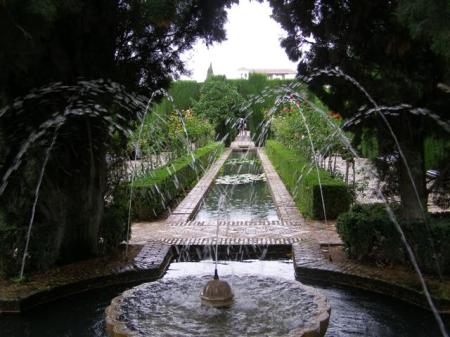
Rococo Gardening in Portugal

Just one of the eclectic collection of water features

Just one of the eclectic collection of water features

I had been warned not to expect too much of Portuguese gardens. That is despite Portugal having a much more equable gardening climate than neighbouring Spain. But there are only so many castles, palaces, cathedrals, ruins and medieval towns one can absorb and I am happiest in a garden. So when I reached Lisbon, I had already planned a couple of days of garden visiting. Sintra is a small town in the hills 30 minutes beyond Lisbon and it seemed the place to be with no fewer than three gardens of note in my guidebook to European gardens.

Alas the day did not go to plan. The light rain in Lisbon translated to very heavy rain and wind in Sintra. With the best will in the world, my sodden footwear, lack of raincoat and a small umbrella which was giving up the ghost and blowing inside out were simply not equal to the task. The water was teeming down the roads and visibility greatly reduced by mist. The gardens of Sintra were destined to remain a mystery though I could see why they were lusher and greener than other areas.

With intermittent showers the following day, I was not going to make the mistake of returning to Sintra but opted instead for the gardens at the Palacio de Queluz, a mere 15 minutes by train from Lisbon and hailed, in my guidebook, as “the best rococo gardens in Portugal – perhaps even in Europe”. I vaguely recalled Elton John’s garden in the UK being described as rococo and, had I thought about it, I may have conjured up a mental image of gilded cherubs and heavy decoration in the Baroque style. That doesn’t even hint at the extent if it, although there was no gilding.

Borrowing from all styles of history

Borrowing from all styles of history

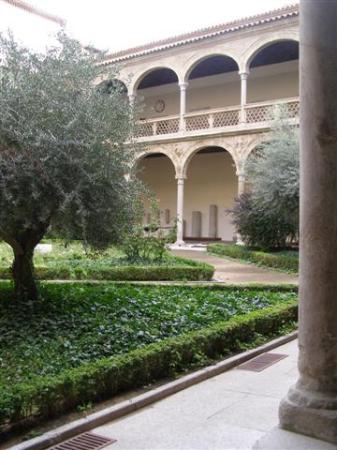
Up until my visit to Queluz, Britain’s Prince Regent, George, held the crown of naff in my books with his self-indulgent, OTT royal pavilion in Brighton. Restrained good taste is not synonymous with breeding and wealth. A penchant for flamboyance will triumph and the gardens at Queluz left the Royal Pavilion for dead. To be honest, the whole thing was a little down at heel but European countries have an abundance of historic places to maintain at vast expense, and I am guessing that the palace at Queluz may be rated as less important than other premier attractions in Portugal. The palace was pink. Yes, pink and palatial in proportions, though most of it was only double storey. The whole shebang dates back to the 1700s and the royal family of Portugal used it as a summer retreat, somewhat akin to Versailles in France. The exterior of the palace itself was heavily ornamented and the gardens, the work of a French jeweller of the time named Jean-Baptiste Robillon, were designed to spread out from the front of the palace.

This rococo garden was all about simplicity of form overlaid with elaborate ornamentation. So there were long avenues radiating out and formal gardens, all defined by clipped buxus and pencil cypresses. Form is everything and I was struck by the importance of allowing sufficient space for wide paths. In New Zealand where we specialise in large gardens, too few demonstrate the courage of allowing generous paths, wide enough for maybe six people to walk abreast comfortably. It gives a sense of space and grace in a larger area.

More about style than plants

More about style than plants

Plants were just soft furnishing in this garden. There was nothing of botanical note – some Magnolia grandiflora from America (introduced to Europe around the 1730s but I don’t think these were original plantings), agapanthus, lindens, planes and eucalyptus. Waist high buxus hedges were of clipped sempervirens, shoulder height ones looked to be Buxus wallichiana. Formal gardens were defined by buxus hedges but often the compartments merely held a citrus tree or were left empty. In one area, clipped buxus was planted in a series of serpentine waves. It is all about form and shape, not about plant interest.

Add in the ornamentation. At every turn possible. The more elaborate and detailed the better. Goodness only knows how many statues and water features, scalloped pools, round pools, a large rock waterfall (with no water running on the day I visited and stuck in the middle of long vista so it made no logical sense and merely looked contrived), tiling, balustrades, urns – the more the better. Stylistically, the ornamentation is borrowed from pretty much every period in history. The exuberance was overwhelming.

A hint of mausoleum style in the canal garden

A hint of mausoleum style in the canal garden

Gild the lily further

Gild the lily further

The piece de resistance were the tiled canals at the end of the garden. A natural stream had been channelled through paved canals, designed with locks so that the water could be held back to raise the level, apparently to hold barges filled with musicians to entertain the royal family and their guests. Pity the poor peasants downstream whose water could be withheld at the royal whim and then possibly released in a wild woosh.
The canals were lined inside and out with glazed tiles predominantly in blue and white (though sometimes in yellow, blue and white), depicting murals of shipping scenes, courtly matters and still life representations. These have withstood the ravages of time over several hundred years and are still in good condition and quite bright. Apparently the Portuguese, like the Spanish, are happy to gild the lily even further- in a heavily decorated scene, add some more detail – so colourful urns adorn the plinths, statues stand guard and steps are constructed and tiled in a manner reminiscent of a mausoleum. The effect was quite astounding.

This is not a style of gardening that is intended to sit easily in the landscape with boundaries between garden and nature blurring, in the style of the English romantic tradition. Nor does it have anything to do with the Japanese gardening traditions of symbolism, restraint and control. It is a long way from the Moorish traditions next door in the south of Spain which are all about restfulness, shade, cool and controlled use of spaces. This is more akin to the historic version of Kath and Kim: “Look at me! Look at me!” It is an ostentatious show of wealth with a certain frivolity within its extravagance and flamboyance. Decoration and ornamentation are the dominant features. I am not surprised if indeed Elton John has the late twentieth century version of a rococo garden.

As a final thought, when our children were little, Para Rubber used to sell a blue, scalloped shell-like plastic affair for use a paddling pool. Possibly they are still around. I hadn’t realised that these had their derivation in the rococo style, along with the hinged clam-shell style of sandpit.

Plant Collector – Syringia palibiniana

Syringia palibiniana - Korean lilac

Syringia palibiniana - Korean lilac

We are not the world’s greatest territory for growing lilacs, those wonderfully fragrant cones of lilac blooms in spring, which is why you don’t see them around this area a great deal. They favour a more continental climate with cold winters and, preferably, hot summers, heavy soil and more alkaline conditions. Taranaki with its friable, volcanic soils and very mild climate is at the opposite end of the scale. But this dwarf Korean lilac is wonderfully adaptable to our conditions. It doesn’t have as strong a scent as the common lilac (Syringia vulgaris), but it is sweetly perfumed and makes a compact little shrub to about 100cm x 100cm. Like all lilacs, it is deciduous and when its little leaves appear, they are completely in scale to the dainty flowers and the small habit of growth. It is one of those handy little shrubs that you can fit in anywhere in the garden which gets reasonable sun and it will delight you at this time each year as it opens its many panicles of little lavender flowers.

In the Garden: October 22, 2010

· While Labour Weekend is the traditional time to get the The Great Summer Veg Plant Out done, the lingering cool temperatures, wind and rain have mitigated against it this year. The soils have not had much of a chance to warm up yet. Don’t rush it especially if you are in a cooler, inland area. A week or two is neither here nor there.

· Priority for planting out when conditions are suitable are the crops which require a long growing season which include aubergines, capsicums, cucumbers, both rock and water melons, kumara, tomatoes and corn. If you have starter plants of these in small pots under cover, be careful about planting them straight out in the open in either blazing sun (unlikely) or torrential ran. You may need to give them some protection while they get established. Cut off soft drink bottles can work as can plastic bags held up by sticks if you don’t have a cloche. A single sheet of newspaper will protect them from the bright sun. You can avoid this by hardening them off gradually over several days by exposing them to a few hours of direct sun only.

· If you are not planting out the little plants yet, make sure that they don’t get set back by being held in pots that are too small or by forgetting to water them. They rarely recover well from such set-backs.

· Clematis are rocketing away and most need something to climb up. If you leave them any longer, you will cause a lot of damage trying to get them to grow in the right direction. A bamboo tepee is a quick and easy solution.

Greeblies in the cordyline

Greeblies in the cordyline

· The caterpillars that chew holes in our native cordylines (cabbage trees) are at their most active. These are the progeny of a native moth (which is why NZ cordylines overseas look so clean and smart). On small plants, running your hands up the base of the tufts of leaves can effect a good kill. On larger plants, if you want clean foliage, you will have to spray with an insecticide. If you look, you may be surprised at what other greeblies your cordyline is hiding, including slugs and snails.

· Esteemed colleague, George Fuller, tells us that it is not a rust that causes orange blotching on renga renga lilies (arthropodium) but in fact a nematode (or wire worm). These critters can build up in a patch over time so if it worries you, it may be necessary to resort to using a systemic insecticide. A systemic insecticide is one that the plant absorbs as opposed to contact insecticides which only kill with a direct hit. The nematode is actually in the plant and it is the same one that attacks chrysanthemums and black currants, answering to the name of afelenchoides ritzemabosi.

· As evergreen azaleas finish flowering, it is time to trim them. These are a forgiving plant which means you can trim back to bare wood and they will shoot again but do not delay if you plan on cutting hard because you want the plant to be flushing with spring growth to help its recovery.

· It is safe to plant both green beans and runner beans now. These are very worthwhile crops for the home gardener, giving good yields and planting successional crops of green beans two weeks apart will extend the harvest season.

Countdown to Festival, October 22, 2010

* It is just one week out from Festival this year and John and Phyllis Malcolm at Lockinge Garden near Kapuni have three young black swans in residence on their lake. The wet winter has certainly suited the hostas and Big Daddy, planted around the lake, is looking particularly splendid. Phyllis says that the irises and Rhododendron Lemon Lodge are looking spot on for flowering right on cue and she is really pleased with how the honesty and aquilegias are naturalising and filling in the spaces under their mature trees.

* Nearer Opunake, Sheryl and Geoff Campbell on Patiki Road are nearly through the last round of preparation (most of us work our way right round our gardens more than once in ever increasing detail as we prepare). The roses put on tremendous new growth in the few sunny days we have had, the clematis are coming into flower and the white wisteria is promising to be spectacular next week.

* Moving around towards Warea, Maria van der Poel is looking forward to her second year of opening. She has been like a big kid playing with a new toy in her recently erected hot house and, with assistance from a friend, has plenty of plants potted up for sale to garden visitors. The wood pigeons have returned to her garden for spring time and the roses have responded to some special TLC and are rocketing away despite recent coastal winds buffeting them around. Maria has her fingers crossed for good weather and a great festival for all her fellow garden openers.

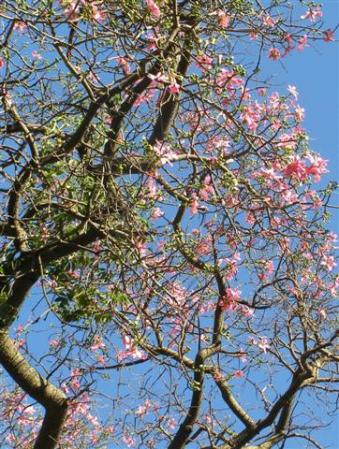
* Inland from Stratford, Lorri and Bruce Ellis have one of the largest private gardens in the Festival and Lorri plans her preparation from six months out. Even so, she wryly notes, she has a tendency to underestimate the vagaries of the spring weather. The recent winds have hurled branches all round the place and the horrendous September rains (324ml of the stuff at their place) saw her and Bruce wading through sticky mud and papa up to the tops of their gumboots as they worked to complete the new trail through their dell. On the bright side, she is enjoying the blues in her garden – a sea of bluebells complemented by a bank of purple ajuga which is alive with busy bumblebees, the mauve pawlonia and the purple sparaxias completing the picture.

* Down the road, more or less, and around a few corners at Gordon Dale Gardens near Toko,
Jan Worthington agrees that timing is all important in the lead-up to Festival. Did she prune the standard photinias at the right time so that they will be glowing red balls at the start of November? Will there be any roses in flower, given the cold spring? How quickly will the vegetables grow so that they look strong, healthy and nearly ready for harvest? Will the bare patches in the garden be filled out with the annuals and perennials over the next week? A few days of sun and warmer weather will make Jan breathe more easily.

* Near Hawera, at Puketarata, Jennifer Horner is irritated by the rabbits nibbling at the new growth on her pinks and tiarellas. Other than that, she is hoping that winds will not return after the mess left last week. They are busy enough with the final round of weeding and tidying and can do without the extra work.

* The unusually wet spring is a recurring theme and Vance Hooper at Magnolia Grove says that at least they have seen the worst case scenario for springs and groundwater on their property after five years of living there. It is so bad in one area that he and Kathryn have decided that best solution will be develop some permanent ponds there in the near future (after Festival, no doubt). However, even the few days of fine weather recently has made a big difference, getting the roses and perennials moving into growth. The pink floribunda wisteria is promising its best display yet.

* It is many years since Josephine and Quinton Reeves at Wintringham in New Plymouth have opened for Festival and they are making a welcome return this year. Josephine says that their blue clematis are rocketing into flower but her Cornus controversa variegata is threatening to become The Wedding Cake Tree of Pisa as it has developed a significant lean in a quest to get away from the domineering influence of the adjacent 80 year old golden elm. It is not the pesky mynah birds that are visiting their ponga trees (as mentioned recently at Te Kainga Marire) but visiting doves who come to sojourn daily and carry out their courting rituals. More decorative, at least, than the mynahs.

* Festival newcomers, Alan and Cath Morris at Pukemara (also in New Plymouth) have been feeling tested by the wind and rain but are well on top of the final preparation work. They are hoping for more sunshine and warmth to hurry along the flower buds on the vireya rhododendrons, but the roses are opening their first buds and the hostas are rocketing away and filling the spaces. They are really looking forward to opening day next Friday.

Tikorangi Notes: Friday October 15, 2010

Latest posts:
1) Hippeastrum aulicum is flowering in abundance in our woodland gardens.
2) Garden tasks for the upcoming week as we hurtle along in spring.
3) Choosing a wheelbarrow – the latest in Abbie’s Outdoor Classroom series.
4) Two weeks until our annual Taranaki Rhododendron and Garden Festival – the pressure is on as we count down.
5) Tried and True – ligularia reniformis (widely referred to as the tractor-seat ligularia).
6) A hot, dry autumn in Spain and Portugal – the first of Abbie’s columns on her recent jaunt to those countries.


Rhododendron polyandrum - big and very fragrant

Rhododendron polyandrum - big and very fragrant


Tikorangi notes
: October 15, 2010
I went away for three weeks and came home to find that I had entirely missed the erythronium flowering for the year, the magnolias are all but over, the michelias are past their peak, but the pleione orchids and rhododendrons are looking great. This is R.polyandrum, one of our favourite species. The fragrance is divine and it is one of the breeder parents of a whole range of cultivars bred by both Felix Jury and Mark, bringing healthy characteristics, flower size and its delicious scent. This is one of those plants where the scent can hang heavy in the air metres away from a large specimen. Others might think it can be a bit open, leggy even, but we don’t mind that because it has splendid peeling bark and we like the open habit rather than a heavy, dense shrub which sits solid on the ground.