
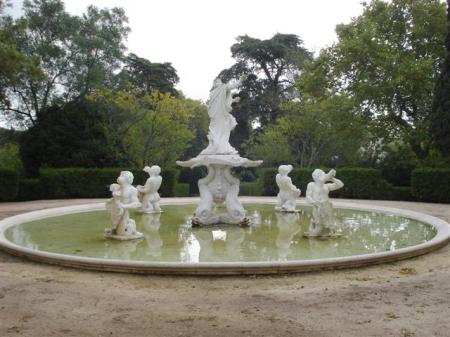
Just one of the eclectic collection of water features
I had been warned not to expect too much of Portuguese gardens. That is despite Portugal having a much more equable gardening climate than neighbouring Spain. But there are only so many castles, palaces, cathedrals, ruins and medieval towns one can absorb and I am happiest in a garden. So when I reached Lisbon, I had already planned a couple of days of garden visiting. Sintra is a small town in the hills 30 minutes beyond Lisbon and it seemed the place to be with no fewer than three gardens of note in my guidebook to European gardens.
Alas the day did not go to plan. The light rain in Lisbon translated to very heavy rain and wind in Sintra. With the best will in the world, my sodden footwear, lack of raincoat and a small umbrella which was giving up the ghost and blowing inside out were simply not equal to the task. The water was teeming down the roads and visibility greatly reduced by mist. The gardens of Sintra were destined to remain a mystery though I could see why they were lusher and greener than other areas.
With intermittent showers the following day, I was not going to make the mistake of returning to Sintra but opted instead for the gardens at the Palacio de Queluz, a mere 15 minutes by train from Lisbon and hailed, in my guidebook, as “the best rococo gardens in Portugal – perhaps even in Europe”. I vaguely recalled Elton John’s garden in the UK being described as rococo and, had I thought about it, I may have conjured up a mental image of gilded cherubs and heavy decoration in the Baroque style. That doesn’t even hint at the extent if it, although there was no gilding.
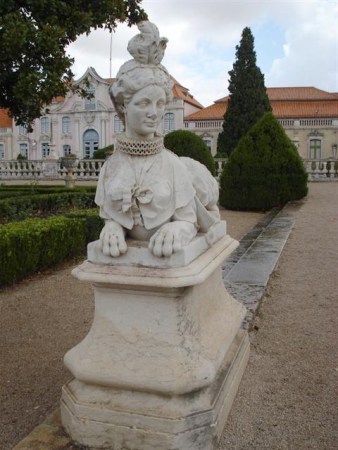
Borrowing from all styles of history
Up until my visit to Queluz, Britain’s Prince Regent, George, held the crown of naff in my books with his self-indulgent, OTT royal pavilion in Brighton. Restrained good taste is not synonymous with breeding and wealth. A penchant for flamboyance will triumph and the gardens at Queluz left the Royal Pavilion for dead. To be honest, the whole thing was a little down at heel but European countries have an abundance of historic places to maintain at vast expense, and I am guessing that the palace at Queluz may be rated as less important than other premier attractions in Portugal. The palace was pink. Yes, pink and palatial in proportions, though most of it was only double storey. The whole shebang dates back to the 1700s and the royal family of Portugal used it as a summer retreat, somewhat akin to Versailles in France. The exterior of the palace itself was heavily ornamented and the gardens, the work of a French jeweller of the time named Jean-Baptiste Robillon, were designed to spread out from the front of the palace.
This rococo garden was all about simplicity of form overlaid with elaborate ornamentation. So there were long avenues radiating out and formal gardens, all defined by clipped buxus and pencil cypresses. Form is everything and I was struck by the importance of allowing sufficient space for wide paths. In New Zealand where we specialise in large gardens, too few demonstrate the courage of allowing generous paths, wide enough for maybe six people to walk abreast comfortably. It gives a sense of space and grace in a larger area.
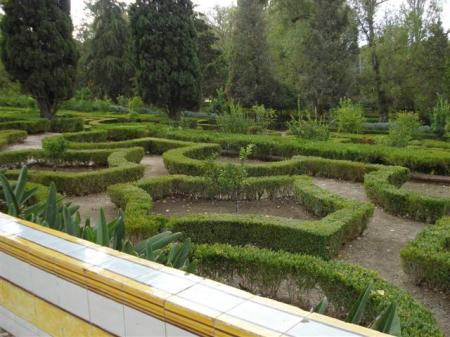
More about style than plants
Plants were just soft furnishing in this garden. There was nothing of botanical note – some Magnolia grandiflora from America (introduced to Europe around the 1730s but I don’t think these were original plantings), agapanthus, lindens, planes and eucalyptus. Waist high buxus hedges were of clipped sempervirens, shoulder height ones looked to be Buxus wallichiana. Formal gardens were defined by buxus hedges but often the compartments merely held a citrus tree or were left empty. In one area, clipped buxus was planted in a series of serpentine waves. It is all about form and shape, not about plant interest.
Add in the ornamentation. At every turn possible. The more elaborate and detailed the better. Goodness only knows how many statues and water features, scalloped pools, round pools, a large rock waterfall (with no water running on the day I visited and stuck in the middle of long vista so it made no logical sense and merely looked contrived), tiling, balustrades, urns – the more the better. Stylistically, the ornamentation is borrowed from pretty much every period in history. The exuberance was overwhelming.
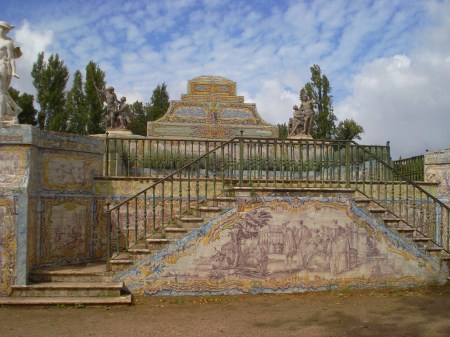
A hint of mausoleum style in the canal garden
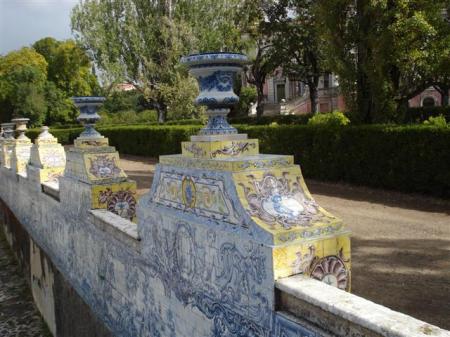
Gild the lily further
The piece de resistance were the tiled canals at the end of the garden. A natural stream had been channelled through paved canals, designed with locks so that the water could be held back to raise the level, apparently to hold barges filled with musicians to entertain the royal family and their guests. Pity the poor peasants downstream whose water could be withheld at the royal whim and then possibly released in a wild woosh.
The canals were lined inside and out with glazed tiles predominantly in blue and white (though sometimes in yellow, blue and white), depicting murals of shipping scenes, courtly matters and still life representations. These have withstood the ravages of time over several hundred years and are still in good condition and quite bright. Apparently the Portuguese, like the Spanish, are happy to gild the lily even further- in a heavily decorated scene, add some more detail – so colourful urns adorn the plinths, statues stand guard and steps are constructed and tiled in a manner reminiscent of a mausoleum. The effect was quite astounding.
This is not a style of gardening that is intended to sit easily in the landscape with boundaries between garden and nature blurring, in the style of the English romantic tradition. Nor does it have anything to do with the Japanese gardening traditions of symbolism, restraint and control. It is a long way from the Moorish traditions next door in the south of Spain which are all about restfulness, shade, cool and controlled use of spaces. This is more akin to the historic version of Kath and Kim: “Look at me! Look at me!” It is an ostentatious show of wealth with a certain frivolity within its extravagance and flamboyance. Decoration and ornamentation are the dominant features. I am not surprised if indeed Elton John has the late twentieth century version of a rococo garden.
As a final thought, when our children were little, Para Rubber used to sell a blue, scalloped shell-like plastic affair for use a paddling pool. Possibly they are still around. I hadn’t realised that these had their derivation in the rococo style, along with the hinged clam-shell style of sandpit.
 Tikorangi The Jury Garden