
Taxus baccata fastigiata - no longer fastigiate in our rockery
A little piece on yew trees in our local newspaper garden pages started us talking about them. They are a most interesting plant. It is just a shame they are not generally happy in Taranaki conditions and there are reasons why they have never featured large in New Zealand gardens and plantings.
We have one feature yew tree still surviving here, a venerable specimen of what is probably widely known as the Irish Yew – Taxus baccata fastigiata. At some point it keeled over at an angle and decided to stay there so we clip it tightly once a year and it resembles a kiwi body (minus any head) as a feature in our rockery. I say venerable, but that is venerable by New Zealand standards – as in probably 60 years old – not venerable by British and European standards where yew trees can survive for a very long time. Many hundreds of years is common and the oldest known tree at Fortingall in Scotland is thought to be somewhere between two and five thousand years old. Astonishing. We used to have many other yew trees here. Mark’s parents were as heavily influenced by English gardening traditions as others of their era and yews are an integral part of that. But over the years, many have, as we say, whiffed off which is our way of describing plants that die from root problems. If you look at where yew trees thrive, it is generally in colder, drier climates and their natural habitats in Britain are on chalk soils. We occupy the cheese side of the chalk and cheese equation – nothing even remotely resembling chalk soils here, thank goodness. We would not try planting more yews here – there are other plants we can grow better in our conditions.
Added to that, another reason why yew trees have never been a big hit in New Zealand is that we still have very strong rural roots and yews are deadly to stock. We know. The remains of our golden yew killed four of our beefies when they got into the paddock with the fire heap in it. This is not at all a suitable tree for country folk to plant here.
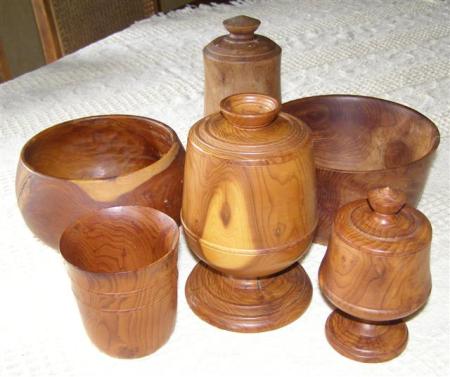
Mark's little collection of treen turned from yew
The fact we can’t grow them well does not stop them from being an interesting plant. They are pretty sacrosanct these days in Britain but if you ever come across anyone cutting down an old yew, get down on the timber. Mark pretty much destroyed a chainsaw cutting into one many years ago (it wasn’t the yew that was the problem – it was the metal stake that somebody had driven in to support the plant and left there to be hidden as the tree grew). But when he came to turn the timber on his lathe it was not only one of the very best woods he ever used – he described it as being like turning hard butter – it also had one of the richest and most varied grains and markings you will ever see. We still have an assortment of treen turned from that one tree. Unusually for timber, the pale sap wood is also durable.
While there are other yew species from Japan, Canada, China and North America, it is the European form of baccata, also known as the English yew, that is the most widely used. It belongs to the family of conifers and its leaves are needle-like. These days it is highly rated in its homelands as a garden plant for specimen, hedging or clipping because it grows slowly, doesn’t ever get too large, it sprouts from bare wood and so lends itself to long-lived topiary and formal hedges where its fine, dark green appearance acts as a splendid punctuation mark in the garden. It is one of the main topiary candidates in English gardens. It is most commonly found with a spreading habit, not upright. In fact the vertical yews which make such splendid pillar shapes, are a far more recent addition dating back just two hundred years to a mere two trees selected in Ireland. No doubt other forms have been discovered since, but the so-called Irish Yew is identified as fastigiata (fastigiate just means tall and narrow) and is traced to those two specimens.
In its natural state, the yew is dark green but it can sport to a yellow variegation and in a country with a long winter, British gardeners continue to value yellow foliaged plants for a spot of colour whereas we tend to shun them in this country. Our most recent yew to kick the bucket (and not greatly mourned) was a specimen of the Golden Irish Yew. I don’t care if yew trees are all class, I still don’t go for yellow variegated conifers.
It may be as garden plants that the yew family are valued nowadays but that was not always the case. They have a history steeped in warfare. For it was the development of the longbow that made Britain a military force and yew wood made the best longbows. As far back as the thirteenth century, England was importing yew wood from Europe and the local supplies were under huge pressure. Within a hundred years there was a serious shortage and in 1350, Henry 1V basically nationalised all the yew trees in Britain so they could be harvested to meet the needs of the royal bowmen. Not only that, but trade with Europe was dominated by the supply of yew timber and within the next couple of hundred years, Bavaria and Austria were stripped of all their native yews to supply bows for the King of England’s archers. The move to firearms at the end of the sixteenth century had more to do with a lack of adequate supplies of yew wood left anywhere in Europe, rather than technological advances. Given the warmongering tendencies of the Middle Ages, it is a bit of a miracle that any yew trees survived in the wild anywhere in Britain and Europe.
Many, if not most of Britain’s significant yew trees survive in churchyards and there are many theories abounding as to why they are such a common tree there. It may just be that a respect for the church meant these specimens could not be plundered for the making of longbows.
There was considerable angst amongst conservationists and historians when researchers first found that Taxus baccata had natural compounds which could be used in the manufacture of a new drug to treat cancer. It seemed that the future of the remaining yews could be under threat because it takes a vast amount of raw material to yield a small amount of the compound. The loyal British gardeners rose to the occasion. When the call went out for them to gather up their yew clippings to contribute to research, apparently they did so in droves. It was sufficient to progress the research to the point where the compound could be manufactured synthetically in a laboratory.
The future of the yew tree seems secure.
-39.042098
174.300314


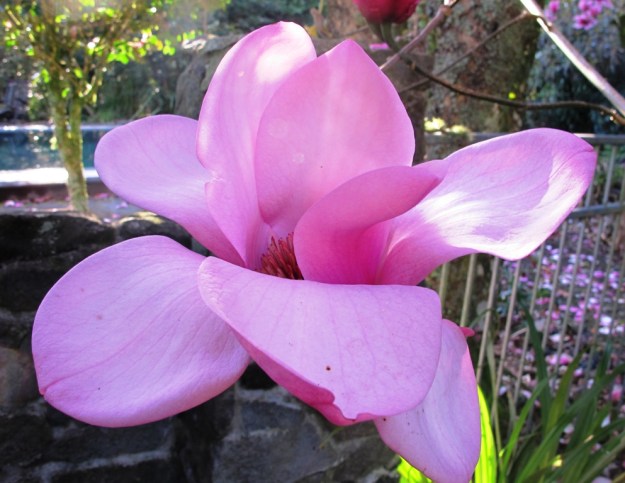 Being so late to flower, Serene is an excellent choice for people in colder areas or prone to late frosts. It also tends to miss the worst of the equinoctial winds. Cold conditions will make the plant adjust to blooming even later but Serene does get its flowers through before its foliage. We are picky here – we want deciduous magnolias to mass flower on bare stems before the new season’s leaves unfurl. When the leaves do come, they are a particularly good deep green and tidy in form so Serene stands out as a good summer foliage plant in a way in which few deciduous magnolias do. It will also set a flush of summer flowers which is bonus territory.
 Tikorangi The Jury Garden