
- Cut the spent flowers off your hellebores to stop the likely infestation of aphids, which find them a pleasant home, and to prevent them self seeding.
- You still have time to start your own summer veg from seed but don’t delay with tomatoes, cucumbers, melons, aubergines, capsicums and the like. These are all started off sown in trays or pots for planting out in the garden later next month. If you only want one or two plants, it is probably just as cheap to buy the plants as packets of seed but sowing seed gives you the chance to be generous and share plants with friends and family.
- Mark will be starting his corn in baby pots here. It is too early to plant out in the open yet but this being his most favourite vegetable of all, he likes to maximize the season and to get an early start with established plants.
- Cloches come into their own at this time of the year. They will warm the soil more quickly, so allowing earlier planting out. They will also protect young crops and keep rain splash off micro greens.
- In the ornamental garden, dahlias can be lifted and divided.
- Feed roses if you have yet to do so. They are in full growth now so will have maximum uptake of fertiliser. If you are laying mulch around your roses, keep it well clear of the rose crown near the ground.
- Kumara can be chitted, like potatoes. Place them on damp sawdust, straw or even crumpled newspaper in a warm, dark spot to encourage them to start sprouting. Kumara are another crop that needs maximum growing time, so the timing of planting out is important.
- Get a copper spray onto deciduous fruit trees as they break dormancy. This is a key application to prevent problems later and is the single most important spray of the season.
Plant Collector: Edgeworthia gardneri
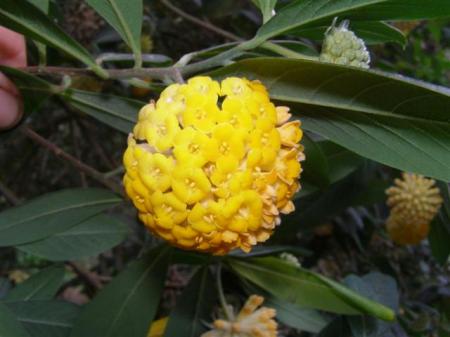
The scented golden orb of Edgeworthia gardneri
This plant has a very curious flower head – fully rounded golden pompoms of tightly packed, almost waxy flowers. Sweetly scented too, which is not surprising because it is a close relative of the daphnes, but because it does not mass flower, it lacks the fragrant oomph of its cousins. Each flower head is only about 3cm across, not much larger than an old fashioned gobstopper. Gardneri is still newly introduced to the west – it comes from Nepal – not easy to propagate from cutting and rare. I tell you this because several years ago we did manage to get some plants successfully growing and offered them on the mailorder list we used to put out. At the same time a gardening magazine showed a photograph of the flower but gave no idea of the size. Somebody in Palmerston North tracked us down and ordered the plant. We shipped her down a splendid specimen but she was not happy. She was expecting a flower more akin, I suspect, to the size of a cricket ball rather than a pingpong ball. She sent back this rare and choice shrub. It cost her more in freight than the plant was worth, but clearly it was a matter of principle because she felt short-changed by the size of the flower.
There are only two, maybe three, species of edgeworthia. The more common Chinese form, papyrifera or chyrsantha, is deciduous but gardneri is fully evergreen and makes an open, airy bush with a graceful appeal. It is not particularly hardy and won’t thrive in areas with cold winters. It has good nectar for the tuis and we are planning to add another plant in full sun to feed our butterflies.
In the garden this week: September 17, 2010
- Give top priority to getting woody trees and shrubs planted which includes fruit trees. The soils are warming up and you want these plants to get established and make fresh root growth before summer. As a general rule, fruit trees do best in full sun.
- It is time to wage war on wandering jew (tradescantia) and onion weed. These are not easy weeds to eliminate. If you are hand pulling them, don’t pile them in a heap and hope they will rot down – they will merely grow. You need to kill them, usually best done with heat – black rubbish sacks on concrete under a hot sun will work but does take effort. If you are willing to spray, Shortcut or Amitrol appear to be best options for home gardeners but you also need to add a surfactant to make the spray stick. Grazon or Tordon Gold will work if you are a farmer with these in the cupboard. Glyphosate won’t work at all. With wandering jew, if you roll up the top layer (and dispose of it elsewhere because every piece will grow again if it gets the chance), you will get a better kill with spray because you are killing the layers closest to the ground. Be prepared to spray on repeated occasions for eradication.
- Don’t rush to plant tender summer crops such as tomatoes, cucumbers, aubergines or melons in the garden yet. You won’t gain anything and it really is still too cold. You can, however, be giving them a head start in containers in a sheltered position such as a porch or a glasshouse. If you have been tempted to buy baby plants from the garden centre, pot them on to a larger pot and cosset them until the great Labour Weekend plant out. It is really important that small plants not be checked in their growth by poor conditions (too dry, too cold, too wet or root bound in pots which are too small for them). They rarely recover from early encounters with adverse conditions.
- Pinch off the first flowers on your freshly planted strawberries. This allows the plant to get larger and stronger and produce more fruit in the long run. It takes a lot of energy for a plant to produce fruit and you don’t want to exhaust the poor wee juvenile plants. You can still plant strawberries but don’t delay if you want fruit for Christmas. I see the handy advice is to put in five plants per family member. If you have a large family and you are buying plants, it would be cheaper to wait until next year and to plant runners much earlier in the season.
- Keep the fertilising round going this month. Cheap and cheerful fertilisers are fine for the garden – keep the expensive, slow release fertilisers for container plants. Compost will also nourish and has the advantage of improving the texture and health of the soils. We recommend laying the compost on top as a mulch to suppress weeds. Nature and the worms will do the rest to mix it in with the dirt below.
Countdown to Festival: September 17, 2010
- Southwards in Hawera at Puketarata, Jennifer Horner has been looking on the positive side and enjoying those spring days which have been lovely (as opposed to sodden). While the early daffodils and Magnolia Vulcan are looking a little weather beaten, (though Jen says Vulcan has been spectacular this year), Rhododendron Bibiani is in full flower and has escaped damage and the pretty Prunus Awanuis are just opening. The lawns have responded most gratifyingly to an application of potash and Jennifer is feeling that she is on top of the pruning, fertilizing and mulching but the vegetable garden is calling.
- Also down in Hawera, one of Festival’s most experienced openers, Mary Dixon is dashing out in between the showers trying to get jobs done – weeding, moving plants, deadheading and getting rid of the winter moss buildup. She is still worried about the possibility of late frosts, so is cautious about rushing to fill the gaps left by earlier frost damage. However the delight of the early spring display of magnolias, flowering cherries, daffodils, violas and pansies, different hellebores and primulas more than compensates. Mary gardens for twelve months of the year but likes to have her garden peaking to perfection for Festival at the end of October.
- Moving northwards, June Lees of Cairnhill Garden, Stratford has been waging war on liverwort, the bane of all our lives in our climate. She is hoping it will be invisible by the time Festival opens. June is also having fun with her new playhouse, as she calls her tunnel house. It may seem an extravagant home for her hanging baskets, but it has made life much easier for both June and said baskets. In the past she has had to house them in her glasshouse where she kept bumping into them so leading her to move them out too early to the patio. So at this stage, her new tunnel house gives room for a glorious line of hanging baskets and no doubt, over time, June will find a whole host of other uses for her tunnel house and she will wonder how she ever managed without it.
- Joyce Young has been in Festival for a very long time indeed but more recently has moved to a small garden in town – a mere 480 square metres, she says. This is an interesting opportunity for Joyce to manage a sustainable gardening model from scratch. She has installed a rain water tank with gravity fed soak hoses to water her vegetable garden – the gentle soaking is far kinder and does not lead to as many mildew problems as overhead watering. Her worm farm has been in operation for a full two years and while her three bin compost system is a commercial structure, it is an efficient and simple option for a retired person for whom the manual labour of a more traditional compost system is a challenge. Joyce is well known for her pottery (particularly pukekos) but of late she has been really enjoying getting to grips with painting with pastels and has just moved on to flower subjects – magnolias, this week.
- Also in New Plymouth, David Clarkson and Valda Poletti at Te Kainga Marire are despairing at the damage being wrought on the black mamaku (ponga) tree ferns, they say by the dreaded Indian mynah birds. Apparently they eat the unfurling leaf buds and the neighbours’ pongas have already succumbed to sustained attack. David and Valda are fighting off the mynahs to try and save their 30 year old pongas, moving Valda to express the wish that people would stop encouraging these pest birds by feeding them household scraps.
- Here at Tikorangi, the mynah birds are a minor issue and the pongas are perhaps too plentiful but we could have done without the ginormous Lombardy poplar that crashed to the ground without warning in our park. At about 80 years old and 80 feet tall, it was perhaps fortunate that it fell inwards to our property and not outwards to the road. It is such a shame that poplar wood of no value either for firewood or timber but in its descent to ground level, it clipped the Magnolia campbellii which is now about half of its former size and magnolia is a good timber. Our rhododendron Loderi King George also bit the dust but considering the size of the tree, the damage was not too bad overall. Now that it is all cleaned up, we are looking at an unexpected new area to plant up.
Abbie Jury and Chris Sorensen make a simple worm farm
A step by step guide by Abbie and Mark Jury first published in the Taranaki Daily News and reproduced here with permission as a PDF.
New Outdoor Classrooms are uploaded fortnightly.
 Tikorangi The Jury Garden