Tikorangi notes: August 13, 2010

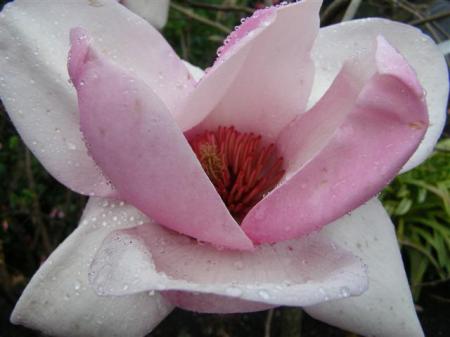
Magnolia Lanarth

Magnolia Lanarth

LATEST POSTS:

1) The wonder of Magnolia Lanarth in flower.
2) Hints for tasks in the garden this week as we race headlong into spring.
3) Beware the bangalow palm – our deep reservations about the weed potential of Archontophoenix cunninghamiana (Abbie’s column).
4) Tried and True for autumn colour where space allows – tree dahlias.
5) Counting down to our annual Taranaki Rhododendron and Garden Festival.

Magnolia campbellii in full flower this week

Magnolia campbellii in full flower this week

TIKORANGI NOTE:
Magnolia time here is our absolutely favourite time of year. At this stage, the spectacular performers are M. campbellii and Magnolia Lanarth, with Vulcan just starting and some of Mark’s unnamed seedlings putting on an early show. With the dwarf narcissi also at their peak (the snowdrops are largely over), there is something particularly delightful about the big and small pictures running simultaneously. The big-leafed rhododendrons in our park are opening, the earliest michelias are flowering and our garden visitor season started this week with an early visit from a local garden club. The pressure is on to get the garden groomed up and the planting out up to date. The pressure of spring is upon us.

In the Garden: August 13, 2010

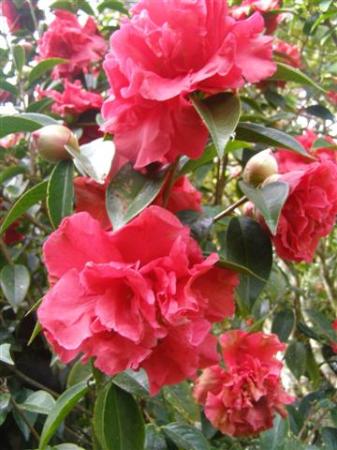
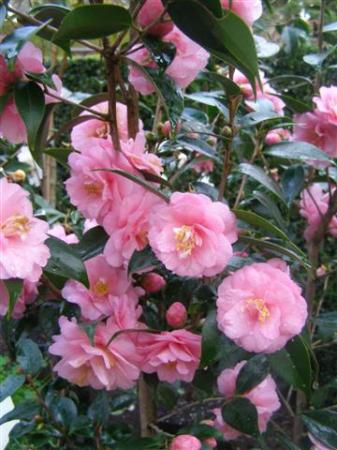
Prunus Pink Clouds - bringing in the tuis

Prunus Pink Clouds - bringing in the tuis

• Spring has certainly made her presence felt this week and our tui have returned to the flowering cherries, including one distinctive golden brown tui in its third season here. It is the campanulata or Taiwanese cherries in flower at this time which attract the native nectar feeders. Try and buy sterile, named forms if you are planting them because some can seed too freely.

• With the warmer weather, there will be an explosion of germinating weed seeds so be vigilant and try and eradicate this crop before they get established and seed further. Spreading a thick enough layer of mulch will suppress weeds as well as retain moisture levels for when drier weather sets in but lay your mulch after you have done a weeding round, not on top of existing weeds.

• Slugs and snails are also getting more active. If you are looking for alternatives to poisonous baits, you can try baker’s bran in reasonably thick circles or mounds (irresistible to the slimy critters who then get picked off by the birds). Alternatively, ring plants in sand, grit or masses of crushed egg shell – it is not bullet proof but it helps discourage them. Or make traps from the time-honoured hollowed out orange skin or half empty cans of beer – but you do have to go round and squash them after you have encouraged them to congregate. Getting out with a torch at night, especially after rain, can show up quite a number of them too.

• Spare a thought for permanent container plants. They need their potting mix replaced every two years and they need feeding at least once a year in spring. You may need to hose all the old mix off the roots and trim the roots to fit back into the same pot. It is less stressful to the plant to do it now rather than when it starts to look very sad in summer.

• I read a hint in a gardening magazine to trample down green crops before you dig them in to the vegetable garden. The crushing process hastens the breakdown. It seems to make good sense. Get onto digging in any green crops without delay.

• If you still plan to plant fruit trees this season, get right onto it now. The sooner they go in, the better chance they have of getting established. The same applies to all trees and shrubs for the ornamental garden.

• And a bouquet this week to Todd Energy who have started the process to put in screening plantings to block their Mangahewa-C well site from public view. Living as we do in green countryside peppered with ugly, albeit small, industrial sites, we applaud this new move and hope that other energy companies will follow the lead. These sites can be rendered almost invisible to ground level view by simple plantings but it has taken a long time before one company has decided that this is an appropriate priority. By planting the right species, they can contribute to the environment as well.

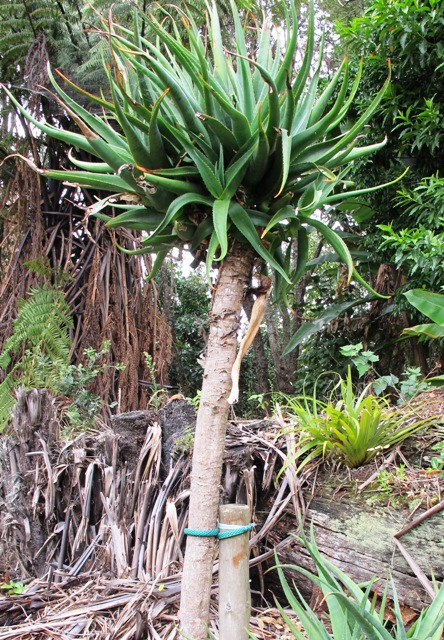
Beware the bangalow (Arcontophoenix cunninghamiana)

A very handsome palm in the landscape, but scary weed potential

A very handsome palm in the landscape, but scary weed potential

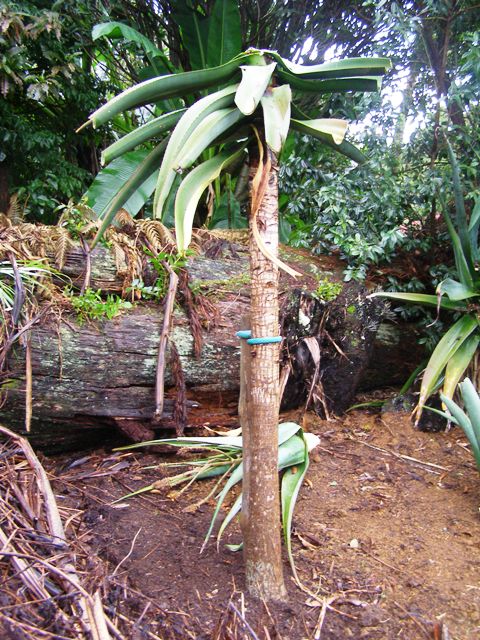
The newest weed in the garden here is a palm. Not the native nikau palm, although that too seeds down freely and we regularly cull self sown seedlings. By definition, we don’t regard natives seeding down as weeds. No, the offending palm is the incredibly popular and very attractive bangalow palm. We have had it in the garden here for decades but it is only recently that it has started to set viable seed. It is a bit too efficient in the seeding stakes and, being attractive to birds, it has been dispersed throughout our entire property at a scary speed.

When alarm bells were first sounded in the Auckland area about bangalow palms, the howls of outrage and denial from within the nursery industry were instant and loud. We watched with a desultory interest and felt that it might not have been our industry’s finest moment. We need to take some responsibility for what we produce and we certainly have enough noxious weeds in this country without knowingly adding more. So we should look at the facts and the information, rather than immediately assuming that out of control bureaucrats are trying to control our livelihoods. The howls of alarm were such that the proposals to ban its sale were put on the back burner and its status is part of a five year review so nothing will happen quickly.

The so-called Chinese Windmill Palm (Trachycarpus fortunei) is also under threat of reclassification as noxious weed. While it has not proved a problem here in our garden, Mark has seen it seeding down and giving rise to a thicket of babies in the Nelson area. I have just found a photograph in the Encyclopedia of Cultivated Palms showing it naturalised in Switzerland. Plants with a climatic range from Switzerland to Nelson and Northland have scary potential. Trachycarpus fortunei is enormously popular throughout the world because it is generally hardy but with that tropical and exotic look so frequently sought by gardeners irrespective of nationality. The big advantage of trachycarpus is that you need both male and female plants to set seed so if female plants were culled, it would not be a problem. Our specimens in the garden here are male so no seed is formed. And Mark’s guess is that the seed is not spread by birds because it only seems to fall to the base of the tree and sprout there, which makes it much easier to contain. The seedlings can be mown off, grubbed out or sprayed. If it was spread by birds, we would hear a great deal more about it appearing all over the place in parks and reserves.

Side by side germinating self-sown bangalows

Side by side germinating self-sown bangalows

But it is the bangalow that worries us more and that is because of our personal experience. There would hardly be a square metre of our garden (which stretches across several acres) where we have not found a bangalow germinating and in those early stages, they closely resemble young nikau palms. Left to its own devices, this Aussie import will threaten our native nikau swamping out the habitat and growing at a hugely faster rate. The proper name is Archontophoenix cunninghamiana and it grows naturally in the coastal forests of southern Queensland down into New South Wales. It is a most elegant palm, tall and graceful and growing sufficiently quickly to give a fast result. It can reach 20 metres when mature, but like many palms, it takes up little space and casts little shade. It is easy to grow but it is also tougher than many palms and will tolerate cooler temperatures – light frosts, even – and damper conditions. It is that easy-going nature which has made it so popular and useful as a garden and landscape plant in relatively mild areas of this country. Alas, if it had only been dioecious, it could have had its wayward reproductive habits curtailed – dioecious meaning that you have both male and female and one of each is required for reproduction.

The bangalow seed is freely dispersed by that great seed dispersal machine that we have in our kereru or native wood pigeon. Presumably the seed casings taste delicious and the resulting guano gives the falling seed a good start after aerial distribution. And it sets a simply astounding amount of viable seed. When our specimen finally set seed for the first time, Mark just left it, noting how very decorative were the lavender flowers and bright orange-red seed hanging in voluptuous bunches. Within months, we were picking out the rash of self sown seedlings everywhere. We left one in the coldest, wettest spot in our garden just to see how it would grow. This is an area where Mark plants his treasures which need a winter chill – the deepest red hellebores, the Chatham Island forget-me-nots, trilliums and Himalayan blue poppies. Nowithstanding the fact that it comes from sub-tropical Australia, the bangalow is very happy there too, thank you. It is a worry.

It is still perfectly legal to buy and sell bangalows or Archontophoenix cunninghamiana in this country. If the prices I have seen on the net are a fair guide, you will pay around $150 for a reasonable sized one, up to an eye-watering $1700 for one already six to eight metres tall. For that sort of money, if you are starting out, our recommendation is to look at alternative varieties which don’t show the potential to be a noxious weed. It really does matter. Besides, as Mark will testify with the advantage of new information, it is an awful lot easier to plant something that will not require you getting out the extension ladder to take off the flowers and fruit when it is mature. Our recommendation, based on personal experience, is the Queen Palm, Syagrus romanzoffiana.

While on the subject of palms, which are a fantastic family of plants, we would like to pay tribute to the work done over many years by Colin Verlaan at The Palm Farm. Some readers may not realise this nursery is local but Colin has done more than anybody to make a huge range of palms available in this country at more affordable prices. Most of the palms you buy could be traced back to The Palm Farm as the main supplier. Colin has announced he is retiring and we think it might be for real this time (I am sure he has tried to retire before). While he may not agree with our opinion of the bangalow and the trachycarpus, we would certainly find common ground in admiring many of the magnificent and interesting palms he has made available. Mark has been gently building a collection of palms from him over recent years, concentrating on varieties which we think should be hardy in our conditions. He hopes to get his new Palm Walk planted sooner rather than later and is pleased he started work on it while he could still source a fantastic range locally.

Tried and True: Tree Dahlias

•Flower from mid to late autumn when few other perennials flower.
• Fill a large space in the garden.
• Many of the best new varieties available here have been bred in New Zealand by our own expert, Dr Keith Hammett.
•Deciduous, so the foliage dies away completely over winter and returns afresh.
• Easy to grow in good conditions which don’t get too dry over summer.

You do need space for these late autumn beauties and they will be badly affected by heavy frosts.


But if you have a suitable position, they are an easy-care delight. These two varieties are both from the breeder, Keith Hammett and alas we no longer have the names. The big, floppy pastel lilac is so pretty against our shed and I thought at first I was looking at a clematis from afar (it is about 2 metres tall). The golden orange sunburst bloom (love the slightly twisted petals) is a little more compact (a little shy of two metres) and has delighted us for a number of years, planted as it is by the mandarin tree whose fruit are colouring to match.

They are not called tree dahlias because they grow up like a tree but rather because they grow much larger than the usual type of perennial dahlias. In windy conditions they need a bit of support – some of ours we fence in with heavy duty bamboo cross bars. Otherwise, they are like any other dahlia with typical hollow stems and dahlia leaves, growing in a large clump from tubers below ground. Most tree dahlias come from D. imperialis which is native to Columbia and Guatemala which explains why they are not keen on cold and frosty conditions.

Countdown to Festival: August 13, 2010

  • Quinton Reeves from Wintringham in New Plymouth describes his lawn as currently looking like army jungle camouflage if viewed from above. This is because he took advice from an expert and used Cold Water Surf sprinkled in powder form to kill out the unwanted mosses. It has apparently worked a treat and he is now waiting for the grasses to come away with renewed vigour. We have never heard of this simple remedy before but plan to experiment with moss in other areas. The trick, Quinton says, is to apply it after a rainy period (no problem there) and the lawn has had a day to dry out and it must be Cold Water Surf which is alleged to have an ingredient which is missing from other brands. So now you know.
  • Also in town, La Rosaleda’s Coleen Peri was shocked to find her renga renga lilies (arthropodium) sporting their own form of acne (orange blotches due to rust), giving lie to the belief that these tough plants are maintenance free and indestructible, bar heavy frosts. Coleen treated the rust but also chopped the plants back hard and disposed of the affected foliage. This may stop the cycle of rust continuing and the plants will have recovered with fresh foliage by festival time. Coleen’s little fellow, Will, discovered to his cost that hurtling down a garden path between rose bushes on his scooter was fraught with danger when he canned out and landed in a rose, embedding a thorn in his cheek. The rose bush fared worse, being snapped off entirely, but Will has made a good recovery.
  • Jan and Graeme Worthington of Gordon Dale Gardens are fresh back from their tour of Britain and Ireland. They were enormously impressed by Beth Chatto’s garden near Colchester (her garden is a magnificent example of how to manage large scale herbaceous plantings over time and her dry garden is magic) but equally impressed by the sight of Mrs Chatto herself, now at a very advanced age, climbing up a red brick wall to water some plants. They will hardly be emulating her dry garden at Toko, but Jan says her first task on return is to prune her 200 roses and to try and salvage the sweet pea babies which have been swamped by weeds in their absence.
  • In Manaia, Jenny Oakley has taken advantage of the presence of a couple of strong and willing young men to spread the contents of four large compost bins across her vegetable and perennial beds. In the process they also uncovered two pairs of secateurs and one Niwashi hand hoe, despite Jenny’s best efforts to keep garden tools to hand and to mark them with ribbon and insulation tape. Any synthetic, fluorescent type of colour is going to stand out best in an outdoor setting because these are not the colours of nature. Jenny, by the way, votes her Niwashi as her most favourite garden tool.
  • In Kakaramea at Te Rata, Jacq Dwyer is delighting in the fragrance of her Daphne bholua. This is the upright Himalayan daphne. It can get a bit scruffy with age and does have a few bad personal habits but we are in complete agreement with Jacq that its perfume is the best and the strongest of any of the daphnes. While on scented plants, Jacq says she has just bought a wintersweet (Chimonanthus praecox) and is looking for the best position in the garden where its scent can be enjoyed. As she has already moved her davidia (ghost tree) twice in search of its permanent home, the chimonanthus may be in for a period of slight instability in its life. There are gardeners who only buy plants for specific garden positions or gaps and there are gardeners, like Jacq, who buy plants because they love them and who then set about finding the right spot.
  • At Paradiso Vegetable Garden, Denise Wood is delighting in the simple sight of her lemon tree underplanted with white primulas and looking very fetching. Her broad beans have been a success at previous festivals so she is pleased to see them growing well and already a metre tall. The sweet peas are also coming along well. By the time she has done her round freshening up the paintwork this month, she feels that she will have done most of her preparations.