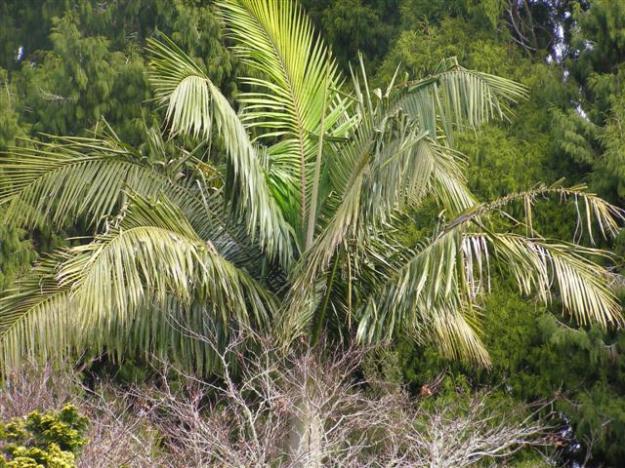
A very handsome palm in the landscape, but scary weed potential
The newest weed in the garden here is a palm. Not the native nikau palm, although that too seeds down freely and we regularly cull self sown seedlings. By definition, we don’t regard natives seeding down as weeds. No, the offending palm is the incredibly popular and very attractive bangalow palm. We have had it in the garden here for decades but it is only recently that it has started to set viable seed. It is a bit too efficient in the seeding stakes and, being attractive to birds, it has been dispersed throughout our entire property at a scary speed.
When alarm bells were first sounded in the Auckland area about bangalow palms, the howls of outrage and denial from within the nursery industry were instant and loud. We watched with a desultory interest and felt that it might not have been our industry’s finest moment. We need to take some responsibility for what we produce and we certainly have enough noxious weeds in this country without knowingly adding more. So we should look at the facts and the information, rather than immediately assuming that out of control bureaucrats are trying to control our livelihoods. The howls of alarm were such that the proposals to ban its sale were put on the back burner and its status is part of a five year review so nothing will happen quickly.
The so-called Chinese Windmill Palm (Trachycarpus fortunei) is also under threat of reclassification as noxious weed. While it has not proved a problem here in our garden, Mark has seen it seeding down and giving rise to a thicket of babies in the Nelson area. I have just found a photograph in the Encyclopedia of Cultivated Palms showing it naturalised in Switzerland. Plants with a climatic range from Switzerland to Nelson and Northland have scary potential. Trachycarpus fortunei is enormously popular throughout the world because it is generally hardy but with that tropical and exotic look so frequently sought by gardeners irrespective of nationality. The big advantage of trachycarpus is that you need both male and female plants to set seed so if female plants were culled, it would not be a problem. Our specimens in the garden here are male so no seed is formed. And Mark’s guess is that the seed is not spread by birds because it only seems to fall to the base of the tree and sprout there, which makes it much easier to contain. The seedlings can be mown off, grubbed out or sprayed. If it was spread by birds, we would hear a great deal more about it appearing all over the place in parks and reserves.
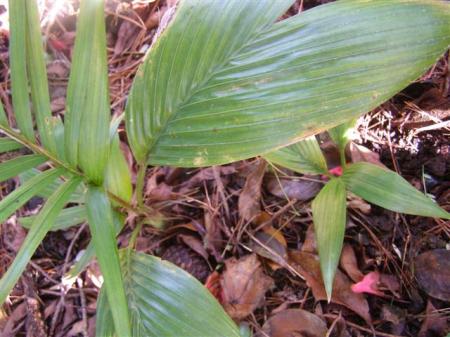
Side by side germinating self-sown bangalows
But it is the bangalow that worries us more and that is because of our personal experience. There would hardly be a square metre of our garden (which stretches across several acres) where we have not found a bangalow germinating and in those early stages, they closely resemble young nikau palms. Left to its own devices, this Aussie import will threaten our native nikau swamping out the habitat and growing at a hugely faster rate. The proper name is Archontophoenix cunninghamiana and it grows naturally in the coastal forests of southern Queensland down into New South Wales. It is a most elegant palm, tall and graceful and growing sufficiently quickly to give a fast result. It can reach 20 metres when mature, but like many palms, it takes up little space and casts little shade. It is easy to grow but it is also tougher than many palms and will tolerate cooler temperatures – light frosts, even – and damper conditions. It is that easy-going nature which has made it so popular and useful as a garden and landscape plant in relatively mild areas of this country. Alas, if it had only been dioecious, it could have had its wayward reproductive habits curtailed – dioecious meaning that you have both male and female and one of each is required for reproduction.
The bangalow seed is freely dispersed by that great seed dispersal machine that we have in our kereru or native wood pigeon. Presumably the seed casings taste delicious and the resulting guano gives the falling seed a good start after aerial distribution. And it sets a simply astounding amount of viable seed. When our specimen finally set seed for the first time, Mark just left it, noting how very decorative were the lavender flowers and bright orange-red seed hanging in voluptuous bunches. Within months, we were picking out the rash of self sown seedlings everywhere. We left one in the coldest, wettest spot in our garden just to see how it would grow. This is an area where Mark plants his treasures which need a winter chill – the deepest red hellebores, the Chatham Island forget-me-nots, trilliums and Himalayan blue poppies. Nowithstanding the fact that it comes from sub-tropical Australia, the bangalow is very happy there too, thank you. It is a worry.
It is still perfectly legal to buy and sell bangalows or Archontophoenix cunninghamiana in this country. If the prices I have seen on the net are a fair guide, you will pay around $150 for a reasonable sized one, up to an eye-watering $1700 for one already six to eight metres tall. For that sort of money, if you are starting out, our recommendation is to look at alternative varieties which don’t show the potential to be a noxious weed. It really does matter. Besides, as Mark will testify with the advantage of new information, it is an awful lot easier to plant something that will not require you getting out the extension ladder to take off the flowers and fruit when it is mature. Our recommendation, based on personal experience, is the Queen Palm, Syagrus romanzoffiana.
While on the subject of palms, which are a fantastic family of plants, we would like to pay tribute to the work done over many years by Colin Verlaan at The Palm Farm. Some readers may not realise this nursery is local but Colin has done more than anybody to make a huge range of palms available in this country at more affordable prices. Most of the palms you buy could be traced back to The Palm Farm as the main supplier. Colin has announced he is retiring and we think it might be for real this time (I am sure he has tried to retire before). While he may not agree with our opinion of the bangalow and the trachycarpus, we would certainly find common ground in admiring many of the magnificent and interesting palms he has made available. Mark has been gently building a collection of palms from him over recent years, concentrating on varieties which we think should be hardy in our conditions. He hopes to get his new Palm Walk planted sooner rather than later and is pleased he started work on it while he could still source a fantastic range locally.