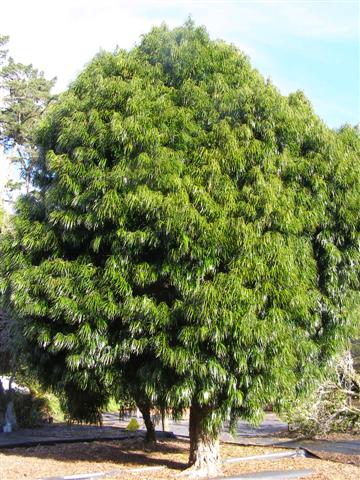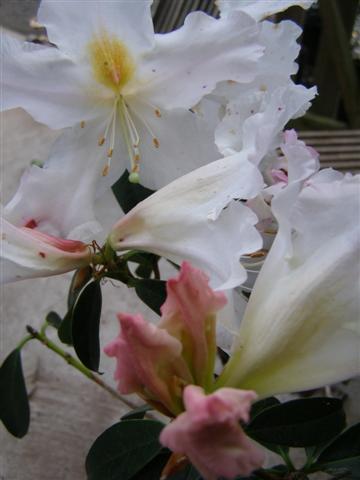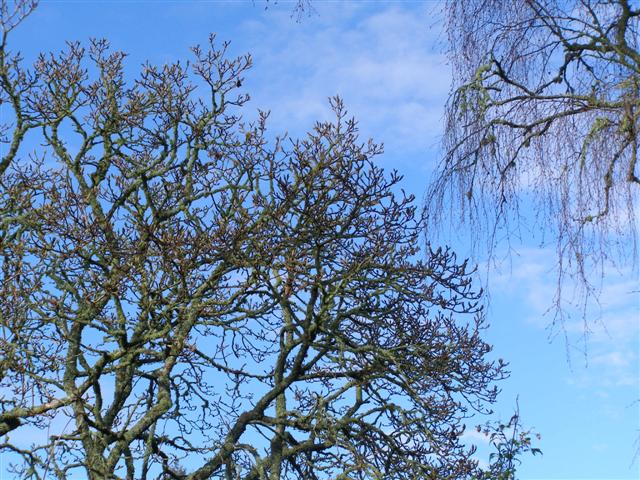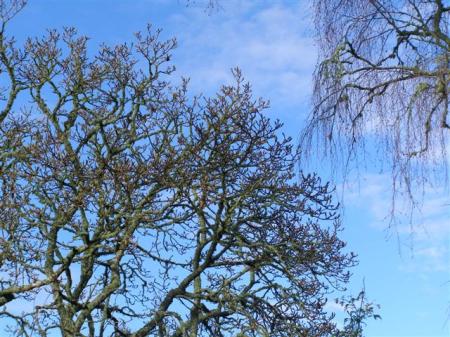
A magnolia to the left and silver birch to the right, silhouetted against the winter sky
Mark has been hiding indoors on bad weather days, watching Victory Gardens on the Living Channel. It is not that it is a very good American programme, he is just addicted to TV gardening. But he was a little shocked recently by presenter, Jamie Durie. Now we are not going to be critical of said Australian who has done a great deal to sex up gardening in his native land and who is a young man of considerable talent. He has also managed to cross over successfully to American TV and we love him because it was he who has twice promoted our very own Cordyline Red Fountain on the Oprah Winfrey Show. Our home grown gardening celebs, such as they are, don’t fall into the same league. I don’t think any of our local candidates would have an alternative career stripping for Manpower Australia. But I digress.
There was Jamie, talking with passion about Australian native plants, brandishing what looked suspiciously like a New Zealand cabbage tree. It was. Our most common cabbage tree is Cordyline australis, you see, but australis does not mean it comes from Australia. The kind interpretation is that our iconic tree is now Australasian, just as our soccer team briefly enjoyed that curious status. Australia does have its own members of the cordyline family including congesta, fruticosa and stricta, but australis is not among them. We are now wondering where Jamie Durie thinks Dicksonia antarctica hails from. It is the Tasmanian tree fern which is a close relation of our own ponga trees.
But at least Jamie avoids the dreary political correctness of a pretentious novel I was recently reading for review. Describing the Christchurch gardens of the relatively well-heeled, the author wrote: “Most of the gardens were populated with imported English varieties, but there were a couple of house owners who had made some effort with native New Zealand vegetation, and the dark greens and rich browns stood out among the bleak, bare branches of the non-native trees that seemed to claw at the grey air.”
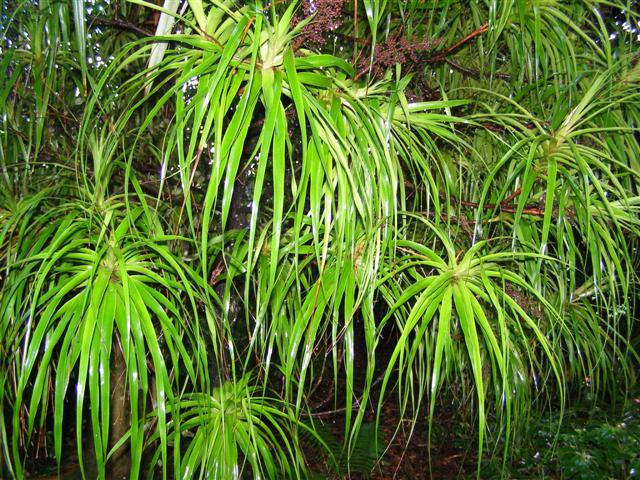
I read this passage aloud to Mark who instantly demanded to know what native tree is a rich brown. Shades of green, dear, they are shades of green. I envisaged the PC Christchurch of the future where gardeners could only plant native trees – towering rimus, totara or kahikeatea, perhaps, which on a small town section will remove all winter sun and light from your neighbour’s property. Or maybe some of the smaller trees such as the interesting dracophyllums or nikau palms which, typically, are forest growers, designed to grow in company and with the protection of surrounding plants. Let’s be PC and maroon these forest dwellers in a sea of suburban grass.
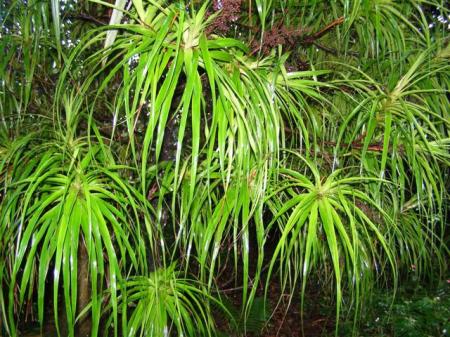
Our native dracophyllum, better in company than marooned as a lawn specimen in solitary splendour
While we are about it, shall we eradicate all the imported fruit trees, veg plants and even the ubiquitous grass? We do have native grasses but they are not usually the ones found in lawns, on road verges or pasture. I am not sure that the author had any understanding at all of botany, let alone gardening. I would be guessing that her derisive reference to imported English varieties includes the cherry trees for which Christchurch is renowned (hailing from Japan), the deciduous magnolias (from Asia), dogwoods (cornus – mostly American) let alone the rest of the options from around the world. As you may have gathered, I regarded that particular passage as particularly ill-informed and downright silly.
I will absolutely stand up for the preservation (and preferably extension) of our remaining forest remnants where the eradication of competing imported species is important. I think defending our diversity of indigenous plant material is equally important. I think incorporating native plants into our public plantings is highly desirable and that our native flora has a key role in our domestic and private gardens. It is what makes us different. But I am not going to put our native plants on such a pedestal as to declare that, by definition, native equals good, imported equals bad and reactionary.
We are hardly living and gardening in an environment where our native plants originally thrived. New Zealand attitudes to our indigenous flora have waxed and waned in recent years. The early settlers often found the native forests intimidating which is to be understood when you consider that all our plants here are evergreen whereas the majority of both native and introduced trees in Britain are deciduous. The forest remnants I have seen there are what I would call woodland. Our bush is akin to impenetrable, tropical forest without the tropical temperatures. I imagine they were terrifying to people more accustomed to woods of white barked birches, sweet chestnut or oaks carpeted below with wild bluebells and snowdrops. No wonder they planted to remind themselves of home.
Even thirty years ago, there was a pretty large-scale dismissal of our native flora as dull, boring and not worthy of garden space. Native plants on sale were under-valued, so sold cheaply and seen as utility – a bit like riparian plantings today. All function and no aesthetics. Then came the big turnaround and suddenly native plants were all the rage. Led by government agencies, public plantings were heavily dominated by native plants. This crossed over to private gardens and planting native became the higher moral ground, a point of principle. A stream of Bright Young Things could be found browsing plant stocks, determined to buy and plant only natives. Though they would make an exception for an apple tree (from Central Asia), a macadamia (from Australia) or an olive tree from Greece. There was also a myth that you had to plant natives to feed our birds. In fact you have to plant the right plants to encourage birds and our indigenous birds are not fussy about whether it is a native or an introduced plant.
The author of whom I am so critical is caught in this PC time warp. As always, the answer lies in the middle ground. We have many fantastic native plants ideal for gardens. We also have boring, utility native plants ideal for land reclamation, shelter or nurse plants. But it doesn’t have to be all or nothing at a gardening level. It is the vast array of plant material that we can grow here, the mix of indigenous and introduced, which makes our gardens interesting. Those Christchurch houses so maligned for their plantings are probably much better served by deciduous specimen trees which allow light and winter sun through. We tend to have cold houses in this country and we don’t need to make them any colder by planting so that they are in the winter shadow of evergreens. Bare branches silhouetted against a winter sky can be seen as a beautiful tracery just as readily as the aforementioned bleak, bare claws. Long may common sense and aesthetics triumph over ignorance, however well intentioned and at least those Christchurch houses planted trees rather than keeping everything to under a metre in height.