The perils of the monochromatic colour scheme in gardening

A random stranger in blue beside the blue and purple border at Sissinghurst

Back in the days when I first started writing this column and we were in the grip of seven day a week retail and mailorder plant supply, I used to despair at the numbers of well-heeled women in search of plants for their white garden. Mostly from Remmers, dear, and most had been to the ultimate white garden – designed and planted by Vita Sackville West at Sissinghurst in England. It was seen as the benchmark for restrained style and class and all wanted to emulate that standard. So all plants had to have white flowers and preferably be scented. Yellow stamens were permitted and cream was allowed but no other colour in the flowers. Fading out to white fell short and white flushed pink flowers were usually rejected as impure.

There were rules for foliage too. Green was fine, silver foliage even better. Variegations were acceptable as long as they were white and green with no yellow or red.

Apparently the secret of the white garden is revealed at night when all those pure flowers light up under moonlight to glow with ethereal beauty. Experienced gardeners realise instantly that this means it needs to be a summer garden because who wants to go out in winter or early spring to see the glowing white rhododendrons and camellias but not many white garden devotees of the early nineties were experienced. I recall reading a critique at the time that far too many of the white gardens were thrown together solely on the basis of colour. As long as it was white, it could be included. Gardens were criticised for the lack of thought given to planting combinations and inappropriate conditions for many of the plant subjects.

When we finally visited Sissinghurst, I was excited at the prospect of seeing the ultimate white garden put together with skill – where plant composition, shape and foliage combinations rule supreme, without the distraction of colours beyond white and green. Alas I was underwhelmed, disappointed. It rather looked to me like plants selected solely on flower and foliage colour bunged in together. So much for setting the standard. It may well have been different in the original days of Vita Sackville-West but in 2009 it didn’t quite cut the mustard.

Colour and flowers hide a multitude of sins. The purple border at Sissinghurst was far more successful on the day we were there and that in part could be attributed to the huge range of tones in blues and purples. There is not a lot of variation of hues of white and cream so it is harder to get visual oomph.

I suspect that monochromatic garden schemes are often the refuge of less experienced gardeners but in fact they require considerable knowledge and skill to get them looking good. They are not actually monochromatic because gardens have green as a base colour but that is generally treated as colour neutral. If you garden only with foliage or with foliage and only one additional colour, then form and texture are your tools and the plants you chose to complement each other and to fill the picture become critical. At its best, it is a restrained and disciplined approach to gardening which can be very restful to the eye. More often, alas, it is a hodgepodge – sometimes a pretentious hodgepodge – or downright dull.

Flowering this week: Dichroa versicolor

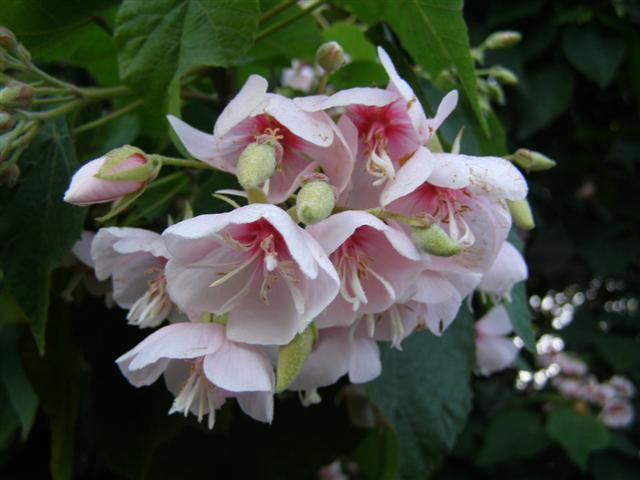
Flowering this week and pretty much most weeks of the year here - Dichroa versicolor

This plant has the most endearing habit of flowering pretty well all year. The trade-off is that when you get a plant which flowers in random sequence all over the bush, you don’t usually get the wham bang impact of a mass flowering all at once but it is rewarding to be able to see the deep blue dichroa flowers all year. It is an evergreen member of the hydrangea family, hailing from China, and was introduced to this country by our very own Taranaki nurseryman, gardener and garden writer, Glyn Church. Most of the evergreen hydrangeas are sensitive to frost and cold temperatures but the dichroa has shown more hardiness than you would expect with its large leaves and is fine with moderate frosts. Grow it under some overhead tree cover if you are worried about your winter temperatures. It also tolerates a wide range of conditions, sun and shade, wet and dry.

Left unpruned, it will get quite large – around the 3 metres high and 2.5 metres wide mark or even larger over time but I frequently trim long growths back to a point in the stem where I can see twin leaf buds either side. A little pruning often is a better strategy with this plant if you can. It means you can avoid cutting off the flower buds. You can never have too much blue in the garden I feel, and a plant which flowers for the better part of the year and is a true blue certainly justifies its position.

Countdown to Festival: May 21 ,2010

Fan-shaped leaf rakes to the right, not to be confused with a traditional garden rake

• In the south at Patea, Rudi Milesi has been out raking up autumn leaves to make compost to return to the garden. He uses a leaf rake which is the fan-shaped implement, not the traditional rake whose prongs dig in rather than grabbing and sweeping. He is also determinedly staying on top of the autumn weeds and has been busy pruning. In a densely planted small garden, he needs to avoid overgrowth and competition between plants by keeping them under control. With the calm weather this autumn, Rudi says he is really pleased with how refreshed the garden is looking.
• Also southwards but near Manaia, Jenny Oakley can’t wait to get back into her garden after a forced period of inaction. She finally got off her crutches this week following a hip replacement and is feeling very liberated to be able to walk unaided. She says she is but one of three garden openers who has had to undergo this operation this year. Other gardeners are hoping this is coincidence and not an indication of a hitherto unsuspected occupational hazard.
• In Stratford, Erica Jago is back in the festival with her pretty garden, Merleswood after a break of a year. Her pond proved such a challenge recently that she had to enlist some male help as it required greater brute strength than she has. The common ornamental grass, acorus, had staged a complete takeover and wound itself around and through all the rocks, achieving menacing proportions. With a reasonably large garden to maintain on her own these days, Erica has been strategising ways of streamlining the garden for easier management. The recent replacement of the gate to her pond area meant much easier access with the lawnmower and proved to her that relatively small alterations can make a big difference to the convenience of maintaining the garden.
• Not far inland from Merleswood is Gordon Dale Gardens where Jan and Graeme Worthington are excited at their upcoming UK trip where they will exchange seven weeks of inland Stratford winter for an English summer – a trade many of us would enjoy. Jan is keen to fit in some gardens to their tour and is gathering recommendations on the must-see options. As always, travelling in a group of four, there needs to be some negotiation on differing interests and the trip will not be wall to wall garden visits. I recommended Hidcote near Stratford on Avon as the single best garden we saw last year and we went there on Glyn Church’s recommendation, it being one of his absolute favourites.
• Back in the Festival after a break of a decade are the inimitable Josephine and Quinton Reeves in New Plymouth. Josephine feels the garden has come a long way in ten years, assisted by Quinton in his self appointed role as garden boy. Though clearly the garden boy did not know his place when he took to ribbing his wife about a recent trip out to a plant sale when she returned with her little car so jam packed that there was no side or rear visibility. But the plants were so cheap, was her justification.
• The first garden openers’ meeting of the year was held in Stratford earlier this week where details of a full programme of workshops and speakers was revealed along with a dramatic take on the landscape installation this year. Watch for further details. Morale is high amongst garden openers after an across the board 25% increase in visitor numbers last year. All are hoping for a repeat of the magic spell of spring weather at the end of October this year.

In the garden: May 21, 2010

• I read in Monday’s paper that the average Brit spends six months of his or life discussing the weather. I wonder if that could be doubled for gardeners everywhere? Last weekend’s rain and fresh coating of snow on our mountain is a timely reminder that the chill of winter is just around the corner. Make the most of the milder autumn weather still lingering on.
• If your dahlia plants were too big, fell apart from the middle and flopped over this year, it is probably a sign that there are too many tubers. In cold climates, dahlias are lifted every year and over-wintered under cover. Here, where most of us just leave them to their own devices, often as roadside plantings, that lifting and thinning process does not happen. Be ruthless. As they die off for winter, lift and thin. You will get a much better display next summer and autumn.
• It is a good time to lift and divide day lilies (hemerocallis) which respond well to a bit of attention occasionally. If the clump is very congested, it is often the outer part which contains the greatest vigour and strength so discard the middle.
• Plant brassicas for spring eating and broad beans too. Continue sowing leafy greens to ensure regular harvests. Most of the quick maturing Asian greens can be grown over winter as well as silver beet and winter spinach. Peas can also be planted.
• Get an autumn copper spray onto citrus trees to prevent leaf drop, fruit rotting on the tree and a range of nasties. This is a critical spray to carry out if you want to protect your harvest. Mandarins are particularly vulnerable.
• Don’t let the autumn leaves build up in your fish ponds. Rotting leaves can reduce the oxygen levels in the water and even kill the fish in extreme cases.
• Keep a sharp eye on weeds. With the shortening day length, pesky cress does not bother about growing large. It just goes straight to seed, as do other weeds.
• Green crops must be sown now if they are to make some sort of growth before winter and to justify their role in nourishing the vegetable garden. Don’t put it off. Green crops develop a root system which makes the soil much easier to break up and till in the spring, particularly with heavier soils.

Tried and True – sasanqua camellias

The cheerful face of Camellia sasanqua Gay Border

• Autumn flowering.
• Excellent hedging and good wind tolerance.
• Generally happy in full sun or partial shade.
• Widely available in a range of colours.
• Hardy in all Taranaki conditions.
• Not affected by camellia petal blight.

The first camellias of the season to flower each year are the sasanqua group from Japan. The white sasanqua hedge, Setsugekka in particular, has become a garden cliché in New Zealand but that should not detract from the garden value of this useful and hardy group of evergreen shrubs. When the deciduous trees are changing colour and dropping their foliage, the mass flowering of sasanquas is a cheerful sight. With smaller leaves in a good deep green and a growth habit that is a little lighter and airier than the rather solid japonica camellias which flower later in winter, sasanquas are less chunky as garden plants.

As well as the whites (Early Pearly, Silver Dollar, Mine No Yuki and the like), there is a whole range of pinks from pale to deep shades, a few reds and some attractive bi-colours such as the deep pink and white Gay Border. The flowers are softer and less formal than the japonicas. If you want to clip your sasanqua camellia, the rule of thumb is to do it as flowering ends with a follow-up on wayward growths in spring. It will then hold its tidy form for the rest of the year.