 My late mother-in-law’s archives came home recently. Very late mother-in-law, to be honest. She died about 1985 but the local museum decided recently her archives were of no interest and returned them. After the slight chagrin at being told this, we are very pleased to have them back because we found all sorts of interesting material. The detailed instructions on how to wax your camellia blooms can wait (that is for those devotees who are absolutely dying to learn the lost art of waxing camellias). One of the historical gems from the collection was the correspondence from Rewi Alley.
If you are much under the age of 50, you may have to google Rewi Alley. He is certainly one of our most interesting and colourful ex-pats having upped sticks and gone to live in China in 1927, there to stay for the rest of his long life which he dedicated to improving the lot of the Chinese peasant. He saw out civil war, acute famine, the Japanese invasion, the rise to power of Chairman Mao and communism, the Cultural Revolution and China’s isolationist policy, achieving venerated status by the time he died in the late 1980s.
Do not ask me how Mark’s mother, Mimosa Jury, ever found an address for Rewi Alley in Peking, as it was still known back then. But find one she did and that can not have been easy, given that she was writing to Alley in 1970 when the Cultural Revolution and the rabid ideology of the Gang of Four saw his position as a foreigner in a closed country more precarious than at any other time of his life. Knowing the late parents in law as I did, I would guess that Felix was trying to get access to some of the special plant material which, even then, was known to be native to China but still not introduced to the west. Mimosa was a thwarted researcher by nature so she would have taken on the task of ferreting out the information. Together, they were going to bring Camellia Diplomacy to China and open doors. 
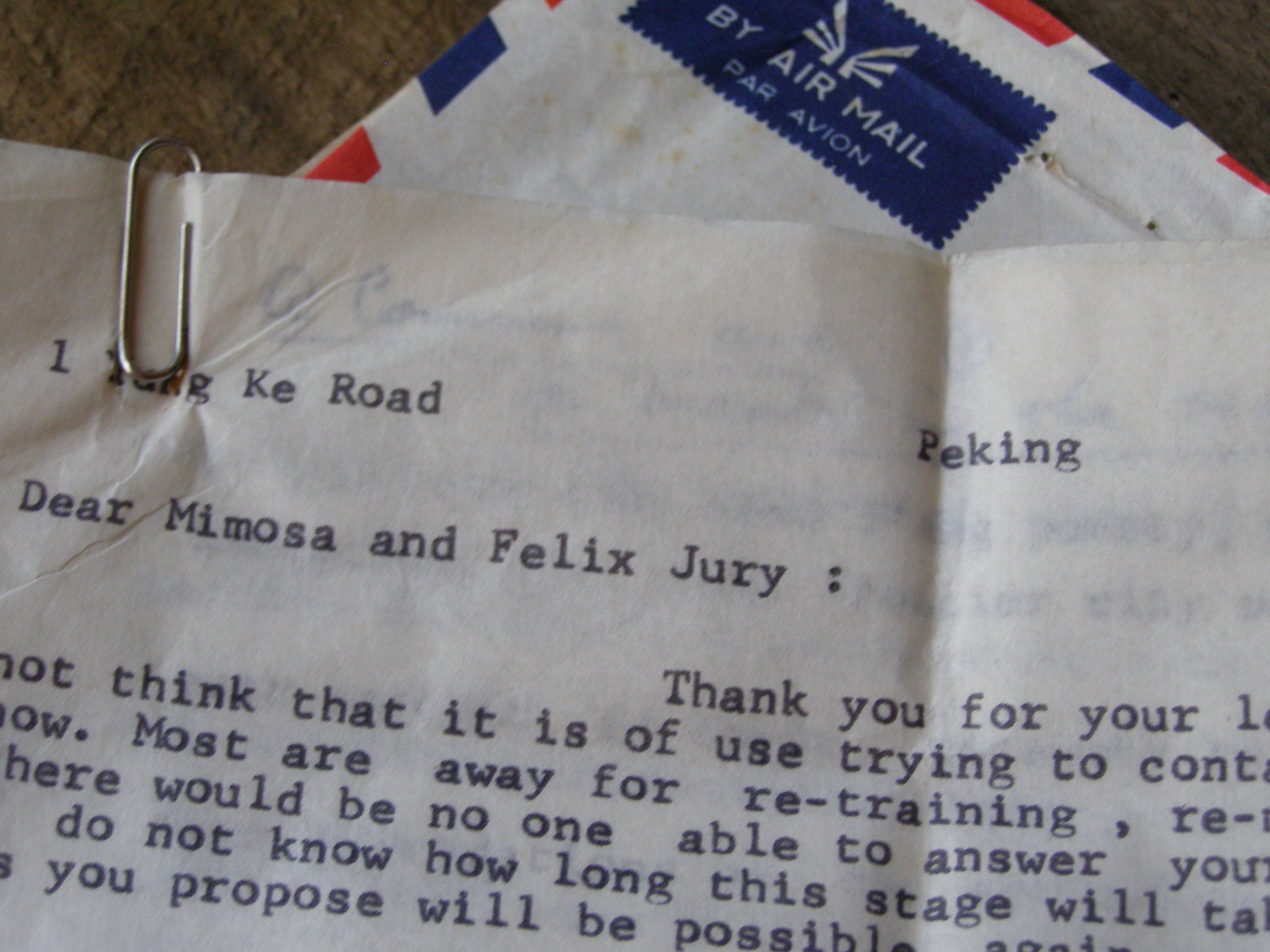
Rewi Alley’s reply is dated October 11th, 1970. His first paragraph speaks volumes about the good nature and resignation of somebody already in his seventies with strong humanitarian principles, politically left wing and taking the long view.
“Dear Mimosa and Felix Jury:
Thank you for your letter about Camellias. I do not think that it is of use trying to contact cadres of institutes now. Most are away for re-training, re-moulding, and politics, so I do not know how long this stage will take, or when such contacts as you propose will be possible again.”
He follows this with a paragraph professing to share their interest in camellias, though it is pretty clear that this is more courtesy than fact because he really doesn’t know anything about them, except for one interesting observation: “… it’s seeds are valuable for food oil. Many counties, especially in the South Kiangsi, are completely dependent on the seeds for their food oil supply. Possibly the olive would give more oil seeds per mou than Cha Shu (the camellia), but then Cha Shu grow wild all over the hills and can be helped to spread.” Best guess is that he is talking about Camellia oleifera, although you can also extract edible oils from other camellia species. This was news to me. Should the end of the world as we know it arrive, we may be self sufficient here in cooking oil between the camellias and our solitary olive tree.
But Alley’s heart lay in reafforestation long before we in the west started to worry about global warming and conservation. He writes with conviction of the pressing need to reclaim deserts, like those of Sinkiang and he enclosed a typed copy of an article about a 1950s reclamation project in the north western area of Liangchow or Wuwei. The article is not attributed but I would guess that it is one of Alley’s own (he was a prolific writer). Globally, it would be hard to find areas with more inhospitable and harsher conditions than the northwest of China. Think of the well known Gobi Desert, though it is in fact the Tengri Desert he writes about – dry, windswept and bitter cold in winter while summers are dry, windswept and hot.
I would assume that the deforestation of China, which is referred to as having taken place over centuries, happened because the population depended on timber for both building and cooking but gradually population growth led to greater demand which outstripped the ability of forests to regenerate. Once denuded of its former cover, the land loses its top soil, floods become more frequent and there is nothing to stop the desert sands from blowing in. From time to time we hear about the spreading of the deserts in Africa but in terms of land mass degraded by encroaching desert, China has the worst problem.
Reference is made to “a low bushy tree, the sand date, locally called the ‘hero of the desert’ because it grows almost everywhere”. The sand date may be hardy but it took three attempts to get it growing, involving digging holes three feet deep (a metre deep is a huge hole to dig for every tree), carting in top soil and watering regularly – all done manually in the early 1950s. Water of course had to be carried with buckets on poles, presumably quite some distance. I tried to find out what the sand date was because it didn’t sound like the date palm which grows in marginal areas of North Africa. It is more likely to be the Chinese date or Ziziphus jujuba.
Aside from the details of this early and apparently successful small effort to hold back the desert, the political context is equally fascinating. Reading between the lines, the original letter sent from Mimosa to Rewi Alley must have mentioned something to do with forestry and described it as being beyond politics. New Zealanders, in those days, tended to see politics as a separate entity altogether with little impact on daily lives (how often did we used to hear the cry that sport has nothing to do with politics?). Rewi Alley was not having a bar of that. Not for nothing had he spent his life working for change in China. He was very much a mouthpiece for the new order of Maoist communism.
“Politics teaches why and for whom a thing is done. If the people can best be served by forests which will prevent floods and drought, then we have forests allright. And national effort is spent in getting them. Which means that it must be a mass movement, and to generate a mass movement, we must have politics. Which is seen here as the task of the government – to so raise the consciousness of people that they activate their minds and hands to carry through the job in hand.”
Consider yourself told. It may be that totalitarianism is a more effective means of countering deforestation and global warming than unfettered free enterprise and market forces. And we should continue to remind ourselves that in New Zealand we have just as a poor a record of deforestation. We are just lucky we don’t have deserts moving in.
-39.042098
174.300314